ICYMI
Our @SarahGAllenSC and @PrestonBaines joined the United Patriots Alliance podcast to discuss the recent SCGOP Special Convention and the shenanigans surrounding it.
250 years of the greatest country in the history of the world 🇺🇸
Built by the brave.
Preserved by the fearless.
Celebrated by me making my entire personality Mel Gibson quotes from The Patriot.
Here’s to the “farmers with pitchforks” who refused to sit down and shut up. Who rejected complacency, questioned authority, and refused to trade liberty for an appearance of peace.
Turns out, the things worth fighting for are rarely won by keeping the room comfortable.
Happy Independence Day, patriots. Stay wrangled and spangled ✨
Part two:
𝐓𝐡𝐞 𝐒𝐂𝐆𝐎𝐏’𝐬 𝐇𝐨𝐮𝐬𝐞 𝐨𝐟 𝐂𝐚𝐫𝐝𝐬
By @SarahGAllenSC
It was supposed to be a convention about closing Republican primaries.
Instead, what many delegates walked away talking about wasn’t the rule itself.
It was the process.
The more delegates I’ve spoken to over the past 72 hours, the more a pattern begins to emerge. Individually, each incident might be dismissed as a misunderstanding. Together, however, they paint a picture that deserves far more scrutiny than it has received.
Let’s begin.
𝐓𝐡𝐞 𝐓𝐚𝐛𝐥𝐞
In a previous article, I reported that the proposed candidate qualifications clause was so controversial during our Lexington County Executive Committee meeting that all but one Executive Committee member voted to table it. There was broad apprehension about handing the State Party new authority to determine who may run as a Republican.
So imagine my surprise when I learned that Lexington’s State Executive Committeeman, Jim McKinney, had voted in favor of the very proposal our county EC’s had overwhelmingly tabled.
I reached out and asked him how and why he came to his decision, and if any further discussion had been had with the county membership prior to his vote.
No response.
I forwarded my email to county leadership in hopes of clarity.
No response.
It’s worth noting that over the last year I have now sent no fewer than eight respectful emails to our LCRP leadership asking questions about party rules, procedures, voting, and representation. And yet every one has gone unanswered.
When I saw Mr. McKinney at the convention Saturday morning, I asked if he had received my emails I sent weeks ago. He claimed he had been on vacation. Dubious, but fair response.
So, I politely pressed the question from my original email. His answer was illuminating.
McKinney told me he “votes his conscience,” regardless of discussions among the county Executive Committee, and that his “loyalties lie with the State Party, not the county.”
That raises an obvious question.
If our elected representatives to the State Executive Committee do not consider themselves accountable to the county they represent, then what representation do we even have?
Why was the 2/3 candidate qualification proposal brought to the county for a vote in the first place?
Why do we even have an EC body to vote on any matters if our consensus is not represented at the state level?
The entire system of governance becomes defunct.
Furthermore, it’s an especially important question considering the newly adopted candidate qualifications rule leaves decisions for waivers in the hands of the State Party. If members aren’t being represented, and can’t even receive a response to a question, it’s foolish to believe “waivers” for candidates will be fairly considered or allowed.
𝐓𝐡𝐞 𝐒𝐡𝐮𝐟𝐟𝐥𝐞
The convention itself quickly raised more questions. Similar to what I witnessed at last year’s state convention, the proceedings throughout the morning were a whirlwind of chaos, frustration, and little to no accountability of those in charge.
Convention officers, beyond the president, are supposed to be elected by the body.
They weren’t.
Motions are supposed to be seconded by credentialed delegates whose identities are known.
Instead, seconds were accepted from anonymous voices somewhere in the crowd.
Delegates requesting more accurate methods of voting were ruled out of order.
Meanwhile, non-voting alternates remained mixed among delegations during voice votes, making it impossible to know whose voices were actually being counted.
Were these mere oversights?
Perhaps. But one would hope than an organization that has been around for 150 years would know how to run a meeting.
Regardless, these were not the only irregularities delegates observed.
Then came credentialing.
𝐓𝐡𝐞 𝐃𝐞𝐚𝐥
Prior to the convention itself, my first red flag was when I noticed I had received both a Call to Convention email from the LCRP, and then later from the SCGOP. Both had a noticeable difference.
The email from Lexington sent on 6/11 stated that the deadline to RSVP as a delegate was 6/19. The link to RSVP simply pulled up an email to the LCRP secretary.
However, the SCGOP Call to Convention email, also sent on 6/11, gave a deadline for 6/25. Its link to sign up took me to an online form to RSPV and purchase my ticket. One can only speculate why two emails for the same event had very different requirements for participation.
As I reported previously, SCGOP leadership interpreted party rules to allow additional individuals to be credentialed as voting delegates under a 2024 Republican primary provision. Meaning, the SCGOP leadership was allowing random people to be credentialed as delegates simply if they had voted in the 2024 primary.
When this provision was questioned by concerned delegates, the convention president, Michael Lyons, cited a law (Code 7-9-40) from 1984 allowing it. However, this law has not existed since 2010. It’s interesting to note that the presiding president is an attorney representing the SCGOP.
SCGOP Rule 2(f) explicitly states that state convention delegates must be ELECTED at county convention, and must meet the party’s qualifications of having voted in the last 2/3 primaries.
After reviewing delegate lists from the 2025 county and state conventions, numerous voting delegates were seated in our Lexington delegation that had not been elected as delegates or alternates during our 2025 county convention.
One Lexington delegate noticed unfamiliar faces seated throughout our delegation and later reached out to county leadership to ask how these individuals had become voting delegates.
First Vice Chairwoman Debbie Heim claimed that these non-elected residents had “heard about it” and wanted to participate.
However, that yarn was already unraveled before it was spun.
The day after Saturday’s convention, an LCRP member reported they had been repeatedly contacted by Debbie Heim personally in an effort to recruit preferred participation for this special convention. Furthermore, the LCRP specifically stated in its Call to Convention that “This message is only being sent to those on the delegate and alternate list.”
So much for the masses simply “hearing about it.”
People were being personally contacted.
People were being recruited.
People were being seated.
Another longtime Lexington Republican reached out to me after reading my previous article.
Back in 2023, she herself had been contacted by Debbie Heim to sign up as a delegate outside of the required ReOrg and convention process. She was told to meet some lady in a parking lot, sign a form, and was ultimately seated as a delegate despite not being elected.
For readers who are unaware, there are no provisions for parking lot signups to be delegates. County delegate elections happen during precinct ReOrg. Then state delegate elections happen during county convention.
The keyword in the official SCGOP rules here is ELECTION, not SELECTION. State Law reiterates this distinction.
Delegate harvesting isn’t a new accusation within Lexington County Republican politics.
It was a major point of contention during our 2025 reorganization, when our First Vice Chair circulated her own interpretation of party rules and represented it as though it came from the SCGOP itself.
Suddenly, what looked like isolated incidents begins looking like a pattern.
Should this come as a surprise? Probably not. At last year’s state convention, resting on each seat was a flier with a list of “Leaders who support Drew McKissick,” with Chairman Mark Weber’s name proudly printed. Due to his oft absence from party meetings and party business, it stands to reason that his right hand and First Vice Chair Debbie Heim would take up Drew McKissick’s marching orders.
Thankfully, Lexington isn’t the only county asking questions.
𝐓𝐡𝐞 𝐓𝐞𝐥𝐥
At least SOME Lexington delegates were notified of the call to convention. Other delegates from other counties have since reported that they never received any notice at all.
One Executive Committee member reported that neither she nor her county chairman ever received the official convention notices from the SCGOP. After asking publicly about the missing notices, she discovered many of her delegates hadn’t received them either.
She ultimately had to forward a copy sent by a friend to all 57 delegates and 57 alternates herself. She said none of them had ever known random residents could be recruited as delegates, but were told, “this is how it’s always done… it’s tradition.”
The obvious question must be asked.
If “this is how it’s always done,” why did so many counties not know about this provision for unelected delegates?
If this is proper procedure, why isn’t there a SINGLE rule confirming it?
Traditions are for family holidays, not a representative organization that directly affects our democratic process.
How ironic that those allowed to vote on the 2/3 candidate qualifications rule were less qualified than the candidates.
𝐓𝐡𝐞 𝐂𝐚𝐥𝐥
Maybe every one of these events has a perfectly reasonable explanation.
Maybe Lexington’s recruitment efforts were entirely independent.
Maybe counties independently experienced the same confusion over credentialing.
Maybe delegates across South Carolina simultaneously misunderstood the rules.
Maybe.
But here’s what we do know.
State Party leadership advanced a rule that dramatically increased its authority over elections.
County leadership in at least one county actively recruited additional unqualified delegates under an unwritten process most party members had never heard of.
Multiple counties reported inconsistent communication regarding convention notices.
Questions about procedure were repeatedly brushed aside, and those who asked for answers were largely met with silence.
So here’s the question.
Was this simply a series of unrelated procedural and parliamentary mistakes?
Or was there a coordinated effort between State Party leadership and cooperating county officials to maximize support for a rule that consolidates more authority at the top?
I’m not asking readers to accept a conclusion.
I’m asking them to take an honest look at the cards on the table and decide for themselves whether they were stacked before the game ever began.
Because once Republicans start believing the outcome is decided before the first vote is cast, our Party stops functioning as a representative organization.
It becomes nothing but a cheap casino trick. A game where everyone’s invited to play, and yet somehow, the house always wins.
https://t.co/jihXJMbs6S
𝐒𝐂𝐆𝐎𝐏 𝐂𝐚𝐥𝐥 𝐭𝐨 𝐂𝐨𝐧𝐯𝐞𝐧𝐭𝐢𝐨𝐧: 𝐁𝐫𝐞𝐚𝐝 𝐚𝐧𝐝 𝐂𝐢𝐫𝐜𝐮𝐬𝐞𝐬
By @SarahGAllenSC
Saturday's special convention of the South Carolina Republican Party was called under the banner of closing our Republican primaries and providing a legal reason to compel the state legislature to do so.
The day’s deliberations were to be followed by a “Unity BBQ,” a perhaps intentional carrot to be dangled to keep the itinerary as uninterrupted as possible.
After watching the proceedings unfold, it became increasingly clear that the true priority was not simply closing the primaries - it was consolidating control over who is permitted to run as a Republican.
Had this convention truly been about closing the primaries, delegates could have voted on that issue alone. Instead, party leadership repeatedly intertwined it with a candidate qualifications provision, insisting the two were inseparable.
That theme was evident from the very beginning.
Standing rule changes for the convention were not provided to delegates for consideration in advance, and the new convention rules added a line item that prevented the two issues from being split and voted on separately without a 75% majority vote. That is unheard of.
Debate was attempted, and quickly shouted down. Because, barbecue.
Another point of contention, prior to the debate on the substance of the meeting, was the SCGOP's divergence from their own rules. This isn't the first time.
The convention was called for the middle of the summer on short notice, directly after elections. A time where elected delegates had many other things to do.
In an apparent attempt to ensure that the numbers were there, new delegates, who had not previously been elected at their county's convention, were permitted. This is a direct violation to the SCGOP rules regarding delegate qualifications.
The new delegates were told that as long as they had voted in the 2024 primary, they were eligible. However, this contradicts SCGOP rule 2(f) in two ways:
𝟏) 𝐃𝐞𝐥𝐞𝐠𝐚𝐭𝐞𝐬 𝐦𝐮𝐬𝐭 𝐛𝐞 𝐄𝐋𝐄𝐂𝐓𝐄𝐃 𝐚𝐭 𝐭𝐡𝐞𝐢𝐫 𝐜𝐨𝐮𝐧𝐭𝐲 𝐜𝐨𝐧𝐯𝐞𝐧𝐭𝐢𝐨𝐧. 𝐓𝐡𝐞𝐫𝐞 𝐰𝐞𝐫𝐞 𝐦𝐚𝐧𝐲 𝐩𝐫𝐞𝐬𝐞𝐧𝐭 𝐨𝐧 𝐒𝐚𝐭𝐮𝐫𝐝𝐚𝐲 𝐰𝐡𝐨 𝐝𝐢𝐝 𝐧𝐨𝐭 𝐩𝐚𝐫𝐭𝐢𝐜𝐢𝐩𝐚𝐭𝐞 𝐢𝐧 𝐭𝐡𝐞 𝟐𝟎𝟐𝟓 𝐑𝐞𝐎𝐫𝐠. 𝐓𝐡𝐞𝐲 𝐰𝐞𝐫𝐞 𝐧𝐨𝐭 𝐞𝐥𝐞𝐜𝐭𝐞𝐝.
𝟐) 𝐃𝐞𝐥𝐞𝐠𝐚𝐭𝐞𝐬 𝐦𝐮𝐬𝐭 𝐡𝐚𝐯𝐞 𝐯𝐨𝐭𝐞𝐝 𝐢𝐧 𝐭𝐰𝐨 𝐨𝐟 𝐭𝐡𝐞 𝐩𝐚𝐬𝐭 𝐭𝐡𝐫𝐞𝐞 𝐑𝐞𝐩𝐮𝐛𝐥𝐢𝐜𝐚𝐧 𝐩𝐫𝐢𝐦𝐚𝐫𝐢𝐞𝐬. 𝐓𝐇𝐀𝐓 𝐢𝐬 𝐭𝐡𝐞 𝐫𝐞𝐪𝐮𝐢𝐫𝐞𝐦𝐞𝐧𝐭, 𝐧𝐨𝐭 𝐡𝐚𝐯𝐢𝐧𝐠 𝐬𝐢𝐦𝐩𝐥𝐲 𝐯𝐨𝐭𝐞𝐝 𝐢𝐧 𝐭𝐡𝐞 𝟐𝟎𝟐𝟒 𝐩𝐫𝐢𝐦𝐚𝐫𝐲.
The credentialing that was allowed would seem to make the special convention illegitimate.
Attempts were made to question the legitimacy of those credentialing, but were ruled out of order and shouted down.
Barbecue, people.
Following several lengthy lectures by Drew McKissick et al gaslighting the congregation to believe that closed primaries cannot happen without candidate qualifications, business finally commenced.
After several county delegates and ECs took the stand to ask questions and express apprehension, Lexington County delegate Preston Baines took the microphone and thoughtfully articulated the concerns shared by many Republicans across the state.
He offered an amendment that would remove the candidate qualification portion of the new rule. That portion requires candidates in Republican primaries to have participated in 2/3 primaries and have been a registered Republican for the past 90 days.
What happened next was telling.
Although Lexington County First Vice Chairwoman Debbie Heim had remained silent throughout the convention, she immediately rose, moved to the front of the line of speakers, identified herself to the body by her party title, and delivered a speech opposing Preston’s position and defending candidate qualifications.
(It’s worth nothing that this is the same Lexington County officer who previously stated that, in her “perfect world,” prospective Republican candidates should have to go through county party leadership before being qualified to run.)
What was disappointing was seeing county party leadership use its position to publicly counter one of its own delegates while presenting its preferred position as though it reflected the consensus of Lexington County Republicans, despite the fact that the majority of our members and ECs had expressed significant reservations about the proposal.
One of the convention’s most revealing moments came when Pickens County delegate Justin Alexander offered what many would consider a straightforward compromise. He proposed that any candidate qualifications provision should, at a minimum, require candidates seeking the Republican nomination to affirm that they would protect innocent human life - a principle explicitly reflected in the South Carolina Republican Party platform.
His reasoning was simple: if the purpose of candidate qualifications is to ensure Republican candidates actually represent our party principles, then protecting the party’s pro-life platform should be among the most fundamental qualifications.
Despite a few claps, the resounding silence from the convention floor was deafening. The amendment received little support and ultimately failed.
It was clear we were too close to barbecue hour for such nonsense as protecting the unborn.
However, that moment raises an uncomfortable question:
If requiring Republican candidates to affirm the Republican Party’s commitment to protecting innocent life cannot even generate meaningful support at a Republican convention, then what exactly is the purpose of granting party leadership greater authority over who may run?
Throughout the remainder of the debate over the new rules, delegates from multiple counties continued offering amendments and raising concerns. Many struggled to be fairly recognized, were ruled out of order, or were drowned out by increasingly impatient calls to move on due to the BBQ hour and their scheduled “tee times.”
Finally, the convention was recessed and off the crowd went to eat their pork, unified.
Unity is a worthy goal.
But unity is not achieved by limiting debate, ruling procedural questions out of order, discouraging amendments, or expecting delegates to quietly accept sweeping changes without meaningful discussion.
Ultimately, Saturday’s convention did not convince many Republicans that closing the primaries requires greater control over candidates.
Rather, it became clear that SCGOP leadership is more interested in controlling Republicans than representing them.
https://t.co/XZSPYHame3
𝐑𝐈𝐍𝐎 𝐑𝐞𝐯𝐞𝐧𝐠𝐞: 𝐒𝐂 𝐒𝐭𝐚𝐭𝐞 𝐇𝐨𝐮𝐬𝐞 𝐑𝐞𝐩𝐮𝐛𝐥𝐢𝐜𝐚𝐧 𝐋𝐞𝐚𝐝𝐞𝐫𝐬 𝐊𝐢𝐥𝐥 𝐎𝐓𝐂 𝐈𝐯𝐞𝐫𝐦𝐞𝐜𝐭𝐢𝐧 𝐁𝐢𝐥𝐥
By Preston Baines @PrestonBaines
South Carolina was poised to join several other Republican-led states by allowing Ivermectin to be purchased over the counter after consultation with a pharmacist. The legislation had already passed both the House and Senate by overwhelming margins.
Today, Republican leadership killed it.
While lawmakers returned to Columbia to finalize the state budget, they also took up unfinished business. In one of his final acts before retiring, House Majority Leader Davey Hiott (R-Pickens) moved to commiit the bill to the Agriculture, Natural Resources and Environmental Affairs Committee, a procedural move that effectively killed the legislation for the year.
The outcome was particularly striking given the bill’s path. On March 25, 2026, after clearing subcommittee and full committee (and after its sponsor agreed to compromises requested by House leadership) the bill finally reached the House floor following more than five weeks of delays. It passed 100-9. The Senate then fast-tracked the measure, approving it 38-3. When it returned to the House at the end of the regular session, Rep. Gilda Cobb-Hunter (D-Orangeburg) delayed final action, pushing the bill into the special session.
Between the close of regular session on May 18 and lawmakers’ return on June 25, Republican primary elections reshaped the political landscape. During those races, the bill’s sponsor, Freedom Caucus Rep. Jay Kilmartin (R-Lexington), endorsed several challengers to incumbent Republican legislators.
According to multiple sources, the House Republican Caucus’s closed-door meeting on June 25 centered almost entirely on members who had supported primary challengers. Freedom Caucus members are not allowed to attend these meetings because they declined to sign the caucus loyalty pledge.
One of the chief grievances discussed was Kilmartin’s endorsement of John Allen in the House District 69 primary against incumbent Rep. Chris Wooten (R-Lexington). Kilmartin and several Freedom Caucus members - and, in some cases, their spouses - also contributed to Allen’s campaign. Wooten ultimately won re-election.
Hiott, who himself first entered the House by defeating a Republican incumbent, reportedly made clear that supporting challengers to sitting House members would not be tolerated.
Hours later, he followed through by moving to commit the Ivermectin bill, ending its chances of becoming law. The motion succeeded after enough Republican members joined Democrats to send the legislation back to committee.
This year’s Republican primaries ended in a stalemate between the House Republican Caucus establishment and the Freedom Caucus. State Rep. Luke Rankin (R-Laurens) lost his bid for re-election, while Hunter Hackett replaced retiring state Rep. Ryan McCabe (R-Lexington).
Throughout the primary campaign, several incumbent Republicans dismissed criticism of their voting records or argued their votes had been taken out of context. Expect similar explanations following the decision to kill one of the session’s highest-profile medical freedom bills.
New day. Same politics. Same pettiness.
𝘞𝘢𝘯𝘵 𝘵𝘰 𝘴𝘦𝘦 𝘮𝘰𝘳𝘦? 𝘊𝘩𝘦𝘤𝘬 𝘰𝘶𝘵 𝘵𝘩𝘪𝘴 𝘴𝘵𝘰𝘳𝘺 𝘢𝘯𝘥 𝘴𝘶𝘣𝘴𝘤𝘳𝘪𝘣𝘦 𝘢𝘵 𝘸𝘸𝘸.𝘴𝘤-𝘤𝘰𝘯𝘧𝘪𝘥𝘦𝘯𝘵𝘪𝘢𝘭.𝘤𝘰𝘮
Twenty years in public office across different positions isn’t the same thing as twenty years in Congress. If you’re going to attack someone over term limits, maybe understand what a term is… or at least be honest enough to admit you’re intentionally blurring the facts.
Ralph Norman says he's for term limits. But he's been in office for TWENTY YEARS! That's TEN TERMS! Where do the limits start? Three decades!?!
Ralph Norman is just another career politician with no results. He says one thing and does another.
It's time for something different.
H.4042, a bill making Ivermectin available over-the-counter, has passed the full 3M committee and heads to the full house floor.
The bill, sponsored by @JayforHouse85 (R-Lexington), is the first @SCFreedomCaucus -sponsored bill to pass onto the full house.
@reddyforgov “Citizen vs. a broken system” is just as much division as the rest.
In my experience, ‘division’ is the label used by the establishment as a strategy to discourage dissent. Citizens who keep asking questions are harder to control.
𝐒𝐭𝐚𝐭𝐞𝐡𝐨𝐮𝐬𝐞 𝐂𝐚𝐧𝐝𝐢𝐝𝐚𝐭𝐞 𝐅𝐢𝐥𝐢𝐧𝐠 𝐖𝐞𝐞𝐤 𝟏: 𝐈𝐧𝐜𝐮𝐦𝐛𝐞𝐧𝐭𝐬 𝐃𝐫𝐚𝐰 𝐂𝐨𝐧𝐬𝐞𝐫𝐯𝐚𝐭𝐢𝐯𝐞 𝐂𝐡𝐚𝐥𝐥𝐞𝐧𝐠𝐞𝐫𝐬 𝐚𝐬 𝐅𝐫𝐞𝐞𝐝𝐨𝐦 𝐂𝐚𝐮𝐜𝐮𝐬 𝐅𝐚𝐜𝐞𝐬 𝐋𝐢𝐦𝐢𝐭𝐞𝐝 𝐏𝐮𝐬𝐡𝐛𝐚𝐜𝐤
By @PrestonBaines
The first week of candidate filing across South Carolina closed with little drama, but several State House incumbents are already facing credible conservative primary challengers. The filing deadline is noon on March 30 ahead of the June 9 Republican primaries.
𝐆𝐨𝐯𝐞𝐫𝐧𝐨𝐫’𝐬 𝐑𝐚𝐜𝐞 𝐓𝐚𝐤𝐞𝐬 𝐒𝐡𝐚𝐩𝐞 - 𝐰𝐢𝐭𝐡 𝐚 𝐓𝐰𝐢𝐬𝐭
The race to succeed Gov. Henry McMaster is underway, marking the end of a nearly decade-long tenure in the Governor’s Mansion. After years defined by corporate cronyism, COVID-era overreach and missed opportunities for reform, Republicans face a pivotal choice about the direction of the state.
Attorney General Alan Wilson (R-Lexington) and U.S. Rep. Ralph Norman (R-York) have filed after months of campaigning. Norman is backed by the Freedom Caucus Fund.
Meanwhile, DOGE SC founder Rom Reddy has entered the race, a late but unsurprising move for those tracking his political ambitions. SC Confidential first covered Reddy's not-so-revolutionary maneuvers in January as well as this week's ominous start to the campaign.
McMaster's Lt. Governor Pamela Evette (R-Greenville), State Sen. Josh Kimbrell (R-Spartanburg), and U.S. Rep. Nancy Mace (R-Berkeley) have all announced their campaigns but have yet to file.
𝐅𝐫𝐞𝐞𝐝𝐨𝐦 𝐂𝐚𝐮𝐜𝐮𝐬 𝐄𝐲𝐞𝐬 𝐆𝐚𝐢𝐧𝐬, 𝐃𝐫𝐚𝐰𝐬 𝐅𝐞𝐰 𝐂𝐡𝐚𝐥𝐥𝐞𝐧𝐠𝐞𝐫𝐬
Following a string of special election setbacks, establishment Republicans led by State House Speaker Murrell Smith (R-Sumter) are working to halt the momentum of the House Freedom Caucus, which is believed to need at least six additional seats to exert meaningful influence.
So far, however, most Freedom Caucus members face minimal opposition.
State Rep. April Cromer (R-Anderson), the group’s vice chairwoman, is the lone member with a serious challenger. She faces a rematch with attorney Kyle White in District 6 after defeating him 56–44 in 2024 - setting up what could become one of the cycle’s most expensive races.
In District 40, Rep. Joe White (R-Newberry) is again challenged by Johnathan Ammons, who garnered just 3% in the 2024 contest for the seat.
𝐊𝐞𝐲 𝐄𝐬𝐭𝐚𝐛𝐥𝐢𝐬𝐡𝐦𝐞𝐧𝐭 𝐯𝐬. 𝐂𝐨𝐧𝐬𝐞𝐫𝐯𝐚𝐭𝐢𝐯𝐞 𝐁𝐚𝐭𝐭𝐥𝐞𝐬
House Majority Whip Brandon Newton (R-Lancaster) faces Kershaw County Council Vice Chairman Russell Brazell in District 45. Newton is widely considered the closest ally of SCGOP Chairman Drew McKissick and expected to become majority leader should he win re-election.
Rep. Neal Collins (R-Pickens) draws a rematch from Brandy Tarleton in District 5 after a 55%–45% win in 2024. Collins is considered by many to be on the farthest-left flank of the Republican Caucus. Tarleton was a Freedom Caucus candidate in 2024.
Rep. Don Chapman (R-Anderson) faces another challenge from Sherry Hodges in District 8, with Patrick Orr also entering the race. Hodges was a Freedom Caucus candidate in 2024, when she fell short 56%-44%.
Rep. Craig Gagnon (R-Abbeville) is challenged by small businessman Jesse Turner in District 11.
Rep. Luke Rankin (R-Laurens) faces a challenge on his right from farmer Rick Shealy in District 14.
Freshman Rep. David Martin (R-York), a reliable vote on the left, faces a strong challenge from Freedom Caucus candidate Dr. Elizabeth Enns in District 26.
Rep. Steven Long, who become a more vocal advocate for the House Republican Caucus, is challenged by Tony Patel in District 37.
Rep. Cal Forrest (R-Saluda) faces Katie Hall in her third attempt for District 39.
Rep. Michael Neese draws a serious challenger in former state Senate candidate Tripp McCoy in District 44.
𝐎𝐩𝐞𝐧 𝐒𝐞𝐚𝐭𝐬 𝐚𝐧𝐝 𝐄𝐦𝐞𝐫𝐠𝐢𝐧𝐠 𝐅𝐢𝐠𝐡𝐭𝐬
Tommy Paradise and Kim Ray have filed to replace retiring Rep. Bill Taylor (R-Aiken) in District 86.
Daniel Alexander and Tyler Morgan will compete for the Republican nomination to challenge Rep. Lonnie Hosey (D-Barnwell) in District 91.
In District 96 where Rep. Ryan McCabe (R-Lexington) is the lone Freedom Caucus retirement, Perry Finch and Hunter Hackett have filed.
In District 112, Rep. Joe Bustos (R-Charleston) faces Woody Sprouse in what is expected to be a costly and contentious race.
In coastal District 115, the retirement of Rep. Spencer Wetmore (D-Charleston) creates a pickup opportunity in the swing seat. Johnnie Garmon and Carlton Walker have filed, with Garmon backed by Freedom Caucus Chairman Jordan Pace.
𝐖𝐡𝐚𝐭’𝐬 𝐍𝐞𝐱𝐭
If no candidate surpasses 50% in the June 9 primary, the top two finishers will advance to a June 23 runoff - setting the stage for a summer of intraparty battles that will define the direction of the South Carolina House.
Check out the story with additional links by visiting:
https://t.co/DdCJ21USPQ
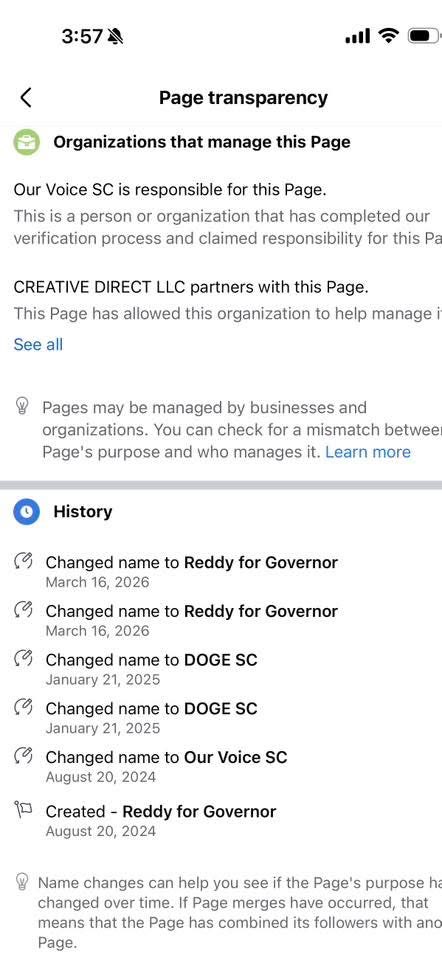
As an update from my last post, Rom Reddy continues to dodge my questions, as well as make false claims.
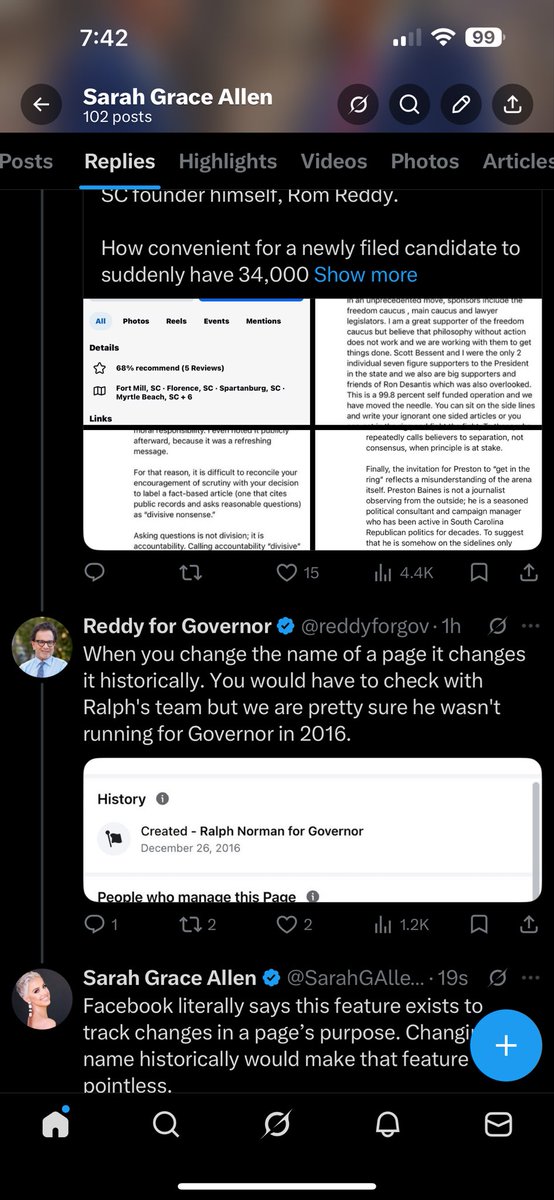
After FitsNews shared my post on X, Rom responded to FitsNews by claiming that changing the page name “changes it historically.” This is the same line I was given by his campaign strategist, as well as a podcaster who decided to enter the chat.
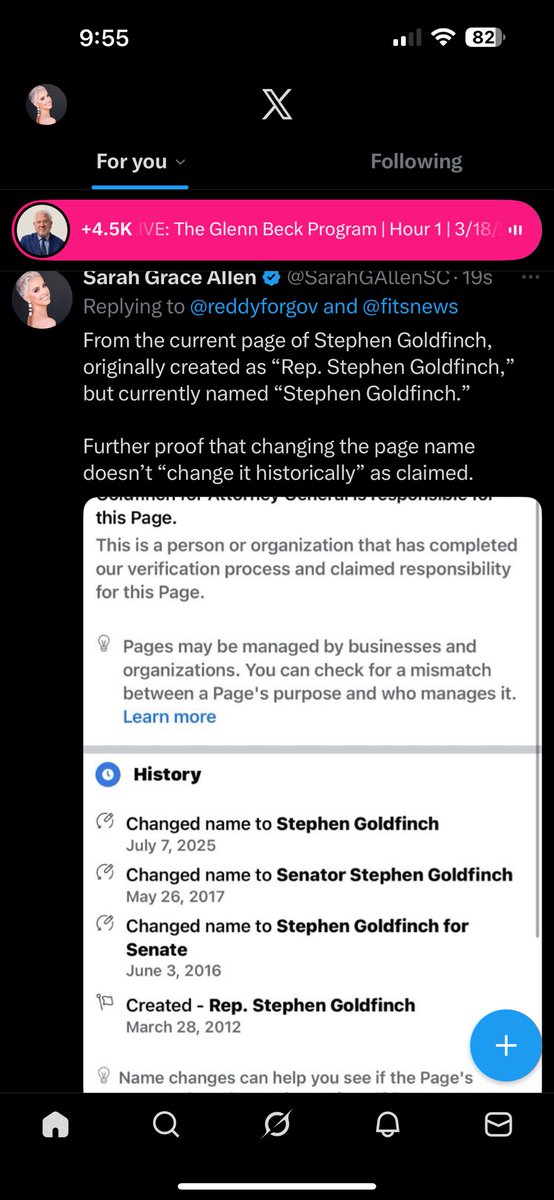
However, as can be seen by Stephen Goldfinch’s page history, for example, changing the name does NOT change the “created as” name retroactively.
After providing this proof, Flotsam and Jetsam retaliated with no contradiction of their own, but instead resorted to petty personal insults and demeaning my questions as “Facebook conspiracy theories.”
Even Fits shared my proof and referred to it as a “spat.” Interesting take from a news source claiming to be unbiased, when their very own Dylan Nolan has transitioned over to being the communications director for Reddy.
A little while ago Reddy’s campaign stated "DOGESC was a committee," and that "the campaign bought the assets of the committee, which is totally legal."
Does this sound like an outsider, straight shooter?
After the Reddy campaign spent the last 24 hours taking all sorts of positions on what happened, they are apparently going to issue a new statement tomorrow.
Let me be clear - I truly couldn’t care less if Reddy thought about running in 2024. Ralph Norman created his campaign page in 2016. However, Ralph isn’t claiming to constituents a gubernatorial run was “never on his bucket list.”
The issue is simple:
If a political page was built using PAC resources, gaining tens of thousands of followers under one purpose, and then quietly converted into a personal campaign page, that raises serious ethical questions.
Furthermore, if a candidate has built his entire brand on demanding transparency from others, but can’t give a straight answer about his own timeline on day one of his campaign… that’s a problem.
Deflection.
Insults.
False claims.
And an attempt to minimize the issue as “silly” so no one looks too closely.
That tactic is as old as politics itself:
When you can’t refute the facts, you try to make the person asking the question look ridiculous.
You can demean my intelligence and purpose all you want. But voters deserve clarity from Mr. Accountability himself, not coordinated condescension from the hired hands.
Facebook Expert Here 🙋♀️ Changing the page name does not “change it historically.” @SarahGAllenSC is correct.
I just pulled up several examples to confirm.
@reddyforgov @fitsnews From the current page of Stephen Goldfinch, originally created as “Rep. Stephen Goldfinch,” but currently named “Stephen Goldfinch.”
Further proof that changing the page name doesn’t “change it historically” as claimed.
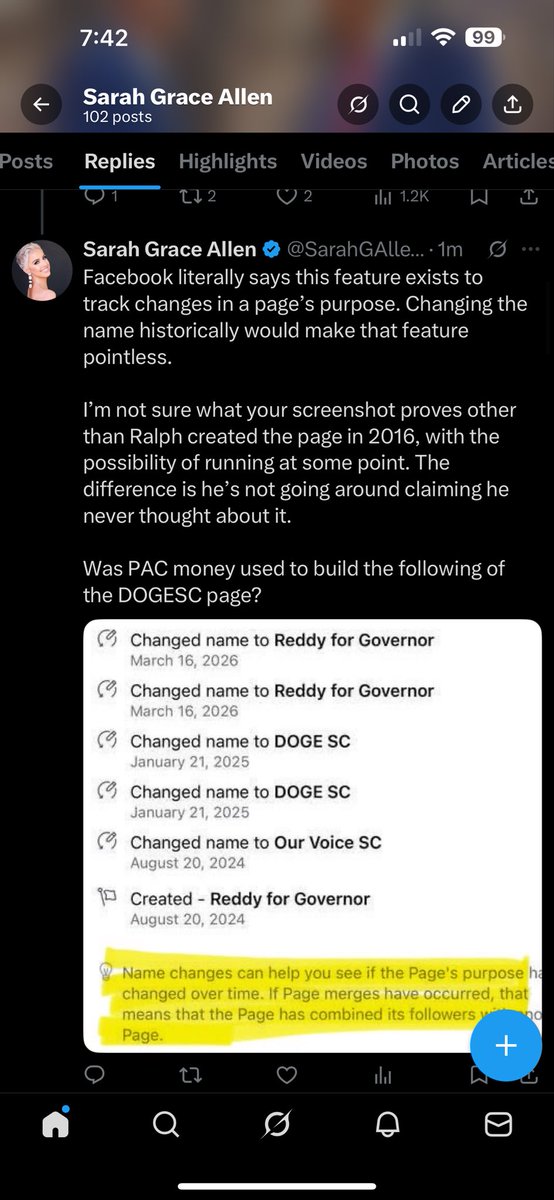
Facebook literally says this feature exists to track changes in a page’s purpose. Changing the name historically would make that feature pointless.
I’m not sure what your screenshot proves other than Ralph created the page in 2016, with the possibility of running at some point. The difference is he’s not going around claiming he never thought about it.
Was PAC money used to build the following of the DOGESC page?
As promised, I’ve continued asking questions. Whether answers will be given remains to be seen.
Yesterday, Rom Reddy was asked when he first considered running for governor. His answer? One month ago.
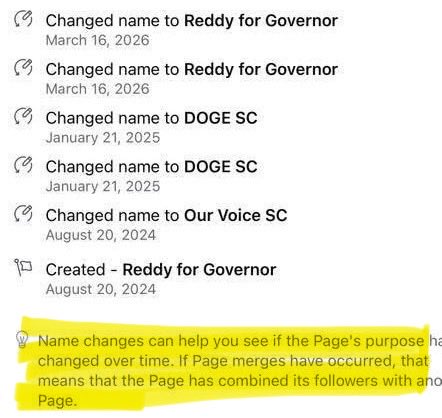
However, according to Facebook’s own page transparency history, the account formerly known as DOGE SC was originally created as “Reddy for Governor” in August of 2024.
So, which is it?
Putting aside that SC Confidential reported two months ago that Reddy intended to run for governor (and many already knew it), the actual page gives evidence of this.
Furthermore, if a significant amount of money was spent through a PAC to build the DOGE SC following, only for it to later be converted into a personal campaign platform, that’s not just a rebrand. It raises serious questions about how campaign assets were built, transferred, and whether proper disclosure requirements were followed.
For someone who built a platform on demanding transparency in government, this is an interesting way to begin a campaign.
Because if the timeline doesn’t add up on day one… what else doesn’t?
@RomReddySC@Nalin_Haley Interesting that you answered here but never responded to my question on Facebook.
“Reddy for Governor” is not a recent purchase date. It’s the original name created in 2024 for what became the DOGESC page. These aren’t useless rumors. These are facts.