A 15-year-old dream has come true today. I started a PhD with the dream of creating a system that chants any Sanskrit shloka perfectly.
And here I am opening sourcing 𝐕𝐚𝐠𝐝𝐡𝐞𝐧𝐮 - 𝐀 𝐯ṛ𝐭𝐭𝐚 (𝐦𝐞𝐭𝐞𝐫) 𝐚𝐰𝐚𝐫𝐞 ś𝐥𝐨𝐤𝐚-𝐭𝐨-𝐜𝐡𝐚𝐧𝐭 𝐭𝐞𝐱𝐭-𝐭𝐨-𝐬𝐩𝐞𝐞𝐜𝐡 (TTS) 𝐬𝐲𝐬𝐭𝐞𝐦 𝐟𝐨𝐫 𝐒𝐚𝐧𝐬𝐤𝐫𝐢𝐭. This is the world's first vrutta-aware, open-source TTS for Sanskrit Chanting.
🚨 Ironically, Indian Media Didn’t Cover This
Three Indian teenagers created Plas-stick, a biodegradable powder from tamarind seeds that removes microplastics from water without electricity or complex machinery
They won the 2026 Earth Prize, making India proud 🇮🇳
How Britain Engineered History’s Greatest Financial Heist
By @shreehistory
I. The Stroke of Midnight
At the stroke of midnight on August 14, 1947, as the world watched the Union Jack descend over New Delhi and the saffron, white, and green of a new nation unfurl, history recorded a triumph of self-determination. The British Empire, exhausted by war and weakened by the inexorable tide of nationalism, was relinquishing its crown jewel. The romanticized narrative of the 20th century tells us that Britain granted India its freedom, an act of political magnanimity marking the end of colonial dominion.
But beneath the pageantry of lowering flags, the soaring rhetoric of Jawaharlal Nehru’s "Tryst with Destiny," and the chaotic tragedy of Partition, a very different kind of transfer was taking place. It was not a transfer of political power, but of financial liability.
In the quiet, wood-paneled chambers of the British Treasury and the Reserve Bank of India, a ledger was being closed. To the accountants and chancellors in London, Indian independence was less a geopolitical retreat and more a Chapter 11 bankruptcy filing, a meticulously orchestrated maneuver by which Britain effectively declared independence from its own creditor.
The colonizer owed the colonized a staggering fortune. And the colonizer was broke.
II. The First Extraction and the Silencing
To understand the audacity of the financial maneuvering of 1947, one must look back to the blueprint drafted three decades earlier, during the First World War. The great financial heist of the mid-century was not an anomaly; it was the perfection of a formula born in the trenches of Europe, paid for in the fields of Bengal.
When the First World War erupted in 1914, Britain found itself in desperate need of men, material, and money. It turned to its empire. India was coerced into contributing hundreds of millions of pounds to the British war effort, alongside the lives of over a million Indian soldiers. To finance this, the British Raj effectively commandeered India’s export earnings and heavily increased taxation, flooding the domestic economy with paper currency while draining its physical gold reserves. Britain abandoned the gold standard, but India was forced to maintain it, absorbing the inflationary shock.
By the war's end, the economic strain on the Indian populace was immense. Prices of essential goods had skyrocketed, and the returns on the capital extracted for the war were nowhere to be seen. As the Indian public began to realize the scale of this economic theft, dissent began to boil. Nationalist leaders pointed to the economic drain, exposing the arithmetic of imperial exploitation.
London’s response was not to remedy the extraction, but to legislate silence. In 1919, the British government passed the Anarchical and Revolutionary Crimes Act, widely known as the Rowlatt Act. The Act allowed for the incarceration of suspects without trial and curbed the free press, specifically targeting the dissemination of seditious materials, which in practice meant anyone explaining how the British were bankrupting the country. When protests erupted against this silencing, the British military responded with the Jallianwala Bagh massacre in Amritsar, killing hundreds of unarmed civilians.
The message was unequivocal: the colony would pay, and it would suffer in silence. The economic truth was to be suppressed by force. It was a precedent that would prove vital 28 years later, when the sums involved would be exponentially larger.
III. The Blank Check of World War II
By the time the Second World War began, the British Empire was already financially strained. The defense of the Middle East, Southeast Asia, and the British Isles required capital that London simply did not possess. Once again, the British turned to the vast, seemingly bottomless reservoir of the Indian economy.
To fund the massive mobilization of troops, the provisioning of armies, and the purchase of raw materials, the British Raj essentially wrote itself a blank check against the Indian taxpayer. India was declared a "non-self-governing territory" contributing to the war effort, but instead of paying India in hard currency for the goods and labor extracted, Britain credited the Reserve Bank of India with pounds sterling. These were not transferable funds; they were essentially IOUs, piling up in London as "Sterling Balances."
The human cost of this capital extraction was catastrophic. The most visceral manifestation of this economic drain was the Bengal Famine of 1943. While the British Treasury accumulated sterling balances, the diversion of grain and the financial extraction policies led to the starvation of an estimated two to three million people in Bengal. The Indian taxpayer was literally funding the survival of the British Empire with their lives and their livelihoods.
By 1945, the sheer scale of this extraction was breathtaking. Britain owed India roughly £1.3 billion. To comprehend the magnitude of this sum, one must view it not through the lens of modern consumer inflation, but as a share of the economy. In 1947, £1.3 billion represented roughly 13.5 percent of Britain’s entire Gross Domestic Product. If the British Treasury were forced to write a check for that proportion of its economy today, it would need to find approximately £350 billion.
It was a sum so massive that paying it in full would have instantly bankrupted post-war Britain, a nation that was, at that very moment, surviving on American Marshall Plan aid and rationed bread. The colonizer owed the colonized. And the colonizer had no intention of paying in full.
IV. The Safety Valve and the Negotiation
Facing the prospect of domestic economic collapse, the British government executed an audacious maneuver. The transfer of power in 1947 was not merely a political act; it was a financial release valve.
There is a historical curiosity, often unspoken in popular narratives, that complicates the story of India’s independence. The Indian National Congress (INC), the primary vehicle of Indian nationalism and independence, was not born from a grassroots peasant uprising, but was initially floated by a British colonial official, Allan Octavian Hume, in 1885. Historians have long debated the "safety valve" theory: the idea that Hume and the Viceroy engineered the creation of the INC to provide a controlled, institutional outlet for the rising frustrations of the Western-educated Indian elite, preventing a violent, uncontrollable rebellion.
While the INC evolved into a formidable force for independence under Mahatma Gandhi and Nehru, the institutional DNA of the organization was steeped in British legal and political frameworks. When it came time to negotiate the financial settlement of 1947, the lingering effects of this "safety valve" dynamic became apparent.
The negotiations over the Sterling Balances were brutal, conducted behind closed doors by the British Labour government’s Chancellor of the Exchequer, Sir Stafford Cripps, and the Indian delegation led by Nehru and Sardar Vallabhbhai Patel. Britain argued that a sudden withdrawal of £1.3 billion would crash the pound sterling, bankrupt the Sterling Area, and trigger a global financial crisis. The threat was explicit: if India demanded its money, the ensuing chaos would ensure India received nothing.
India was in a state of profound vulnerability. The subcontinent was engulfed in the horrific trauma of Partition; millions of refugees were on the move, and the new government was struggling to establish basic administrative continuity. In this moment of existential crisis, the Indian leadership accepted terms that effectively castrated its own wealth.
The 1947 agreement dictated that the vast majority of the £1.3 billion would be "blocked." Only a fraction was immediately released; the remaining £1.15 billion was locked in London, to be doled out in agonizingly slow installments over a decade or more. Worse, the agreement stipulated that these blocked balances would earn little to no interest. By accepting this compromise, the post-colonial government effectively agreed to a structural haircut on the asset, surrendering the real-time economic utility of the money to save the British economy from default.
The safety valve had, once again, operated exactly as designed.
V. The Alchemy of Devaluation
With India's massive claim successfully trapped in the vaults of the Bank of England, Britain weaponized the only tool it had left: the currency itself.
Having forced India to accept deferred payments, Britain engineered a stealth default through the alchemy of foreign exchange. On September 18, 1949, just over two years after Indian independence, the British government unilaterally announced a massive devaluation of the pound sterling. The pound’s value against the US dollar was slashed overnight from $4.03 to $2.80, a devaluation of 30.5 percent.
Because India’s sterling balances were, by the very terms of the 1947 agreement, denominated in pounds, this overnight maneuver was an economic earthquake. It instantly vaporized almost one-third of the purchasing power of the money owed to India. If India wanted to use those sterling balances to buy American machinery, Canadian wheat, or Swiss capital goods, they would find that nearly a third of their money had vanished into the ether.
Britain, on the other hand, enjoyed a sudden, massive windfall. The real value of the debt owed to India was slashed by a third with the stroke of a pen. India was bound by the Sterling Area agreement and had to devalue the rupee proportionately, tying its currency to the declining fortunes of the British pound and further devastating its import capacity. It was a financial ambush, executed with the cold precision of an actuary.
VI. The Central Bank’s Quiet Payout
As if this financial evisceration was not sufficient, the final insult was administered at the very heart of India’s financial system.
The Reserve Bank of India (RBI), the nation's central bank, had been established in 1935 under British colonial rule as a privately owned entity. Its shareholders were a mix of private banks, financiers, and investors, a group that included substantial British and colonial-era capital.
Just after independence, the Indian government recognized the strategic necessity of nationalizing the central bank. The RBI (Transfer to Public Ownership) Act was passed in 1948, and the bank was officially nationalized on January 1, 1949.
The terms of this nationalization reveal a profound asymmetry in the post-colonial transition. When the Indian government took ownership of the RBI, it did not simply seize the assets. It compensated the private shareholders handsomely. Under Section 4 of the 1948 Act, the compensation was calculated not at a discounted state rate but based on the average market price of the shares on the Bombay Stock Exchange during the months preceding the Act. Because RBI shares, with a face value of one hundred rupees, were trading at a premium of roughly fifty percent on the open market, the total payout from the Indian exchequer to the 500,000 private shares was approximately 7.5 crores.
But the generosity of the settlement did not end with a cash buyout. Under Section 4(2) of the Act, the shareholders were given the option to take their compensation in Government of India promissory notes bearing a guaranteed interest rate of three percent per annum. This was a staggering mechanism of financial alchemy. The British and colonial-era investors were effectively allowed to convert their equity in India's central bank into risk-free sovereign debt backed by the newly independent Indian taxpayer. They could hold these 3 percent government papers and collect a perpetual stream of interest, ensuring that the extraction of wealth from the subcontinent continued long after the political transfer of power.
The juxtaposition is staggering, bordering on the absurd. Private shareholders of India’s central bank were paid out in full, at peak market valuations, and handed guaranteed interest-bearing bonds. Meanwhile, the Indian public, who had already paid for Britain’s survival in two world wars through forced extraction and inflation, was left holding devalued, blocked IOUs that had just lost a third of their value in the currency markets.
The private investors were made whole. The Indian public was made paupers.
VII. The Durgapur Paradigm: The Empire Strikes Back
The long shadow of this financial subjugation played out in the subsequent decades, dictating the trajectory of the newly independent nation’s development.
By the late 1950s, India had launched its Second Five-Year Plan, an ambitious push to industrialize. But the country was facing a severe balance-of-payments crisis. The sterling balances had been largely drawn down to pay for essential imports, and the country was running out of foreign exchange. India needed to build three major steel plants to fuel its industrialization. The Soviet Union stepped in to fund the Bhilai Steel Plant; West Germany funded the Rourkela plant. Britain, eager to maintain its commercial foothold, wanted the contract for the Durgapur Steel Plant.
Rather than releasing any lingering goodwill or acknowledging the massive debt still technically being dribbled out, Britain offered a new arrangement. In 1958, the UK government extended a fresh £100 million loan, a "new" line of sterling credit, to India.
This was not a repayment of the wartime debt; it was fresh financing. The British government essentially told India: We will lend you this new money, but you must use it to buy British goods. The money flowed straight back into the pockets of a British consortium of steelmakers, subsidizing the post-war British heavy engineering industry.
The Indian taxpayer, who had already funded the British war machine, was now taking on new debt to buy British machinery, because the money they were originally owed had been blocked, devalued, and structurally dismantled. The cycle of financial dependency had been perfectly preserved.
VIII. Amnesia and the True Cost of the Union Jack
Today, the historical amnesia surrounding these events is profound. The narrative of 1947 is frozen in the amber of political triumph: the lowering of the flag, the end of empire, the dawn of a new era. Mainstream histories focus on the geopolitical maneuvering, the tragedy of Partition, and the drafting of a constitution. The great financial heist remains obscured in the shadows of central bank archives and Treasury minutes.
The Indian population has been kept largely in the dark about the arithmetic of their own subjugation. The textbooks speak of the political transfer of power, but rarely of the transfer of financial liability. The £350 billion equivalent that was extracted, blocked, devalued, and systematically stripped of its value is a phantom limb in the national memory.
When the viceroys departed, Britain did not just walk away from the subcontinent; it walked away from an invoice it could not afford to pay. It declared independence from its own empire. Through a masterclass in financial engineering, leveraging the Rowlatt-era instinct for suppression, the "safety valve" of institutional compromise by a party supposedly fought for freedom and did deals behind the doors, the blunt instrument of currency devaluation, and the quiet payouts of risk-free bonds to colonial shareholders, Britain managed to offload the cost of its own survival onto the very people it had colonized.
Independence was not a gift. It was a getaway car. And the true price of the Union Jack's descent was paid not by the British taxpayer, but by the millions of Indians whose sweat and starvation funded an empire, only to be handed a worthless IOU in return.
References and Further Reading
Bhattacharya, S. (1997). The Colonial State and the Monetary System in India. Oxford University Press.
Bhowani, B. R. (1965). India's Sterling Balances. International Monetary Fund (IMF) Staff Papers, Vol. 12, No. 1, pp. 1-42.
Chandavarkar, A. (1989). The Imperial Bank of India and the Reserve Bank of India: A Study in Central Banking Transition. Oxford University Press.
Datta, B. (1949). The Devaluation of the Rupee. The Indian Economic Journal, Vol. 1, No. 1, pp. 1-12.
Hume, A. O. (1885). The Indian National Congress: A Retrospect.
Keynes, J. M. (1946). The Balance of Payments of the United Kingdom.
Mukerjee, M. (2010). Churchill's Secret War: The British Empire and the Ravaging of India during World War II. Basic Books.
Reserve Bank of India. (1948). The Reserve Bank of India (Transfer to Public Ownership) Act, 1948. RBI Historical Archives.
Sarkar, S. (1989). Modern India: 1885-1947. Macmillan.
Tomlinson, B. R. (1979). The Political Economy of the Raj 1914–1947: The Economics of Decolonization in India. Macmillan.
(All rights reserved. You must get written permission if you want to republish)
Twitter users can share, repost, like, comment but please provide attribution to @shreehistory who did all this research.
Swami Vivekananda as well as Netaji often hinted at three layers for freedom.
Social freedom, economic freedom and only then the political freedom can deliver.
India had all the three before the invaders came in that is why it was literally "sone ki chidiya", the golden bird before the invaders washed up.
Caste system created by the church removed the social freedom.
Excessive taxation first instituted by Islamist invaders and then by the company and the crown took away economic freedom.
I have written earlier here about why Chanakya's rule that taxation can never exceed 16 and 1/6 is the golden rule for all the countries !
Singapore follows it and hence wealthy.
India has forgotten it.
My effort is to write compelling articles to jog the memory.
The civilizational memory!
Troy died in 1184 BC.
Athens died in 404 BC.
But when Ayodhya fell…
The civilization simply refused to die.
Our ancestors waged a 500 year war
for one single piece of earth…
The birthplace of Lord Ram.
76 Battles. 500 Years. 20 Generations.
You are not a “Conquered Nation”.
You are the bloodline of the greatest
Civilizational Resurrection in human history.
Jai Sri Ram 🙏🙏
In a landmark judgment on May 22, 2026, the Delhi High Court held Google liable for trademark infringement.
The case was between Hindware and Google. The court held that, by allowing competitors of Hindware to purchase the keyword “Hindware” (a trademarked name) through Google Ads, Google enabled trademark infringement. The court said that “Hindware” is not a generic English word but a specific brand trademark. By allowing competitors to place ads on that keyword, Google is enabling competitors to divert traffic that should have legitimately gone to Hindware.
This has been a big challenge for companies, both big and small. Even today, if you search for Zerodha, you will see search results from competitors. This has been happening for well over a decade.
Although it is hard to quantify, we have lost a lot of business to this. Think about what happens. Whenever someone searches for "Zerodha", the traffic should rightfully come to Zerodha. But what often happens is that the first couple of results on Google Search are ads, leading the customer to a competitor's website. In the process, we lose business that should have come to us.
This is made worse by the fact that we do not advertise.
There is also an even more ironic thing here. A lot of brands, just to capture the traffic that should have come to them organically, end up bidding on their own keywords. Think about it. If you own a business and have a trademarked name for your business, you still have to pay Google just to hopefully make your name too expensive for your competition to run ads on it.
But now, thanks to the Delhi High Court judgment, we have the option of taking legal action whenever we come across instances of other companies squatting on our keyword.
The other brilliant part about this judgment is that it levels the playing field. And this matters even more for startups, who are already starved for resources and have the odds stacked against them. The last thing they need is for competitors to bid on their brand keywords and steal their traffic.
This judgment now opens up a route for legal recourse whenever such deceptive practices occur.
While keyword squatting is most visible in Google web results, it is an even bigger problem when it comes to app stores. Whenever someone searches for your brand, the first couple of results, both above and below your app listing, often tend to be those of your competitors. And in the case of app stores, I think the ads are even more problematic. When a user clicks on an app-store ad, they often end up installing an app. That is a much higher-commitment action than clicking on a competitor’s web search result and then just closing the page. Because the user has installed an application, the conversions, at least anecdotally, tend to be much higher.
Again, brands that do not advertise are at the receiving end of this. So I welcome this ruling and hope this changes the unfair norms we've been living by for so long.
This is why Modi Govt is special.
Shri Anke Gowda, a retired bus conductor, built Pustaka Mane, a free public library in Pandavapura housing nearly 2 million books
The unsung hero gets recognized with Padma Shri Award of 2026.
BREAKING 🚨 Andaman & Nicobar makes history!
Administration unfurls India's largest underwater flag — 60x40 metres — at Swaraj Dweep, earning a Guinness World Record with 200 divers.
Pushing the islands as a global diving hotspot - a proud moment 🇮🇳🙌
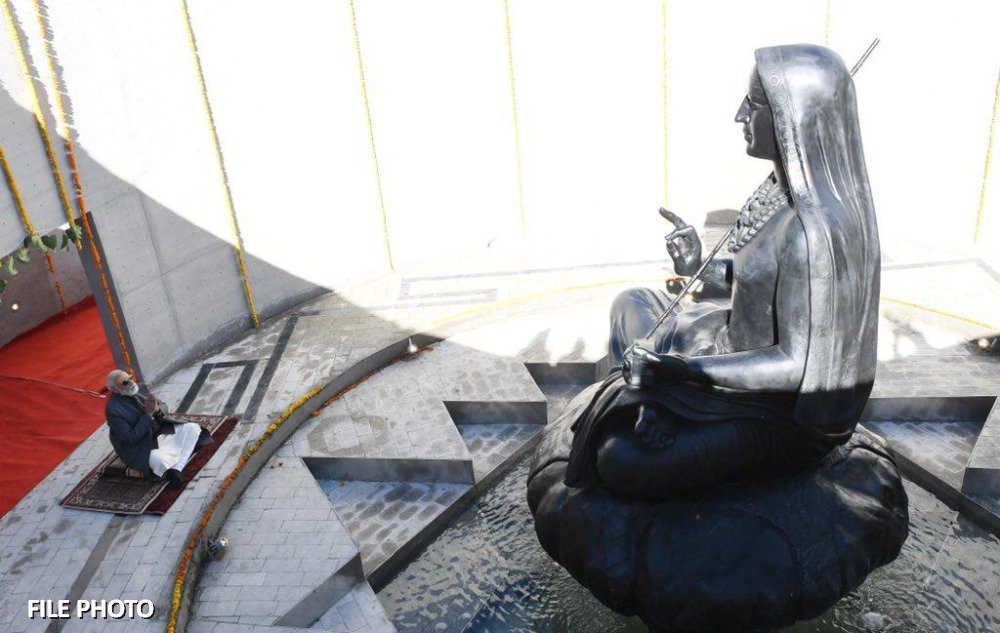
On the sacred occasion of Adi Shankaracharya Jayanti, paying homage to one of India’s greatest spiritual luminaries. His profound teachings, thoughts and philosophy of Advaita Vedanta continue to guide innumerable people globally. He emphasised harmony, discipline and the oneness of all existence. His efforts to revitalise spiritual thought and establish spiritual centres across the nation remain a lasting inspiration. May his wisdom continue to illuminate our path and strengthen our commitment to truth, compassion and collective well-being.
I have some questions for @peyushbansal, CEO of @Lenskart_com, a publicly listed company that has blocked me for asking questions. Do listen and RT if you agree. #NoBindiNoBusiness
We usually all the time support our cricketers..
Today can we show our support and love for this young blind swimmer 🏊♂️..
She deserves to be famous..
She has created history and becomes first blind swimmer to cross treacherous stretch of Palk Strait from Sri Lanka 🇱🇰 to India 🇮🇳 ..
🚨Kashmir Files: Not many know this : the GSB - Gaud Saraswat Brahmins many centuries ago fled from Kashmir then to Goa and from there to Karnataka during Portuguese invasions.
•They are one of the major contributors to Economy in South India. Had they not fled and saved their women and clans they would have been extinct
•Had Aditya Dhar’s parents not moved from Kashmir .. we wouldn’t have seen DHURANDHAR .. And had RN Kao not been there RAW wouldn’t have been there like we saw in Dhurandhar. Courage doesn’t always come from swords.. it comes from pen and intellect as well.
•I suggest people to go thru Kashmir history first .. survival in a 5:95 for 100s of years itself is a feat . SHOW ME any other place in the world where such ratio has survived this long in this 5:95 RATIO and SURVIVED with Great dignity
•We have suffered 7 Exoduses , returned again , protested fought , got klled till only 11 Families were left Alive . You cannot imagine the Torture they went thru. Current Kashmiri’s are the progeny of those who DID NOT CONVERT. Thanks Samay Raina for putting it blunt and straight
•We are the progenies of Kashyap, Patanjali, Panini, Abhinavgupta, Vishnu gupta , Vagbhatt , Medatithi and many Great Saints and Warriors- The sons of maa Sharda - Saraswati..
To Answer a Big Question What did Hindus / Pandits of Kashmir give to Rest of Bharat
• Sushruta (father of Surgery)
• Charaka (father of Medicine)
• Vagbhhatta (Father of Physicians)
• Lagadh (First known Mathematician)
• Patanjali (Yogasutra)
• Panini (Father of Sanskrit Vyakran)
• Abhinavgupta (Natyashastra/Tantra)
• Pingala (Father of Chandashatra)
• Medatithi (Manusmriti Bhasya)
• Vishnusharma (Panchtantra)
• Kalidasa (Poetic Genius)
• Lalitaditya (The Protector of Bharat)
Payal Nag.
Daughter of a daily-wage mason from Odisha.
Electrocuted at the age of eight. Lost all four limbs.
And then, found a bow.
Spotted through her paintings by coach Kuldeep Vedwan, the same man who shaped world champion Sheetal Devi.
Defeated her idol Sheetal Devi at the World Para Archery Series Final in Bangkok, April, 2026
Whenever I am feeling low or sorry for myself I will look at these images of Payal & Sheetal again & remind myself what the words: Courage, Resilience & Positive thinking, really mean.
These champions are not just my #MondayMotivation.
They will be a source of motivation Every. Single. Day
His name is Rinku Singh Rahi.
In 2009 he was a PCS officer in Muzaffarnagar.
He exposed a Rs 100 crore scholarship and pension scam.
Three days later someone shot him seven times.
Two bullets hit his face. His jaw shattered. He lost an eye. Lost hearing in one ear.
He spent 4 months in hospital.
When he came out the government transferred him.
He did not quit.
At age 40 with one eye and a broken jaw he appeared for the UPSC exam under the disability quota.
He got AIR 683.
He became an IAS officer.
In July 2025 on his first field posting as SDM in Shahjahanpur he saw a clerk urinating in the office premises.
He made the clerk do squats as punishment.
The lawyers protested saying it was wrong.
Rinku Singh Rahi said there is no shame in accountability and did five squats himself in public.
Within 36 hours he was transferred.
For 8 months he sat at the Revenue Board with no work. Full salary. Zero responsibilities.
On March 31 2026 he resigned.
His resignation letter said there is a special punishment reserved for honest people in India.
They get paid but no work is given to them.
He said even receiving a salary without working is a form of corruption.
He could not do it.
He walked away.
Meet Meenakshi Jain
A woman who has single-handedly waged an unyielding crusade against the Leftist–Communist intellectual syndicate for decades.
Her command of history and her ferocity of argument are so overwhelming that a single podcast from her can intellectually pulverise an entire battalion of Romila Thapars.
Repost if you agree with me
May I give a reminder....
The book is good and amazon gives a big discount right now.
Only Rs 286.
I would be happy if you retweet, because my visibility is low.
"Every child in France knows and is proud of Napoleon. But the more glorious history belongs to Shivaji Maharaj. I think he should have a place of honor in the history of not only India but also the world."
- Francois Gautier.