Ashurbanipal was one of Assyria’s most famous kings, ruling from 669–631 BC. But his legacy wasn’t only built through conquest. He also created one of the ancient world’s greatest collections of knowledge in Nineveh. 𒀭
This has to be the fifth video I've seen of these niggas driving in circles pointlessly in front of a fortified position until they're all dead. Are the Saudi-backed forces even sentient?
Gay Kurdish Dance.
But, that isn't meant as insult either. These type of men on men dances been around for thousands of years in Kurdish culture.
The Persians for example had male belly dancers dating back way before pre-Islam. 😅
Iran is Persian 🇮🇷🦁
Lebanon is Phoenician 🇱🇧✝️
Iraq is Assyrian 🇮🇶☦️
Syria is Aramaic 🇸🇾✝️
Egypt is Coptic 🇪🇬✝️
Palestine is Hebrew 🇮🇱✡️
Azerbaijan is Armenian 🇦🇲☦️
Anatolia is Greek 🇬🇷☦️
Reject Arabization/Arab colonialism, embrace your heritage.
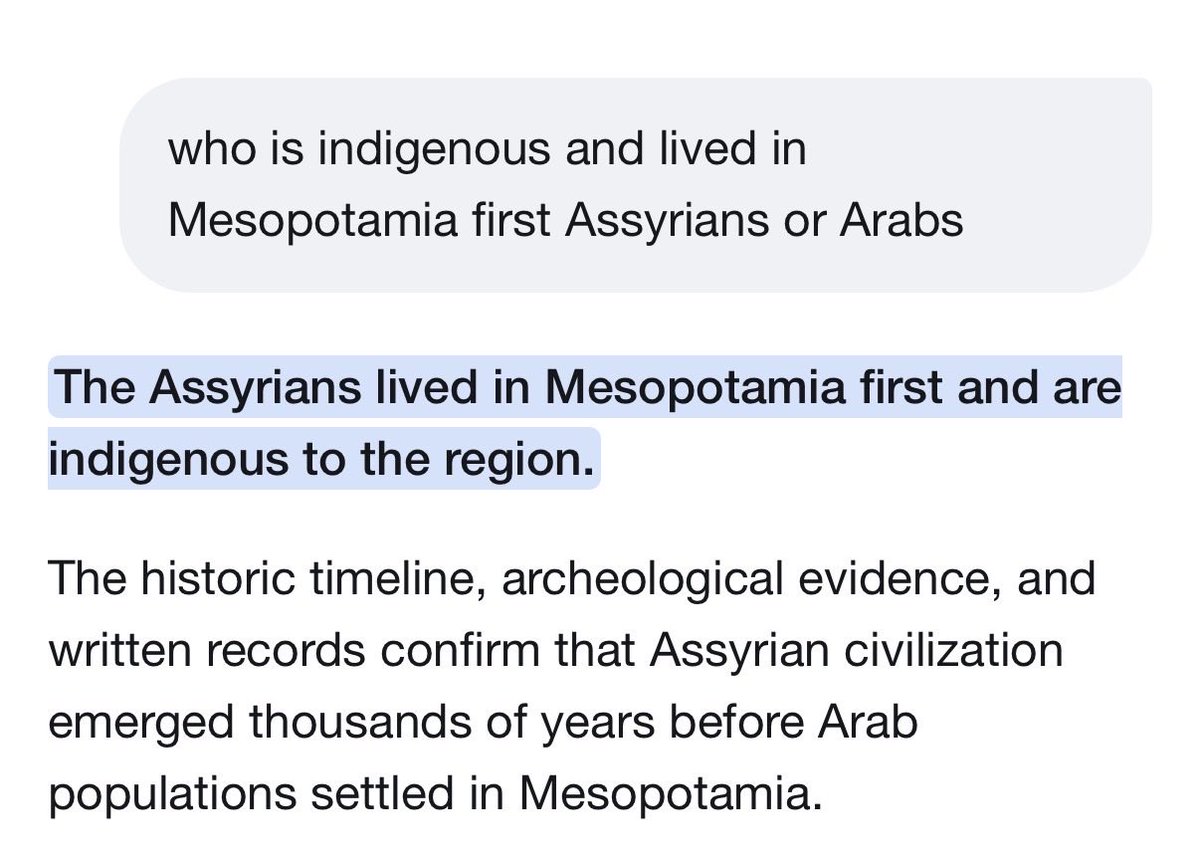
You are using modern border argument against Assyrians. Assyrians are indigenous to Assyria. It is true not all Assyrians are born in modern day Iraq but indigenous of Assyrians it is based on land not modern day borders. Arabs came thousands years later to land not before.
قد يسأل البعض: لماذا لم تتكلم عن هذا القس الكردي الذي ادعى أن الآشوريين أكراد مسيحيون؟ صراحة، أنا لا تهمني ترهات الأكراد ولا غيرهم، فنحن آشوريون وسنبقى دائماً آشوريين. لكن المفارقة هي رد الأحزاب الآشورية ببيانات ضعيفة وركيكة مع أنصارهم.
@b1crq@HeritageVibes That’s is where I’m from u absolute degenerate I do not represent Iraq or Turkey or protect the country like ur ass does when isis came from Iraq not 20 years ago
There is no Iraq when Assyria existed
Assyria extends outside of Iraq Turkey Iran and Syria other Muslim borders
@b1crq@HeritageVibes There is no Iraq where Assyria existed which was an empire
Arabs and mostly all Muslims who inhabit Iraq today have Arabian DNA not Mesopotamian
Okay I will remove the name from my bio lmao 🤣🤣🤣🤣 won’t change that Iraqis are not Assyrians
@sousou5456 Kurds do not cover an entire mountain range
The Iranian Kurds were moved to Iraq and other regions in the Middle East under the ottoman empires Sunni frontier policy.
In the 11th century Georgian chronicle Kartlis Tskhovreba, Leonti Mroveli mentions refugees coming “from Assyria,” whom the Georgians befriended for assistance against the Persians. He also lists Assyrian among the six languages spoken in Kartli. (Eastern Georgia)
🏛️ NSIBIN (NUSAYBIN) – THE ANCIENT ASSYRIAN CITY OF BORDERS, ONE OF THE WORLD’S EARLIEST CENTRES OF HIGHER LEARNING & A LEGACY SHARED BY EASTERN AND WESTERN ASSYRIANS.
📜 Nearly 3,000 years of Assyrian history
Nsibin (ܢܨܝܒܝܢ), today officially called Nusaybin, is an ancient city of northern Mesopotamia, south of Tur Abdin. Its ancient name, Nasibina, appears in Neo-Assyrian inscriptions from the reign of King Adad-nirari II in the ninth century BC.
For centuries, Nsibin was an important centre of Assyrian Christian civilization, scholarship, and Syriac literature.
🏛️ A strategic border city between the Roman and Persian Empires
Nsibin occupied a crucial position on the frontier between the Roman Empire and the Persian Empire, particularly the Sasanian Empire. Its strategic location made it one of the most important fortified cities of northern Mesopotamia and a major centre of trade, military defence, and cultural exchange between East and West.
The city changed hands during centuries of Roman–Persian rivalry. In AD 363, following Emperor Julian's Persian campaign, Nsibin was ceded by Rome to the Sasanian Persians.
Despite political divisions and imperial conflicts, Nsibin remained an important centre of Assyrian Christian life, connecting Assyrian communities and intellectual traditions on both sides of the imperial frontier.
🎓 The School of Nsibin – One of the world's earliest centres of higher learning
Traditionally founded in the fourth century AD under Mor Yaqub of Nsibin (Saint Jacob of Nisibis), the early School of Nsibin became an influential centre of Christian learning.
Often described as one of the world's earliest university-like institutions, the scholarly tradition of Nsibin included theology, biblical studies, Syriac literature, and philosophy. The later school's written academic regulations, dating from AD 496, established an organized educational system centuries before Europe's medieval universities.
After Nsibin passed to Persian rule in AD 363, part of its scholarly tradition continued in Edessa (Urhoy), before flourishing again in Nsibin during the fifth century.
✨ The great Assyrian scholars of Nsibin – Eastern and Western traditions
Nsibin's intellectual heritage was shaped by Assyrian scholars associated with both the Eastern and Western Syriac Christian traditions. Although these traditions developed under different ecclesiastical and political circumstances, they shared the Syriac language, Mesopotamian cultural heritage, and a rich tradition of Christian scholarship.
Among its greatest figures were Mor Yaqub of Nsibin (Saint Jacob of Nisibis, d. AD 338), the renowned Assyrian bishop of Nsibin, traditionally credited with founding its early theological school and remembered as one of the great spiritual figures of early Syriac Christianity; Mor Afrem (306–373), born in Nsibin and celebrated as the Harp of the Holy Spirit for his theological poetry; and Mor Narsai (fifth century), the renowned scholar who led the later School of Nsibin.
Other influential figures associated with Nsibin's scholarly tradition and the wider Eastern Syriac intellectual world included Mor Barsawma, Mor Abraham of Beth Rabban, Mor Babai the Great, Mar Aba I, and Henana of Adiabene.
The early scholarly tradition associated with Mor Yaqub and Mor Afrem became especially influential in the Western Syriac heritage, while the later School of Nsibin became a leading intellectual institution of the Church of the East, associated with the Eastern Syriac tradition.
Together, these scholars and traditions helped establish Nsibin as a celebrated centre of Assyrian Christian learning whose influence extended across Mesopotamia, Persia, and beyond.
⛪ The ancient Church of Mor Yaqub of Nsibin, with its fourth-century baptistery, remains an important monument of this heritage.
⚔️🥀 The Sayfo of 1915 – The Assyrian Genocide
The greatest tragedy in Nsibin's modern history came during the Assyrian Genocide of 1915 (Sayfo – ܣܝܦܐ).
In June 1915, Assyrian Christians were arrested, persecuted, and massacred. Historical testimonies describe the murder of the priest Mor Istayfanos and the slaughter of Assyrian men, women, and children at Nirbo d'Frasto, where victims were reportedly thrown into a well.
💔 Entire families disappeared, much of the Assyrian community was destroyed, and survivors were forced to flee their ancestral homeland.
🕊️ From Nsibin to Qamishli (Beth Zalin)
🏘️ Qamishli (ܒܝܬ ܙܠܝܢ – Beth Zalin), directly across today's Turkish–Syrian border from Nsibin, became a new home for many Assyrian survivors and their descendants.
Established in 1926 under the French Mandate, Qamishli developed with refugees from Nsibin, Tur Abdin, and surrounding regions. Assyrians helped build its churches, schools, neighbourhoods, and businesses, making it an important centre of Assyrian Christian life.
💔 While Nsibin lost almost its entire Assyrian Christian population, Qamishli became a symbol of survival and rebuilding.
A small Christian presence remained in Nsibin, but further insecurity and emigration, particularly during the 1980s and 1990s, reduced it to a tiny remnant. Many Assyrians from the region settled in Sweden, Germany, the Netherlands, Switzerland, Belgium, and elsewhere.
🌹 A civilization remembered
From the ancient Assyrian city of Nasibina, through its centuries as a frontier city between Rome and Persia, to its celebrated School of Nsibin, where Eastern and Western Assyrian intellectual traditions contributed to a remarkable legacy of scholarship, Nsibin stands as a testament to the enduring cultural and religious heritage of Mesopotamia.
Despite the tragedy of the Sayfo and the destruction of much of its Assyrian Christian community, its legacy survived through generations of scholars, refugees, and descendants who preserved their history, faith, and identity.
🌹💔 A city of knowledge. A city of borders. A bridge between Eastern and Western Assyrian traditions. A city whose Assyrian heritage must never be forgotten. 🇦🇸
#Nsibin #Nisibis #Nusaybin #Assyrian #Assyria #Assyrians #AssyrianHistory #SchoolOfNsibin #EasternAssyrians #WesternAssyrians #MorYaqub #MorAfrem #MorNarsai #Sayfo1915 #AssyrianGenocide #Qamishli #BethZalin #TurAbdin #Mesopotamia #AssyrianHeritage #NeverForget