Update:
The Devnet recovery rehearsal has completed successfully. Following successful recovery runs on both Testnet and Devnet, we are proceeding with Mainnet recovery today, Wednesday, September 23.
The planned validator upgrade and synchronization window is 14:00–16:30 UTC today. This preparation period allows participating nodes to become ready before block production resumes.
We currently estimate that Mainnet will begin producing blocks at approximately 16:35 UTC, subject to successful completion of the recovery process and validator readiness. This remains an estimate, not a confirmed restart time.
Mainnet remains paused, and a separate all-clear will be issued for users. Until then, please do not submit or rebroadcast transactions, or use EGLD and ESDT deposit and withdrawal routes through exchanges or bridges.
We appreciate your patience as we work to restore Mainnet safely. Thank you to the validators, exchanges and infrastructure partners working with us on the recovery.
the war room is non stop since the incident, with little to sleep, people doing multiple jobs, audits, verifications, preparing everything for communication, alignment, restart and recovery.
code is ready, it is public, tests are ongoing and all the agents are working in parallel to make even more checks and validations.
one thing is for sure: we will get out of this stronger.
we build and keep building.
We have temporarily paused the protocol following an attempted exploit involving the MEX money market. The incident has been contained.
User funds are safe. The incident was detected and contained in time.
The protocol will remain paused until we have verified that operations can safely resume. We will share further updates through our official channels, followed by a detailed incident report covering what happened and the measures taken.
$EGLD : Review 📜
What if a blockchain solved the scaling problem years before its rivals, and then broke the one promise its holders cared about most?
Meet MultiversX, the first network to implement all three types of sharding in production, and as of today running 600-millisecond blocks after its Supernova activation.
The engineering has been ahead of the field for six years, approved almost unanimously by its own community. In October 2025, that same community voted to remove the hard supply cap the project had promoted since launch.
Let's explore the sharpest split between technology and trust in the series. 👇
⚪ MultiversX at a Glance
Marketplace Insight: MultiversX has one of the strongest technical records in crypto and one of the most damaged token narratives. It shipped adaptive state sharding in 2020 while Ethereum's sharding roadmap was repeatedly redesigned, and Supernova now delivers a tenfold speed increase on identical validator hardware, approved by governance with 99.64% support.
The clean contrast is what the community will and will not unite behind. The same holders who backed the technical roadmap almost unanimously were sharply divided by the October 2025 vote that removed the supply cap the project had promoted for years. The engineering keeps its promises. The monetary policy did not.
⚪ Mission
MultiversX exists to make blockchain scale without fragmenting the user experience. The founding argument was that scaling through layers and bridges forces users to manage assets across competing environments, and that the better answer is a single network that splits itself internally instead. Adaptive State Sharding does that by partitioning state, transactions, and network communication simultaneously, with shards merging or dividing automatically as demand changes, so throughput scales without users ever choosing a chain or bridging an asset.
🔵 A Brief History
MultiversX was founded in late 2017 by brothers Beniamin and Lucian Mincu alongside Lucian Todea, with Beniamin having previously served as Head of Product and Business at NEM Core and both brothers having founded MetaChain Capital. Development began in earnest in August 2019 and mainnet launched in July 2020 as Elrond, with EGLD trading around $13.
The token's own history involved a dramatic restructuring. Originally issued as ERD on Binance Chain with a 20 billion supply, 500 million were burned in November 2019, and a September 2020 swap converted holdings at 1,000 ERD to 1 EGLD, collapsing supply from 20 billion to 20 million and establishing the scarcity model the project would promote for years.
November 2021 brought the peak at $542.58, followed by a rebrand from Elrond to MultiversX in November 2022, repositioning around the metaverse, a narrative that did not age well. The technology kept advancing regardless, with the Andromeda upgrade halving required confirmation blocks and pushing toward near-instant finality.
October 2025 was the turning point for the token. A governance proposal from within the Foundation moved EGLD from its fixed roughly 31.4 million supply to a model with approximately 9.47% annual tail inflation, burning 10% of validator fees. It passed despite public opposition from Justin Bons of CyberCapital, who argued the inflation was too high and the burn too low. Further pressure followed, with Binance delisting EGLD/ETH and EGLD/BTC pairs in June 2026 over low liquidity, and the token reaching an all-time low of $2.77 that month.
The engineering did not slow. Stripe's Machine Payments Protocol integrated in March 2026 for agent-to-agent settlement, followed by Google UCP. Supernova, the largest protocol change in the network's history, passed governance in January 2026 with 99.64% approval, ran on devnet from late August, and reached mainnet node software v2.0.6.0 on 4 September.
By 6 September roughly 84% of nodes had migrated to the new client, up from 4% five days earlier. Activation is set for 10 September at epoch 2233, with a planned 22 to 24 minute drain window so no transaction is caught between the old six-second clock and the new 600-millisecond one. The token rallied roughly 80% to 100% into the event.
🔵 Ecosystem Narrative
The organizing idea is that a single network should scale internally rather than pushing complexity onto users.
➛ Adaptive State Sharding. The network splits state, transactions, and network communication across shards that merge or divide automatically with demand, the first production implementation of all three sharding types, live since 2020 while competitors deferred their own designs.
➛ Supernova. Consensus decoupled from execution so validators vote without re-executing blocks, cutting block times from six seconds to 600 milliseconds on unchanged hardware, with intra-shard finality targeted below 250ms and cross-shard settlement near 2.4 seconds. Validator requirements stay at 4 cores, 8GB RAM, and 2,500 EGLD, so the tenfold gain costs operators nothing.
➛ Machine payment rails. Stripe's Machine Payments Protocol and Google's UCP both integrate MultiversX for agent-to-agent settlement, use cases where sub-second finality is a hard requirement rather than a convenience.
➛ Developer economics. Developers receive 30% of the gas fees generated by their own smart contracts, a direct revenue share that few networks offer and a genuine structural incentive to build, supported by a Cookbook now at 61 complete projects.
➛ Consumer and payments surface. xPortal has surpassed 3 million users with over 100,000 staking EGLD, xMoney handles SmartBill invoice payments and card funding, and Guardians extends 2FA-style protection to wrapped BTC and to agents rather than only humans.
➛ Unified user experience. One wallet covers the entire network natively, with no bridging between shards or managing assets across competing layer twos, which is the practical payoff of sharding over rollups.
⚪ Token Utilities
$EGLD secures and powers the network.
➛ Gas: pays for transactions, smart contract deployment, and all network operations, with 30% of contract gas routed to the developer.
➛ Staking: validators stake EGLD under Secure Proof-of-Stake with rating-based selection, securing the network across a record 3,259 nodes with roughly 14.5M EGLD staked.
➛ Governance: holders vote on protocol decisions, including both the Supernova approval and the 2025 vote that removed the supply cap.
➛ Fee burn: 10% of validator fees are burned, the partial offset against tail inflation.
⚪ Key Features
➛ Adaptive State Sharding across state, transactions, and network, live since 2020.
➛ Supernova delivering 600ms blocks and sub-250ms intra-shard finality on unchanged hardware.
➛ Secure Proof-of-Stake with validator rating scores across 3,259 nodes.
➛ 30% of smart contract gas fees paid directly to developers.
➛ Stripe Machine Payments and Google UCP integrations for AI agent settlement.
➛ Protocol development using Runtime Verification's formal methods framework.
🔵 Meet the Team
MultiversX has one of the more stable and technically credentialed founding teams in the sector, with all three co-founders still in place nine years on.
▶️ Core Members:
➛ Beniamin Mincu [ @beniaminmincu ] - Co-Founder and CEO | Previously Head of Product and Business at NEM Core, and an early investor in Binance, Brave, and Tezos. He co-founded MetaChain Capital and ICO Market Data before starting Elrond, and remains the project's principal public voice.
➛ Lucian Mincu [ @lucianmincu ] - Co-Founder and CTO | Brings IT engineering and security experience from Uhrenwerk 24, Cetto, and Liebl Systems, and co-founded MetaChain Capital alongside his brother. He owns the technical architecture behind the sharding design.
➛ Lucian Todea [ @luciantodea ] - Co-Founder and COO | The third founder from 2017, running operations across the organization through the Elrond era and the MultiversX rebrand.
➛ Adrian Dobrita [ @AdrianDobrita ] - Head of Engineering | Built software for Samsung, Intel, and Continental before joining, anchoring the engineering discipline behind a network that has shipped major upgrades on schedule for six years.
🔵 Ratings
➛ Use Case: ★★★★ (4/5). MultiversX has a genuine and rare technical claim: it shipped all three types of sharding in production in 2020, years before competitors delivered comparable designs, and Supernova now delivers a tenfold speed increase on identical validator hardware with sub-250ms intra-shard finality. Stripe's Machine Payments Protocol and Google's UCP integrating it for agent settlement are real validation of that speed, the 30% developer gas share is a structural incentive few networks match, and a record 3,259 nodes give it meaningful decentralization. The 1-point deduction is adoption relative to capability. Ecosystem TVL sits in the low millions against Solana, Sui, and Aptos, the 2022 metaverse repositioning was a narrative misstep that cost momentum, and the network's throughput has consistently exceeded the demand for it.
➛ Tokenomics: ★★★ (3/5). The structure has real positives: supply is effectively fully circulating with no unlock overhang or vesting cliff, staking utility is genuine with roughly 14.5 million EGLD staked across a record validator set, and 10% of validator fees are burned. The 2-point deduction is a broken commitment, and it is specific rather than general. The project promoted a hard cap of roughly 31.4 million EGLD for years, with its own website stating only 30 million could ever exist and positioning the asset explicitly against currencies that can be printed endlessly. The October 2025 vote removed that cap and introduced roughly 9.47% annual tail inflation, drawing public objection from a serious institutional fund manager on the grounds that the inflation was too high and the burn too low. Whatever the technical merits, a project that reverses its central scarcity promise carries that on its record.
➛ Audits: ★★★★ (4/5). MultiversX's security foundation is stronger than most and rests on formal methods rather than periodic review. The project has worked with Runtime Verification, a specialist firm applying a framework pioneered at NASA, since inception, using it across the protocol, core components, and applications, and Runtime Verification later became a staking provider on the network. Secure Proof-of-Stake with validator rating scores adds an operational security layer, and the network has run since July 2020 through multiple major upgrades without a protocol-level exploit. The staged Supernova rollout across devnet, testnet, and mainnet with a planned drain window reflects genuine operational discipline. The 1-point deduction is that no verified top-tier security score or specific published formal verification report is available for review, and Supernova introduces substantial new consensus surface that is hours old at time of writing.
➛ Community: ★★★★ (4/5). The distinction between what this community unites behind and what divides it is the most informative thing about it. Supernova passed governance with 99.64% approval and validators migrated to the new client at pace, reaching 84% within five days of release, while validator count hit an all-time high of 3,259 nodes during a period when the token was near its lows, which is real operational conviction rather than sentiment. xPortal has over 3 million users with 100,000-plus staking, the developer Cookbook has reached 61 complete projects, and the network was cited among the top six in Web3 by commit volume. The 1-point deduction is the trust damage from the supply cap reversal, which divided the same community that backs the roadmap almost unanimously, compounded by exchange delistings at Binance, Bitfinex, and KuCoin narrowing access.
🔵 Conclusion
MultiversX is a case study in how far excellent engineering can carry a project, and where it stops. The network shipped adaptive state sharding in 2020 while Ethereum's own plans were deferred, and as of today Supernova delivers a tenfold speed increase on the same validator hardware, approved by 99.64% of governance and migrated to by 84% of nodes within five days. Stripe and Google both route machine payments through it. Validator count sits at an all-time high. The founding team is intact after nine years.
The risks are real and largely self-inflicted. The project spent years telling holders that only 30 million EGLD could ever exist, then voted to remove that cap in favour of roughly 9.47% annual inflation. Exchange access has narrowed through delistings at three major venues, the token trades far below its 2021 high, and adoption has never matched the throughput the network provides.
But the bull case is arriving in real time. If machine-to-machine payments become a genuine category, sub-second finality stops being a specification and becomes a requirement, and as of today MultiversX has it live with Stripe and Google already integrated.
The technology was never the question. What MultiversX has to rebuild is the belief that the people running it will not change the rules again.
I post from time to time an open letter to the @MultiversX team. Here’s another one before the big day.
I’m just the same person who’s been here since Elrond, before the rebrand, before half the timeline decided the story was over. You already know that part. I’ve said it before.
Tomorrow is September 10. Supernova.
There’s going to be that ~24 minute window. Drain the old work. Hold the new txs. Then the clock changes. If your EGLD is in your own wallet you don’t do anything. I keep repeating that to people because everybody still thinks a hard fork means packing bags. It doesn’t. Not this one.
I’m not going to pretend the last years were easy to sit through. They weren’t. Delays. Quiet charts. People leaving in that polite way people leave. I had the same nights as everyone else. The difference is I never moved the original belief. I didn’t come here for a narrative season. I came here because I know, this is the future. Simple as that.
Andromeda took confirmation blocks out of the way. Supernova takes execution off the critical path. That’s the same bet, just finally allowed to run at the speed it was supposed to.
99.64% voted this through. Battle of Nodes already tried to break it. A billion transactions. Devnet already running the new heartbeat. So tomorrow is not a surprise party. It’s the mainnet version of work that’s been in public for a while.
I will believe in this the same way I believed at the beginning. Not louder. Not cleaner. Same way. I believed when it was still called Elrond and most people weren’t watching. I believed when the name changed and a lot of people used that as an exit. I’ll believe when a same-shard transfer stops feeling like a small ceremony. That’s it. That’s the whole standard.
To the team: thank you for not taking the cheap version of speed. Thank you for keeping validator hardware in the realm of normal machines. Thank you for putting this through governance instead of just shipping a story. I know I’m one voice in a long line of voices. I also know I didn’t go anywhere.
I’ll be here through the twenty-four minutes. I’ll be here after.
See you on the other side.
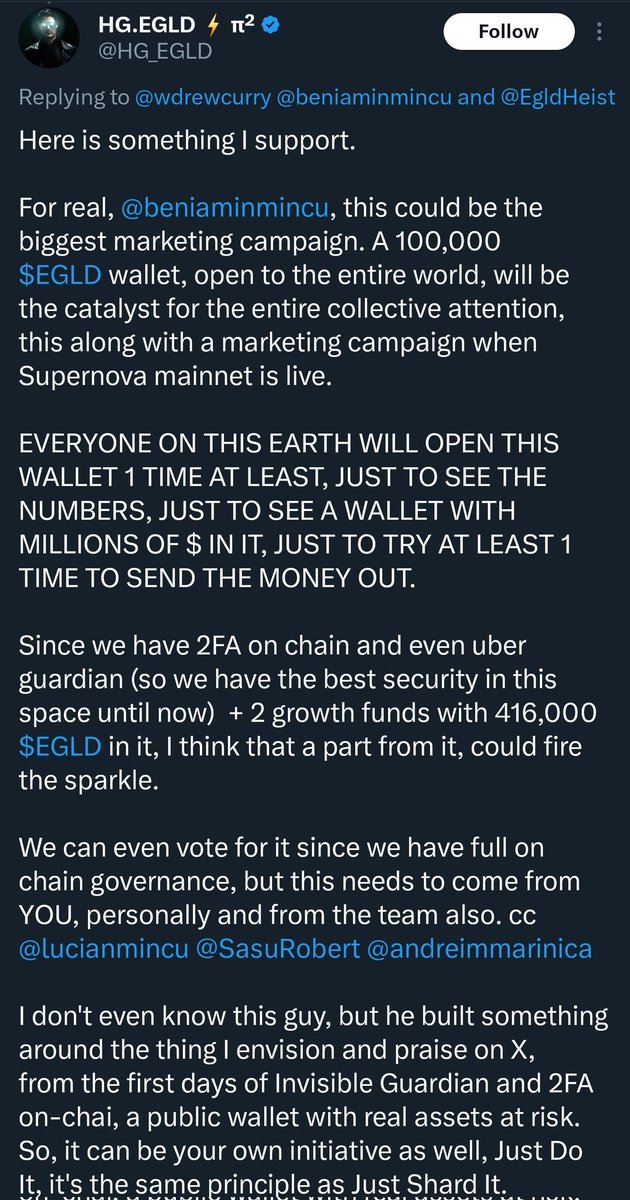
Hello @HG_EGLD, I noticed you blocked me. I fully support an initiative like this, and I’d gladly promote it if @MultiversX agrees to fund that wallet. I still don’t understand why they haven’t done it so far, considering they essentially have nothing to lose. Unless there’s something we’re unaware of and the wallet could actually be vulnerable to being hacked.
🔥 FIRST PRIZE 100$
🔥 SECOND PRIZE 50$
🔥 THIRD PRIZE 1 @Boogas
only on OOX
Trading challenge in progress!
Duration: 60 days
Open for all @MultiversX traders, collectors, artists…for everyone!
Keep reading for all details 👇
GM OnionS 🧅
we are ready!
🔥 New $ONX burn mechanism is LIVE on OOX 🔥
How does it work?
Vote to burn. 🔥
The new mechanism is very simple and available to everyone; to burn $ONX, simply vote for any NFT on OOX.
Each vote costs 20 $ONX - of these 20 $ONX, 10 are burned directly by our smart contract. 10 are returned to the $ONX staking pool.
The era of scarcity begins. The $ONX supply will decrease until it reaches 60 million $ONX - once the 60 million goal is reached, we will turn off the burn forever. The final $ONX supply will be 60 million.
You can monitor new ONX supply from @eCompass_io page.
https://t.co/AnS6QXYv0P
Start to vote, start to burn 🔥
https://t.co/gx4tFsGHlZ
All CHUBBERs are whitelisted.
Market conditions have slowed our ideas but haven't stopped them. Soon, everyone who owns our CHUBBYs will be truly happy.
two weeks ago I wrote: "finality faster than the block slot. 120K TPS. same hardware."
today: 1 billion transactions processed on Battle Net. 120K TPS confirmed live.
still think nobody's building? RT this and tag someone who needs to see it.
Crypto is dead and we fucking killed it…
Five years ago, if you told someone “I own crypto,” you’d get at least a reaction, maybe even admiration.
1. At this point crypto = scam. Everything falls under the same label.
If an OpenClaw dev can’t keep security tight and crypto people front-run him, hijack his GitHub, and more… then all crypto people are scammers.
Nah bro, you just need to be more careful—not everyone in crypto has bad intentions.
Don’t label everyone and everything and start a witch hunt.
2. In 2021 we had one of the biggest crypto rallies in history and a huge influx of retail investors. It was one of the best shots at mass adoption.
What did we do? We gave them wallet drains, pump-and-dumps, phishing, and https://t.co/REA5R3qlDz.
Retail is gone and won’t come back for a while.
3. In 2026 altcoins are down 99.99999%.
Guess what’s not down 99%? Bitcoin—the only real-world crypto asset, the digital gold everyone tries to sell you in disguise.
Bitcoin is not a travesty; it’s real.
You need to understand why Bitcoin doesn’t behave like the other shitcoins:
1. Anonymous launch via a powerful white paper
2. Unmatched decentralization and mass adoption
3. Limited supply and scarcity—only 21 million will ever exist, ~20 million already mined, the next million will take over 130 years
4. Utility and payments—Bitcoin is used worldwide for payments, investment, even national budgets
So where does that leave the rest of altcoins?
The Bitcoin model is simple, but no one has replicated it.
4. Enter ICOs, IDOs, investment rounds, whatever the fuck they’re called now.
“We are the Bitcoin and Ethereum killers…
Just support our shitcoin so we can make our dream come true…
Infinite magic internet money!”
Tokens with unlimited supply sold in ICOs with big promises.
You get teams building their dream Layer 1 at the community’s expense. You are the exit liquidity.
You buy their ICO, buy their shitcoin on dips, keep DCA-ing.
Then it hits you: all these Layer 1s need cash to survive, and the only way is selling their tokens.
Infra, servers, offices, staff, devs—you paid for that.
First-class trips, failed undisclosed investments, paid partnerships that went nowhere, regulatory lobbies, lawsuits, hacks, damages… Yup, you’re the sucker paying for it.
So where does that leave us?
We’re definitely not in a great position, yet strong communities are emerging—especially from the REKT NFT space. Somehow, there is hope we will make it.
We need to break the Ponzi.


![0xchainink's tweet photo. $EGLD : Review 📜
What if a blockchain solved the scaling problem years before its rivals, and then broke the one promise its holders cared about most?
Meet MultiversX, the first network to implement all three types of sharding in production, and as of today running 600-millisecond blocks after its Supernova activation.
The engineering has been ahead of the field for six years, approved almost unanimously by its own community. In October 2025, that same community voted to remove the hard supply cap the project had promoted since launch.
Let's explore the sharpest split between technology and trust in the series. 👇
⚪ MultiversX at a Glance
Marketplace Insight: MultiversX has one of the strongest technical records in crypto and one of the most damaged token narratives. It shipped adaptive state sharding in 2020 while Ethereum's sharding roadmap was repeatedly redesigned, and Supernova now delivers a tenfold speed increase on identical validator hardware, approved by governance with 99.64% support.
The clean contrast is what the community will and will not unite behind. The same holders who backed the technical roadmap almost unanimously were sharply divided by the October 2025 vote that removed the supply cap the project had promoted for years. The engineering keeps its promises. The monetary policy did not.
⚪ Mission
MultiversX exists to make blockchain scale without fragmenting the user experience. The founding argument was that scaling through layers and bridges forces users to manage assets across competing environments, and that the better answer is a single network that splits itself internally instead. Adaptive State Sharding does that by partitioning state, transactions, and network communication simultaneously, with shards merging or dividing automatically as demand changes, so throughput scales without users ever choosing a chain or bridging an asset.
🔵 A Brief History
MultiversX was founded in late 2017 by brothers Beniamin and Lucian Mincu alongside Lucian Todea, with Beniamin having previously served as Head of Product and Business at NEM Core and both brothers having founded MetaChain Capital. Development began in earnest in August 2019 and mainnet launched in July 2020 as Elrond, with EGLD trading around $13.
The token's own history involved a dramatic restructuring. Originally issued as ERD on Binance Chain with a 20 billion supply, 500 million were burned in November 2019, and a September 2020 swap converted holdings at 1,000 ERD to 1 EGLD, collapsing supply from 20 billion to 20 million and establishing the scarcity model the project would promote for years.
November 2021 brought the peak at $542.58, followed by a rebrand from Elrond to MultiversX in November 2022, repositioning around the metaverse, a narrative that did not age well. The technology kept advancing regardless, with the Andromeda upgrade halving required confirmation blocks and pushing toward near-instant finality.
October 2025 was the turning point for the token. A governance proposal from within the Foundation moved EGLD from its fixed roughly 31.4 million supply to a model with approximately 9.47% annual tail inflation, burning 10% of validator fees. It passed despite public opposition from Justin Bons of CyberCapital, who argued the inflation was too high and the burn too low. Further pressure followed, with Binance delisting EGLD/ETH and EGLD/BTC pairs in June 2026 over low liquidity, and the token reaching an all-time low of $2.77 that month.
The engineering did not slow. Stripe's Machine Payments Protocol integrated in March 2026 for agent-to-agent settlement, followed by Google UCP. Supernova, the largest protocol change in the network's history, passed governance in January 2026 with 99.64% approval, ran on devnet from late August, and reached mainnet node software v2.0.6.0 on 4 September.
By 6 September roughly 84% of nodes had migrated to the new client, up from 4% five days earlier. Activation is set for 10 September at epoch 2233, with a planned 22 to 24 minute drain window so no transaction is caught between the old six-second clock and the new 600-millisecond one. The token rallied roughly 80% to 100% into the event.
🔵 Ecosystem Narrative
The organizing idea is that a single network should scale internally rather than pushing complexity onto users.
➛ Adaptive State Sharding. The network splits state, transactions, and network communication across shards that merge or divide automatically with demand, the first production implementation of all three sharding types, live since 2020 while competitors deferred their own designs.
➛ Supernova. Consensus decoupled from execution so validators vote without re-executing blocks, cutting block times from six seconds to 600 milliseconds on unchanged hardware, with intra-shard finality targeted below 250ms and cross-shard settlement near 2.4 seconds. Validator requirements stay at 4 cores, 8GB RAM, and 2,500 EGLD, so the tenfold gain costs operators nothing.
➛ Machine payment rails. Stripe's Machine Payments Protocol and Google's UCP both integrate MultiversX for agent-to-agent settlement, use cases where sub-second finality is a hard requirement rather than a convenience.
➛ Developer economics. Developers receive 30% of the gas fees generated by their own smart contracts, a direct revenue share that few networks offer and a genuine structural incentive to build, supported by a Cookbook now at 61 complete projects.
➛ Consumer and payments surface. xPortal has surpassed 3 million users with over 100,000 staking EGLD, xMoney handles SmartBill invoice payments and card funding, and Guardians extends 2FA-style protection to wrapped BTC and to agents rather than only humans.
➛ Unified user experience. One wallet covers the entire network natively, with no bridging between shards or managing assets across competing layer twos, which is the practical payoff of sharding over rollups.
⚪ Token Utilities
$EGLD secures and powers the network.
➛ Gas: pays for transactions, smart contract deployment, and all network operations, with 30% of contract gas routed to the developer.
➛ Staking: validators stake EGLD under Secure Proof-of-Stake with rating-based selection, securing the network across a record 3,259 nodes with roughly 14.5M EGLD staked.
➛ Governance: holders vote on protocol decisions, including both the Supernova approval and the 2025 vote that removed the supply cap.
➛ Fee burn: 10% of validator fees are burned, the partial offset against tail inflation.
⚪ Key Features
➛ Adaptive State Sharding across state, transactions, and network, live since 2020.
➛ Supernova delivering 600ms blocks and sub-250ms intra-shard finality on unchanged hardware.
➛ Secure Proof-of-Stake with validator rating scores across 3,259 nodes.
➛ 30% of smart contract gas fees paid directly to developers.
➛ Stripe Machine Payments and Google UCP integrations for AI agent settlement.
➛ Protocol development using Runtime Verification's formal methods framework.
🔵 Meet the Team
MultiversX has one of the more stable and technically credentialed founding teams in the sector, with all three co-founders still in place nine years on.
▶️ Core Members:
➛ Beniamin Mincu [ @beniaminmincu ] - Co-Founder and CEO | Previously Head of Product and Business at NEM Core, and an early investor in Binance, Brave, and Tezos. He co-founded MetaChain Capital and ICO Market Data before starting Elrond, and remains the project's principal public voice.
➛ Lucian Mincu [ @lucianmincu ] - Co-Founder and CTO | Brings IT engineering and security experience from Uhrenwerk 24, Cetto, and Liebl Systems, and co-founded MetaChain Capital alongside his brother. He owns the technical architecture behind the sharding design.
➛ Lucian Todea [ @luciantodea ] - Co-Founder and COO | The third founder from 2017, running operations across the organization through the Elrond era and the MultiversX rebrand.
➛ Adrian Dobrita [ @AdrianDobrita ] - Head of Engineering | Built software for Samsung, Intel, and Continental before joining, anchoring the engineering discipline behind a network that has shipped major upgrades on schedule for six years.
🔵 Ratings
➛ Use Case: ★★★★ (4/5). MultiversX has a genuine and rare technical claim: it shipped all three types of sharding in production in 2020, years before competitors delivered comparable designs, and Supernova now delivers a tenfold speed increase on identical validator hardware with sub-250ms intra-shard finality. Stripe's Machine Payments Protocol and Google's UCP integrating it for agent settlement are real validation of that speed, the 30% developer gas share is a structural incentive few networks match, and a record 3,259 nodes give it meaningful decentralization. The 1-point deduction is adoption relative to capability. Ecosystem TVL sits in the low millions against Solana, Sui, and Aptos, the 2022 metaverse repositioning was a narrative misstep that cost momentum, and the network's throughput has consistently exceeded the demand for it.
➛ Tokenomics: ★★★ (3/5). The structure has real positives: supply is effectively fully circulating with no unlock overhang or vesting cliff, staking utility is genuine with roughly 14.5 million EGLD staked across a record validator set, and 10% of validator fees are burned. The 2-point deduction is a broken commitment, and it is specific rather than general. The project promoted a hard cap of roughly 31.4 million EGLD for years, with its own website stating only 30 million could ever exist and positioning the asset explicitly against currencies that can be printed endlessly. The October 2025 vote removed that cap and introduced roughly 9.47% annual tail inflation, drawing public objection from a serious institutional fund manager on the grounds that the inflation was too high and the burn too low. Whatever the technical merits, a project that reverses its central scarcity promise carries that on its record.
➛ Audits: ★★★★ (4/5). MultiversX's security foundation is stronger than most and rests on formal methods rather than periodic review. The project has worked with Runtime Verification, a specialist firm applying a framework pioneered at NASA, since inception, using it across the protocol, core components, and applications, and Runtime Verification later became a staking provider on the network. Secure Proof-of-Stake with validator rating scores adds an operational security layer, and the network has run since July 2020 through multiple major upgrades without a protocol-level exploit. The staged Supernova rollout across devnet, testnet, and mainnet with a planned drain window reflects genuine operational discipline. The 1-point deduction is that no verified top-tier security score or specific published formal verification report is available for review, and Supernova introduces substantial new consensus surface that is hours old at time of writing.
➛ Community: ★★★★ (4/5). The distinction between what this community unites behind and what divides it is the most informative thing about it. Supernova passed governance with 99.64% approval and validators migrated to the new client at pace, reaching 84% within five days of release, while validator count hit an all-time high of 3,259 nodes during a period when the token was near its lows, which is real operational conviction rather than sentiment. xPortal has over 3 million users with 100,000-plus staking, the developer Cookbook has reached 61 complete projects, and the network was cited among the top six in Web3 by commit volume. The 1-point deduction is the trust damage from the supply cap reversal, which divided the same community that backs the roadmap almost unanimously, compounded by exchange delistings at Binance, Bitfinex, and KuCoin narrowing access.
🔵 Conclusion
MultiversX is a case study in how far excellent engineering can carry a project, and where it stops. The network shipped adaptive state sharding in 2020 while Ethereum's own plans were deferred, and as of today Supernova delivers a tenfold speed increase on the same validator hardware, approved by 99.64% of governance and migrated to by 84% of nodes within five days. Stripe and Google both route machine payments through it. Validator count sits at an all-time high. The founding team is intact after nine years.
The risks are real and largely self-inflicted. The project spent years telling holders that only 30 million EGLD could ever exist, then voted to remove that cap in favour of roughly 9.47% annual inflation. Exchange access has narrowed through delistings at three major venues, the token trades far below its 2021 high, and adoption has never matched the throughput the network provides.
But the bull case is arriving in real time. If machine-to-machine payments become a genuine category, sub-second finality stops being a specification and becomes a requirement, and as of today MultiversX has it live with Stripe and Google already integrated.
The technology was never the question. What MultiversX has to rebuild is the belief that the people running it will not change the rules again.](https://pbs.twimg.com/media/HR2F-nZa4AAw1Yv.jpg)