I grew up convinced my dad had a favorite. Every Saturday morning, he’d take my younger brother out for breakfast. Just the two of them.
It became such a routine that eventually nobody questioned it. I never asked why. Partly because I didn’t want to sound jealous.
The other part was that I was afraid I already knew the answer. If I was being honest, it hurt. Not enough to start an argument, just enough to quietly notice it every weekend.
Then one Saturday, my brother came down with the flu. My dad knocked on my bedroom door instead. “Want to come with me?”
I almost said no. Not because I didn’t want breakfast. Because I didn’t want to feel like I was only getting an invitation because someone else couldn’t go.
Geoengineering researcher Nikki Florio points to an often overlooked development: in 2017, the World Meteorological Organization and the American Meteorological Society updated the International Cloud Atlas to include additional cloud classifications, including homogenitus, a term used for clouds formed through human activity such as aviation before they may evolve into other cloud types.
This is one of many reasons the conversation deserves more public attention, especially as many people continue to debate the role of human activity in shaping what we see overhead.
At The GeoFight, we're committed to asking difficult questions, examining the available evidence, and pursuing transparency through education, legislation, and litigation. @RenzTom@NicolePearsonJD@BlakeHorwitz
Paul and Elizabeth Kaiser run Singing Frogs Farm on 2.5 acres in Sebastopol, California.
They grow around 140 crops with zero tractors and no pesticides of any kind.
Permanent beds get cleared, composted, and replanted the same day, allowing 5 to 7 harvests a year.
Most California farms average 14,000 dollars per acre annually.
Singing Frogs grosses close to 100,000 dollars per acre, roughly six times the state average
We take for granted how rich and versatile our soil is in the Northeast.
I didn’t realize this until I spent a day with ranchers from out West.
We’ve all heard of the Dust Bowl of the 1930s. But what about that land today?
Ranchers from Utah, Arizona, etc. talked about how the land is so dry, arid, and rocky that they can’t till. If they do, it’ll blow away in the wind. Heavy irrigation is required if they want to grow food in the ground.
So they ranch instead (and we thank them for it!).
In contrast, our soil is so fertile and richly watered in Upstate NY that the vast majority of it qualifies as @USDA prime farmland. You can walk outside, clear a patch of land in your yard, plant seeds, and watch them grow.
Do you understand how much of the world would kill for that kind of soil?
That’s the same soil @KathyHochul is throwing away to foreign corporations as part of the green energy grift.
A nation that discards its most fertile soil for subsidies and credits is a nation that will not exist to see its future.
BREAKING 🚨: How corrupt is the United States? The day after the Justice Department launched an investigation into Wall Street short sellers the largest document storage facility, TD Ameritrade Bartlett Warehouse, went up in flames. They hauled the evidence away ON FIRE in direct violation of OSHA safety requirements. 60 hedge funds were to undergo investigations for manipulative short selling. Authorities concluded that a “falling shelf” took out the entire building’s sprinkler system that was located on the roof.
⠀
The facility was a newer facility outfitted with state of the art fire prevention technology.
⠀
Hedge funds have been under heavy scrutiny from retail investors.
⠀
More specifically from the AMC and GME community after the ‘meme stock’ frenzy early last year, 2021
⠀
Hedge funds have been able to suppress the share price of both these stocks through predatorial short-selling strategies.
⠀
In a Bloomberg exclusive, Gary Gensler states 90%-95% or retail market trades do not go through the lit exchange, but rather through dark pools.
⠀
This happened on February 4th 2022. Just like everything with out government absolutely NOTHING has come from the investigation. No charges. No stop to the blatant naked short selling taking place on a daily basis robbing investors.
⠀
The primary offender of naked shorting of course is Citadel, owned by Ken Griffin. Griffin is Ron DeSantis’s MEGADONOR and #WEF member.
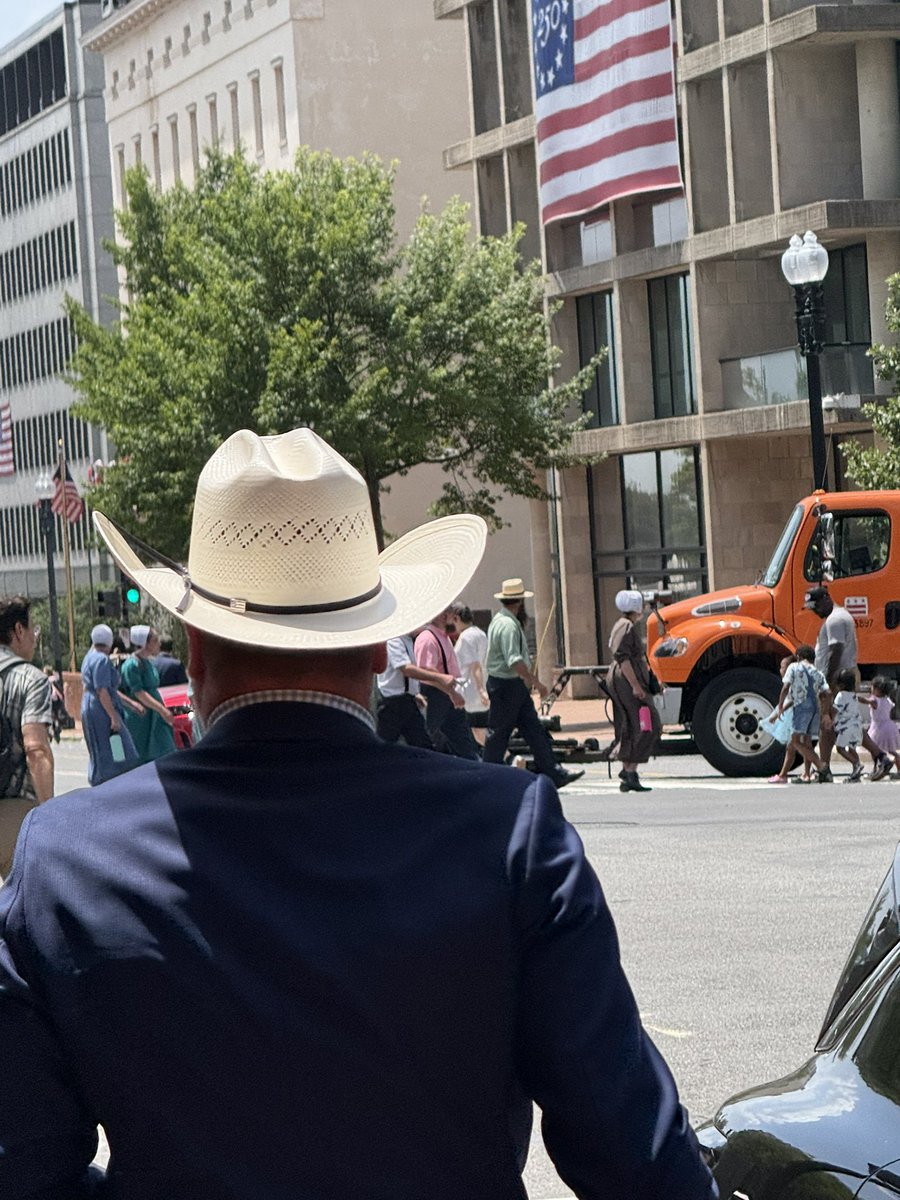
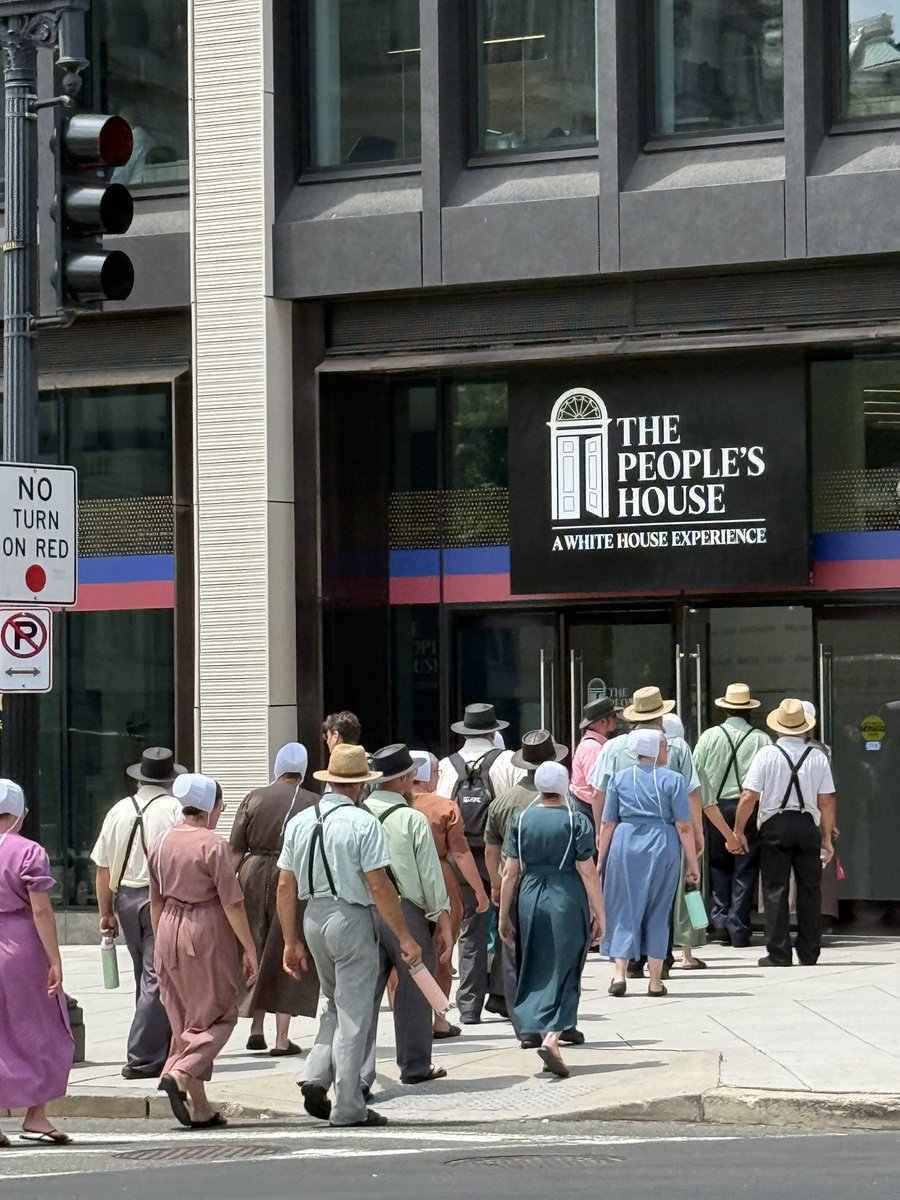
When I was walking to the White House this past Thursday in DC, I looked up and saw something that had everyone else there stopped in their tracks.
An Amish delegation had come to Washington DC to take part in America 250.
Just that morning, I had shared with congressmen, @SecRollins and @SBA_Kelly, @johnrich, the @BLMNational, the @USDA, and many, many attorneys what is happening to the Amish of New York State as part of the green energy grift.
These solar monstrosities (and soon to be wind) are being sited in the epicenter of Amish communities, where they rely on horse and buggy, and the ability to walk, to get to church and their children to school.
Countless Amish have gone on the ORES record stating they’ll be forced to leave the state if they build these industrial complexes inside of their homes.
ORES tries to shut the Amish out of public discussions. They don’t inform them of incoming complexes or make it easy for the Amish to file their comments.
Expert anabaptist testimony by Steven Nolt has been entered into the ORES docket for Mill Point and Flat Creek Solar. ORES ignores it.
The Amish are the backbone of many rural Upstate NY counties. If they pull out, county economies will collapse.
The Amish have done so much for me, starting with building out my farm.
I will not stand by while eco terrorists purposely force them from their homes.
Seeing the Amish in DC felt like seeing a piece of home.
🚨#BREAKING: A 28-year-old confirms he has spent the last 10 YEARS of his life interviewing World War II combat veterans to keep their stories alive...
...in fact, for the last 10 years, he has interviewed World War 2 veterans EVERY SINGLE DAY
He started as a teenager, ditching school to ride his BIKE to the local retirement home, walking up to the front desk and asking to, "meet some World War II heroes."
His name is Rishi Sharma.
He's crossed all 50 states and half the world.
He's slept in his car and lived on gas-station food to afford it.
He asks these men for hours of their memories, and then he hands the entire recording to their families...
...FOR FREE
So that 200 years from now, a great-great-grandchild will know not just their hero's name, but how he laughed, how he cried, and what he sacrificed.
Rishi has no military family, his parents immigrated here from India.
He does it out of pure gratitude.
In his words:
"My parents were given the opportunity to immigrate and raise a family because of veterans like these. It's a debt of love I'll spend my entire life trying to repay..."
As one 100-year-old Marine who stormed Iwo Jima told him, remembering the flag going up:
"The hair on my arms still stands up when I think about how beautiful it was."
THAT is America.
250 years of ordinary people doing extraordinary things...
God bless our veterans. 🇺🇸🇺🇸
The US Navy operates a 50,000 acre forest in Indiana whose entire job is keeping one wooden ship from 1797 afloat.
The ship is USS Constitution, still a commissioned warship with an active-duty crew. Cannonballs bounced off her in 1812 because the hull sandwiches a wall of live oak ribs between two layers of white oak planking, nearly 2 feet of solid wood so dense it barely floats. British 18-pounders hit it and dropped into the sea. A sailor yelled "her sides are made of iron" and the nickname stuck.
Here's the problem with owning a 229-year-old wooden ship: you can't buy the parts. Hull planks run up to 40 feet long and 7 inches thick, cut from single white oak trunks. A white oak takes over a century to grow that big. No lumberyard on earth stocks it.
So the Navy grows its own. Constitution Grove at Naval Support Activity Crane holds trees over 100 years old, reserved exclusively for this ship. Foresters there are managing oaks today that will become hull planking in the 2100s. The maintenance plan literally runs on tree time.
Every 20 years or so she enters dry dock and shipwrights swap out rotted timber. After two centuries of this, estimates put original 1797 wood at maybe 10 to 15 percent of the ship. The Navy keeps replacing her plank by plank because Congress mandated her preservation and because she's the only active US warship that has sunk an enemy vessel.
Every other asset in the Navy has a decommission date. This one has a tree farm.
🚨WHAT ON EARTH?!!!
Over 100 Flock cameras that were set to "go dark" at the end of June after city council voted to shut them down...
...have bizarrely just REMAINED ON and the police are still using them
On June 17, the city council's safety committee voted to END the contract because when they asked police to prove these cameras actually reduce crime, the police could point to only 3 cases that led to convictions.
So the city council let the contract expire on June 29th, but then people noticed the cameras were still up...
...because Flock VOLUNTEERED to keep running them for FREE while the city "figures it out."
In fact, police confirmed they are still running them to "keep the community safe" and the company agreed to keep the system live, despite the contract expiring.
It gets worse.
When reporters asked simple questions like... is data still being collected? Do the cameras shut off or keep recording? Who can access what was already stored? It turned out that neither the city NOR Flock would answer.
So just to recap:
The contract is expired.
The elected body said no.
Nobody re-authorized it.
Flock won't say what it's doing with the data.
...but the cameras are STILL ON and being used by police
8 Ways To Take Down Flock Without A Sawzall:
1. Demand An Audit
Most cities never independently audit whether Flock cameras in town actually reduce crime. Ask your city council to show evidence that these cameras reduced violent crime. Make them prove it. They usually can't.
2. Find Out When the Contract Expires
Every Flock camera program has a contract renewal date. Use FOIAs to request the original contract, all amendments, renewal dates, and termination clauses.
This one is SO important because we must organize BEFORE renewal, not AFTER the cameras go up.
3. Demand the Privacy Impact Assessment
Before deploying any type of surveillance devices with public funds, many city governments are supposed to evaluate the privacy risks.
Ask for privacy Impact Assessment, civil liberties review, and constitutional analysis. If they never conducted one... Ask why not (they hate that.)
4. Show Up Before They Vote
Flock cameras aren't installed overnight. They usually require budget approval, council approval, contract approval. Use tools like "Citizen Portal" to setup automatic notifications for upcoming city council meetings. Speak before, not after installation.
5. Follow the Money
Want to know why your city suddenly wants Flock cameras? It's usually always grants or cronyism.
Ask for grant applications: DHS grants, DOJ grants, Homeland Security funding, ect. Surveillance programs begin because outside money make them "free."
6. Ask About Data Sharing
Every city should have to answer this question: "Exactly which agencies can search our city's license plate database?"
Ask for sharing agreements, MOUs, list of agencies with approval, and search logs. Most people think it's just local police. It rarely is, usually the feds too.
7. Audit Every Search
Public records requests aren't just for the contracts. You can publicly request every audit log showing who searched the Flock system and why.
Ask for date, user, reason for search and any case numbers. Abuse often shows up in the logs before it makes the news or a viral social media post.
8. Compare Crime Before & After
Download your city's crime data. Compare property and violent crime before and after Flock was installed.
If there's no meaningful change... Ask why taxpayers are still paying for it. If officials claim the cameras are effective, ask them to produce the evidence supporting continued funding.
WHY are we doing this!???? It is overcast & raining 50% of the time in Genesee County! 😳😳😳 Yet we are destroying prime farmland so this endeavor ! 🙄🙄
We don’t have an affordability crisis. We have an expectations crisis.
These 1,000 square foot brick homes were printed in mass in suburban Detroit in the 1950s and 60s to support an exploding population.
This would solve our housing problem.
But no one wants this anymore.
I wouldn’t want to be on @johnrich’s bad side! That is for sure.
As the man said: a letter is going to @KathyHochul with many, many questions about what they’ve let ORES do in New York State.
Let the games begin 🇺🇸