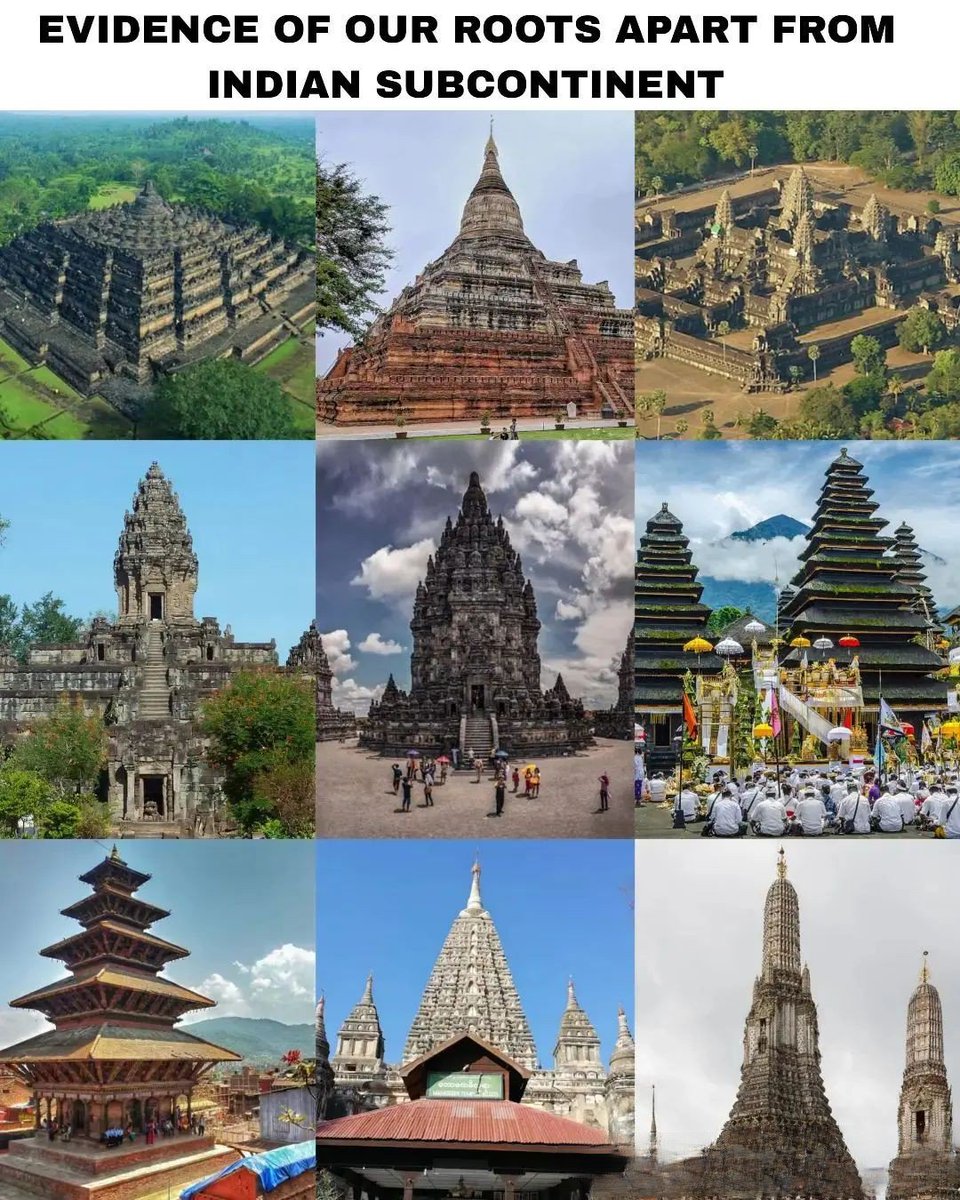
Evidence of our roots beyond the Indian subcontinent.
Temples as evidence of cultural and spiritual roots beyond the Indian subcontinent.
◆ Top Row (Left to Right):
🔸1. Borobudur Temple - Central Java, Indonesia
🔸2. Shwemawdaw Pagoda - Bago, Myanmar
���3. Angkor Wat Temple - Angkor, Cambodia
◆ Middle Row (Left to Right):
🔸4. Hariharalaya Temple - Cambodia
🔸5. Prambanan Temple - Yogyakarta, Indonesia
🔸6. Besakih Temple - Bali, Indonesia
◆ Bottom Row (Left to Right):
🔸7. Nyatapola Temple - Bhaktapur, Nepal
🔸8. Mahabodhi Temple - Bagan, Myanmar
🔸9. Wat Arun Temple - Bangkok, Thailand
"Ritucharya"
As the weather changes with each season, our bodies need to adjust to stay strong and prevent illness.
This is where Ritucharya, or seasonal routines, comes in.
The term "Ritucharya" comes from two Sanskrit words: "Ritu" meaning season, and "Charya" meaning regimen or discipline.
◆ Seasons in Ritucharya:
🔸Shishira Ritu (Late Winter)
🔸Vasanta Ritu (Spring)
🔸Grishma Ritu (Summer)
🔸Varsha Ritu (Monsoon)
🔸Sharad Ritu (Autumn)
🔸Hemanta Ritu (Early Winter)
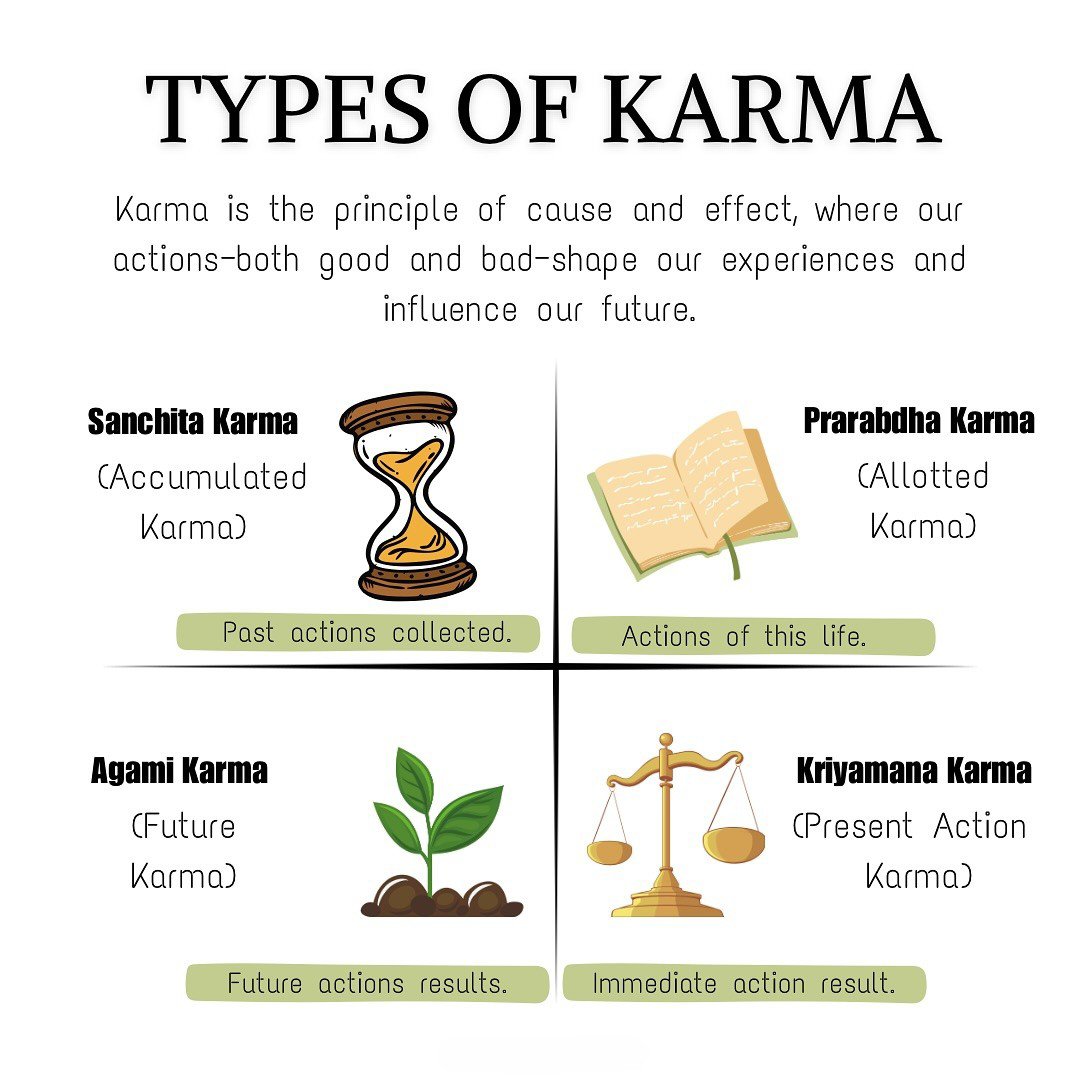
TYPES OF KARMA
Karma is the principle of cause and effect, where our actions—both good and bad—shape our experiences and influence our future.
🔸Sanchita Karma.
🔸Prarabdha Karma.
🔸Agami Karma.
🔸Kriyamana Karma.
◆ Sanchita Karma (Accumulated Karma)
This is all the karma you’ve collected over your past lives. Think of it as a big storage of all the actions you’ve ever done, whether good or bad, that haven’t fully played out yet.
Example:
Imagine you’ve saved a lot of money in a bank over the years. Some of it you haven’t spent yet, but it’s there, waiting.
Similarly, your past actions (karma) are stored and will eventually affect your life.
◆ Prarabdha Karma (Allotted Karma)
This is the portion of your accumulated karma that’s currently affecting your life. It’s the karma you are working through in this lifetime. It determines things like where you were born, the family you’re in, or certain events that happen to you.
Example:
Let’s say from your savings, you withdraw some money to spend on daily expenses. This is like prarabdha karma—you’re using a portion of your stored karma right now, shaping your current situation.
◆ Agami Karma (Future Karma)
This is the karma you’re creating right now with your actions. What you do today—whether it’s good or bad—will create results that you’ll experience in the future, maybe later in this life or in the next.
Example:
Imagine you plant a seed today. The tree will grow and bear fruit later. Similarly, the actions you take today will affect you later on, creating future experiences based on what you’ve done.
◆ Kriyamana Karma (Present Action Karma)
This is the immediate effect of your current actions. It’s the instant result of what you do, like a cause and effect that happens quickly.
Example:
If you touch a hot stove, you immediately feel pain. This is like kriyamana karma—it’s the direct outcome of your action happening right now.
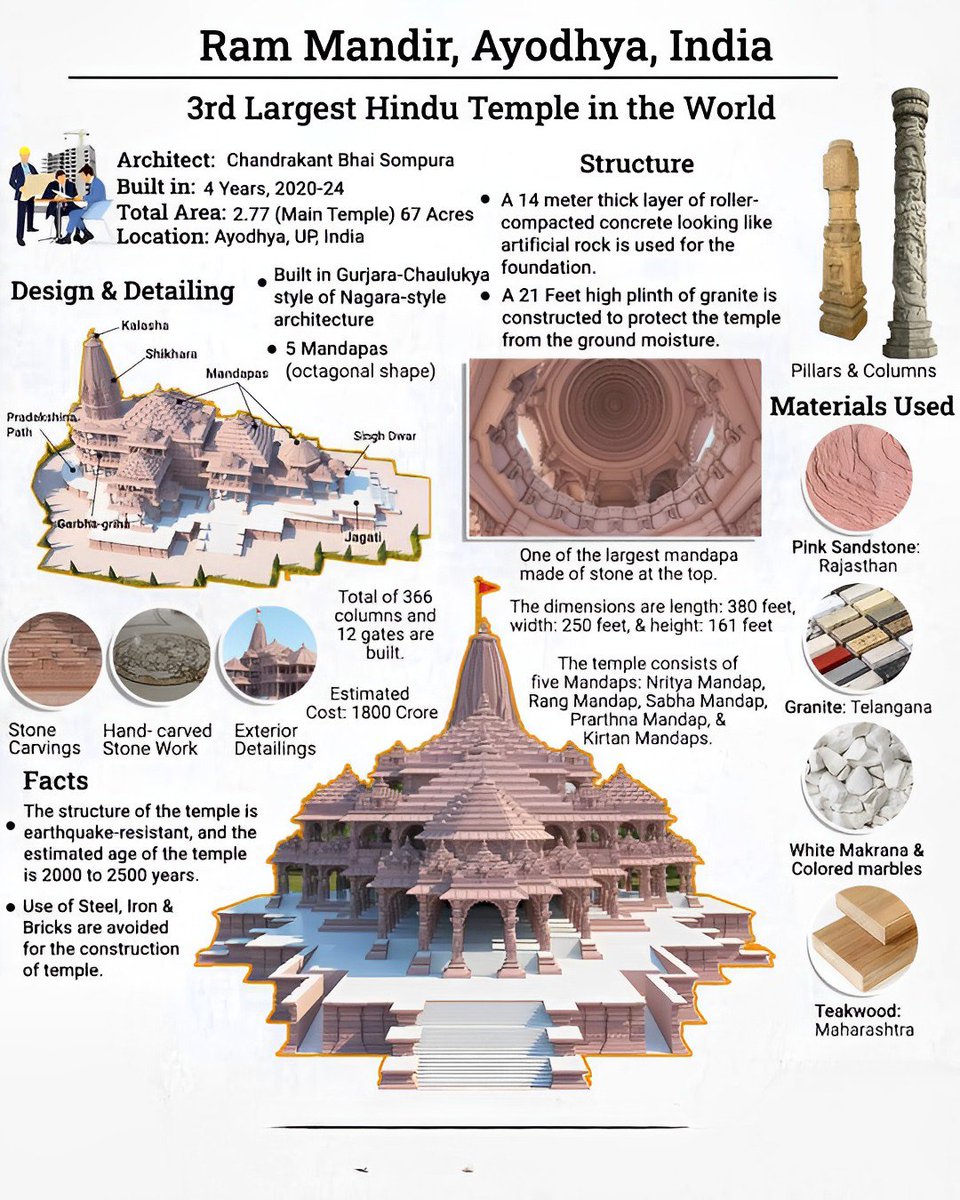
Shri Ram Mandir, Ayodhya, Bharat
3rd Largest Hindu Temple in the World
◆ Architect: Chandrakant Bhai Sompura
◆ Built in: 4 Years, 2020-24
◆ Total Area: 2.77 (Main Temple) 67 Acres
◆ Location: Ayodhya, UP, India
◆ Structure
🔸A 14 meter thick layer of roller-compacted concrete looking like artificial rock is used for the foundation.
🔸A 21 Feet high plinth of granite is constructed to protect the temple from the ground moisture.
◆ Design & Detailing
Built in Gurjara-Chalukya style of Nagara-style architecture
5 Mandapas (octagonal shape)
◆ Features:
🔸Total of 366 columns and 12 gates are built.
🔸Estimated Cost: 1800 Crore
🔸Stone Carvings, Hand-carved Stone Work, Exterior Detailings
◆ Mandapa
One of the largest mandapa made of stone at the top.
The dimensions are length: 380 feet, width: 250 feet, & height: 161 feet.
The temple consists of five Mandaps: Nritya Mandap, Rang Mandap, Sabha Mandap, Prarthna Mandap, & Kirtan Mandaps.
◆ Materials Used
🔸Pink Sandstone: Rajasthan
🔸Granite: Telangana
🔸White Makrana & Colored marbles
🔸Teakwood: Maharashtra
◆ Facts
The structure of the temple is earthquake-resistant, and the estimated age of the temple is 2000 to 2500 years.
Use of Steel, Iron & Bricks are avoided for the construction of temple.
Jai Shri Ram.
The Vedic texts behind Hindu Temple Architectures:
Temple Architecture is based on various ancient texts and principles, forming different styles such as Nagara, Vesara, and Dravida architectures.
◆ Vastu Shastra (Guide to Architecture, Design & Spatial Harmony):
◆ Available texts: Few, including Manasara (10,000 verses) and Puranas (Architectural portion).
◆ Lost texts: Many ancient texts.
🔸Principles:
🔸Temple architecture
🔸Vastu Purusha Mandala (spatial geometry and orientation)
🔸Panchabhoota (Five elements: Earth, Water, Fire, Air, Space)
🔸Yantras (Geometrical designs for spiritual invocation)
🔸Materials & construction methods.
◆ Agama Shastra (Guide to Temple Rituals, Worship & Spiritual Practices):
Available texts: Some, including Shaiva Agamas (28), Shakta Agamas (64), and Vaishnava Agamas (200-225).
◆ Sections:
🔸Jnana Pada (Philosophical & spiritual knowledge)
🔸Yoga Pada (Yoga and spiritual disciplines)
🔸Kriya Pada (Temple rituals, construction, including architectures)
🔸Charya Pada (Code of conduct & social rules)
◆ Shilpa Shastra (Guide to Shilpa – Art & Crafts, Architecture & Iconography):
◆ Available texts: Few, including Kashyapa Shilpa Shastra.
◆ Lost texts: Many ancient texts.
�� Principles:
🔸Temple architecture
🔸Sculpture
🔸Performing arts
🔸Jewelry (Abhusana)
🔸Painting (Chitrakala)
🔸Iconography
◆ Additional Elements:
🔸Tantra: Rituals & practices for spiritual transformation.
🔸Yantra: Geometrical symbols for divine energy invocation.
🔸Mantra: Sacred sounds used for spiritual invocation.
This image highlights the ancient texts like Vastu Shastra, Agama Shastra, and Shilpa Shastra, which guide the architecture, design, and spiritual aspects of Hindu temples, integrating both philosophical and practical knowledge.
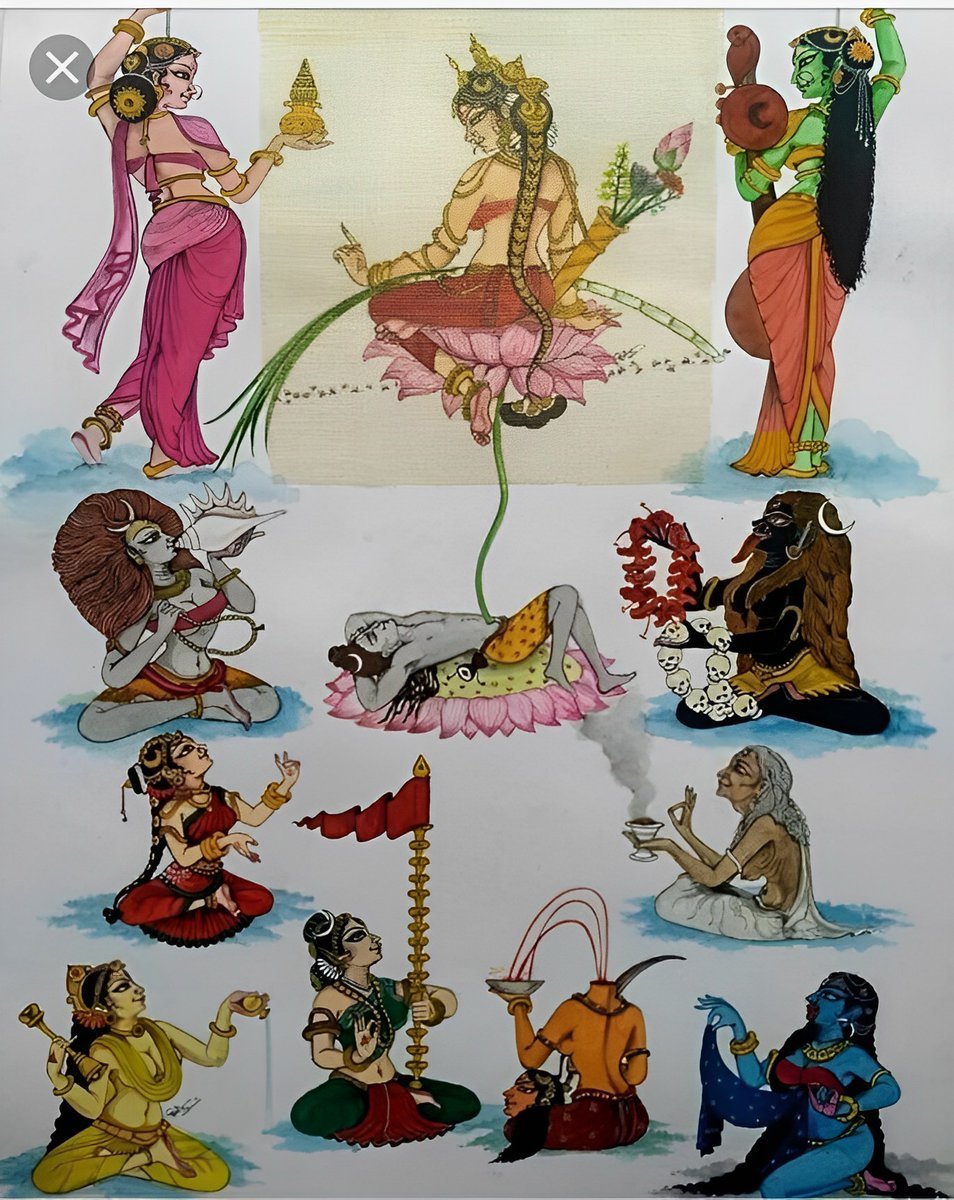
10 महाविद्या तंत्र की देवी...
हमारे शास्त्रों में दस महाविद्याओं का उल्लेख किया गया है। तंत्र क्रिया में विद्या में इन 10 महाविद्याओं का विशेष महत्व होता है।
इन 10 विद्याओं की साधना और उपासना से विशेष फल की प्राप्ति होती है। ये महाविद्याओं को दशावतार माना गया है। 10 महाविद्याएं मां दुर्गा के ही रूप है जिसे सिद्धि देने वाली मानी जाती है।
मां दुर्गा के इन दस महाविद्याओं की साधना करने वाला व्यक्ति सभी भौतिक सुखों को प्राप्त कर बंधन से भी मुक्त हो जाता है। मां को प्रसन्न करने के लिए तांत्रिक साधकों द्वारा यह पूजा की जाती है।
ये दस महाविद्याएं इस प्रकार है- काली, तारा, छिन्नमस्ता, षोडशी, भुवनेश्वरी, त्रिपुर भैरवी, धूमावती, बगलामुखी, मात���गी व कमला।
1- काली
सभी 10 महाविद्याओं में काली को प्रथम रूप माना जाता है। माता दुर्गा ने राक्षसों का वध करने के लिए माता ने यह रूप धारण किया था। सिद्धि प्राप्त करने के लिए माता के इस रूप की पूजा की जाती है। जिस तरह से भगवान शिव जल्दी प्रसन्न और जल्द रूठने वाले देवता है उसी तरह काली माता भी स्वभाव है। इसलिए जो भी भक्त इनकी साधना कर चाहता है उसे एकनि��्ठ और पवित्र मन का होना चाहिए। देवताऔं और दानवों के बीच हुए युद्ध में मां काली ने ही देवताओं को विजय दिलवाई थी। कोलकाता, उज्जैन और गुजरात में महाकाली के जाग्रत चमत्कारी मंदिर हैं।
मुख्य बातें-
- दस महाविद्या में काली प्रथम रूप है।
- माता का स्वरूप हाथ में त्रिशूल और तलवार
- पूजा के लिए विशेष दिन शुक्रवार और अमावस्या
- कालिका पुराण में इनका विस्तार से वर्णन किया गया है
- काली को ॐ ह्रीं श्रीं क���रीं परमेश्वरि कालिके स्वाहा के प्रसन्न किया जा सकता है।
- कोलकाता, उज्जैन और गुजरात में महाकाली के जाग्रत चमत्कारी मंदिर हैं।
2- तारा
सर्वप्रथम महर्षि वशिष्ठ ने तारा की आराधना की थी। यह तांत्रिकों की मुख्य देवी हैं। देवी के इस रूप की आराधना करने पर आर्थिक उन्नति और मोक्ष की प्राप्ति होती है। पश्चिम बंगाल के बीरभूम जिले में तारापीठ है इसी स्थान पर देवी तारा की उपासना महर्षि वशिष्ठ ने करके तमाम सिद्धियां हासिल की ��ी। तारा देवी का दूसरा प्रसिद्ध मंदिर हिमाचल प्रदेश की राजधानी शिमला में स्थित है।
मुख्य बातें-
- चैत्र मास की नवमी तिथि और शुक्ल पक्ष के दिन तंत्र साधकों के लिए सर्वसिद्धिकारक माना गया है।
- तारा मां को जगृति करने के लिए ऊँ ह्नीं स्त्रीं हुम फट' मंत्र का जाप कर सकते हैं।
- परेशनियों को दूर करने के कारण इन्हें तारने वाली माता तारा कहा जाता है।
3- त्रिपुर सुंदरी
इन्हें ललिता, राज राजेश्वरी और त्रिपुर सुंदरी भी कहते हैं। त्रिपुरा में स्थित त्रिपुर सुंदरी का शक्तिपीठ है। यहां पर माता की चार भुजा और 3 नेत्र हैं। नवरात्रि में रुद्राक्ष की माला से ऐं ह्नीं श्रीं त्रिपुर सुंदरीयै नम: मंत्र का जाप कर सकते हैं।
मुख्य बातें-
- इनकी चार भुजा और तीन नेत्र हैं।
- ऐ ह्नीं श्रीं त्रिपुर सुंदरीयै नम: मंत्र का जाप कर सकते हैं।
4- भुवनेश्वरी
पुत्र प्राप्ति के लिए माता भुवनेश्वरी की आराधना फलदायी ��ानी जाती है। यह शताक्षी और शाकम्भरी नाम से भी जानी जाती है। इस महाविद्या की आराधना से सूर्य के समान तेज ऊर्जा प्राप्ति होती है और जीवन में मान सम्मान मिलता है।
मंत्र- ह्नीं भुवनेश्वरीयै ह्नीं नम:
5- छिन्नमस्ता
इनका स्वरूप कटा हुआ सिर और बहती हुई रक्त की तीन धाराएं से सुशोभित रहता है। इस महाविद्या की उपासना शांत मन से करने पर शांत स्वरूप और उग्र रूप में उपासना करने पर देवी के उग्र रूप के दर्शन होते है। छिन्नमस्तिके का यह मंदिर झारखंड की राजधानी रांची में स्थिति है। कामाख्या के बाद यह दूसरा सबसे लोकप्रिय शक्तिपीठ है।
मंत्र-
'श्रीं ह्नीं ऎं वज्र वैरोचानियै ह्नीं फट स्वाह���
6-भैरवी
भैरवी की उपासना से व्यक्ति सभी बंधनों से मुक्त हो जाता है। इनकी पूजा से व्यापार में लगातार बढ़ोतरी और धन सम्पदा की प्राप्ति होती है।
मंत्र- ह्नीं भैरवी क्लौं ह्नीं स्वाहा:
7-धूमावती
धूमावती माता को अभाव और संकट को दूर करने वाली माता कहते है। इनका कोई भी स्वामी नहीं है। इनकी साधना से व्यक्ति की पहचान महाप्रतापी और सिद्ध पुरूष के रूप में होती है। ऋग्वेद में इन्हें 'सुतरा' कहा गया है���
मंत्र- ऊँ धूं धूं धूमावती देव्यै स्वाहा:
8- बगलामुखी
बगलामुखी की साधना दुश्मन क��� भय से मुक्ति और वाक् सिद्धि के लिए की जाती है। जो साधक नवरात्रि में इनकी साधना करता है वह हर क्षेत्र में सफलता प्राप्त करता है। महाभारत के युद्ध में कृष्ण और अर्जुन ने कौरवों पर विजय हासिल करने के लिए माता बगलामुखी की पूजा अर्चना की थी। भारत में मां बगलामुखी के तीन प्रमुख ऐतिहासिक मंदिर माने गए हैं।
मंत्र-
- ऊँ ह्नीं बगुलामुखी देव्यै ह्नीं ओम नम:'
- 'ह्मीं बगलामुखी सर्व दुष्टानां वाचं मुखं ���दं स्तम्भय जिह्वां कीलम बुद्धिं विनाशय ह्मीं ॐ स्वाहा
9- मातंगी
जो भक्त अपने गृहस्थ जीवन को सुखमय और सफल बनाना चाहते हैं उन्हें मां मातंगी की आराधना करना चाहिए। मतंग भगवान शिव का भी एक नाम है। जो भक्त मातंगी महाविद्या की सिद्धि प्राप्त करता है वह अपने खेल, कला और संगीत के कौशल से दुनिया को अपने वश में कर लेता है।
मंत्र- ऊँ ह्नीं ऐ भगवती मतंगेश्वरी श्रीं स्वाहा:
10- कमला
मां कमला की साधना समृ���्धि, धन, नारी, पुत्र की प्राप्ति के लिए की जाती है। इनकी साधना से व्यक्ति धनवान और विद्यावान हो जाता है।
मंत्र- हसौ: जगत प्रसुत्तयै स्वाहा:
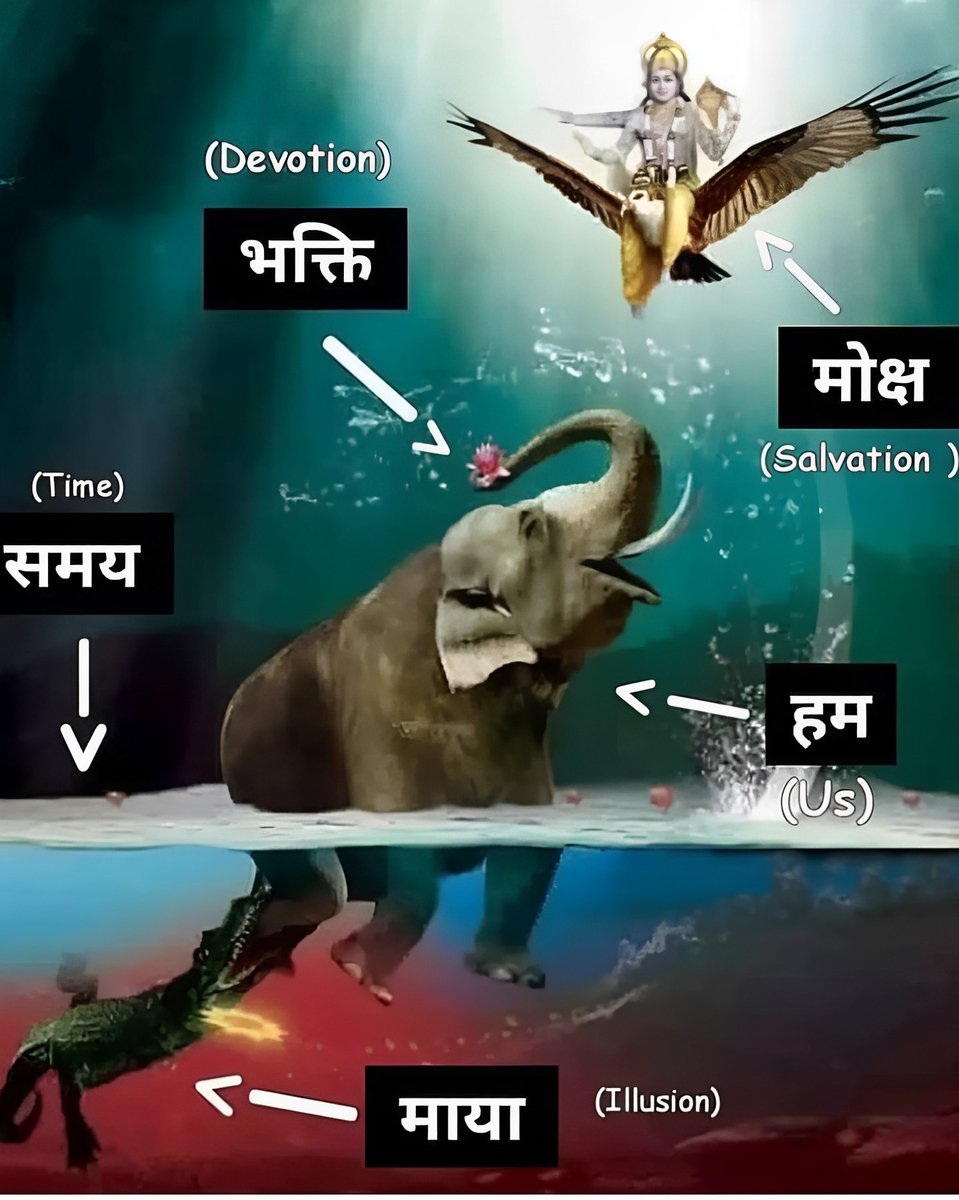
We are like the elephant trapped by the crocodile of Maya (Illusion).
Only through Bhakti (Devotion) and the grace of time, can we rise towards Moksha (Salvation).
May we find the strength to break free from the illusions and reach the divine.
Are We Eating Right?
Because What We Eat, We Become.
▪️The Three Gunas of Food:
🔸Rajas (Red Circle): Represents Movement and Energy.
Associated with Desires, Passion, and Anxiety.
Foods that stimulate the body and mind, often leading to restlessness.
🔸Sattva (Green Circle): Signifies Positivity and Purity.
Promotes Balance, Peace, and Harmony.
Consuming Sattvic foods enhances mental clarity and spiritual growth.
🔸Tamas (Black Circle): Reflects Dullness and Inactivity.
Associated with Negativity, Depression, and Ignorance.
Foods that lead to lethargy and a lack of awareness.
▪️Conclusion:
The food we consume influences our mental and physical state. To foster a balanced and harmonious life, prioritizing Sattvic foods can lead to improved well-being and spiritual awareness.
Relationship Between Temple Architecture and Human Anatomy
◆ Vimana: Represents the divine presence, symbolizing the head of the individual, and serves as the main tower of the temple.
◆ Mahal Mandapam: Corresponds to the chest region of the human body, where vital energy and spiritual essence converge.
◆ Garbhagruha (Sanctum): The sacred inner chamber of the temple, akin to the heart or core of a person, housing the deity (soul).
◆ Gopuram: Symbolizes the feet of the deity and serves as the entrance, reflecting the grounding aspect of human existence.
◆ Chakras: The diagram illustrates the alignment of temple components with the human chakras:
🔸 Ajna: Represents intuition and insight.
🔸 Vishuddha: Associated with communication and expression.
🔸 Anahata: Linked to love and compassion.
🔸 Manipura: Connects to personal power and self-esteem.
🔸 Swadhisthana: Related to emotions and relationships.
🔸 Muladhara: Represents stability and grounding.
This diagram signifies the deep philosophical connection between temple architecture and human anatomy, emphasizing the belief that the physical and spiritual realms are intricately linked.
ग्रह नक्षत्रों का विज्ञान क्या है?
ग्रह नक्षत्रों का विज्ञान, जिसे ज्योतिष शास्त्र के नाम से जाना जाता है, एक प्राचीन विज्ञान है जो ब्रह्मांड में स्थित ग्रहों, नक्षत्रों और अन्य खगोलीय पिंडों का अध्ययन करता है और उनके हमारे जीवन पर पड़ने वाले प्रभाव का विश्लेषण करता है।
- इतिहास:
इसका इतिहास हजारों साल पुराना है और यह विज्ञान भारत, ग्रीस, चीन और माया सभ्यता जैसी विभिन्न संस्कृतियों में प्रचलित रहा है।
ग्रह नक्षत्रों के विज्ञान के महत्वपूर्ण पहलू:
1. ग्रह (Planets):
- ग्रह वे खगोलीय पिंड होते हैं जो सूर्य के चारों ओर परिक्रमा करते हैं।
- भारतीय ज्योतिष में नौ मुख्य ग्रहों को 'नवग्रह' कहा जाता है:
- सूर्य (Sun)
- चंद्रमा (Moon)
- मंगल (Mars)
- बुध (Mercury)
- गुरु (Jupiter)
- शुक्र (Venus)
- शनि (Saturn)
- राहु (Rahu)
- केतु (Ketu)
2. नक्षत्र:
- नक्षत्र आकाश में स्थित तारों के समूह होते हैं ज��� विशिष्ट आकृतिय���ँ बनाते हैं।
- भारतीय ज्योतिष में कुल 27 नक्षत्र होते हैं, जिनका व्यक्ति की कुंडली पर विशेष प्रभाव होता है।
3. राशि:
- राशि चक्र 12 राशियों में विभाजित होता है, और प्रत्येक राशि 30 अंश का एक खंड होती है:
- मेष (Aries)
- वृषभ (Taurus)
- मिथुन (Gemini)
- कर्क (Cancer)
- सिंह (Leo)
- कन्या (Virgo)
- तुला (Libra)
- वृश्चिक (Scorpio)
- धनु (Sagittarius)
- मकर (Capricorn)
- कुंभ (Aquarius)
- मीन (Pisces)
4. जन्म कुंडली:
- जन्म कुंडली व्यक्ति के जन्म समय और ���्थान के आधार पर ग्रहों और नक्षत्रों की स्थिति का चार्ट है।
- यह चार्ट व्यक्ति के जीवन के विभिन्न पहलुओं का पूर्वानुमान लगाने के लिए उपयोग किया जाता है।
5. ग्रहों के गोचर:
- ग्रहों के गोचर का मतलब होता है ग्रहों की चाल और उनका विभिन्न राशियों में प्रवेश।
- गोचर का व्यक्ति की कुंडली पर बड़ा प्रभाव पड़ता है।
6. दशा और अंतरदशा:
- दशा और अंतरदशा ग्रहों के प्रभाव की समयावधि को दर्शाते हैं।
- भारतीय ज्योतिष में प्रमुख दशा प्रणाली 'विंशोत्तरी दशा' है।
7. वैज्ञानिक दृष्टिकोण:
- ज्योतिष शास्त्र का एक महत्वपूर्ण सांस्कृतिक और धार्मिक पहलू है, लेकिन इसे विज्ञान के मानदंडों के अनुसार नहीं माना जाता है।
- ज्योतिष के सिद्धांतों का कोई वैज्ञानिक आधार नहीं है।
8. ज्योतिष शास्त्र के प्रकार:
- वैदिक ज्योतिष
- पाश्चात्य ज्योतिष
- चीनी ज्योतिष
- माया ज्योतिष
9. उपाय:
- ज्योतिष शास्त्र में ग्रहों के अशुभ प्रभावों को कम करने के लिए विभिन���न उपाय बताए गए हैं जैसे कि रत्न पहनना, मंत्र जप, दान, व्रत, पूजा आदि।
- इन उपायों का उद्देश्य ग्रहों की नकारात्मक ऊर्जा को कम करना और सकारात्मक ऊर्जा को बढ़ावा देना है।
निष्कर्ष:
जो ब्रह्मांड में है, वह पिंड (शरीर) में भी है। इस दृष्टि से ग्रह नक्षत्रों का प्रभाव पिंड पर भी पड़ता है। ऋषियों ने ऐसी विधियाँ बताई हैं जिनसे हम ग्रहों के दुष्ट प्रभाव से बच सकें और अच्छे प्रभाव को प्राप्त कर सकें।
ग्रहों की पूजा के माध्यम से हम उनसे संबंध स्थापित करते हैं। इस प्रकार रत्न, धातु, औषधि तथा मंत्रों के आधार पर ग्रहों की अनुकूलता हम ��पने जीवन में ग्रहण कर सकते हैं।
ज्योतिष शास्त्र का उद्देश्य भविष्यवाणी करना नहीं, बल्कि व्यक्ति को आत्म-ज्ञान और आत्म-सुधार की दिशा में मार्गदर्शन करना है। यह एक प्राचीन परंपरा है जो सदियों से लोगों की जीवन की दिशा निर्धारण में सहायक रही है।
Vedic Hindu cosmology 🪷
In ancient Hindu Cosmology, what we know as the earth is only one of countless world's located in Brahmanda, which is itself only one of the unconutable universes.
The know world was locoted in the middle of Bhu-loko, comprised of many ring-shoped londmasses seporoted by oceans of vorious composition. From it's center rose Mount Meru reaching, into the heavens. With the cycle of reincornation, it was possible to reach other, upper or lower realms (or lokas). Below the Bhu-loka was a multitude of increasingly worse hellish realms, with the oceon Garbhodaka located ot the: very bottom.
Above the Earth and the sky were the heavenly realms, with the abode of the creotor god Brahma located at the top of the world.🚩🙏
Inspirations from Hindu Gods
1. Shri Hari Vishnu - Daya (Mercy):
Represents compassion and mercy towards all living beings.
2. Shri Ganesh - Buddhi (Intelligence):
Symbolizes intellect, wisdom, and the removal of obstacles.
3. Shiv Shankar - Vairagya (Reclusion):
Embodies detachment and the renunciation of worldly desires.
4. Shri Hanuman - Bhakti (Devotion):
Stands for unwavering devotion and loyalty, particularly to Lord Rama.
5. Brahma Dev - Gyaan (Knowledge):
Represents the pursuit of knowledge and understanding of the universe.
6. Shri Krishna - Dharma (Path of Righteousness):
Advocates living a life of righteousness and moral duty.
7. Shri Rama - Maryada (Dignity):
Exemplifies honor, respect, and adherence to one’s principles.
Kalaripayattu: The Oldest Martial Art
◆ Origin:
Kalaripayattu is rooted in ancient Indian martial traditions and is believed to be the oldest martial art form in the world.
◆ Lineage:
The lineage traces back to ParaBrahman and Brahma, evolving through revered sages and warriors, including:
Atri, Narada, Angirasa, and others.
Important figures include Agastya and Bhargava Rama.
◆ Unarmed Combat:
Developed as a system of unarmed combat, Kalaripayattu emphasizes agility, flexibility, and physical conditioning.
◆ Connection to Vedic Texts:
The martial art is mentioned in ancient texts such as the Dhanurveda Samhita.
◆ Expansion:
Kalaripayattu comprises 21 disciples and has led to the establishment of 108 Kalaris (schools) across India.
◆ Influence on Other Martial Arts:
The principles of Kalaripayattu influenced other martial arts forms, including Shaolin Kung Fu in China, through Bodhidharma.
◆ Historical Context:
The art has its roots in the Mahabharata Era (circa 3137 BCE) and continued through various dynasties.
This historical overview underscores Kalaripayattu's significance not just in martial arts but also in cultural and spiritual contexts in India.
Mantras are Frequencies that can Heal, Kill and Transcend 🧵
Frequencies of various Beej Mantras
OM – 7.83 Hz Gam – 14 Hz Hleem – 20 Hz Hreem – 26 Hz Kleem – 33 Hz Krowm – 39 Hz Sreem – 45 Hz
Sanskrit (संस्कृत) is the oldest language that was based on sounds (ध्वनि) and vibrations.
(कंपन) Every alphabet and its pronounciation have specific meaning, OM ॐ is the first and foremost of all mantras.
OM is the sound of cosmic energy and contains all the sounds in itself. The spiritual efficacy of OM is heard, not by the ears but by the heart. It surcharges the innermost being of man with vibrations of the highest reality. All galaxies (including ours) are rotating and they sound they make is OM.
Similarity between human cell and the universe.
Brain Cell 👉 The Universe
Birth of a Cell 👉 Death of a Star
Yajurveda says -
"यथा पिंडे तथा ब्रह्मंडे, यथा ब्रह्मंडे तथा पिंडे"
◆ It is - "As is the individual, so is the universe, as is the universe, so is the individual" or
"As is the human body, so is the cosmic body, as is the cosmic body is the human body."
◆ Details:
🔸 1. Connection Between Micro and Macro:
The imagery of a brain cell and the universe illustrates the profound connection between the individual and the cosmos. Both realms operate under similar fundamental principles, deepening our appreciation of existence.
🔸 2. Yajurveda Philosophy:
The Yajurveda highlights the interconnectedness of all things, suggesting self-awareness is tied to understanding the universe. This promotes a holistic view where personal growth aligns with universal insight.
🔸3. Cosmic Perspective:
The birth of a cell and the death of a star exemplify the cycles of creation and destruction in nature. This perspective underscores that endings lead to new beginnings, reflecting life's interconnectedness.
🔸4. Spiritual and Scientific Harmony:
The images bridge spiritual teachings with scientific discoveries, inviting exploration of both realms. Ancient wisdom and modern knowledge together enhance our understanding of existence.
🔸5. Unity in Diversity:
The message conveys that every individual reflects the universe, emphasizing our shared existence. This unity fosters self-awareness and responsibility towards all living beings and the environment.
Creation of Beings According to Hindu Mythology...
◆ Bhagwan Brahma and Mata Saraswati:
The universe was created by Lord Brahma, who is often referred to as the creator deity in Hinduism, alongside Goddess Saraswati, the embodiment of wisdom and knowledge.
◆ The Four Kumaras: From Brahma, the Four Kumaras were born:
🔸Sanaka
🔸Sanandana
🔸Sanatana
🔸Sanat Kumara
◆ Sapta Rishis: Brahma also created the Sapta Rishis (seven sages):
🔸Atri
🔸Kashyapa
🔸Vasishtha
🔸Vishwamitra
🔸Gautama
🔸Jamadagni
🔸Bharadvaja
◆ Narad Muni: Narad Muni, a divine sage known for his role as a messenger and a devotee, is also a significant figure derived from Brahma's creation.
◆ Maharishi Kashyapa's Wives:
Maharishi Kashyapa had five wives, including:
🔸Aditi (mother of the Devas)
🔸Diti (mother of the Daityas)
🔸Vinata (mother of Garuda and the birds)
🔸Kadru (mother of the Nagas)
🔸Surasa
◆ Devas and Daityas: The Devas (gods) are the children of Kashyapa and Aditi, while the Daityas (demons) are the children of Kashyapa and Diti.
◆ The First Humans: Manu and Satarupa are considered the first human couple on Earth. From them, the human race developed.
◆ Jambavan:
Jambavan, known as the king of bears, is another important figure in the mythological narrative.
◆ Reptiles and Quadrupeds:
All reptiles and quadrupeds, except for those born from Surasa, are also descendants of Kashyapa.