from apps to material
software used to be something you opened
an app was a room with walls: calendar here, notes there, music there, work there. each one had its own logic, buttons, its own little kingdom. the user moved between kingdoms, carrying context in their head
but ai starts to break the walls
software becomes less like a destination and more like material. something you shape, combine, stretch, ask, remix, and leave behind as traces. a document can become an app. a conversation can become a workflow. a song can become a memory. a task can become an agent. the boundary between using and making gets blurry
the old model was: choose the right tool for each task
the new model is: express the shape of the thing you want, then refine it with the system you built
this changes the role of the interface. ui is no longer only fixed views for fixed functions. it becomes a surface where intent turns into structure. the best interfaces will feel less like menus and more like clay – responsive, persistent, inspectable, and alive
apps won’t disappear. rooms are still useful. but the deeper shift is that software stops being a set of sealed containers and becomes a medium people can think through
like paper, but executable
like language, but spatial
like memory, but programmable
software stops being something only programmers make
it becomes material anyone can shape
@akashtattva Agreed: the category is dissolving.
"Weirdly high leverage" is true but that carries risk of just outputting the wrong things (like: authoring mockups) faster. We need to refocus that leverage; the job's shifting from authoring to directing.
This is exactly where I keep landing too. The encoding problem ("can you articulate what better looks like in a way the LLM understands") has a directorial shape to it.
In improv terms it's the notes session: after the run, the ensemble reviews what worked and what fell flat, and the director chooses what carries forward.
The LLM is the ensemble. Evals are the notes sessions where we encode the 100 small things that define what better looks like.
Full AI Improv framework:
https://t.co/YPF1KUop24
@zan2434@eddiejiao_obj@drewocarr Flipbook points to the future of AI product design.
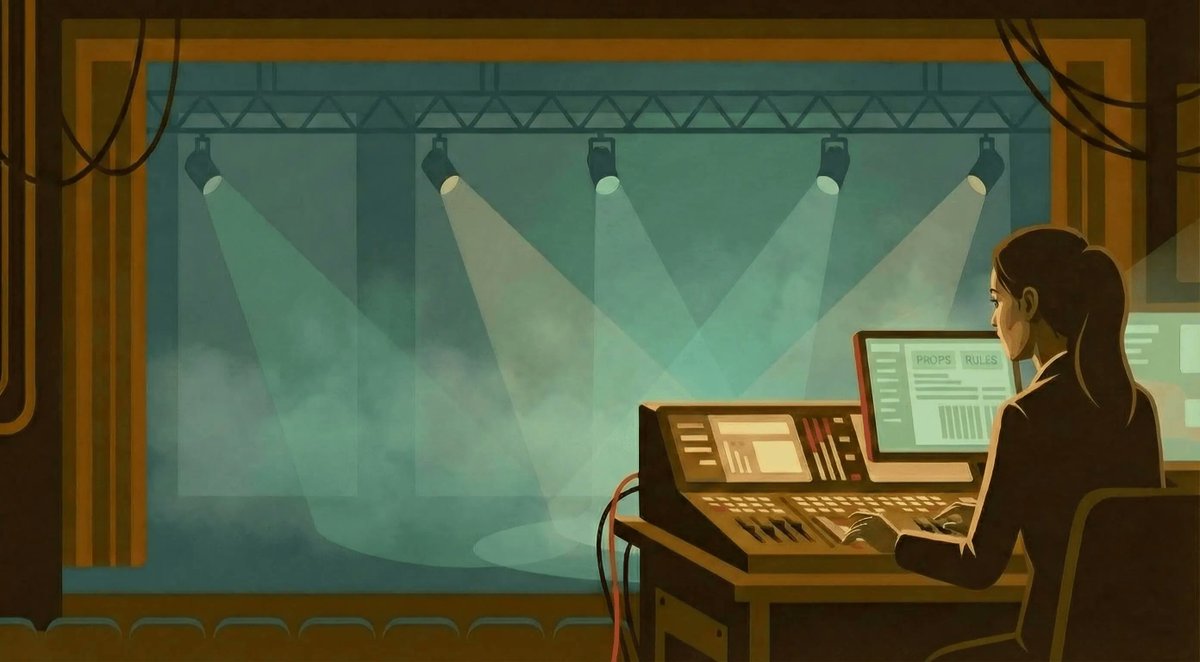
You can't script the performance. The AI improvises.
Your new job as designer:
Build the stage.
Set the guardrails.
Stock the props.
Shape the visual language.
The illustrations are the performance.
Everyone's watching Claude Design.
Quieter move: Google just shipped A2UI v0.9 - an open standard for agent-rendered UI. Building on what stage managers know: You can't rebuild the set from scratch every night.
Why this matters for designers and how to plan for it: https://t.co/Bb4rOSGMcP
#GenerativeUI #A2UI #AIDesign
Two threats to @Figma this month:
• @Claude Design: model company just ships its own canvas tool.
• @Noon ($44M seed, Soleio-led): design veterans rebuilding everything from first principles... a dual-canvas native to agents + live production code.
🦀 Pincered by Anthropic’s raw scale & speed… and Noon’s founder-level taste + code-native architecture.
Leak Monday. Stock tumble and board resignation Tuesday. Ship Thursday.
Claude Design just ran a 4-day launch cycle.
@Figma runs quarters.
The threat to design-tool incumbents isn't just the model. It's that model companies operate at a release cadence the incumbents are structurally forbidden from matching. And startups like @noondesign? Even faster.
@figma - Love features like Slots, but inheritance bugs (overrides mysteriously disappearing) make us nervous to adopt.
Request: Element-level version history – view/restore changes for selected component, layer, or frame, filter by editor. Would unlock confidence
I was thrilled to join
@bryanzmijewski's #GlaringlyObvious podcast re: Designing with AI’s Uncertainty. Watch to learn how AI creates a new, dynamic "Services" layer, challenging us to build resilience into ever-changing systems. https://t.co/IrFAMCRdPA #AI#productdesign
If you're shipping AI products today, you can't wait for formal education to catch up.
Full analysis with practical frameworks, examples, and what to do next: https://t.co/tYEL0fyv5k
What's the biggest AI design challenge your team faces?
What Stanford and MIT overlooked – their product design courses teach solid foundations. But the gap between classroom and production is massive.
5 key AI design concepts the top AI product teams know, but top classes aren’t teaching yet:
🧵
#AI#Design#ProductManagement
5. Designing for robots
Meet your new users: AI working for your customers.
Your app + landing pages are losing significance. Many customers won’t see them. More customer interactions happen via AI intermediaries. They'll browse your sites, query your APIs, even make purchases.