You’ve heard of staking in crypto.
But what if you could stake and still use your tokens?
And then stake that stake for even more yield?
Welcome to the world of LSDs and LRTs 🧵
🪂 New Airdrop: USDT
🚀 Total Reward: 10,000 USDT
🎁 Joined Reward: 10 USDT
👬 Refer Reward: 5 USDT
⏳ Distribution: Instantly
⚡️ Join now: https://t.co/ai6At53DCa
👀 How to join?
- Start Airdrop Bot
- Complete All Tasks of Airdrop
- Submit Your USDT (Bep-20) Wallet address
👀 𝗗𝗶𝘀𝗰𝗹𝗮𝗶𝗺𝗲𝗿: Financial risks may be involved in airdrop activities. Always do your own research (DYOR) before joining any project!
🙌 #AirdropFam #USDT #Airdrop #Airdrops #CryptoAirdrop #Giveaway #campaign
Once you're making serious money
Hire a maid.
Buy a super comfortable bed.
Get the fastest MacBook.
Invest in a proper desk and chair.
Join a serious gym.
Eat organic. Eat quality.
You'll level up 10x Faster!
Give a like and follow @SavantXbt if you enjoyed till the end.
Share with frens if you learnt something;
https://t.co/lvpU4FYpxj
Share your experience in the comments. It might help someone.
What’s stopping you from making it? 🧵
I first saw this question in David Goggins’ Can’t Hurt Me.
It stayed with me longer than I expected.
So I asked myself honestly.
What’s stopping you from making it? 🧵
I first saw this question in David Goggins’ Can’t Hurt Me.
It stayed with me longer than I expected.
So I asked myself honestly.
So now I will build in public, without fear of attention.
I know what’s holding me back.
I know how to fix it.
Now it’s time to execute.
Game is game. 📌
This shows that if companies continue to hold tokens, it won't be for speculative gains. Rather treasuries will be filled with tokens that have shown a history of generating real revenue like $hype, $AAVE and more.
The only speculative asset that will be held is likely $BTC.
From +2600% to -86%: the “hottest” crypto-treasury trade has blown up
Companies that stuffed their balance sheets with crypto massively outperformed at the start… and then saw their stocks crater as the market realized the business itself wasn’t generating real cash flow
On average, these “digital asset treasuries” are down ~43% this year, with some names nuked more than 99% despite still holding valuable tokens
Investors have shifted from “number go up” to “show me the earnings”: token bags don’t pay coupons or dividends, while the debt and preferreds issued to finance those bags still need servicing
Lesson for the next cycle: holding volatile assets on corporate balance sheets is leverage on the way up – and a brutal mismatch between hard liabilities and speculative treasury assets on the way down
@Ethanh141 @CryptoKaduna @clanker_world@base@farcaster_xyz Bro is onto something 🧐
I believe the issue is on how sustainable this is.
It might go parabolic if we see a base szn tho.📌
I’ll never make a subscription.
My content is free
it always has been, and it always will be.
My biggest value is you
If you want to be closer to me, just be yourself.
Don’t say “follow back”
would you say that to someone on the street?
You would be a weird mfer right?
Be real.
Comment, talk, and connect like a real person with real interest.
And I’ll always support you back
Easy as that.
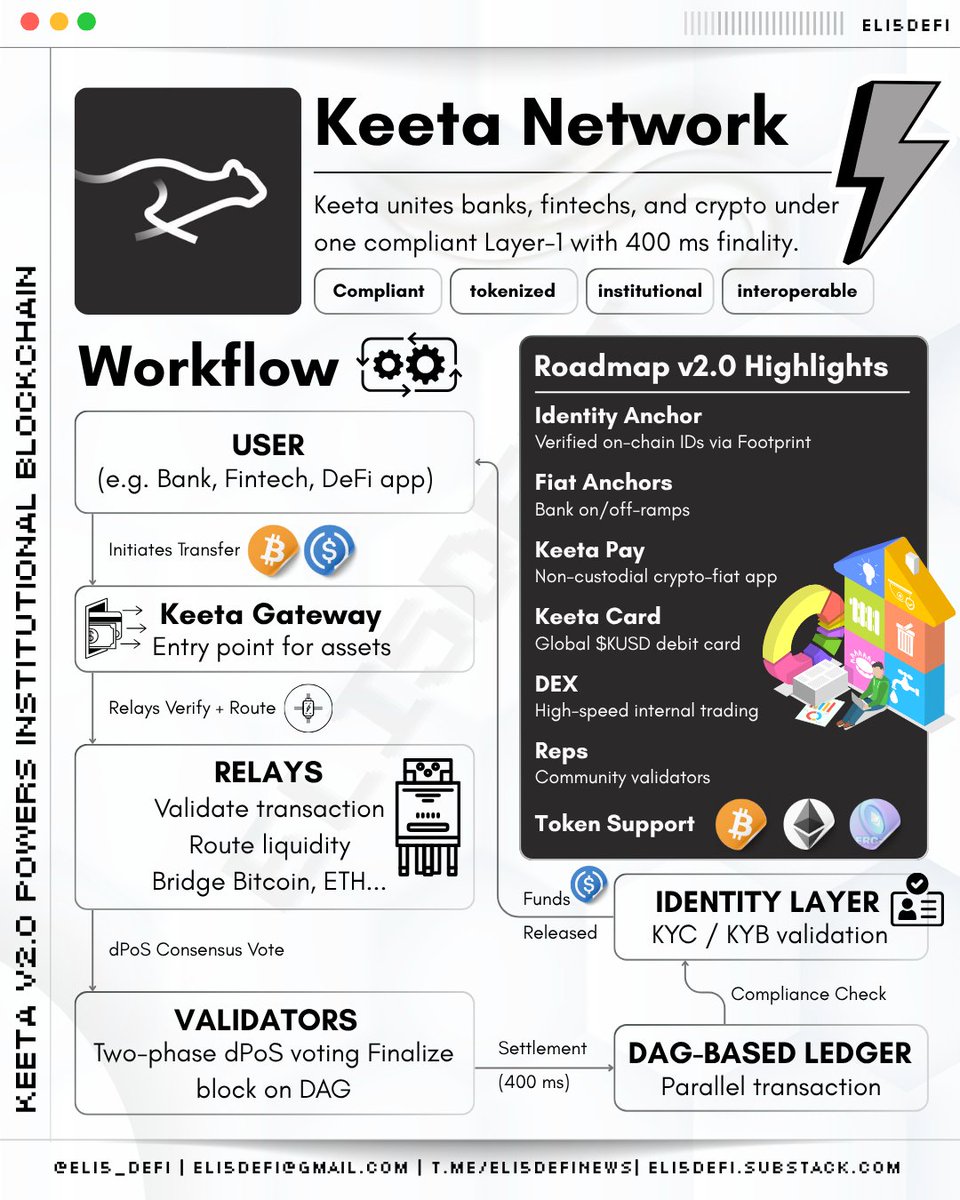
➥ All You Need to Know About Keeta v2.0
@KeetaNetwork reached 11 million TPS in a verified test with @googlecloud, setting a new bar for scalability.
Now it’s moving from speed to structure, building a compliant settlement layer for global finance.
With its updated roadmap, Keeta is turning scale into substance, aiming to bring institutions fully on-chain.
— — —
► What is Keeta?
Keeta is a Layer-1 blockchain connecting banks, fintechs, and crypto networks under one compliant settlement layer with 400 ms finality.
➤ Why it’s different
▸ On-chain compliance: Identity certificates for KYC / AML
▸ Native tokenization: RWAs issued and managed at protocol level
▸ Interoperability: DAG design enables direct cross-chain transfers
▸ Institutional-first: Compliant by default, open to crypto users
— — —
► How it works
Keeta connects blockchains and payment networks through a single compliant layer.
Workflow:
❶ User initiates a transfer (e.g., $BTC → $USDC)
❷ Keeta relays verify the transaction and route liquidity
❸ dPoS consensus finalizes the block through a two-phase vote
❹ Funds settle within 400 ms on Keeta’s DAG-based ledger
❺ Identity layer confirms compliance before final confirmation
Core components:
▸ Unified bridge: Connects Bitcoin, Ethereum, and stablecoins directly
▸ Relays: Manage liquidity routing and transaction settlement
▸ DAG structure: Processes transactions in parallel for scalability
▸ dPoS consensus: Ensures fast and verified block validation
▸ Identity layer: Attaches KYC certificates for regulated interactions
— — —
► Roadmap v2.0 Highlights
Keeta’s roadmap focuses on compliance, usability, and real-world integrations.
▸ Identity Anchor (Live): Footprint integration enables verified on-chain identities
▸ Fiat Anchors: Direct fiat on/off-ramps connecting banks to Keeta Network
▸ Keeta Pay: Non-custodial payment app for seamless crypto and fiat transactions
▸ Keeta Card: Debit card for spending $KUSD balances globally
▸ Decentralized Exchange: High-frequency trading within Keeta’s ecosystem
▸ External Representatives: Community-run validators improving decentralization
▸ Expanded Token Support: BTC, $ETH, and ERC-20 assets for cross-chain liquidity
— — —
► Wrap-up
Keeta has proven scale and now focuses on bridging institutions with blockchain infrastructure. By combining speed, compliance, and interoperability, it’s closing the gap between traditional finance and DeFi.
Its roadmap builds a unified system where fiat, crypto, and RWAs move under one regulated framework.
This matters because it removes the biggest barrier to institutional adoption, trust and compliance at the base layer.
With speed validated and integrations underway, Keeta is shaping the foundation for global settlement to run natively on-chain.
--
cc:
- @schenkty
- @CoinGurruu
Airdrop farmers are the single worst possible foundation for a community (except for maybe 'gaming' airdrop farmers)
They're all mercenary gaslighters who will literally turn the barrel around on you the *instant* you suggest that they'll get less than they think they deserve
And they all think they deserve way more than they're worth because we conditioned them for 4 years to believe that spamming random txns on testnets or playing the role of gm scientist in discord for a few months somehow produced economic value in the 4-5 figure
skin in the game or gtfo is the path forward
Monad raised $225m entirely from VCs
megaETH raised $20m from VCs + $70m from the community
See the difference?
But since Monad gave us boxes to open, we should be so excited about their tech?
The VC sell pressure after 1-year TGE is going to be insane.
Zero.
Apps and Chains Are Taking the Stablecoin Crown
The Stablecoin Meta Is Exploding, But Who’s Actually Winning?
Stablecoin activity is booming. Volumes up, integrations everywhere, every chain wants in.
But here’s the truth: the real winners aren’t us, they’re the issuers: Circle, Tether, and a few platforms earning on the float.
For most traders, stablecoins are just tools to store, move, or settle dollars.
Useful, yes, but not profitable.
We’re using stablecoins, not owning them.
--------------------------------------------
The Missed Opportunity
Retail traders aren’t in the best position to profit from the stablecoin meta, and there are clear reasons why:
You can’t invest directly in Circle, its equity isn’t tokenized.
➢ @ethena's $ENA token has complex tokenomics and ongoing sell pressure.
➢ @Plasma's $XPL rewarded early backers before crashing over 60% post-TGE.
Policymakers and VCs now call stablecoins one of the biggest financial innovations: Sparking a new wave of ecosystems launching their own.
Why? Because they’ve realized that all the yield flowing to issuers could instead be captured within their own chains and apps.
--------------------------------------------
The Numbers Tell the Story
Tether and Circle have reached scale few imagined possible:
➢ @tether is reportedly raising $20 billion at a $500 billion valuation, with $185 billion in circulation.
➢ @circle sits around an $80 billion supply with a $35 billion valuation.
These numbers are staggering, but they also show how concentrated the power is.
Tether and Circle built strong networks, but their dominance is plateauing.
Circle’s partnership with @coinbase, for example, gives Coinbase 50% of USDC reserve yield and 100% of the yield on-platform.
In 2024, Circle earned $1.7 billion from reserves and paid $908 million of that to Coinbase.
So, instead of giving up yield to these issuers, ecosystems with large user bases are asking:
Why not just issue our own stablecoins and keep the yield ourselves?
--------------------------------------------
The Economics Are Changing
Cross-chain tech has changed the game.
Swapping between stablecoins is now cheap, fast, and seamless.
With U.S. regulations like the GENIUS Act making stablecoins safer and more standardized, they’ve effectively become a commodity.
The differentiation now lies not in the coin itself, but in who captures the underlying yield.
That means ecosystems with strong distribution and user bases can own the value directly, instead of paying it to Circle and Tether.
--------------------------------------------
HyperLiquid: The Blueprint
The best example so far? HyperLiquid.
At one point, roughly $5.5 billion in USDC was sitting idle in the exchange during its USDH proposal.
That’s around $220 million per year in potential yield that would have gone to Coinbase and Circle.
So HyperLiquid flipped the script.
They launched USDH, a native stablecoin, and ran a competitive bidding process involving @Paxos, @fraxfinance, @nativemarkets, @withAUSD, MakerDAO, @ethena, and @CurveFinance.
It was an intense process and Native Markets won.
Now, 50% of the reserve yield stays within the HyperLiquid ecosystem, while the other 50% is used to deepen USDH liquidity.
The result?
@HyperliquidX turned a passive drain into a self-sustaining revenue engine.
--------------------------------------------
What Chains Stand to Gain
Across the broader ecosystem, over $30 billion in USDC and USDT sits idle on @solana, @arbitrum, @avax, and @Aptos.
That capital earns roughly $1.1 billion annually for Circle and Tether, more than many blockchains make from transaction fees.
If that yield stayed within ecosystems, it could fund development, staking rewards, liquidity incentives, or DAO treasuries, creating a perpetual revenue stream.
Chains have three paths forward:
1. Negotiate revenue-sharing deals with existing issuers.
2. Follow HyperLiquid’s model and launch native stablecoins.
3. Build yield-bearing stablecoins integrated into their DeFi ecosystems.
--------------------------------------------
The Next Generation of Ecosystem-Led Stablecoins
We’re already seeing this play out across DeFi:
> @megaeth launched USDm in partnership with Ethena Labs.
> @JupiterExchange is building JupUSD for its Solana-based ecosystem.
> @SuiNetwork teamed up with Ethena to roll out a yield-bearing stablecoin of its own.
Apps like @HyperliquidX and @pumpdotfun are generating hundreds of millions in revenue, yet the blockchains they sit on earn far less, even though those base chains often trade at higher valuations.
If chains don’t start capturing stablecoin yields, their token economics will keep lagging behind the apps that live on top of them.
--------------------------------------------
The Solana Dilemma
Take Solana as a case in point.
Roughly $15 billion in stablecoins circulate on Solana, producing around $500 million a year in yield.
But instead of benefiting the Solana ecosystem, that money goes to Circle, Coinbase, and even Base, one of Solana’s competitors.
Many in the community have called for a Solana-owned stablecoin, but leadership has been cautious, prioritizing stability and cohesion over bold experimentation.
Meanwhile, chains like Sui and MegaETH have already moved.
The message is clear:
Move fast, or watch your ecosystem subsidize someone else’s.
--------------------------------------------
The Bottom Line
Stablecoins have evolved far beyond simple payment tools.
The real opportunity now lies in who captures the yield behind the liquidity.
Apps and chains that internalize that value, keeping the yield within their ecosystems, will lead the next era of DeFi.
Those that move too slowly will end up enriching the same centralized players DeFi was meant to replace.
The next stablecoin revolution won’t be about who issues the coin, It’ll be about who owns the yield.
--------------------------------------------
Disclaimer: This post is based on the @Delphi_Digital's report written by @simononchain. Link to the report in the second tweet.
@AnonVee_ No one knows when the next cycle will come
I think it's a risky move unless they can find a winning product or incentives ( $bera had this yet still went down )