This is us - we are all about trust, simplifying complexity and unleashing your company's potential to grow.
We design Salesforce for what you don’t see coming.
How would you know if the AI agent you're evaluating is worth having? We've created a quick 6-item checklist of the most important criteria you need to consider when vetting any agent.
Read about this and how to ensure your agents are safe and trustworthy in our experts' article below. 👇 Link in comments.
We design Salesforce for what you don't see coming.
In a recent Deloitte study, nearly 70% of all C-level participants named AI agents’ safety and governance as one of the most important issues at hand.
We witness this first-hand when talking to clients - questions about how safe, reliable and predictable agentic AI is, sit very high on executives’ list of priorities.
Our new blog post brings together our engineers’ advice on building safety-first customer agents: what to look out for, where agents could go wrong, and how it all ties to regulations like the EU AI Act, which is already in force and tightening over the next two years.
Read or listen to the article and let us know what you think. Link in the reply below.👇
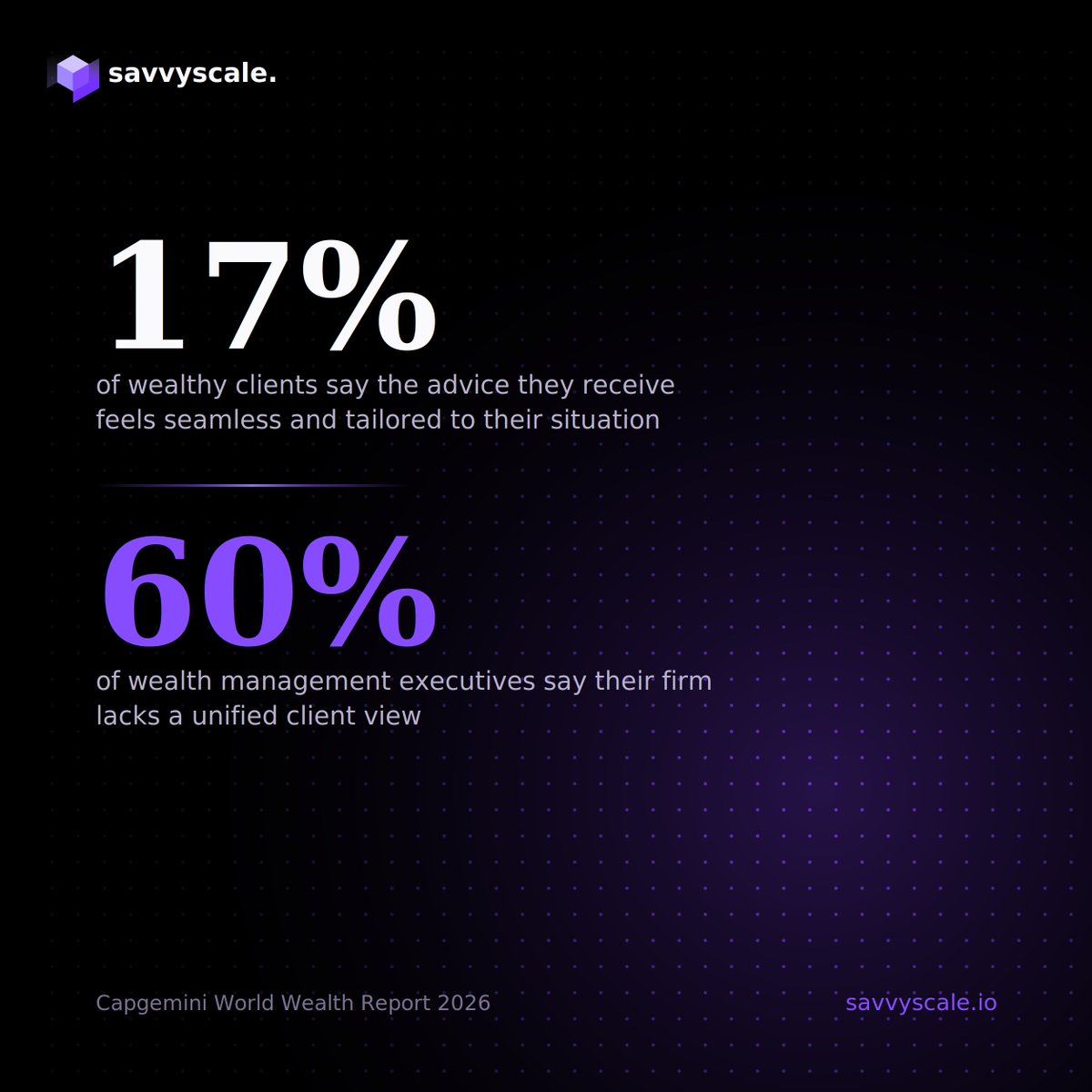
Capgemini's World Wealth Report 2026 lists what a wealth manager is now expected to have: automated onboarding and KYC, portfolio analytics, advisor copilots, auto-generated meeting briefs, and clean client 360 data in a unified CRM. In the report's words, these are rapidly becoming industry standards.
In the same research, 42% of clients say they restate their goals and preferences multiple times to the same firm.
One of the executives quoted in the report puts the consequence plainly: without clean, accessible data across systems, AI will not deliver reliable outcomes.
Salesforce covers every item on that list. Making them work as a consolidated client record, in a single place - this is our job.
We design Salesforce for what you don't see coming.
Salesforce in Claude.
This is familiar ground for us. Our team works with Claude daily, and we built our own MCP connection into Salesforce that obeys each user's profile and permissions, before an official one existed.
We built it that way because an AI agent working inside a regulated org has to answer to the same permission model as the person it is acting for. Without that, it cannot be trusted with anything that matters.
Seeing Salesforce and Anthropic make this official is good news for everyone building on the platform.
One thing worth knowing before you switch it on. Salesforce put it plainly: Claude sees what the user is authorised to see, and can do what that user is authorised to do, no more. Which makes this a good moment to look at what your profiles and permission sets actually allow today.
We design Salesforce for what you don't see coming.
An AI agent that resolves customer cases is making decisions your company is accountable for.
That changes the questions worth asking. Not "how good is the model", but:
• What data does the agent read? Does it see the complete customer profile, or a fragment of it?
• What actions is it allowed to take?
• Who defines the boundaries?
• Can it be talked into revealing what it should not? It has to follow the same access rules as your employees.
• What evidence does it leave behind? Not the chat transcript, the reasoning behind every decision.
In Financial Services, the stakes are double. The agent has to serve the customer well, and it must stay within regulation and company policy while doing it.
Get those questions right, and the agent does both. Leave them unanswered, and it fills the gaps by guessing.
A guessed answer about a customer's account is not just poor service. It is a compliance and company failure.
The technology is ready. Whether it is safe in front of your customers depends on the architecture underneath it.
We design Salesforce for what you don't see coming.
Getting MiCA-authorised is months of work. What comes after 1 July is the part that never ends.
Authorisation is a milestone. The obligations behind it are continuous: regular reporting to your regulator, complaints handling, client-asset segregation, disclosures, and records you have to keep for years and produce on request.
The rules are clear. The hard part is meeting them every day, at volume, and proving it. A firm can be fully compliant on 1 July and struggle months later, not because the rules changed, but because the platform underneath was never built to carry them. Reports turn manual. Records sit in separate systems. Answering the regulator gets slow and painful.
None of this is fixed in the days before a deadline. It is fixed by building the obligations into the platform that runs the business, so compliance is part of the system and the evidence is one query away. That is true the day after 1 July as much as the day before.
We design Salesforce for what you don't see coming.
Your screening tool flags. Your CRM has to resolve.
Sanctions screening rarely fails at the match. The vendors who specialise in it catch the names. What breaks is everything around the alert:
Disposition, when a potential match needs a human decision.
The audit trail of why an alert was cleared, by whom, and when.
Customer communications when an account is under review.
The compliance officer's single view of every open alert.
These are not screening problems. They belong in the CRM. When they live in spreadsheets, email threads, and standalone tools, your compliance team absorbs the gap by hand.
We design Salesforce for what you don't see coming.
Your KYC provider verifies. Your CRM has to handle the rest.
The verification itself is rarely the problem. The KYC vendors who own that work do it well. What breaks is everything around it:
Case management when a verification needs a human reviewer.
The periodic refresh cycle that should trigger automatically or when a customer's risk profile changes.
Customer-facing communications when information has to be re-collected.
The audit trail of who reviewed what, when, and why.
The compliance officer's view of every customer's KYC status at once.
These belong in the CRM. When they live in spreadsheets, email chains, and separate tools, the compliance team carries the difference every day.
We design Salesforce for what you don't see coming.
Part 4 of 4. The outcome, in 19 seconds.
Salesforce is a long-term investment.
The decisions made around architecture, data and automation determine how easily the business can change and respond to new requirements.
We design Salesforce for what you don't see coming.
Part 3 of 4. How we work, in 39 seconds.
We analyze first - department workflows, friction points, manual effort. Then we connect what is usually disconnected, and add Agentforce and AI where they truly deliver.
We design Salesforce for what you don't see coming.
Part 2 of 4. Who Savvyscale is, in 20 seconds.
We are built for complex Salesforce work that regulated businesses depend on.
Salesforce expertise is only half the equation. The other half is understanding the business.
We design Salesforce for what you don't see coming.
Part 1 of 4. The problem, in 29 seconds.
Salesforce is implemented. Yet manual work, disconnected processes and departmental silos keep holding the business back.
We design Salesforce for what you don't see coming.
A compliance review that used to take a week now takes minutes.
Same team. Same headcount. Same regulatory questions.
What changed is the platform underneath. Consent, jurisdiction, sanctions history, source of funds, and PEP status. Tracked and queryable in one place, not chased across separate systems.
When a compliance officer can answer, "Every customer onboarded in Q1 who triggered enhanced due diligence," on demand, the audit conversation changes. Investigations close faster. Friction with regulators drops.
The team stops carrying the burden of the platform.
We design Salesforce for what you don't see coming.
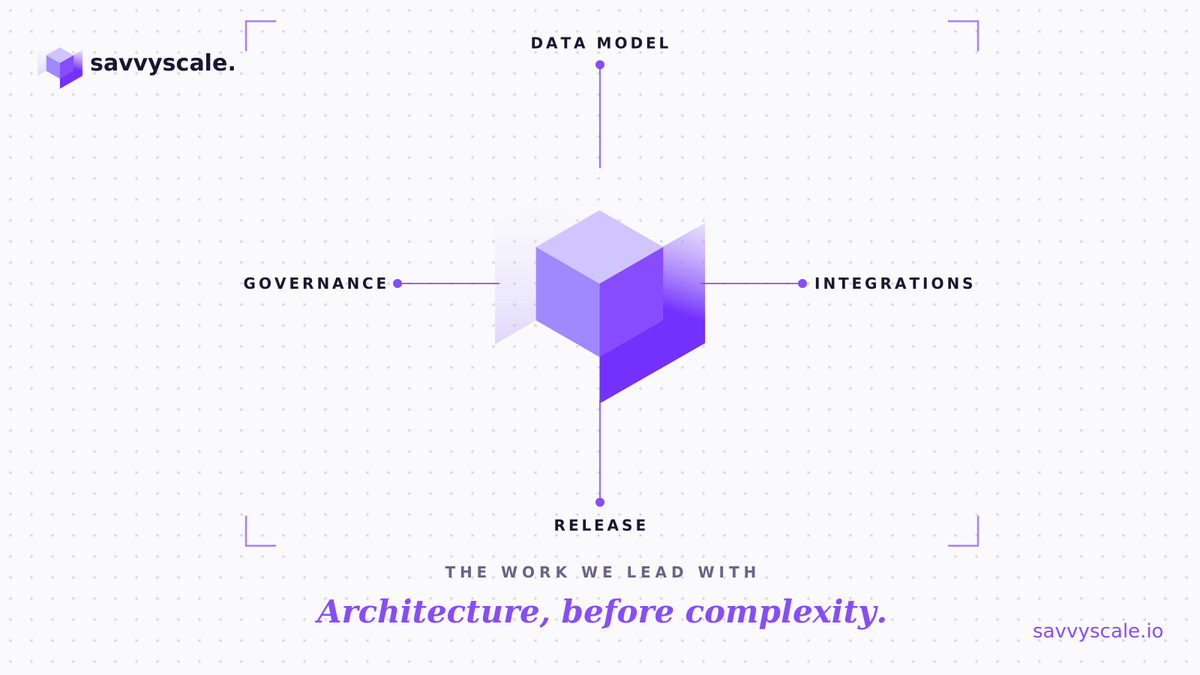
If your Salesforce platform becomes harder to change as the business grows, the cause is rarely Salesforce itself.
It is usually:
- a weak data model
- fragile integrations
- poor release management
- unclear governance
Get these foundations right and the platform stays cheap to evolve.
That is the work we lead with: architecture, governance, integrations, and release discipline designed before complexity compounds.
We design Salesforce for what you don't see coming.
https://t.co/esBNCR1HeL
Introducing Savvyscale.
Official Salesforce partner.
Senior-only delivery.
Architecture-first thinking.
AI, automation, and enterprise Salesforce execution.
Built from experience across banking, fintech, crypto, and regulated environments.
We design Salesforce for what you don’t see coming.
https://t.co/esBNCR1HeL
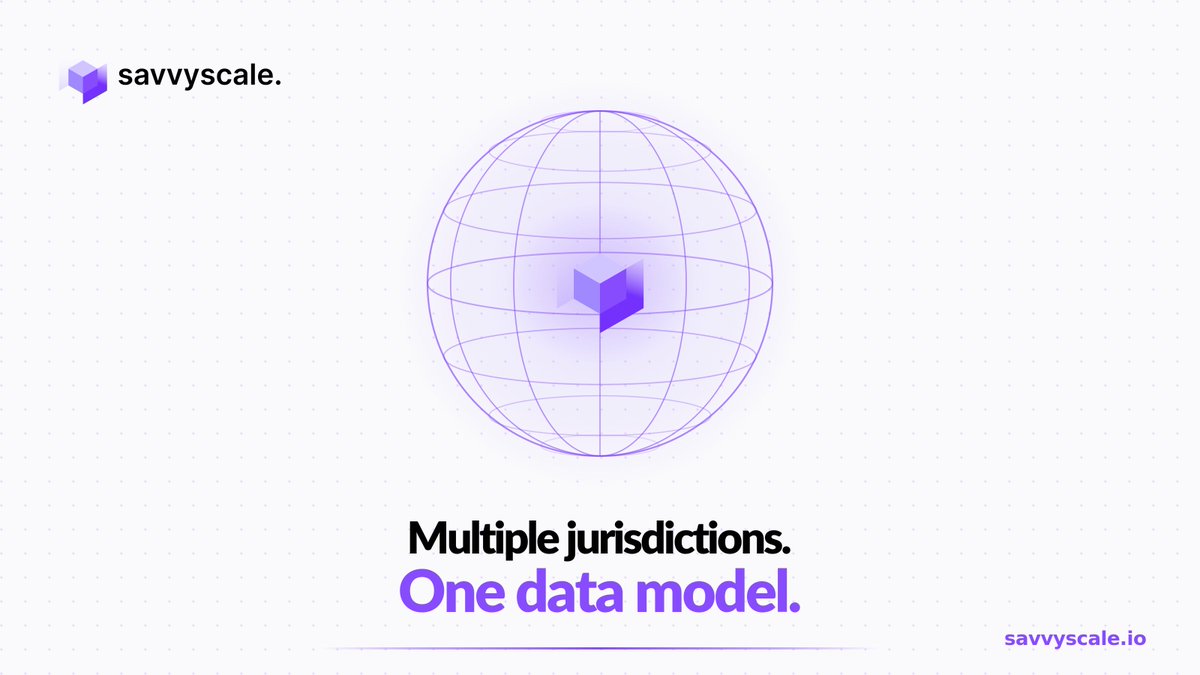
Building Salesforce for a platform that operates in multiple jurisdictions starts with a different architecture decision.
The data model is no longer about objects and relationships. It is about which jurisdiction owns each customer's record, which retention rule applies, which sanctions list to screen against, which currency to settle in.
Get it right, and the platform expands into new markets the way it was supposed to — quietly and fluently.
We design Salesforce for what you don't see coming.
https://t.co/esBNCR1HeL