Most people analyze Strategy after the decision.
War Room makes you take the decision first.
$1B.
BTC. MSTR. STRC. Cash.
23,426 feasible allocations. One SW Score.
Think you understand Strategy?
Run it.
https://t.co/fmpcr0PRqJ
I would vote For too.
Daily dividends look like a payment-frequency change.
But strategically, they make Digital Credit much easier to use as financial infrastructure.
Yield accrues every day.
No quarterly timing problem.
Cleaner tokenization.
Easier integration into TradFi and DeFi products.
The annual economics stay the same.
The product becomes more programmable.
That may matter far more than the payment frequency itself.
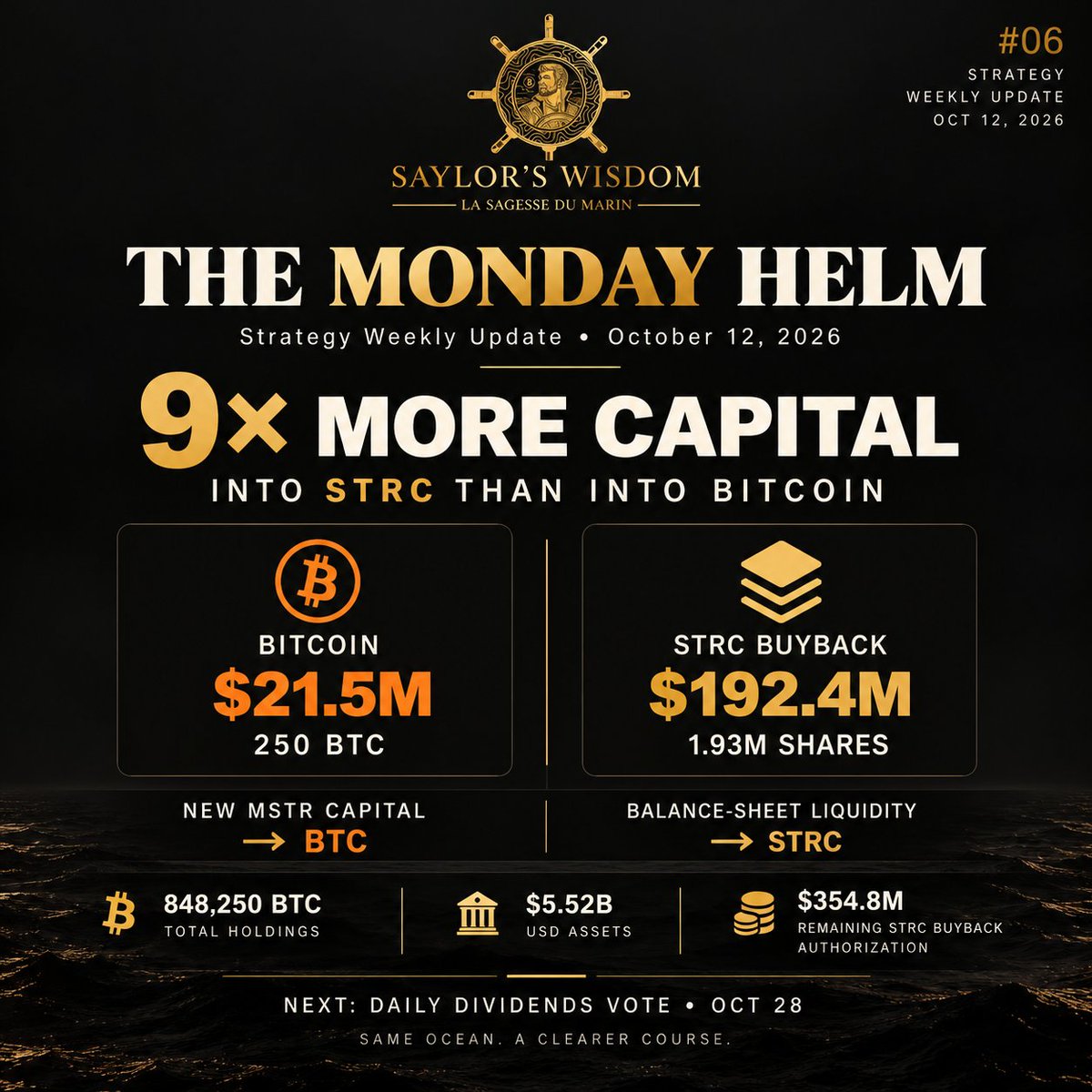
⚓ THE MONDAY HELM #06
Strategy Weekly Update · October 12, 2026
STRATEGY SPENT 9× MORE ON STRC THAN ON BITCOIN. WHY?
Strategy acquired another 250 BTC last week. But the much bigger transaction happened somewhere else in the capital stack.
Between October 5 and October 11, Strategy spent $21.5M to acquire 250 BTC. During the same period, it spent $192.4M repurchasing 1,932,145 STRC shares.
That is almost nine times more capital allocated to STRC than to Bitcoin.
The financing tells us even more. Strategy issued 125,183 new MSTR shares and raised $21.0M net, with those proceeds specifically used to acquire Bitcoin. Another $0.5M of USD Cash completed the purchase. No preferred securities were issued during the week.
So the capital flows were remarkably clear: new common equity financed new Bitcoin, while Strategy simultaneously used its balance sheet to shrink part of its preferred capital.
At first glance, that can look contradictory. Why issue one type of equity while buying back another?
The answer lies in what MSTR and STRC actually do.
- MSTR is common equity. Issuing it brings fresh capital into the company but increases the number of common shares outstanding. Whether that is ultimately accretive depends on how much economic value Strategy acquires with the capital relative to the dilution created.
- STRC is very different. It is perpetual preferred equity with a current annualized dividend rate of 12% on a $100 stated amount. Every STRC share outstanding therefore represents a recurring preferred claim on Strategy's future cash flows, subject to the applicable dividend terms and declarations.
This week, Strategy paid about $99.58 per STRC share on average. That is only slightly below the $100 stated amount, so this was not primarily a deep-discount arbitrage.
The more interesting effect is on the future dividend burden.
Repurchasing 1.93 million STRC shares removes roughly $193.2M of stated preferred capital from circulation. At the current 12% annualized rate, that corresponds to approximately $23.2M of annualized regular dividends attached to those shares, assuming the current rate were maintained.
In other words, Strategy had a choice for its capital: buy more Bitcoin today, or use part of its liquidity to reduce a recurring claim on future cash flows.
This week, the second opportunity received almost nine times more capital.
That does not mean Strategy suddenly prefers STRC to Bitcoin. It means management is making a marginal capital allocation decision: given today's Bitcoin price, STRC price, liquidity position and cost of capital, where does the next dollar create the most economic value?
And this is where daily dividends become interesting
During the same period, Strategy also opened shareholder voting on another important change to its Digital Credit platform: daily dividends for STRC, STRF, STRK and STRD.
If approved, STRC would move from semi-monthly dividends to daily accruals beginning November 1, with payment on the following business day. STRF, STRK and STRD would follow in January 2027. Importantly, Strategy says the amendment would not change the annualized dividend rate. Investors would simply receive smaller payments much more frequently.
Why repurchase STRC aggressively while simultaneously trying to make STRC more attractive?
Because these two actions can serve the same objective.
Strategy has stated that it wants STRC to trade around $99–$100. Repurchases can support the capital structure when STRC trades below stated amount, while more frequent dividends are intended to reduce reinvestment lag, dampen payment-date cyclicality, improve liquidity and potentially strengthen investor demand.
This is the important evolution.
Strategy is not simply trying to accumulate the maximum possible number of Bitcoin every Monday. It is trying to build a repeatable financing architecture around Bitcoin.
If Digital Credit becomes liquid, stable and attractive enough to a large income-investor base, it potentially gives Strategy another source of capital besides repeatedly issuing common MSTR shares. That does not make preferred financing free: STRC carries a recurring dividend obligation and ranks ahead of common equity. But it gives management another lever.
That is why the apparent contradiction disappears.
Buy back STRC when the existing capital stack makes that attractive. Strengthen STRC so that Digital Credit can become a more effective funding channel in the future. Use MSTR when common equity is attractive. Buy Bitcoin when the economics justify it.
At the end of the week, Strategy held :
- 848,250 BTC,
- alongside $4.88B of USD Reserve
- and $640.5M of flexible USD Cash.
The question is therefore becoming more sophisticated than:
“How much Bitcoin did Strategy buy?”
It is increasingly:
“How efficiently can Strategy finance the next Bitcoin without destroying value per common share?”
Bitcoin remains the destination. Capital allocation is the engine.
Same ocean. A clearer course. ⚓
$MSTR @saylor $BTC $strc
This is a fair criticism.
At $86, buying back STRC was clearly accretive capital allocation.
At $99.58, the economics are very different.
Strategy spent ~$192M to retire roughly $193M of stated value — only about $0.8M of discount capture.
It does remove roughly $23M of annualized dividends at today’s 12% rate, so the trade is not irrational.
But at this point, the buyback is less about exploiting a discount and more about supporting price stability near par.
And that raises the real question:
If $99–100 is already the target, when should Strategy stop being the buyer and let independent demand prove the product works?
Maybe the most important milestone for STRC won’t be reaching $100.
It will be staying there without Strategy’s bid.
La mémoire du corps
Berkeley, Gloucestershire, 1796. Edward Jenner observe depuis longtemps une croyance rurale : les laitières ayant contracté la vaccine, maladie bénigne transmise par les bovins, semblent échapper à la variole humaine, l’un des grands fléaux de l’époque.
Le 14 mai, il introduit dans la peau du jeune James Phipps du matériel prélevé sur une lésion de Sarah Nelmes, une laitière atteinte de vaccine. L’expérience serait aujourd’hui éthiquement inacceptable. Elle ouvre pourtant une voie décisive : l’exposition à une forme apparentée peut préparer le corps à résister à une menace plus grave.
Le corps ne devient pas plus fort parce qu’il aime la douleur. Il devient plus rapide parce qu’il se souvient.
La mémoire immunitaire n’est pas une image poétique. C’est une organisation biologique précise. Certaines cellules reconnaissent l’antigène, d’autres se multiplient, une partie persiste. Lors d’une nouvelle rencontre, la réponse peut être déclenchée plus vite et avec davantage d’efficacité.
La blessure, à elle seule, n’enseigne rien.
Pour qu’un choc devienne protection, il faut qu’un système sache sélectionner l’information utile, la conserver et reproduire une réponse adaptée.
Certains virus, notamment les rétrovirus, peuvent bien intégrer leur matériel génétique et laisser une trace évolutive. Mais l’immunité ordinaire ne fonctionne pas comme un pillage du code de l’ennemi.
Cette correction rend l’analogie plus intéressante.
Un organisme adaptatif ne se contente pas d’encaisser. Il trie. Il mémorise. Il distingue ce qui doit être reproduit de ce qui doit être éliminé.
#Bitcoin possède lui aussi une mémoire, mais d’une autre nature.
La blockchain conserve des transactions, pas des enseignements. Elle peut prouver qu’un événement a eu lieu, mais elle ne sait pas pourquoi il a été dangereux, quelles erreurs l’ont permis ni quelles pratiques devraient être abandonnées.
Les leçons restent ailleurs : dans les rapports d’incident, les discussions entre développeurs, les logiciels corrigés, les pratiques de garde, les standards techniques et la culture des utilisateurs.
Le protocole n’apprend donc pas comme un organisme.
L’écosystème apprend comme une société : lentement, imparfaitement, par imitation, concurrence, documentation et débat.
Une plateforme s’effondre. Certains retirent leurs actifs. D’autres changent seulement d’intermédiaire.
Une clé est perdue. Certains améliorent leurs sauvegardes. D’autres répètent la même erreur.
Une attaque révèle une faiblesse. Certains la documentent. D’autres préfèrent l’oublier dès que le prix remonte.
Le registre conserve tout ce qui a été validé.
Mais il ne garantit pas que les hommes retiendront la bonne leçon.
Et comme toute société, l’écosystème peut confondre survivre avec apprendre.
La véritable résilience ne consiste pas à être frappé sans disparaître.
Elle consiste à transformer le choc en mémoire, puis la mémoire en comportement.
Le corps ne survit pas parce qu’il souffre.
Il survit parce qu’il se souvient.
#Histoire #Science #SaylorWisdom #MichaelSaylor
Why does @saylor want his competitors to succeed?
Because Bitcoin changes the mathematics of competition.
If Coca-Cola wins a customer, Pepsi gains nothing.
But if a credible Bitcoin treasury raises capital and buys BTC, it can strengthen the value of the same scarce reserve asset sitting on every other Bitcoin treasury balance sheet.
Then a second effect begins:
more issuers → more research → more liquidity → more institutional familiarity → potentially lower funding costs for Digital Credit.
And then a third:
if several companies prove that Bitcoin treasury management works through different market cycles, investors may start valuing Digital Equity itself as a new category.
So Strategy and Strive can compete for the same investor dollar… while simultaneously expanding the market, improving the infrastructure and strengthening the capital base they share.
This isn’t Coke vs Pepsi.
It is closer to Ford and Standard Oil, except both balance sheets are anchored to the same scarce monetary asset.
Competition becomes partially positive-sum.
Maybe the real moat isn’t just Strategy.
Maybe it’s the industry Strategy is helping create around Bitcoin.
$MSTR $BTC
Strategy ended last week with roughly $833M of USD Cash.
That cash is not simply waiting to become Bitcoin.
Last week, Strategy used liquidity to buy Bitcoin and repurchase $176.3M of STRC, while its separate USD Reserve continued servicing preferred dividends and debt interest.
That distinction matters.
Bitcoin = reserve asset.
USD Reserve = capital-stack protection.
USD Cash = optionality.
For MSTR shareholders, liquidity has strategic value because it allows Strategy to choose between Bitcoin, preferred buybacks and other opportunities without automatically issuing new common equity every time capital is needed.
Cash is no longer just dry powder.
It is part of the capital allocation machine.
$MSTR $BTC $STRC
Le 3 janvier 2009, le bloc Genesis est produit.
Un registre monétaire peut désormais être copié, vérifié et conservé sans dépendre d’une administration unique.
La mémoire ne réside plus dans un palais.
Elle devient redondante.
#genesis#bitcoin
ANATOMIE DE STRATEGY — 5/12
STRE : pourquoi Strategy a créé un preferred en euros
Pourquoi une entreprise américaine, cotée aux États-Unis, dont le bilan est dominé par Bitcoin et le dollar, a-t-elle décidé d’émettre une preferred… en euros ?
Parce que Strategy ne cherche plus seulement à lever du capital.
Elle cherche à multiplier les marchés de capitaux auxquels elle peut accéder.
C’est là qu’intervient STRE — Stream.
STRE est une preferred perpétuelle de Strategy, mais contrairement à STRF, STRC, STRK ou STRD, son unité de compte est l’euro.
Sa valeur nominale est de 100 € et son dividende fixe est de 10 % par an, soit 10 € par titre et par an. Les dividendes sont cumulatifs : s’ils ne sont pas payés, ils ne disparaissent pas. Ils restent dus et commencent même à accumuler des dividendes supplémentaires.
Mais voici le premier détail intéressant.
Lors de son émission en novembre 2025, Strategy n’a pas vendu STRE à 100 €.
Elle en a placé 7,75 millions à 80 € par titre, levant environ 620 M€. Strategy
Donc au prix d’émission :
10 € de dividende / 80 € investis = 12,5 % de rendement courant initial.
Le coupon officiel était de 10 %.
Mais l’investisseur qui entrait à 80 € recevait bien 10 € par an sur un capital investi de 80 €. 12,5 %.
Pourquoi offrir autant ?
Parce que Strategy devait convaincre un nouveau marché.
STRE n’était pas simplement un nouveau titre.
C’était une tentative d’ouvrir une nouvelle source de financement : le marché européen du capital en euros.
Et c’est là que STRE devient beaucoup plus intéressant.
Un investisseur européen qui achète un preferred américain classique doit généralement accepter une exposition au dollar.
Avec STRE, la valeur nominale, les dividendes et la structure du titre sont libellés en euros.
Autrement dit :
Strategy peut lever des euros auprès d’investisseurs qui veulent du rendement en euros, puis utiliser ce capital pour financer son bilan, son fonds de roulement ou acheter du Bitcoin. Strategy indiquait explicitement que les fonds levés pouvaient notamment servir à l’acquisition de BTC.
C’est une nouvelle étape dans la logique du capital stack.
Jusqu’ici, on pouvait résumer grossièrement :
Bitcoin = actif mondial
mais
financement Strategy = essentiellement dollar
Avec STRE, Strategy commence à dissocier les deux.
Bitcoin peut rester l’actif central du bilan…
…pendant que le financement vient de plusieurs monnaies et plusieurs marchés de capitaux.
Et STRE possède aussi une place précise dans la file d’attente.
Il est :
derrière la dette, STRF et STRC,
mais
devant STRK, STRD et l’action MSTR.
Donc STRE n’est pas le preferred le plus sécurisé de Strategy.
Mais il bénéficie de dividendes cumulatifs, contrairement à STRD.
Et Strategy a ajouté un mécanisme particulièrement intéressant en cas de non-paiement.
Si un dividende STRE n’est pas payé, le montant impayé commence à capitaliser à un taux supérieur. Le taux appliqué à ce dividende différé augmente ensuite progressivement, jusqu’à un maximum de 18 %.
Autrement dit, retarder le paiement devient progressivement de plus en plus coûteux pour Strategy.
C’est une protection supplémentaire pour l’investisseur.
Mais attention :
STRE n’est pas une obligation.
Il est perpétuel.
Il n’existe donc pas de date normale à laquelle Strategy doit rendre automatiquement les 100 € de nominal.
Et comme pour les autres preferreds, détenir STRE ne signifie pas posséder une fraction identifiable des bitcoins de Strategy.
Le détenteur possède une créance preferred sur l’entreprise.
Pas une clé donnant accès à une partie des BTC.
C’est donc là que se trouve le véritable intérêt de STRE.
Ce n’est pas seulement :
« STRF, mais en euros. »
C’est la preuve que Strategy commence à penser son capital stack comme une infrastructure mondiale de financement.
- Dollar aujourd’hui.
- Euro avec STRE.
- Et demain ?
D’autres monnaies, d’autres juridictions, d’autres pools de capitaux pourraient théoriquement venir financer la même réserve mondiale de Digital Capital.
Bitcoin est mondial.
Pour que le Digital Credit le devienne aussi, il doit pouvoir parler la langue monétaire des investisseurs qui l’achètent.
STRE est la première vraie démonstration de cette logique.
Strategy ne cherche plus seulement à lever du capital.
Elle cherche à connecter Bitcoin aux différents marchés de capitaux du monde.
$MSTR $STRK #AnatomieDeStrategy #michaelsaylor $btc
This is exactly why Strategy should be analyzed as a capital allocation system, not simply a Bitcoin accumulator.
848k BTC can become more valuable to each shareholder without buying another Bitcoin.
Raise capital through STRC.
Retire common equity when it is cheap.
Build liquidity.
Let the denominator do the work.
Sometimes the highest-BTC/share decision is not “buy more BTC.”
That’s where capital allocation becomes the game.
Exactly. The real unlock may be distribution, not yield.
STRC’s addressable market is no longer just U.S. preferred-stock investors.
For someone living with 10%+ currency debasement, the comparison may not be STRC vs Treasuries.
It may be STRC vs local cash.
Tokenization can turn a U.S.-listed security into globally accessible Digital Credit.
There are still issuer, market, wrapper and regulatory risks.
But if access becomes seamless, the TAM stops being “crypto investors.”
It becomes global savings.
Bitcoin globalized capital.
Tokenization may globalize yield.
This may be the more important signal:
Strategy didn’t need to tokenize MSTR or STRC itself.
The market started doing it for them.
Four of the top 10 tokenized stocks already reference Strategy securities, representing 42.5% of the group’s market cap.
First came Digital Capital.
Then Digital Equity and Digital Credit.
Now third parties are building global, onchain distribution rails around them.
The product is becoming infrastructure.
Our Saylor, who art at Strategy,
Hallowed be thy Bitcoin,
Thy mNAV rise,
Thy capital be allocated on Earth as it is on Nasdaq.
Give us this day our daily BTC.
Forgive us our ATMs,
As we forgive those who short MSTR.
And lead us not into FUD,
But deliver us from fiat.
₿men.
$MSTR $STRC #michaelsaylor
Why did Strategy spend $176.3M buying back STRC and only $28.7M buying BTC last week?
Because capital allocation is not about choosing one asset forever. It is about deciding where the next dollar creates the most value today.
- Buying BTC increases Strategy’s reserve asset.
- Buying back STRC reduces preferred capital outstanding and the future dividend burden attached to it.
So the real comparison is not BTC vs STRC. It is more reserve assets today vs fewer capital obligations tomorrow.
Last week, Strategy decided the second opportunity was more attractive at the margin.
That is what makes increasingly interesting to analyze as a capital allocator, not just a Bitcoin holder.
Capital allocation is the engine. ⚓
$btc $STRC $MSTR
Le 17 décembre 1903, le premier vol des frères Wright dure 12 secondes.
L’humanité ne gagne pas des ailes.
Elle combine portance, contrôle, propulsion et légèreté jusqu’à transformer l’air en distance.
⚓ THE MONDAY HELM #05
Strategy Weekly Update · October 5, 2026
BITCOIN WAS NOT THE PRIORITY THIS WEEK.
Strategy bought another 334 BTC last week. But the most interesting part of the update is that Bitcoin
received only a small portion of the capital deployed.
Between September 28 and October 4, Strategy acquired 334 BTC for $28.7M, at an average price of $85,839 per Bitcoin, bringing total holdings to exactly 848,000 BTC, acquired for approximately $63.97B in aggregate.
During the same week, Strategy repurchased 1,773,802 STRC shares for $176.3M. In other words, Strategy deployed more than six times as much capital into STRC repurchases as into Bitcoin.
That allocation becomes even more interesting when we look at how it was financed.
The Bitcoin purchase was funded with :
- $15.7M raised through new MSTR issuance
- $13.0M of existing USD Cash.
The STRC repurchases, by contrast, were funded primarily from the balance sheet:
- $154.1M of USD Cash,
- plus $22.2M of interest income generated by Strategy’s cash, cash equivalents and short-term investments.
Why would Strategy prefer STRC to Bitcoin?
The important point is not that Strategy suddenly believes STRC is “better” than Bitcoin.
The two investments serve completely different purposes.
1) Buying Bitcoin increases the size of Strategy’s reserve asset. If BTC appreciates, that can increase the economic value of the company’s treasury, but Bitcoin itself produces no recurring cash flow.*
2) Buying back STRC works differently. STRC is preferred equity carrying an ongoing dividend burden. When Strategy repurchases and retires STRC, it reduces the amount of preferred capital outstanding and therefore reduces the future dividends associated with those securities.
So management is comparing two uses for the same dollar: use it to acquire more Bitcoin today, or use it to remove a recurring claim on future cash flows.
This is what we mean by marginal capital allocation.
Strategy is not asking whether Bitcoin is a good asset in absolute terms. Its entire strategy already answers that question. It is asking a much more practical question: given current BTC prices, STRC prices, funding costs and liquidity needs, where does the next dollar create the most value?
This week, the answer was overwhelmingly STRC.
That does not mean Bitcoin accumulation has stopped. Strategy still purchased BTC for the third consecutive week. It simply means that the company is becoming less mechanical in the way it deploys capital. Not every available dollar automatically goes into Bitcoin anymore.
The balance sheet now has three different jobs
The same logic can be seen in Strategy’s liquidity structure. At the end of the week, the company held $4.88B in USD Reserve and $833.4M in USD Cash, for roughly $5.7B in USD Assets. During the week, it also used $142.5M of the USD Reserve to pay preferred dividends and debt interest.
These pools serve different functions:
- Bitcoin is the long-term reserve asset.
- USD Reserve is the buffer designed to service preferred dividends and debt interest.
- USD Cash is the flexible pool that can be deployed into Bitcoin, security repurchases or other capital-allocation opportunities.
That distinction matters because it explains why Strategy can simultaneously buy Bitcoin, repurchase STRC and continue servicing its capital stack without treating all of its liquidity as one undifferentiated pile of cash.
Strategy is therefore evolving from a relatively simple “raise dollars → buy Bitcoin” model into something more sophisticated: a company continuously arbitrating between the asset side and the financing side of its balance sheet.
The question is no longer simply:
“How much Bitcoin did Strategy buy?”
It is increasingly:
“Where does the next dollar create the most value?”
Bitcoin remains the destination. Capital allocation is the engine.
Same ocean. A clearer course. ⚓
#bitcoin $BTC $MSTR $STRC
L’« Amplification » : le levier n’est pas forcément l’ennemi
Strategy utilise un mot intéressant : Amplification.
À première vue, on pourrait penser : « Plus il y a de levier, plus c’est mauvais. »
Ce n’est pas exactement le raisonnement de $MSTR .
L’Amplification compare sa réserve brute de Bitcoin avec ce qui reste après prise en compte de certains claims seniors, nets de la réserve USD.
Au 27 juillet, Strategy affichait environ 1,51×.
Plus ce chiffre monte, plus la structure comporte de claims à absorber relativement à la réserve nette.
Donc oui : plus d’amplification signifie aussi plus de risque.
Mais la vraie question est : qu’est-ce que ce risque produit ? Si lever du capital à faible coût permet d’acheter du #Bitcoin dont la performance dépasse durablement ce coût et augmente le Bitcoin par action, le levier peut créer de la valeur.
S’il coûte davantage qu’il ne rapporte, il la détruit.
Le bon débat n’est donc pas “levier ou pas levier”.
C’est : combien coûte l’amplification, et combien de BTC par action produit-elle ?
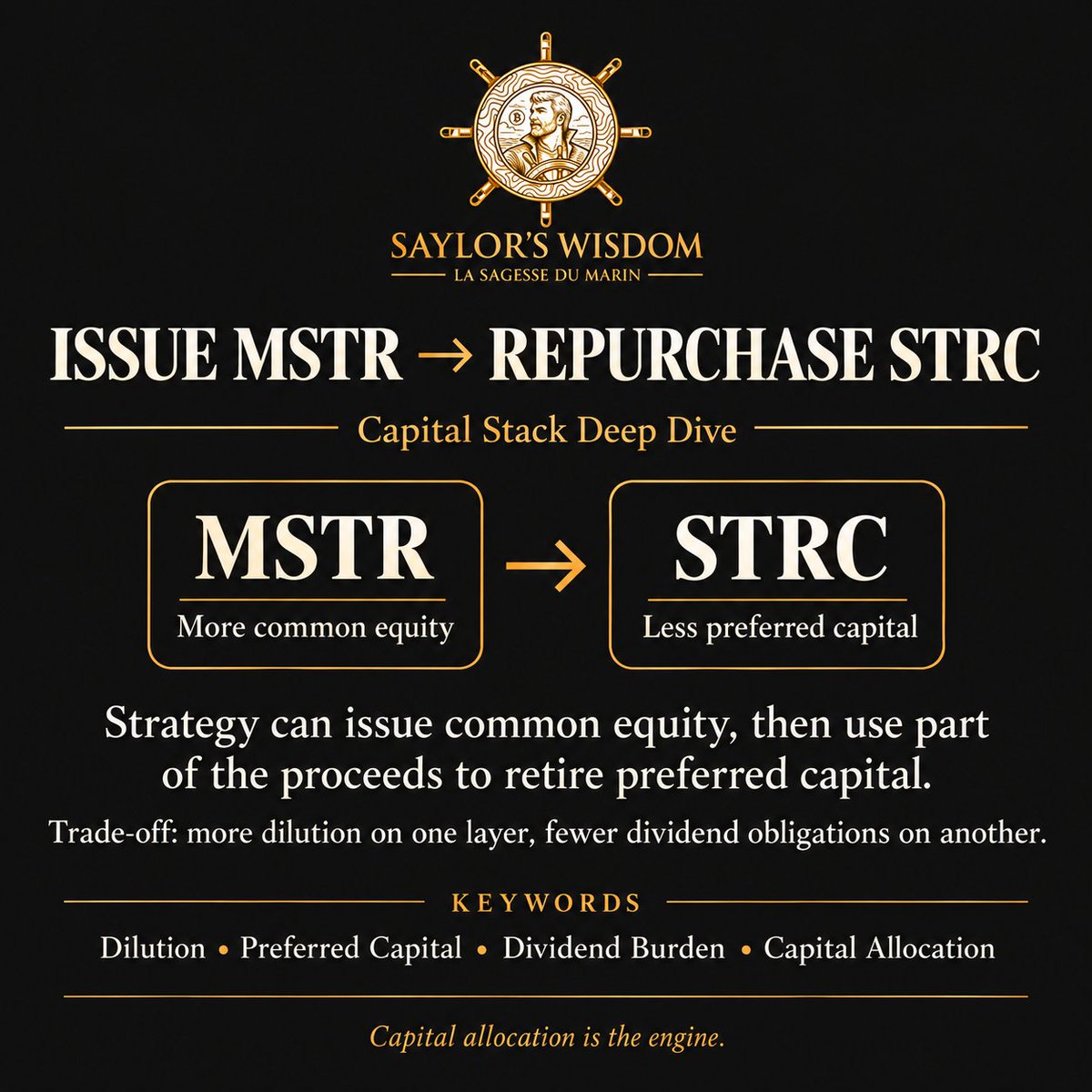
WHY WOULD STRATEGY DILUTE MSTR SHAREHOLDERS TO BUY BACK STRC?
At first glance, it sounds counterintuitive. Why issue new shares only to spend part of the proceeds repurchasing other shares?
Last week, Strategy raised $246.2M by issuing 1.47M new MSTR shares. While $142.7M went into Bitcoin, another $103.5M was directed toward STRC repurchases, supplemented by $48.1M of existing cash.
The key is understanding that MSTR and STRC are two fundamentally different claims on the same balance sheet.
$MSTR is common equity. Its shareholders bear dilution and absorb the residual risk of Strategy's Bitcoin exposure.
$STRC is preferred equity, carrying a variable dividend rate, currently 12% annually on its $100 stated amount. Its dividend rights rank ahead of common shareholders.
By issuing MSTR to retire STRC, Strategy is effectively exchanging one type of capital for another.
More common shares outstanding, but fewer preferred claims and a smaller prospective dividend burden.
And there is another detail: Strategy repurchased STRC at approximately $98.86 per share, below its $100 stated amount.
Does that automatically create value for MSTR shareholders?
Not necessarily. The dilution cost must be weighed against the discount captured, prospective dividend savings and the resulting capital structure.
This is why measuring Strategy solely through its Bitcoin purchases misses an increasingly important part of the equation.
The objective isn't simply to accumulate more BTC. It's to improve the economics of the Bitcoin exposure attributable to each common share.
Capital allocation is the engine. ⚓
STRC is the experiment
Watch the progression:
2025: Monthly
2026: Semi-monthly
Next: Daily
STRC currently pays a 12.00% dividend rate and already moved to two dividend periods per month.
If shareholders approve Strategy's proposal, STRC would be the first of its U.S. Digital Credit securities to move to the new structure, beginning in November.
STRF, STRK and STRD would follow in January. Strategy
STRC isn't just another preferred.
It is becoming Strategy's laboratory for Digital Credit.
$STRC