Economista, Abogado, Prof. UCV, Arte, ciencia, deporte, tenacidad -Festina lente. Ah! Una gran combinación para vivir. No es fácil, pero es maravillosa la vida!
THE DEVASTATION OF VENEZUELA
In his monumental work “The Wheels of Commerce”,* economic historian Fernand Braudel described the vital interplay between Fixed Capital and Circulating Capital for a country's economic activity. To illustrate this, he relied upon a brilliant metaphor used by economist Heinrich Von Storch (1820) to instruct the Grand Dukes of Russia, Nicholas (the future Tsar) and his brother Michael, about the importance of circulating capital. Von Storch assumed an extremely wealthy nation, with an enormous amount of capital in productive land, residential structures, bridges, canals, factories, workshops, machinery, and tools. Upon being invaded by barbarians, this nation is stripped entirely of its circulating capital—all rations, raw materials, and manufactured consumer goods—leaving its physical assets of production completely intact. This theft causes an immediate interruption to all labor and induces widespread famine; workers lacked the daily food to subsist, animals to till the land, and industry the raw materials to function. Without the vital flow of its circulating capital, the country was brought to its knees, condemned to absolute poverty and death—characteristics of all ancient warfare.
With analytical wit, Braudel inverts the plot by suggesting that barbarians vandalize that nation, but instead of draining the circulating capital, completely destroy all fixed capital—machinery and equipment, tools of labor, infrastructure (buildings, schools, hospitals, factories, bridges, and highways), and everything required to produce consumer goods and services. The resulting paralysis and misery would alter the country's way of life just as catastrophically as Von Storch’s scenario. Braudel concludes by noting that each one is important to the other. He described them as a “two-speed engine.” Circulating capital—comprising money, labor, and raw materials—is consumed and reproduced rapidly in each operational cycle, acting as the indispensable input required to physically produce and sustain fixed capital goods. Without this constant material feed, the creation or maintenance of capital goods becomes physically impossible, and the fixed structure is condemned to rapid decay and permanent paralysis.
It is clear that neither Von Storch nor Braudel ever imagined, in their worst nightmares, Hugo Chávez, Nicolás Maduro, and the criminal faction accompanying them. They did not merely disrupt the system; they simultaneously dismantled both Venezuela's fixed and circulating capital, burying the country under an unconstitutional public debt entirely appropriated by corrupt elements within the state apparatus.
The surviving regime itself estimates this unapproved burden at 240 billion dollars—a bill that the autocrats and their cronies will ultimately have to settle themselves. Indeed, Articles 312, 150, and 187 (numeral 9) of the 1999 Constitution textually invalidate this debt burden, firmly categorizing it under the international Doctrine of Odious Debt, which also applies to the blatant misuse of funds. Consequently, no lender can claim ignorance.
Aggressive seigniorage was deployed to finance the fiscal deficit—which they caused through institutionalized corruption—alongside the imposition of the highest inflationary tax in the world. These actions pulverized the national currency, destroying its function as a store of value and systematically crushing domestic consumption capacity.
To make matters worse, the double earthquake of June 24, 2026, was added today to this productive desert—an event and date that must never be forgotten due to the humanitarian catastrophe that exacerbates the devastating diagnosis for Venezuela. Chavismo did not just execute simple economic mismanagement; they carried out a systematic, deliberate destruction of both gears of the economic engine. Through a predatory policy of expropriations, confiscations, and asphyxiating price and currency controls, the regime first choked the daily cash flow of the economy. They looted circulating capital to enrich themselves while ruining productive enterprises, inevitably triggering the collapse of consumer goods supplies and the essential intermediate goods for businesses to operate.
It was a criminal and irreversible assault on fixed capital: basic industries, electrical infrastructure, water supply systems, the refining network, and highly productive agricultural land and livestock. Confiscated properties were vandalized, thoroughly cannibalized, or abandoned to physical decay without the slightest reinvestment for their replacement.
Today, the country's physical production structure is dismantled. The apparent "wealth" or stability observed in certain buildings or residential assets is not wealth created by the regime; it is the inertial inheritance of the decades prior to Chavismo—a physical remnant that refuses to disappear but languishes day by day. The collapsed buildings, with few exceptions, were shoddy structures rushed to completion under the governments of Chávez and Maduro for low-income families, who did not know they had acquired their cinderblock sarcophagi.
The direct consequence for its citizens is a population plunged into a landscape of structural misery that they cannot escape on their own. The average Venezuelan finds themselves trapped in a perfect snare: they lack the physical infrastructure to produce, they lack a stable currency, and they are condemned to chronic underemployment. From the informal laborer to the highly educated professional, virtually the entire domestic workforce has been systematically downgraded—forced into precarious, severely underpaid positions that command only a fraction of their true productive worth. A former nation with a brilliant future has been reduced to a society where nearly 90% of the population is structurally underemployed, stripped of the ability to earn a dignified living matching their skills.
Without extensive investment in fixed capital and access to international financing, it is technically impossible for civil society or the remaining private sector to spearhead an economic recovery on their own. The country’s economic engine is not merely idling; it has been structurally gutted.
*Braudel, Fernand. Civilization and Capitalism, 15th–18th Century. Vol. 2, The Wheels of Commerce, pp 242-243. London: Phoenix Press, 2002.
#Economics #Venezuela #Constitución1999 #EconomicHistory #OdiousDebt #FixedCapital #Hyperinflation #HumanitarianCrisis
Gran trabajo de Andreina Ramos donde devela un secreto a voces: 3 universidades avalaron los cuestionados doctorados que varios aspirantes chavistas a magistrados del Tribunal Supremo de Justicia presentan como credenciales académicas.
El argumento de esta joven no es equivocado en principio. La policía debió ser más expedita en llegar al sitio donde esta chica fue acosada. Ella tiene razón en que aquel individuo debió ser detenido y seriamente penalizado, al punto de impedirle la oportunidad de dañar a alguien más en el futuro.
Evidentemente, ella está agradecida con el joven que la protegió, pues correctamente logró que el acosador desistiera en su intento y con ello protegió la vida de ambos. No obstante, pretender algo más hubiera sido altamente peligroso.
Y, sí. Las mujeres deben poner más cuidado en aprender a defenderse. Por suerte, pudo llegar hasta alguien que la defienda.
@C_SMaldonado Has votado por una trampa electoral intencionada de Pedro Sánchez y porque eres un HdlGP socialista que quiere vivir en un Estado de Bienestar que te favorece, a costa de los españoles que trabajan de verdad y pagan impuestos.
🇹🇿 WATCH: Tanzania’s newly commissioned passenger vessel PLOWS BOULDERS
The $45.34 million MV New Mwanza drove headfirst into Bismarck Rock.
Oh captain, my captain. Are you drunk?
Writer: Marie
@ricwe123 Zarg Finley
@threni
Asked me to prove my argument on J. Sachs, and blocked me to stop me from proving it.
But, Zarg, you can prove it to yourself just by reading.
TERRIFYING: In Sudan, Arab Muslim gangs and slave traders are now in control and kidnapping Sudanese Christians for slavery.
Where is the UN? Where are the pro-Palestine advocates? Where are Greta, BLM, and the self-proclaimed human rights defenders?!
Why is Canada getting poorer than US. Not because it has less, it is because it cannot churn out more.
Credit for the video to Neighbors Apart
Grab a coffee: 9min.
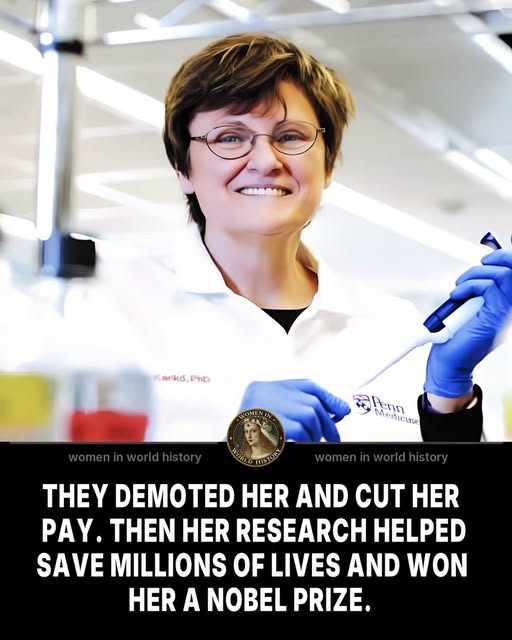
In 1985, a young Hungarian scientist sewed about $1,200 into her toddler's teddy bear and boarded a plane to America. It was all the money her family had, and they were never coming back.
Her name was Katalin Karikó. She was a butcher's daughter who grew up in a small house without running water, and she had one obsession: messenger RNA, the molecule that tells our cells which proteins to make. She believed it could one day be used to treat disease.
Almost nobody agreed with her.
At the University of Pennsylvania, her grant applications were rejected again and again. In 1995, the university took her off the path to a permanent professorship and cut her pay. She has said she was told she was not "faculty quality." She was in her forties, earning less than some of the technicians around her, and she kept going.
Then came a chance meeting at a photocopier. She started talking with immunologist Drew Weissman, and the two began working together. In 2005, they published a discovery that solved one of the biggest problems in the field: by tweaking a single building block of mRNA, they stopped the body from attacking it.
The world barely noticed. Karikó eventually left Penn and joined a small German company called BioNTech.
In 2020, the pandemic hit. The Pfizer-BioNTech and Moderna vaccines were both built on the breakthrough she and Weissman had made. Hundreds of millions of people received a shot that would not exist without the research her own university had sidelined.
In 2023, Katalin Karikó and Drew Weissman were awarded the Nobel Prize in Physiology or Medicine.
And that toddler with the teddy bear? Her daughter, Susan Francia, grew up to win two Olympic gold medals in rowing for the United States.
Karikó spent decades being told she wasn't good enough by people who were looking at the wrong things. She didn't wait for their approval. She outlasted their doubt.
Drew Weissman is Jewish.
Watch how well Rubio answers!
Question about Iran to Rubio:
You demonstrated a victorious American mentality, so at this point in the conflict in Iran, what would you consider an American victory?
SECRETARY RUBIO: I am on the American side of every issue — that I even have to say that is stunning. I am the Secretary of State of the United States.
🚨 BREAKING: Iran just launched a DRONE ATTACK on a U.S. military base in Bahrain, and American air defenses SHOT DOWN every drone.
It's Iran's second attempt to attack the country in the past THREE DAYS.
Reports say Israel warned U.S. officials about an Iranian plan to TARGET PRESIDENT TRUMP AND TOP CABINET OFFICIALS with explosive-laden drones.
DHS Secretary Markwayne Mullin says the U.S. is well prepared at home and that protecting the president, his family and the public is "OUR NUMBER ONE CONCERN."
Tehran is now warning that any American "military aggression" will "not go unanswered."
The Wall Street Journal reports Iran still has more than 1,500 BALLISTIC MISSILES.
Three carriers are in the region. Iran keeps testing American resolve, and it's going to regret it.