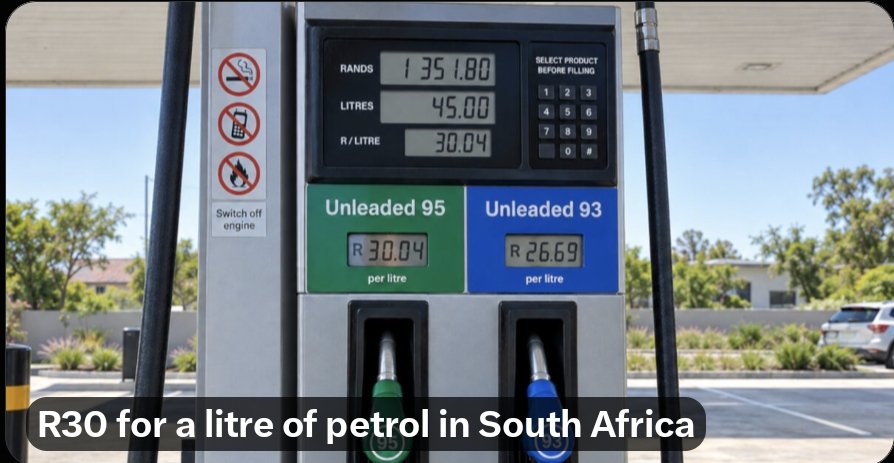
R30.20.
That is what a litre of petrol will cost on Wednesday. Up from R26.92 in September. The previous record was R28.06. Both get erased at the same pump.
But R30.20 is not what it sounds like.
Break it down.
The oil itself. Roughly R20.50. That is the Basic Fuel Price - what it cost to buy the barrel, ship it to Durban, and refine it. Brent hit $103.50 in September. Hormuz has been tight since the US-Israel strike on Iran in February. Every barrel carries a war premium now.
The levies. R6.54. General fuel levy R4.10. Road Accident Fund levy R2.25. Carbon levy 19 cents. This number does not move with oil. It does not care about Brent. It is baked in.
R6.54 out of R30.20 is just tax. Before you drive a single kilometre. That is 22% of what you pay at the pump going straight to the state.
Margins and transport. Roughly R3.16. Wholesale. Retail. Getting it from the depot to the forecourt.
The hidden part people miss.
R3.28 of this week's jump is not a price increase. It is a bill coming due.
For months the pump price was held below what the oil actually cost. The difference accumulated in the Central Energy Fund as under-recovery. Felt like relief. Was deferral.
Now the deferred amount hits all at once. R3.28 in a single week. Not smoothed. Not phased.
The comparison that matters.
In March 2020, petrol was R15.90. Oil had crashed. Demand vanished. The lockdown made driving pointless.
Now it is R30.20. Almost double.
The person earning R15,000 a month spends about 8% of their income on fuel to get to work. At R15.90 it was 4%. The tax did not change. The oil did. The worker did.
Who benefits.
The Treasury. R6.54 per litre is a revenue stream that does not need Parliament to vote on it. Every fill-up is a tax payment you cannot decline.
SASOL and the refiners. Higher import parity means domestic production margins expand even if they did not buy expensive oil.
Who pays.
The minibus taxi owner. The long-haul trucker. The delivery driver. The nurse doing night shifts because public transport does not run at 2am. The small business owner whose stock comes from a depot three towns away.
Diesel is worse. Tracking at R33.24. That is what moves food. Every rand added to diesel is a rand added to bread.
The uncomfortable truth.
R6.54 in levies is fixed. It does not go down when oil crashes. It only goes up when Parliament votes to raise it.
The oil price can fall back to $70 tomorrow. You will still pay R6.54 in tax. You will still pay the retail margin. You will still pay the VAT on top of all of it.
The floor keeps rising. The relief never compounds.
The question is not whether R30.20 is a record. It is.
It is whether the next time oil crashes, the consumer sees any of the relief — or whether the under-recovery fund just pockets the difference to cover the next spike.
Dear Mr President Ramaphosa @CyrilRamaphosa Fire
1. Public Protector Gcaleka
2. Police Minister Mchunu
3. Home Affairs Schreiber
4.IDAC Andrea Johnson
5.NPA Batohi
6. Minister of Small Business Development, Stella Ndabeni-Abrahams
#MadlangaCommission