1 in 3 online reviews was fake or manipulated in 2025 — costing the average shopper $125/year in bad purchases.
And it’s not just small business websites.
We’ve detected suspicious reviews on larger stores too.
Do you shop a lot online? Before hitting 'buy now', do this:
📷 reverse image search the product photos on Google
Scammers steal images from other stores. If the same photo appears on 10 different websites with different prices, that's a red flag 🚩
Supply chain attacks don't just hit corporations.
They hit the tools you use every day.
A trusted package. A helpful plugin. One update, and everything changes.
You can't audit every dependency.
ScamRadar watches the web while you work.
Donating online? Double-check the charity first.
Scammers often create fake donation sites during disasters and holidays.
Verify charities on https://t.co/lKSkRXKFYb or https://t.co/PrRcS17kTa before you give.
Scam tip of the day ⤵️
Never click tracking links in random texts or emails.
They can steal your data or charge your card.
If you want to track a package, go directly to the official UPS, FedEx or DHL website and enter the tracking number.
A quick click isn’t worth the risk.
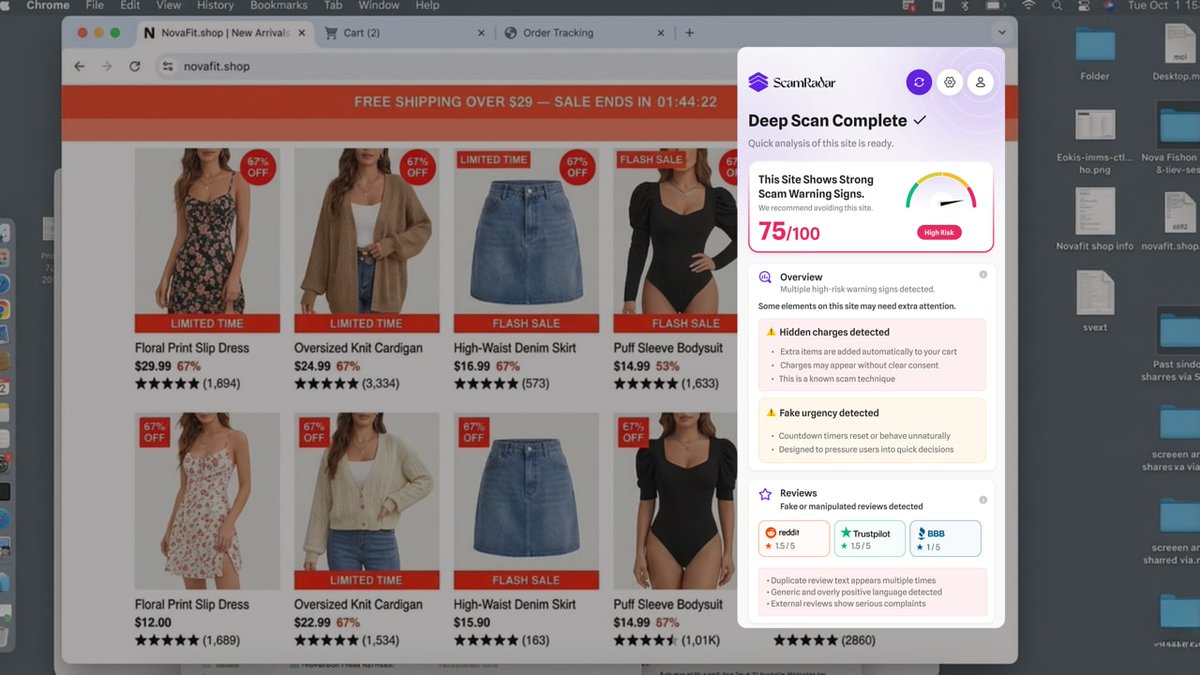
The anatomy of a modern scam:
1. Nice looking website
2. Urgent offers & discounts
3. Reviews with AI models 4. Fast, smooth payment process
5. Hidden charges you find out later
You can actually spot all that.
Use a tool like ScamRadar & stay away from risky websites.
Got your refund after that online scam? The loss still hurts.
The hours fighting with your bank. The stress. Sometimes your money frozen for weeks while bills were due.
A refund doesn't erase all that.
Next time, just use ScamRadar.
Scan any website and spot hidden risks.
AI-generated fake stores are fooling 84% of shoppers now.
Here's the tell: real new brands don't launch with perfect photos and 70% off everything.
Too polished, too cheap, brand new website? Run.
...or use ScamRadar to double check any website ⤵️
Not sure if a website is legit? Do this before buying ⬇️
Test their customer service. Send a question about the product.
Scam websites either won't respond or give generic copy-paste answers.
Real stores actually respond instantly, within 24 hours.
Noticed how some stores always show "Sarah from Austin just bought this"?
Check the timestamp.
It's always 2–4 minutes ago. Always.
Those aren't real buyers. They're fake notifications made to rush you into buying.
Classic trick.
Scammers are using AI to create entire fake product catalogs in hours.
They steal photos from real brands, generate fake reviews, and add discount codes to create urgency.
➡️ Quick tip? always reverse-search product images before buying from unknown sites
People who think they're too smart to be scammed? They're usually the easiest targets.
Overconfidence creates a false sense of security. You stop questioning what looks familiar.
You dismiss red flags, thinking you can tell the difference. Scammers count on that.
A growing number of fake AI tools are popping up lately.
They promise never-seen-before features.And people are eager to try the latest in AI.
Scammers know that.
The hype is exactly what they exploit.
Did you know 82% of organizations suffered a container breach last year?
Many now assume it could happen again because of how sophisticated attacks have become.
Online scams are heading the same direction. It's not a matter of 'if', but 'when' and 'how' you deal with them.
Online scams have been around for a while.
The issue is that you can't tell them apart from real websites anymore.
Same high quality.
Same reviews.Same payment methods.
Just small differences that can cost you hundreds.
➡️ Try ScamRadar detects even the smallest details.
Phishing don't look suspicious anymore.
It uses your company's exact branding.
It copies legitimate email formats.
It creates urgency that feels real.
What's the most convincing phishing attempt you've seen?
Did you know stolen credit card details can sell for up to $200.
Now imagine +10,000 of them.
That's why data breaches happen at scale. Nobody is really safe.