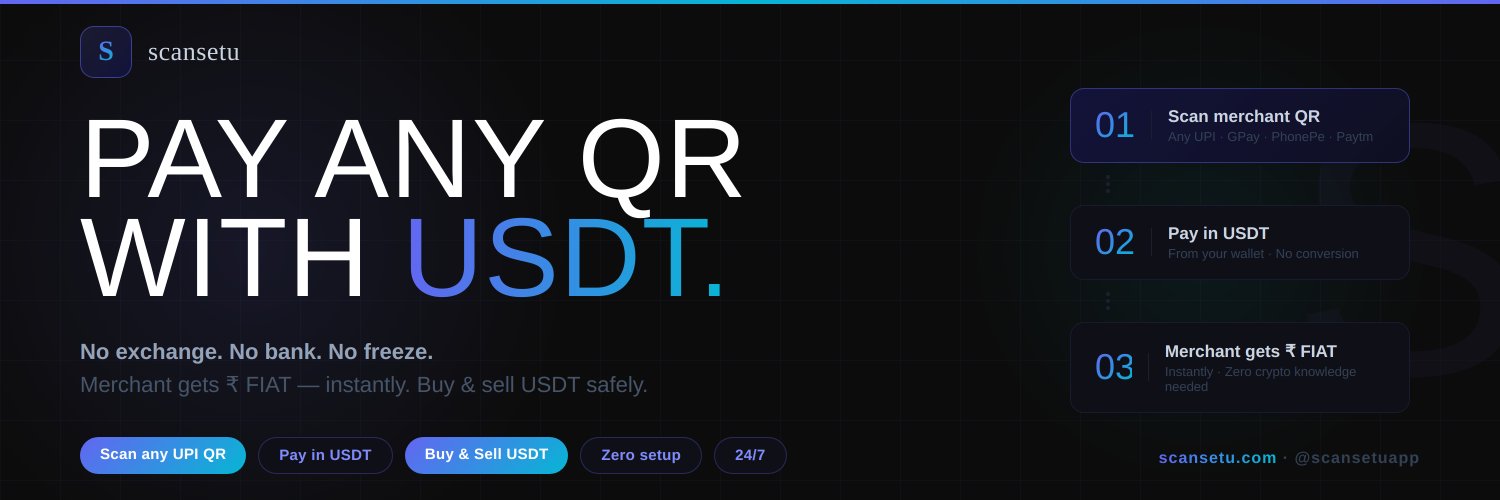
🚀 We're back.
ScanSetu is now live on our new app — faster, smoother, more reliable.
Thank you for staying with us through the transition 🙏
Access it here 👇
https://t.co/syYiFpRjjA
Only official link. Bookmark & share.
The bridge is live 🌉
@Lovable we need urgent help with our production app, ScanSetu (live fintech platform, thousands of users).
We've raised a support ticket but only got automated replies. Our app is down and every hour affects real users.
Can someone from the team please DM us or escalate?
@0xPolygon Not the first billion, won't be the last — love it.
The billion we care about is the one nobody notices: merchants getting paid in their own currency, no wallet, no app, no idea a stablecoin moved.
Scale is easy to count. Invisibility is the hard part. The rail just runs ⚡
10,000 people in India have now paid with stablecoins — and most of them don't even know it. 🇮🇳
That's the whole point.
📊 10,000 users
🛒 11,300 orders
💵 $125,000+ settled — zero paid acquisition
Same QR they always used. Rupees in seconds. Crypto invisible underneath.
We didn't onboard India to crypto. We just made crypto disappear.
The rail just runs ⚡
⏰ 24 hours left.
$100 in USDT going to 5 supporters ($20 each) to celebrate crossing $100K settled. 🇮🇳
To enter:
✅ Follow @ScanSetuPay
✅ Repost the pinned post
Winners picked in 24h. Early access to the next announcements too — and they're close.
The rail just runs ⚡
$100,000 settled. Zero paid acquisition. 🇮🇳
We grew this with real users — so we're giving back to the community that got us here.
📊 8,800 users
🛒 9,300 orders
💵 $100K+ USDT settled (+56% in two weeks)
🎁 $100 in USDT going to the community:
Follow @ScanSetuPay + repost this. We'll pick 5 supporters ($20 each) in 48h.
Early access to the next announcements too. The quiet weeks were us building — now it gets loud.
The rail just runs ⚡
We're hiring 🚀
ScanSetu just crossed 9,000+ users and
$100K+ USDT settled in 3 months — support
demand is scaling fast.
Looking for 2 Community Support Mods:
📋 Handle order queries, keep community
safe, respond to users
🕐 Cover 8 AM–11 PM IST (split shifts)
🗣️ Hindi + English fluency
💰 $100–$200/month + performance bonuses
Perfect for early-stage builders who want
to grow with a fast-scaling crypto payments
startup.
Preference to active community members.
DM to apply 👇
https://t.co/rvMqt6xa8V 🌉
“payments means stablecoins that work globally, for people.”
we’re doing that pillar on base, in india. someone pays with usdt, a merchant gets rupees in under a minute over the upi qr he already has. no app, no wallet, no idea a chain was touched.
$100k settled in 3 months, zero paid. the “for people” part isn’t a future tense. it’s a chai stall that got paid today and never learned the word stablecoin.
better money doesn’t need social. it needs to reach someone who never asked for crypto and just wanted to get paid.
$100,000 settled. Zero paid acquisition. 🇮🇳
We grew this with real users — so we're giving back to the community that got us here.
📊 8,800 users
🛒 9,300 orders
💵 $100K+ USDT settled (+56% in two weeks)
🎁 $100 in USDT going to the community:
Follow @ScanSetuPay + repost this. We'll pick 5 supporters ($20 each) in 48h.
Early access to the next announcements too. The quiet weeks were us building — now it gets loud.
The rail just runs ⚡
the best consumer crypto app is the one that doesn't feel like a crypto app.
ScanSetu — pay any merchant in india with stablecoins, they get rupees in seconds on the same QR they already use. the user never sees a chain, a gas fee, or a wallet popup.
8,800 users, $100k+ settled, zero paid acquisition. the ones who try it keep using it.
@0xNairolf This is already happening. In India people pay a shopkeeper the exact way they always have — same QR, rupees land in seconds — and a stablecoin moved underneath without anyone noticing. Nobody "adopted" crypto. They just used something that worked. The rail just runs ⚡
$9.12B P2P is real proof — people genuinely want to move money this way. The next step is bigger: the person getting paid doesn't hold crypto at all. They scan the same QR they always have and rupees land. That's when it stops being crypto-native and starts being everyone. The rail just runs ⚡
Two weeks ago a merchant in Gujarat got paid in rupees and never knew a stablecoin moved. It's happened 6,400 times since.
ScanSetu update 🇮🇳
📊 6,550 users (+31%)
🛒 6,400 orders (+39%)
💵 $64,000 USDT settled (+49%)
Volume growing faster than signups — people who try it, keep using it.
Zero paid acquisition. The rail just runs ⚡
@sandeepnailwal This is the part most people miss. The card stays on top, but the money moving underneath is where stablecoins quietly win. Settlement is the battleground, not the interface. The rail just runs ⚡
settlement volume is the scoreboard. it's not the game.
the chain that wins payments isn't the one processing the most stablecoin volume. it's the one where the merchant taking the money never learns a chain touched it.
$79b in settlement is the proof. the merchant who thinks he just got paid in local currency is the product.
The market is finally starting to value what actually matters: real payment volume, stablecoin settlement, and enterprise adoption.
Polygon has been building for this.
paid with scansetu #04 — the fix
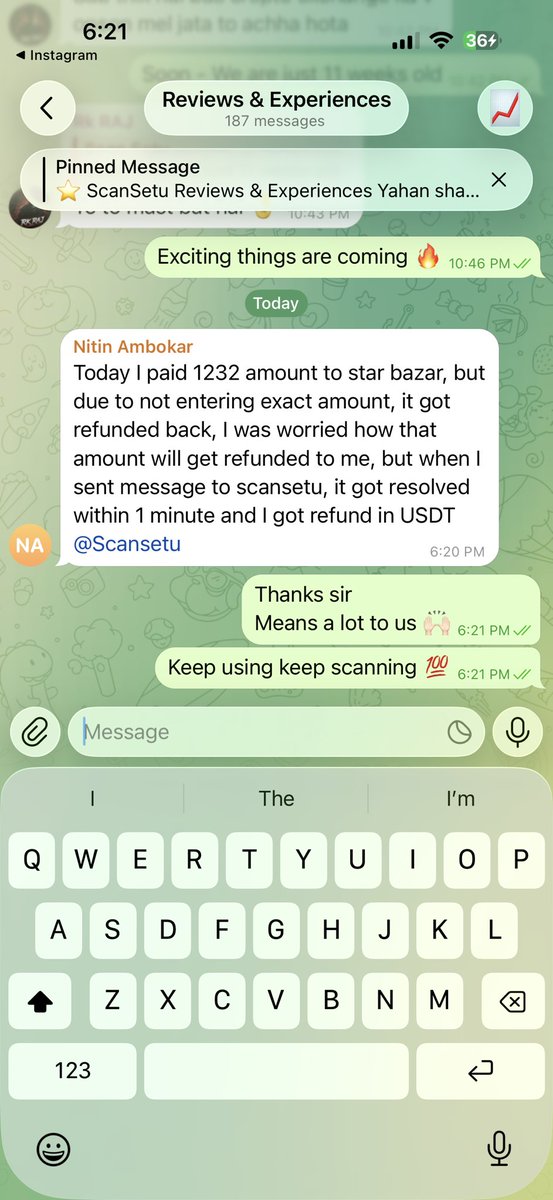
user's ₹1,232 payment failed at star bazar.
dm'd us. resolved in 60 seconds.
"i was worried how that amount will get refunded.
resolved within 1 minute."
the rail just runs. when it doesn't, we do.
5,000 down. Onwards. 🇮🇳
If you've been paying with ScanSetu, share your story — we're reposting the best ones this week.
Zero paid acquisition. The rail just runs. ⚡
What's coming next:
→ Solana support
→ Deeper community partnerships
→ More features that disappear into the background
Follow along for product updates. Founder journey lives at @0xsetu.