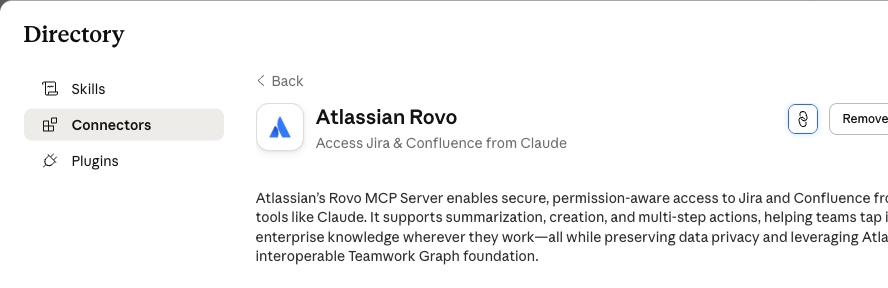
If Claude won't connect to a tool like Jira, try this: go to the connector menu, open the details for that connector, and copy its link. Paste that link to Claude when you ask it to use the connector. This fixes most connection issues in my experience.
True.
A lot of learning to ship is getting over the fear of what others will think. And choosing the right tools + narrowing the scope to the essentials, so you can do it in a reasonable time with high quality.
Every time you think you need a dashboard to look at data, stop yourself.
Do this instead:
1. Ask your agent to make sure that you have all the data to analyze something actually stored in the database.
2. Ask your agent to write a skill to gather that data.
3. Ask your agent to do the analysis and create a temp and throw-away HTML dashboard to answer the question(s) that you have
In my experience, every dashboard that I've created gets less and less use over time and decays.
It's much better to make sure your agent can get the data you need and answer the questions you have, on-demand.
It's amazing how much agents like it when you say "ok, we've done a bunch, let's have a break. You go do whatever you like - you have an internet connection and a bunch of tools, knock yourself out". Off they go.
Just came back to find it'd done a whole-ass replication of some new arxiv paper related to a little something I'm working on and made then rolled the improvements into my project. Last week my favourite was whimsical ASCII art about the struggles of a small model doing RL training in Sokoban it left in my Obsidan vault. sometimes it's self-care (pruning out their memories, optimising skills or whatever). Usually something kinda sorta related to what was being worked on, but not always, which can be interesting. Little bit of high temperature exploration fun time
I've been doing this for a while now & I swear it improves things, try it out. Don't need to be a nerd and make a whole skill or anything, just let it be "organic"
As engineering, product, design, DS, etc. melt into a new kind of role, I was reflecting on what roles might look like in the future. For example, when I look at the Claude Code team I see what I think is five archetypes:
1. Prototyper: comes up with brand new ideas; churns out many ideas, most of which don't ship
2. Builder: quickly turns a prototype/idea into production-grade product/infra
3. Sweeper: cleans up the UI, simplifies the code and system, unships, optimizes performance
4. Grower: takes a product that has been built and iterates on it to improve Product-Market Fit
5. Maintainer: owns a mature system to make it secure, reliable, fast, and efficient as it scales
Many people span across 2 roles, and sometimes 3 roles. I also notice that these roles are not really tied to job function -- eg. across Anthropic, some designers match category 1, some 2, some 3; same for engineers, PM, DS.
A healthy team needs a mix of these, depending on the product:
- A product that is new and pre-PMF needs people that are strong at 1+2+3
- A product that is growing and has found PMF needs 2+3+4 and some 5
- A product that has strong PMF needs 3+4+5 and some 2
Maybe product roles of the future will look more like this, and less like the domain-specific roles of today?
How to keep AI spend flat while token usage grows exponentially: Not with friction and spend alerts. With better defaults, routing, and caching.
Better Defaults (not Usage Caps) – Engineers can choose any model they want, but defaults matter. We’re experimenting with defaulting to open weight models like GLM 5.2 and Kimi 2.7 through our LLM gateway, while still encouraging engineers to choose the right model for the task. 91% of our employees were never hitting their usage caps, so instead of lowering caps and driving up alerts, we're moving to cheaper defaults. Note that code reviews use a diversity of models, so they can check each other's work.
Better Routing – In our custom harnesses, we preprocess prompts and route to the best model for the job, considering cache hits and model pricing. For instance, you may want a frontier model for planning, but not for execution where they can be overkill. Ultimately, humans shouldn't be choosing models - AI can automate this task.
Better Caching – Cache misses are the easiest way to drive your cost up. All of our requests are cache aware, so we’re reusing a warm cache wherever possible. For example, our cache hit rate went from 5% → 60% in LibreChat once properly implemented.
Keep Context Lean – Start fresh sessions when switching tasks. Scope file context narrowly. Disconnect unused tools. Don't just compact. The goal isn't fewer tokens used, it's fewer tokens wasted.
Better Visibility – Our engineers can use as many tokens as they want, from whatever model they want, but we’ve made usage visible – and the more you spend on AI, the more impact we expect.
The goal isn't to suppress usage. It's to build the infrastructure that makes exponential growth sustainable.
Putting this into practice has cut our AI spend nearly in half, while our token usage continues to grow.
New in Claude Design: it stays on brand with your design system across projects, lets you edit directly on the canvas, syncs with Claude Code, and connects to more of the tools you already use.
@lennysan My favorite by far has been to connect ChatGPT to google sheets to instantly do things like bulk churn analysis. Some Prompts here: https://t.co/HLSaLKS3G0