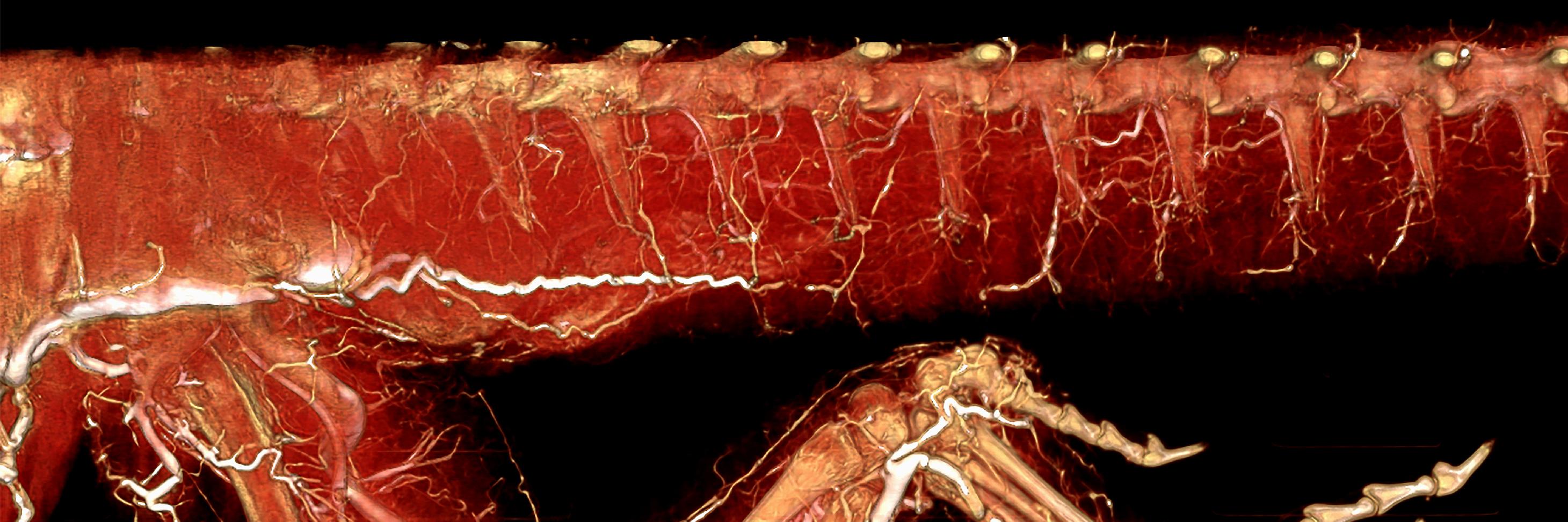
Happy #3DThursday! In celebration of Thanksgiving, today’s specimen is an incredibly imaged Peking duck. This is an ex vivo CT Scan done using a unique contrast dye.
Special thanks to Dr Scott Echols and the Comprehensive Anatomy Research Project for these amazing data. #syglass
Happy #3DThursday! In celebration of Thanksgiving, today’s specimen is an incredibly imaged Peking duck. This is an ex vivo CT Scan done using a unique contrast dye.
Special thanks to Dr Scott Echols and the Comprehensive Anatomy Research Project for these amazing data. #syglass
If you care for a non-traditional species and use veterinarians who work with and especially specialize in these animals, I encourage you to read this story and better understand the issue.
For those of you with exotic animal pets (birds, reptiles, small exotic mammals, fish, etc), there has been an ongoing discussion about veterinary board certification for exotic animal specialties.
This is not to say these veterinarians are of poor quality- in fact several are good friends and colleagues of mine. However, it is creating a rift within the community of specialists.
However, there is a new self-certifying non-AVMA recognized group calling themselves specialists in everything exotic that the public may not realize is a non-recognized specialty nor have applicants completed the rigorous standards of ABVP or ACZM.
and ACZM [American College of Zoological Medicine]) that have certifications for board certifying veterinary specialists dealing with these species. For example, I am ABVP board certified in Avian Practice.
There are two AVMA (American Veterinary Medical Association) recognized specialty groups (ABVP [American Board of Veterinary Practitioners- Avian Practice, Exotic Companion Mammal Practice, Reptile and Amphibian Practice and Fish Practice]
Congrats to my colleagues Emily Lessner, Xing Xu, Bruce Young, Marc Jones, Ruth Elsey and Casey Holliday on our publication (official today) titled 'Predicting behavior in extinct reptiles from quantitative analysis of trigeminal osteological correlates'.
With special thanks from my team led by Dr Emma Schachner, we just got an incredible publication in Nature. The following is summarized by Dr Schachner.
5. Takeaway: The respiratory system is modified in specific groups of birds to mechanically enhance the flight muscles for soaring
6. Another takeaway: This work demonstrates a previously unknown role for avian air sacs and diverticula.
and analyzed muscle fascicle length in soarers and non-soarers. We found that the SPD and muscle architecture together improve the torque generating capacity of the wing when held in the extended "soaring" position.
4. What is it for: To assess its functional significance, we evaluated the impact of an inflated SPD on the pectoralis muscle using a method called MDA modeling (with a computational open-source gait modeling program: Gaitsym)
3. Who has it: We then looked at 68 species of birds (57 via CT or microCT - including a previously collected clinical dataset) and found that the SPD independently evolved at least 7 times in different clades of soaring birds, but does not appear in non-soaring species.
They can voluntarily collapse the SPD and still breathe, and independently open and close it on one side only. These birds were imaged for clinical purposes prior to this project (for unrelated reasons).
2. What is it not for: We found that the SPD does not play a critical role in ventilation in the Red-tailed hawk or Swainson's hawk by looking at CT scans of live sedated birds while they breathed.