Mujer musulmana en un taxi:
"Disculpe, ¿podría apagar la música?"
Taxista: "¿Por qué?"
-"La música es haram (prohibida)."
-"¿Por qué es haram?"
-"Porque en la época del profeta Mahoma no había música."
El taxista apaga la música, avanza unos metros y para el coche:
-"Muy bien, ahora bájese".
-"¿Por qué? Aún no hemos llegado."
-"Porque en la época del profeta Mahoma tampoco había taxis. Espere a que un camello la recoja."
If THIS doesn't infuriate you, then you're not paying attention: black couple who posted about "white privilege" sentenced after taking the life of their 3-year-old white foster daughter.
Ariel Robinson and Jerry Robinson, who had publicly posted content attacking "white privilege," were the foster parents of 3-year-old Victoria "Tori" Rose Smith, a little white girl.
The child d*ed from severe blunt force trauma and internal bleeding caused by repeated beatings while in their care.
Ariel Robinson was sentenced to life in prison. Jerry Robinson received 20 years.
Where's the widespread coverage from the mainstream media? Oh - that's right- it doesn't fit their narrative.
Let's do their jobs for them. Make sure everyone sees this.
#FosterCareFailure #ProtectOurChildren
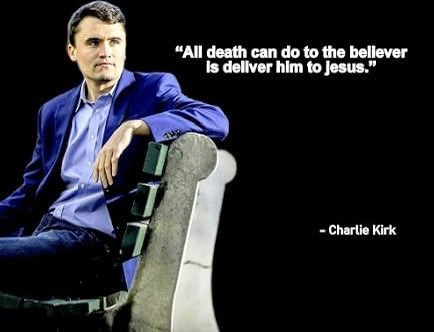
🙏 Powerful truth from Charlie Kirk:
“All death can do to the believer is deliver him to Jesus.”
In the face of loss and uncertainty, this is our unshakable hope. For those who trust in Christ, death is not the end — it’s the beginning of eternal life with our Savior.
Rest in that promise.
@KennethFCrowe1™
#CharlieKirk #Faith #Jesus #EternalLife #Christian #MAGA
It’s not the unvaccinated who are suddenly passing away or being diagnosed with turbo cancer.
The pattern is clear.
Many of those affected proudly announced their boosters and often criticized those who chose not to comply.
Their own words and bios tell the story.
The evidence is right there for anyone willing to look, yet the denial continues.
She was changing her newborn's diaper on the eighth floor when the world dropped out from under them. In the pitch-black hours that followed, buried alive beneath tons of concrete, a mother had only one way to know her 18-day-old baby was still alive — and she used it over and over, praying each time for the same answer...
Her name is Dayana Patiño, and her son, Juan David, was just eighteen days old.
On June 24, 2026, two massive earthquakes struck northern Venezuela within seconds of each other — the most powerful the country had seen in over a century. In the coastal city of La Guaira, buildings folded like paper. And Dayana was inside her eighth-floor apartment, tending to her tiny newborn, when the ground began to roar.
She barely had time to hope it was only a small tremor before the floor gave way beneath her.
The entire building collapsed. Dayana and Juan David fell with it, down through the crumbling structure, and as they fell she pulled her baby to her chest. Then the world went black and still, and tons of broken concrete pressed down around them.
When she came to, she was pinned. One leg was crushed beneath the rubble; her head was pressed against a rock. She couldn't move. She was buried alive, somewhere deep inside the wreckage of her own home — and cradled against her body was her eighteen-day-old son.
Everything around her was total darkness, except for one tiny "pinprick of light that looked like the moon."
Most people cannot imagine surviving that. And a newborn — a baby not even three weeks into the world, so impossibly fragile — trapped under a collapsed building? It defies belief.
But in that crushing darkness, Dayana Patiño made a decision. She was not going to give up. And the reason was lying right there against her chest.
"The one who gave me the strength not to fall into despair," she would later say, "was my son. I kept saying, 'As long as he was alive, I was going to be alive.'"
So through those endless black hours, she clung to one small, heartbreaking ritual. She couldn't see him. She could barely move. So every little while, in the dark, she would gently reach up and touch his tiny nose — just to feel the breath, just to be sure he was still breathing.
Again and again. A touch. A breath. He's alive. Then I'm alive.
Above them, the desperate search had already begun. Juan David's father, Gerson Trujillo, had just arrived home as the quakes struck, surviving only by leaping over a fence as the building came down. In an instant, everything he loved was buried somewhere in that mountain of rubble. He believed, in those first hours, that his wife and newborn son were gone.
But he would not stop. He rallied neighbors, and they began to dig, tearing at the debris with their hands, searching for any sign of life.
And then came the moment that gave Dayana her first real hope. Down in the darkness, she heard a familiar voice calling her name — her brother, somewhere above her in the ruins.
She summoned everything she had and screamed back: "I'm here!"
And her brother answered with a promise: "I've found you — and I won't leave until I get you out."
Now the rescuers faced an agonizingly delicate task. Mother and baby were alive, but reaching them without collapsing the rubble further would take painstaking hours. And a newborn cannot go long without fluids. So the rescue teams did something ingenious and tender: they carefully slid a straw through a small pipe running down into the rubble, and used it to get water to the baby — keeping the tiny boy alive, sip by sip, while they worked.
The digging went on. Hour after hour. More than thirty hours in total, mother and child trapped in the dark, as the careful, deadly-serious work of freeing them continued above.
And then, finally — they broke through.
Rescuers reached Dayana and Juan David and lifted them, at last, out of the wreckage and into the light. The people gathered around the site erupted, cheering and weeping, as the mother and her newborn emerged alive after more than a day entombed in the ruins.
Dayana was badly hurt — a broken knee, torn ligaments, injuries to both legs that would need surgery. But baby Juan David, the eighteen-day-old who had spent more than thirty hours buried beneath a collapsed apartment building?
He came out without a single scratch.
Not one. A newborn, pulled whole and unharmed from a disaster that killed thousands. When his father finally saw him alive, he could barely speak. "I thought they were dead," Gerson said. "And when I saw my son, I felt like I was born again. I felt the life come back to me."
The family has their own explanation for how a tiny baby survived without a mark. When the building fell, they say, mother and son came to rest on top of a copy of the family Bible — and they believe, with all their hearts, that this was what protected them. Dayana said that spotting that Bible beneath her in the darkness gave her a wave of peace and faith, a certainty that somehow, some way, she and her son were going to be saved. "That's where my fight for survival began," she said.
Believe what you will about the Bible beneath them. What is beyond dispute is this: a mother, crushed and trapped in total darkness, refused to surrender because her baby needed her — and kept herself conscious and fighting for more than thirty hours by reaching up, over and over, to feel her newborn breathe.
Their story swept across a grieving Venezuela, where tens of thousands were still searching for the missing, and became something the whole shattered nation could hold onto: a symbol that even in the worst catastrophe imaginable, life and hope can still be pulled, breathing, from the rubble.
The family lost their home. They lost nearly everything they owned. But they walked out of that disaster with the only thing that truly mattered still in their arms.
Little Juan David won't remember any of it. But one day, his parents will tell him the story — of the eighteen-day-old boy who survived the unsurvivable, and the mother who kept them both alive in the dark, one tiny breath at a time.
Sometimes hope is a rescue caught on camera. And sometimes it's a mother's fingertip, resting gently on a sleeping baby's nose, refusing to let go. If this story moved you, leave a note of hope for the Trujillo family — and for everyone in Venezuela still waiting for their own miracle — in the comments below.
Whenever an ICE agent kills an illegal its immediate outrage by Democrats and we must abolish ICE. But when an Illegal kills an American citizen, which is almost every day, the Democrats are silent.