Hola Iker. Al parecer has confundido un mapa con el riesgo potencial en caso de rotura para la población cercana a la presa con el riesgo de rotura en sí de la propia presa. Por cierto, seguímos esperando que nos invites a tu programa para hablar de las DANAS 😉
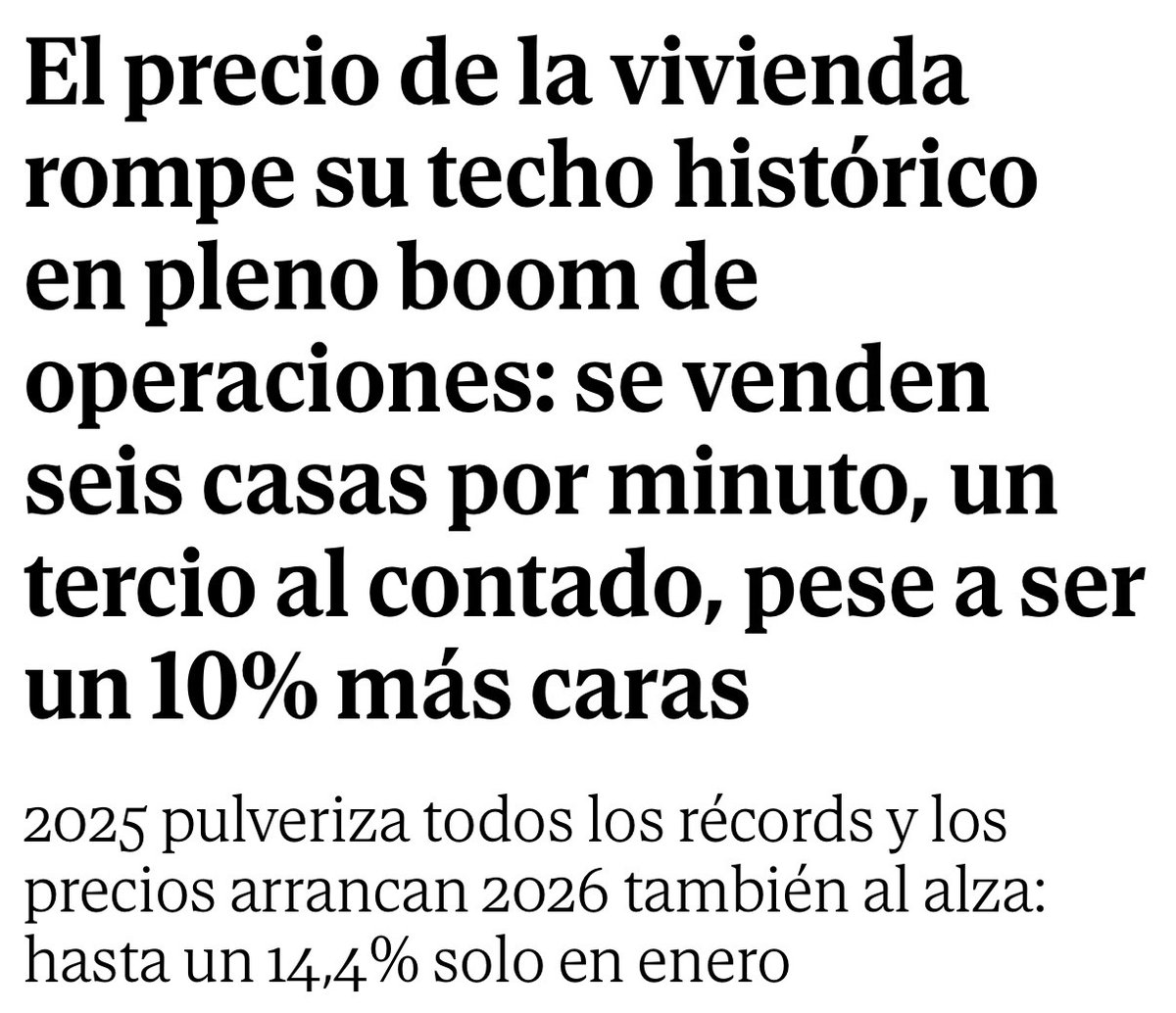
Récord de compraventa de vivienda, pero no para vivir.
🏠 Solo el 20% son primera vivienda.
💶 El 34% se compran sin hipoteca.
📈 El 56% de las hipotecas son para invertir.
La vivienda ya no es un derecho, está en manos de especuladores.
Son las 4 últimas portadas de El Mundo.
Además de los bulos, que son gordos, el periódico crea una línea clara de relato para echar todas las culpas al Gobierno de España, obviando en todo momento que las competencias son de las comunidades autónomas, donde gobierna el PP.
M. Rajoy con un par: "Unos actuamos contra la corrupción y otros contra los jueces, los fiscales y la Guardia Civil".
Un "breve" resumen de casos de corrupción del PP:
Caso Gürtel: Trama de sobornos y adjudicaciones públicas fraudulentas en varias comunidades autónomas.
Caso Púnica: Red de corrupción en la adjudicación de contratos públicos y financiación ilegal.
Caso Lezo: Corrupción en la empresa pública Canal de Isabel II (Madrid).
Caso Bárcenas (Caja B del PP): Financiación ilegal y contabilidad paralela del partido.
Caso Kitchen: Espionaje ilegal para encubrir pruebas del caso Bárcenas.
Caso Taula: Blanqueo de capitales y sobornos en el Ayuntamiento y la Diputación de Valencia.
Caso Palma Arena y Nóos: Malversación y desvío de fondos públicos en Baleares.
Caso Brugal: Corrupción en la adjudicación de contratos de basuras en Alicante.
Caso Erial: Comisiones ilegales en la Comunidad Valenciana.
Caso Imelsa: Trama de comisiones ilegales en Valencia.
Caso Madeja: Cobro de comisiones a cambio de contratos públicos en varias regiones.
Caso Rasputín: Uso de fondos públicos para fines privados en Baleares.
Caso Pokémon: Sobornos municipales en Galicia.
Caso Auditorio: Prevaricación y fraude en Murcia.
Caso Perla Negra: Corrupción urbanística en Castilla y León.
Caso Tótem: Enriquecimiento ilícito en Totana (Murcia).
Caso Over Marketing: Desvío de fondos en Baleares.
Caso Patos: Corrupción en Galicia.
Caso Scala: Malversación en Ibiza.
Caso Terra Natura: Corrupción en la Comunidad Valenciana.
Caso Trajes: Adjudicaciones irregulares en la Comunidad Valenciana.
Caso Valmor Fórmula 1: Desvío de fondos en la organización de la Fórmula 1 en Valencia.
Caso Abogados Melilla (Melilla)
Caso Aceinsa (Castilla y León)
Caso Acuamed (Comunidad Valenciana)
Caso Aerocas (Comunidad Valenciana)
Caso Aguas de Calpe (Comunidad Valenciana)
Caso Alhama de Granada (Andalucía)
Caso Amat (Andalucía)
Caso Ambulancias (Madrid)
Caso Andratx (Baleares)
Caso Arena (Galicia)
Caso Arroyo Encomienda (Castilla y León)
Caso Ático Estepona (Madrid)
Caso Auditori Paterna (Comunidad Valenciana)
Caso Avialsa (Comunidad Valenciana)
Caso Baltar (Galicia)
Caso Barraca (Murcia)
Caso Benagéber (Comunidad Valenciana)
Caso Biblioteca (Murcia)
Caso Bitel (Baleares)
Caso Bolsos (Madrid)
Caso Bragasgate (Canarias)
Caso Brugger (Comunidad Valenciana)
Caso Caballo de Troya (Galicia)
Caso Cabanes (Comunidad Valenciana)
Caso CAM (Comunidad Valenciana)
Caso Campus de la Justicia (Madrid)
Caso Carioca (Galicia)
Caso Carlos Fabra (Comunidad Valenciana)
Caso Carmelitas (Comunidad Valenciana)
Caso Cártel del fuego (Comunidad Valenciana)
Caso Casalarreina (La Rioja)
Caso Castor (Madrid)
Caso Ceivam (Galicia)
Caso Chocrón (Melilla)
Caso Clepsidra (Comunidad Valenciana)
Caso Colmenar Viejo (Madrid)
Caso Comfort Letter (Castilla y León)
Caso Conde Roa (Galicia)
Caso Contratos Marbella (Andalucía)
Caso Cooperación (Comunidad Valenciana)
Caso Coristanco (Galicia)
Caso Cuevas del Concejo (Madrid)
Caso Cursach (Baleares)
Caso de la Ciudad del Golf (Castilla y León)
Caso de la Construcción (Castilla y León)
Caso de los Espías (Madrid)
Caso Deportes Crevillente (Comunidad Valenciana)
Caso Depuradora Borriol (Comunidad Valenciana)
Caso Desguaces La Torre (Madrid)
Caso DV4 (Comunidad Valenciana)
Caso El Carabassí (Comunidad Valenciana)
Caso Emarsa (Comunidad Valenciana)
Caso Enredadera (Nacional)
Caso Eólica Valladolid (Castilla y León)
Caso Eólico (Canarias)
Caso Escorratel (Comunidad Valenciana)
Caso Faycán (Canarias)
Caso Funeraria Madrid (Madrid)
Caso Guateque (Madrid)
Caso Gran Alacant (Comunidad Valenciana)
Caso Gürtel (Nacional)
Caso Halsa (Andalucía)
Caso Hidrogea (Murcia)
Caso Imelsa (Comunidad Valenciana)
Caso IVAM (Comunidad Valenciana)
Caso Jadraque (Castilla-La Mancha)
Caso Lezo (Madrid)
Caso Líber (Murcia)
Caso Los Bonales (Castilla-La Mancha)
Caso Maldonado (Andalucía)
Caso Mar Blau (Baleares)
Caso Mar Menor Golf Resort (Murcia)
Caso Marchelo (Andalucía)
Caso Máster (Madrid)
Caso Matinsreg (Andalucía)
Caso Medina del Campo (Castilla y León)
Caso Mercamadrid (Madrid)
Caso Mijas (Andalucía)
Caso Mislata (Comunidad Valenciana)
Caso Monroy (Extremadura)
Caso Naseiro (Comunidad Valenciana)
Caso Nazarí (Andalucía)
Caso Nóos (Baleares)
Caso Novo Carthago (Murcia)
Caso Obras de Arte (Comunidad Valenciana)
Caso Olula del Río (Andalucía)
Caso ORA (Baleares)
Caso Over Marketing (Baleares)
Caso Palau de les Arts (Comunidad Valenciana)
Caso Palma Arena (Baleares)
Caso Patos (Galicia)
Caso Perla Negra (Castilla y León)
Caso PGOU Valladolid (Castilla y León)
Caso Pokémon (Galicia)
Caso Polideportivo Estación (Madrid)
Caso Púnica (Nacional)
Caso Rasputín (Baleares)
Caso Rato (Nacional)
Caso RTVV (Comunidad Valenciana)
Caso Salmón (Canarias)
Caso San Javier (Murcia)
Caso Santa Brígida (Canarias)
Caso Serrallo (Andalucía)
Caso Son Espases (Baleares)
Caso Taula (Comunidad Valenciana)
Caso Terra Natura Benidorm (Comunidad Valenciana)
Caso Tótem (Murcia)
Caso Trajes (Comunidad Valenciana)
Caso Turismo Joven (Baleares)
Caso Umbra (Murcia)
Caso Valmor Fórmula 1 (Comunidad Valenciana)
Caso Zamora (Castilla y León)
Caso Zerrichera (Murcia)
La encuesta de #ElPais muestra que el 28% de los jóvenes votarán a los fascistas que llevaron a Europa y al mundo a la guerra más grande de la historia de la humanidad.
Algo estamos haciendo mal los demócratas y antifascistas, para que los jovenes, entre 18-34 años, voten a VOX.
🔴 El juez Peinado deja morir la instrucción de un caso de presunta prevaricación que salpica al alcalde Almeida y a Eduardo Inda.
Hoy presentamos una queja ante el Consejo General del Poder Judicial para que abra un expediente por esta actuación negligente.
Te lo cuento 🧵👇🏽
Es que te tienes que reír. Es delirante. Años demonizando. Se rompe España. La amnistía es corrupción, manifestaciones, oposición a que se hable catalán en el Congreso, en el parlamento europeo…y ahora que a poner el contador a cero.
ahahahahahaha
this is Milei's second rug he "accidentally" promoted on social media. he promoted CoinX (a ponzi) in 2021 while Senator.
what a complete and utter disgrace for a head of state.
Funding Rates
The funding rate is the cost of holding an open position in a perpetual swap contract (perp).
It is usually calculated by the difference between the [price of the perpetual swap contract] and [price of a spot-based index].
If funding is positive, the perp price is trading at a premium (above) the index price. Open long positions pay funding, open short positions receive funding.
If funding is negative, the perp price is trading at a discount (below) the index price. Open short positions pay funding, open long positions receive funding.
Perps are different to standard futures contracts because there is no expiry or rollover mechanism.
This begs the question: how and why do perps generally trade in line with spot markets?
Answer: Funding.
This is a built-in arbitrage mechanism designed to incentivise traders to keep these instruments (specifically their prices) in line with one another.
For example: Perp trading meaningfully above the spot index price --> funding rate goes up.
Two things happen:
1. It becomes more expensive for long holders to keep their positions open (negative incentive).
2. Traders can buy spot, sell the perp, and collect the funding rate with minimal directional exposure (positive incentive).
The bigger the difference between the perp price and the spot price, the higher the funding rate.
Think of this as providing greater incentives to arb the difference the more out of line these instruments get from each other.
To be crystal clear, funding is primarily a product of the difference between [perp price] and [spot-based index price].
I'll also reiterate an important point from an earlier tweet: if funding is at baseline and/or there is no interesting divergence forming between price, funding, and time - you are unlikely to find an attractive setup.
All of these tools become complementary and contextually interesting when "something doesn't add up" or if they're at/near a relative extreme.
From a trading perspective, identifying divergences between funding and price can lead you closer to productive trade ideas:
1. Example: High positive funding but price is moving lower or stalling/not moving higher.
1.1. Reasonable inference: Perp longs are aggressive but are not being rewarded for it. This is potentially bearish (especially if other contextual clues present e.g. price into key resistance).
2. Example: High negative funding but price is moving higher or stalling/not moving lower.
2.1. Reasonable inference: Perp shorts are aggressive but are not being rewarded for it. This is potentially bullish (especially if other contextual clues present e.g. price into key support).
3. Example: Funding becoming more positive as price is moving lower.
3.1. Reasonable inference: Perp dip buyers are in 'disbelief' fading the move AND/OR spot traders are the aggressive sellers. This is potentially bearish (especially if other contextual clues present e.g. perp OI increasing, spot volumes and CVD leading, et cetera).
4. Example: Funding becoming more negative as price is moving higher.
4.1. Reasonable inference: Perp sellers are in 'disbelief' fading the move AND/OR spot traders are the aggressive buyers (especially if other contextual clues present e.g. perp OI increasing, spot volumes and CVD leading, et cetera).
These are just a few basic ones and you can build more setups especially if you incorporate OI + CVD where appropriate.
In essence, we're circling back to very important first principles here:
1. Who (if anyone) is being aggressive?
2. Is their aggression being rewarded?
As a final note, it's also important to understand not only what the funding rates are and their implications, but also how they came to be.
I can think of three particular examples where funding rates are misinterpreted most frequently.
1. Negative funding after an outsized move with liquidations.
As discussed, funding reflects the difference between the perp price and the index price.
Perps have higher leverage than the spot-based assets that typically make up the index. As a result, when there's a large amount of liquidations in the perp, those liquidations and messy unwinds exacerbate the size of the move.
Perps typically become more dislocated than spot at extremes, so naturally they end up trading at a discount to the index.
Accordingly, the negative funding after a wipeout does not necessarily mean that the market is short from the bottom now. It's just a reflection of perps getting hammered harder than spot because of the leverage that they offer.
2. "Spot premium".
Spot premium - where spot price of an asset is trading consistently higher than the perp or future price of an asset - can provide useful signals.
For example, during the 2021 bull run it was common to see spot exchanges like Coinbase consistently trading at a premium to perps and futures during the U.S. session.
One could reasonably see this as a reflection of risk appetite and more aggressive buyers in the spot market, which is generally a good sign.
However, this same argument was made many times on the way down from circa ~50k BTC - and it didn't quite work out.
Mechanistically, spot was leading the selling --> perps would follow --> perps get liquidated and move more aggressively than spot --> perps end up below spot --> "spot premium".
It's the same spot premium in form but completely different in substance and context.
If you will be relying on spot premium as an argument for spot demand, make sure that you have other arguments for there being demand in the market (not just the funding rate or basis).
3. Dodgy outlier altcoin (max) funding = squeeze imminent.
Particularly pertinent pattern in the second half of 2023.
It goes something like: huge price increase --> hugely negative funding --> speculators pile in the long side for continuation/short squeeze on account of the negative funding rate --> spot gets mega dumped instead and funding normalises.
For the outlier lower caps specifically, I'd be sceptical about looking into funding-oriented stuff too closely as it tends to be 'gamed' more often than not. The signals tend to be clearer on more liquid, higher cap assets.
More broadly, funding alone does not always make for a compelling argument for a squeeze.
You need to first build a prima facie credible case that the aggressors are the ones offside, ideally with some confluence via OI.
Even then, positive funding can normalise by perps closing/spot buying and negative funding can normalise by perps buying/spot selling - without any dramatic squeeze.
There are a lot of other interesting things about funding rates, but this is already quite long for an 'introductory' post.
Hope you enjoyed this one.
Thanks for reading and let me know if you want more.
HellCats x Mutantz! 👾🔥 #RaiseHell
Our friends from the Mutantz Team are giving away 3 limited edition custom skateboards to enter
👾 Follow @wearethemutantz
👾 RT & Tag 2 Friends
Winners chosen in 48hrs!
It's time for a @dystopAI_NFT giveaway! 🔥
20 winners will receive an AI-generated boomerang video of their LunaBull and @dystopAI_NFT Defenders WL. To enter:
- Post your Bull in the replies
- Retweet
- Follow @dystopAI_NFT and @LunaBulls