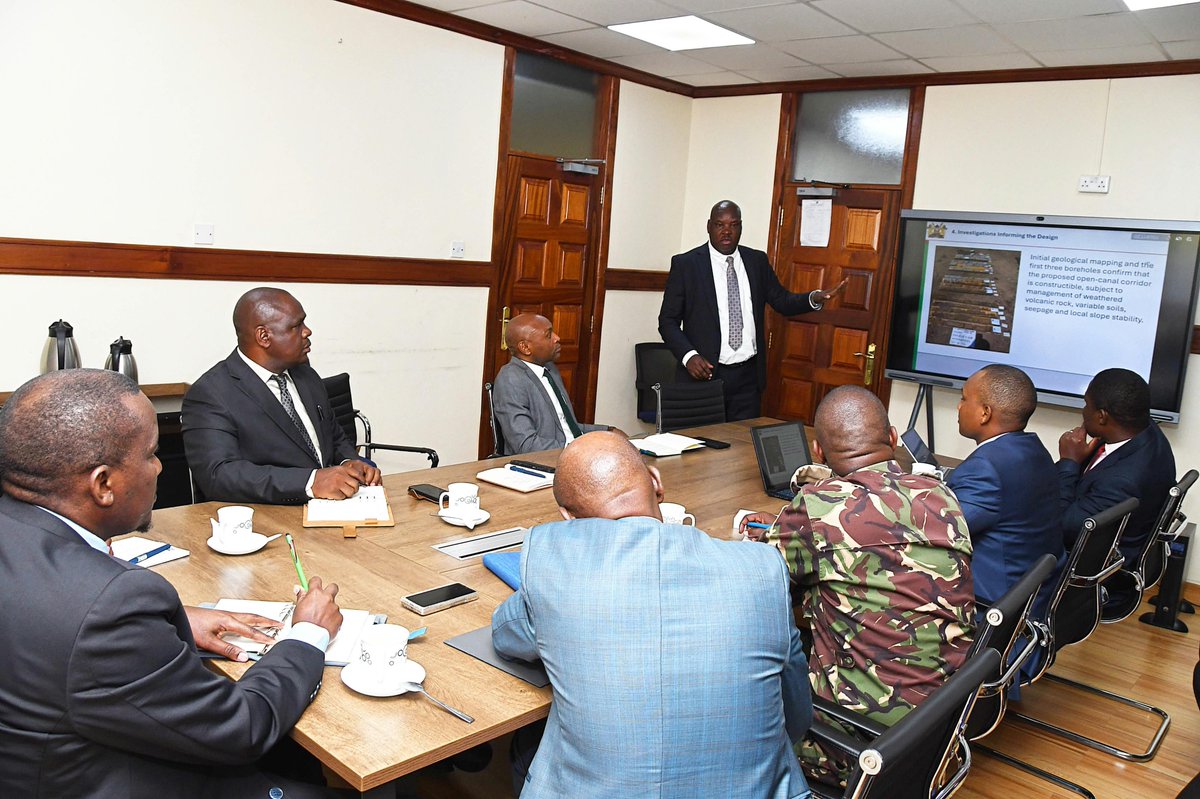
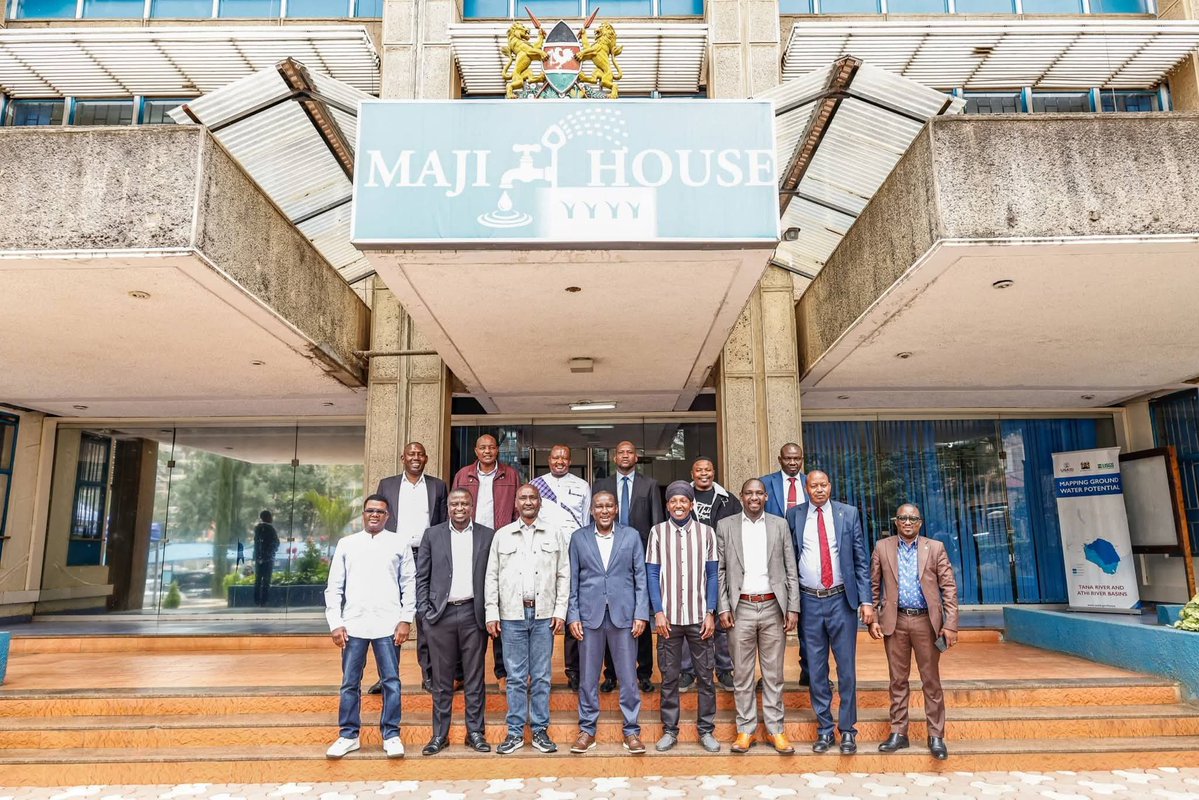
I today hosted my counterpart, Principal Secretary for Defence Dr. Patrick Mariru, at the Ministry Headquarters for a follow-up meeting on the proposed Lake Baringo–Lake Bogoria water management and irrigation project.
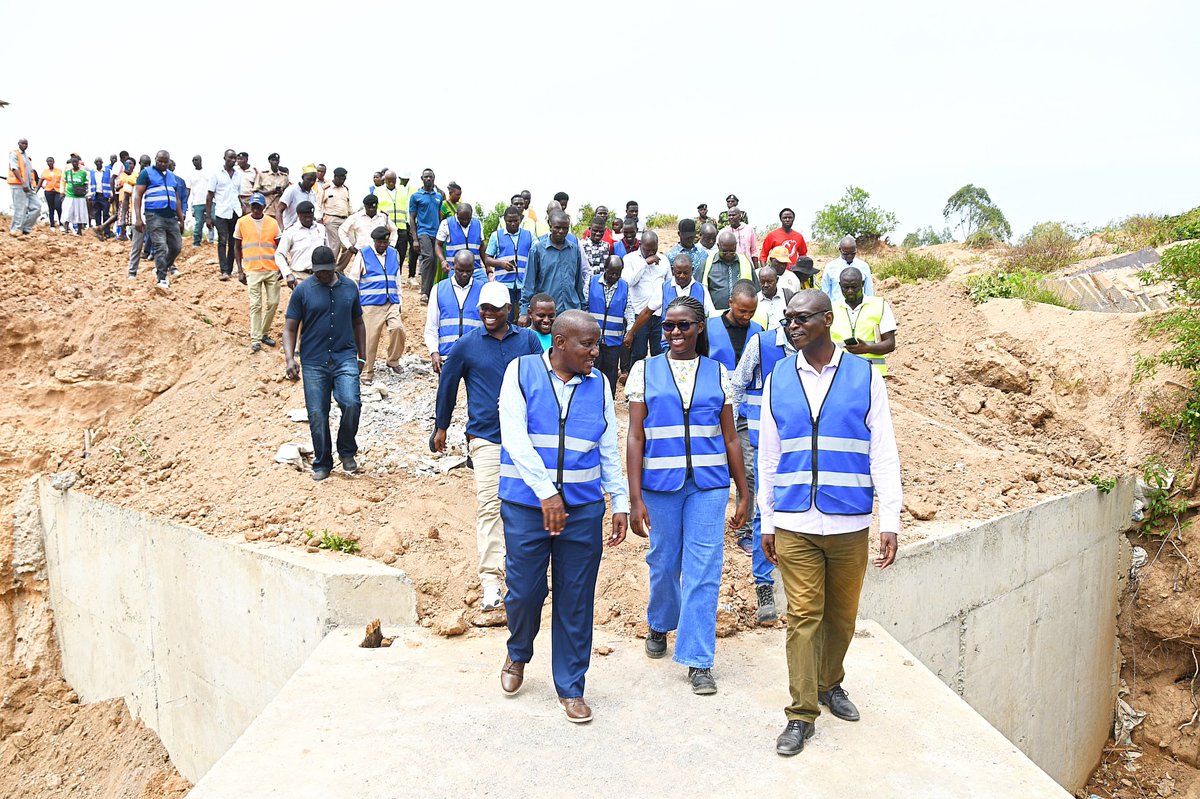
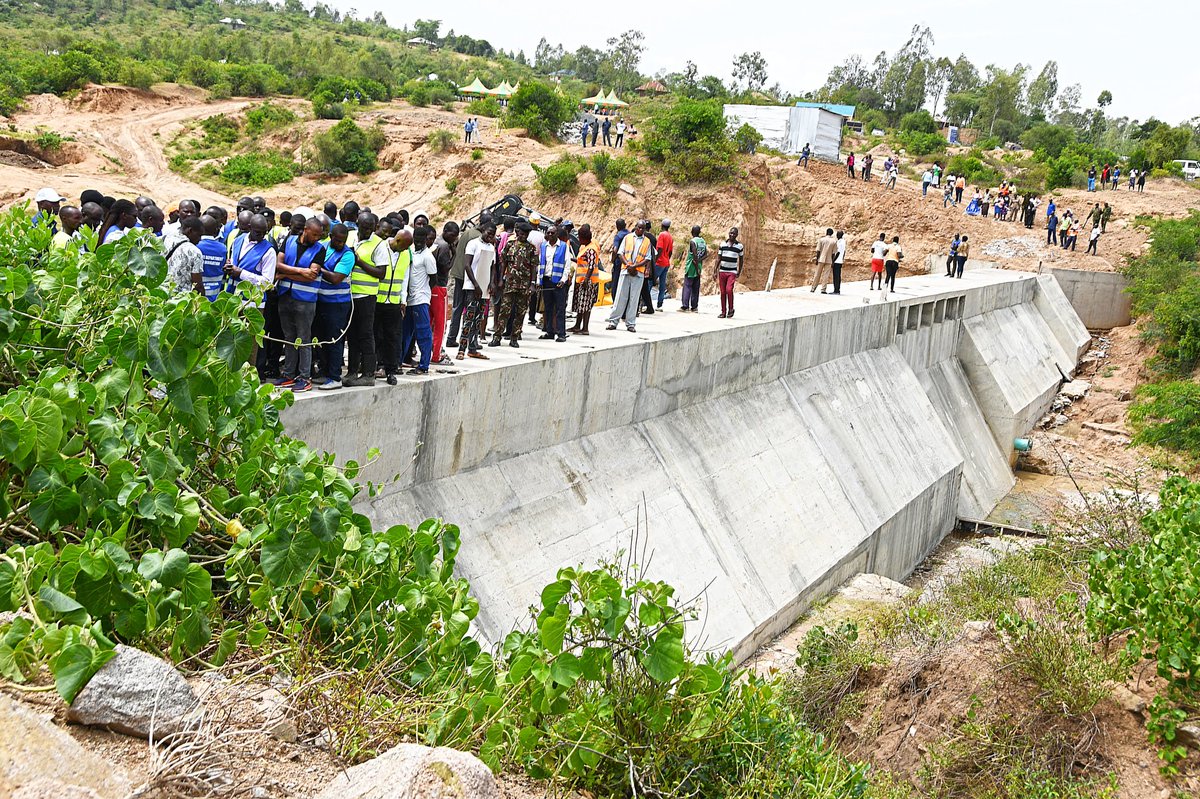
The meeting followed technical consultations and a joint site assessment undertaken by the two State Departments to examine rising water levels in the lakes and explore opportunities to safely manage excess water while unlocking its potential for irrigation and agricultural development.
Technical assessments have identified feasible routes for controlled water evacuation from Lake Baringo towards the Kinyang/Ginyange River system and potential irrigation areas. The immediate intervention includes approximately 10.5 kilometres of open canal, complemented by tunnel/deep-cut sections for the longer-term irrigation component. Geotechnical and hydrological investigations are ongoing to inform detailed designs and phased construction.
The revised hydrological assessment, incorporating additional flows from the Waseges and Loboi rivers, estimates potential design flows of approximately 41 cubic metres per second. The Nginyang River has also been assessed for its capacity to safely accommodate the diverted flows.
The project has the potential to unlock more than 100,000 acres of land for irrigation, significantly expanding agricultural production in Baringo and neighbouring areas. The additional water could support both large-scale and community-based irrigation, enabling farmers to transition from rain-fed agriculture to more reliable and climate-resilient production.
The State Department for Irrigation is leading the development of the irrigation component, including identification of command areas, water requirements, irrigation infrastructure and suitable agricultural value chains.
We will continue working with the Ministry of Defence and other relevant stakeholders to mobilise resources for detailed feasibility studies, environmental and social assessments, engineering designs and priority infrastructure works.
The initiative aligns with the Government's agenda of expanding irrigation, strengthening water security, enhancing climate resilience and increasing food production. It provides an opportunity to transform a significant water management challenge into a major driver of food security, employment creation and economic development in the region.
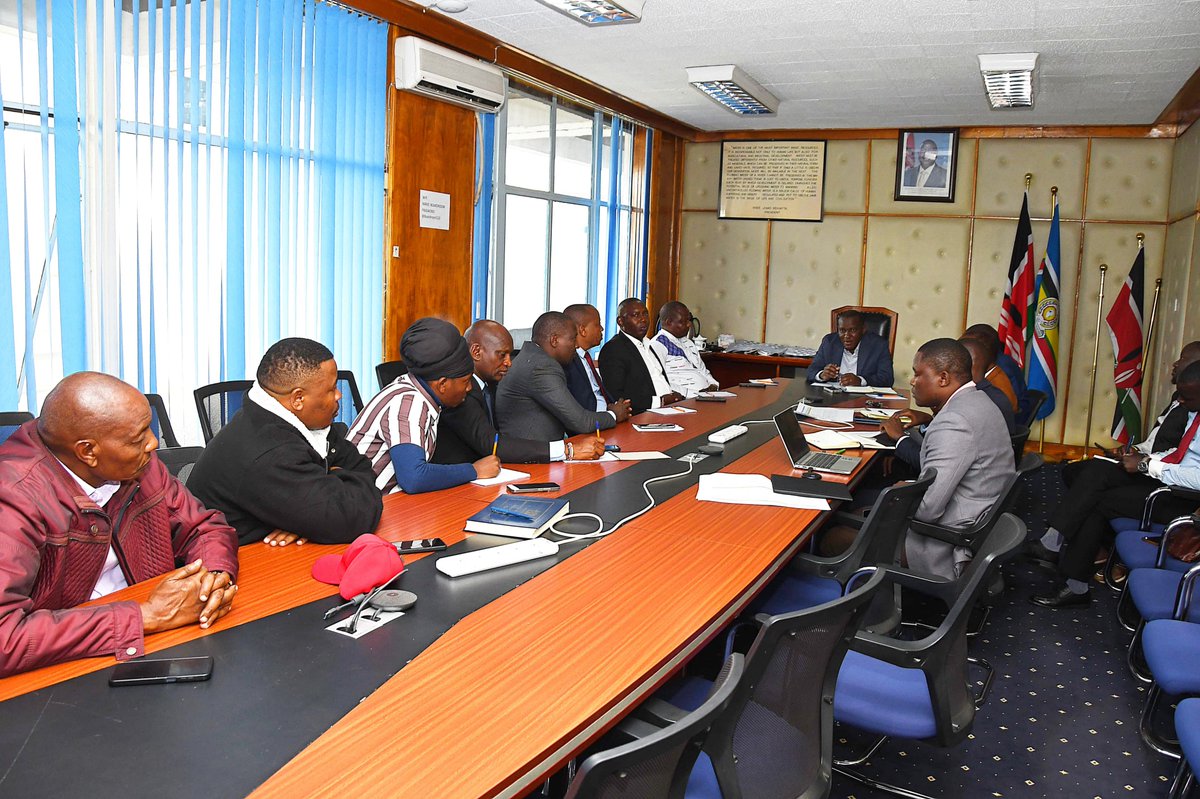
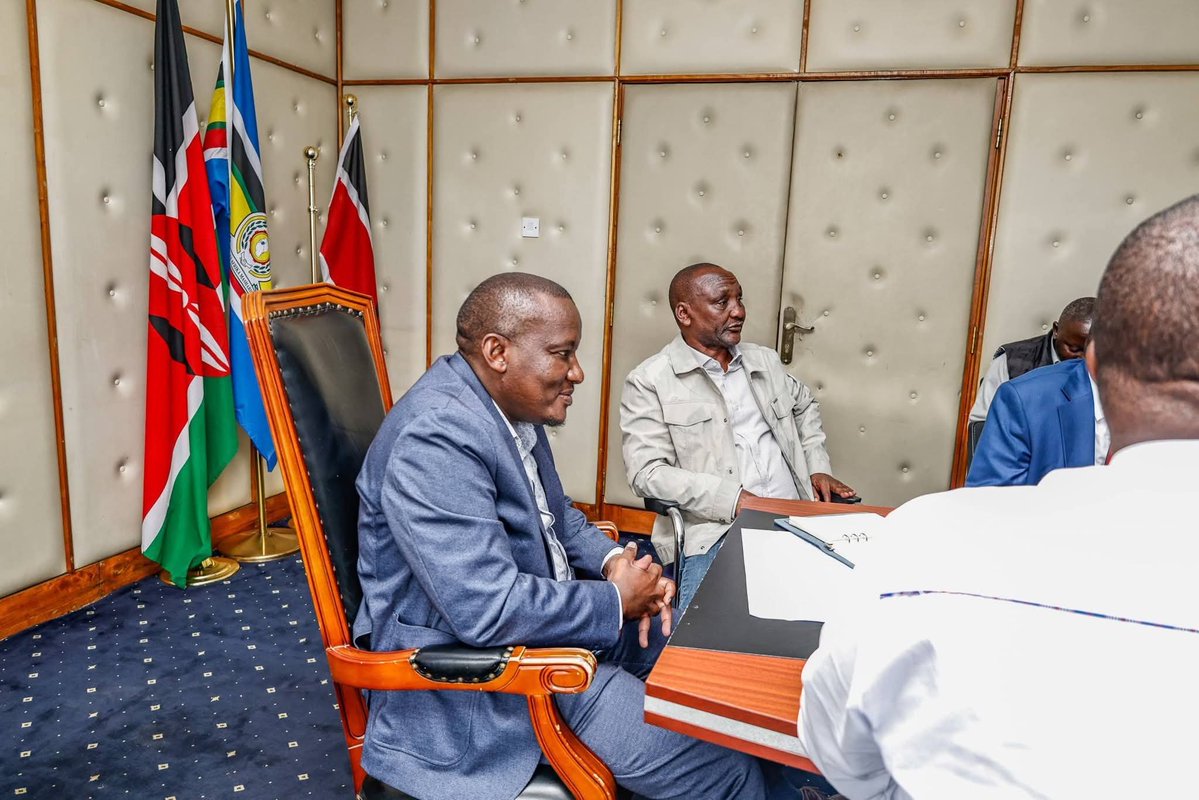
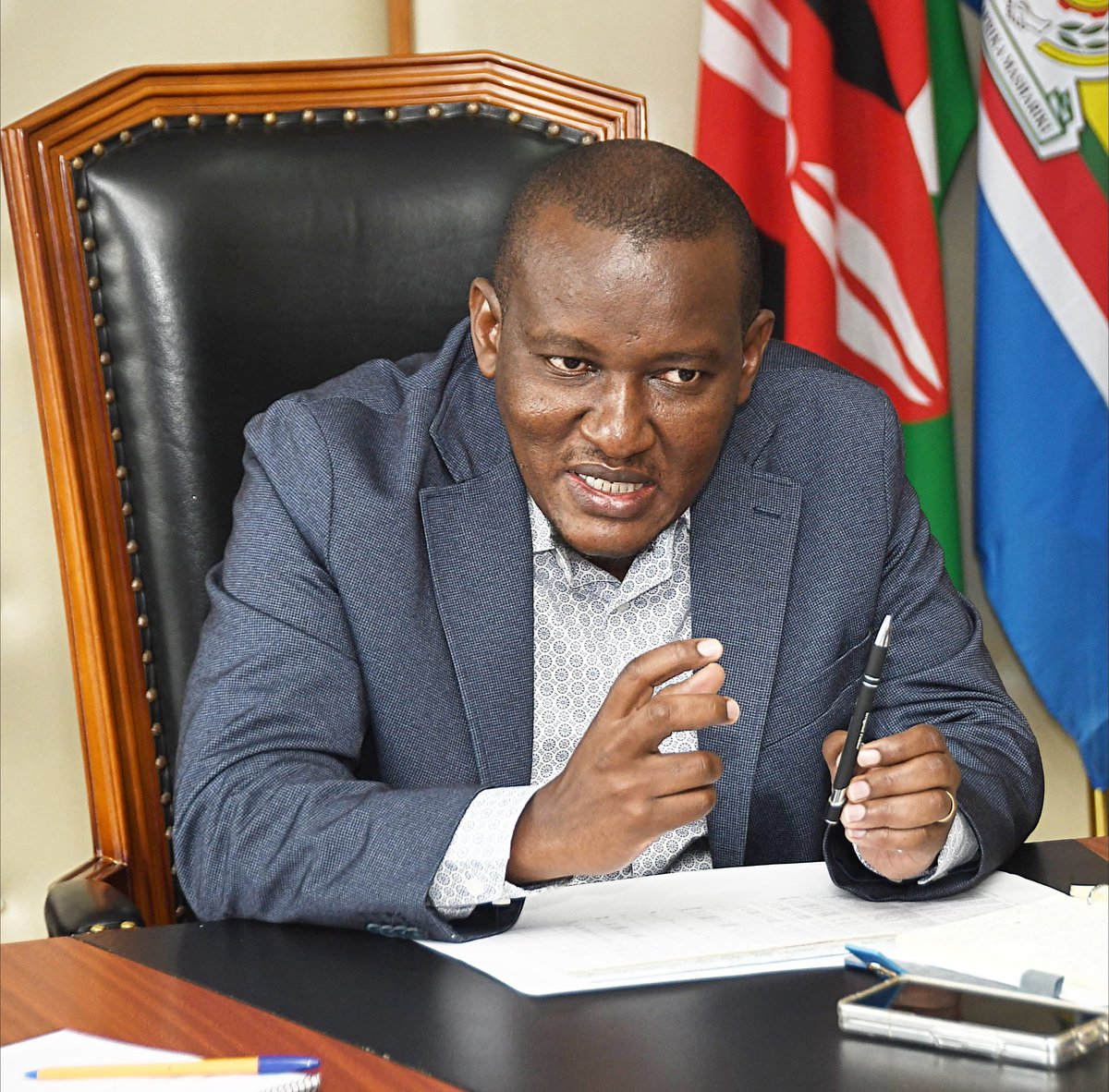
Today, I had the honour of hosting a delegation of Members of the County Assembly (MCAs) from Kajiado County, led by the Speaker of the County Assembly, for a consultative meeting on accelerating irrigation development and strengthening food security.
Our discussions focused on the progress of irrigation projects across Kajiado County and the strategies required to fast-track ongoing and planned interventions. As an ASAL county, Kajiado has immense potential for agricultural transformation through irrigation, and the Government remains committed to investing in sustainable water infrastructure that will enhance climate resilience, increase agricultural productivity, create jobs, and improve household incomes.
I noted that irrigation projects in Kajiado currently covers approximately 10,280 acres and benefits over 17,190 farmers.
The leaders presented priority projects from their respective wards, reaffirming the importance of strengthening collaboration between the National Government, County Government, local communities, and development partners to unlock Kajiado's agricultural potential.
Under the leadership of H.E. President @WilliamsRuto , the Government remains steadfast in expanding irrigation as a key pillar of the Bottom-Up Economic Transformation Agenda (BETA). Through strategic investments in irrigation and water infrastructure, we are enhancing food security, building resilience to climate change, and creating sustainable livelihoods for farmers across the country.
Together, we will continue working to ensure that every viable acre is put to productive use for the benefit of our people and the nation's food security.
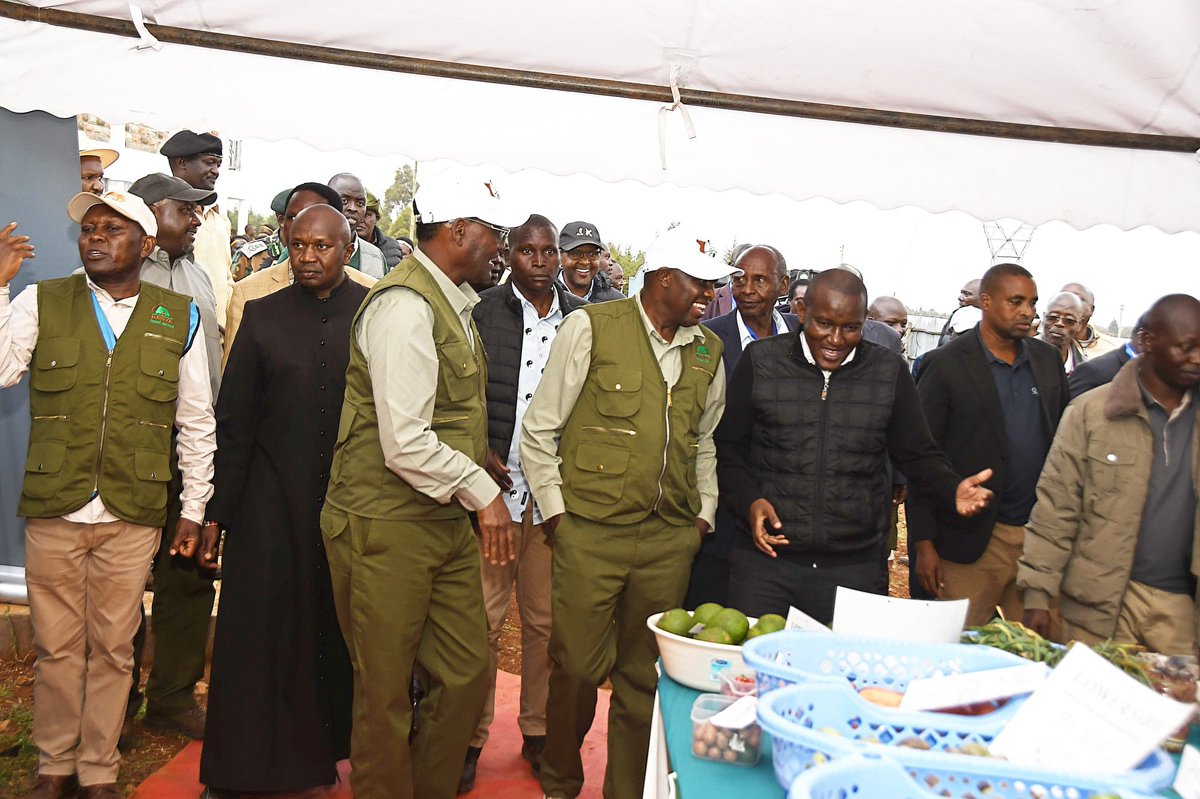
Today, I had the privilege of hosting Mr. Felix Kosgei, EGH, Chief of Staff and Head of Public Service, during the Farmers' Expo and inspection of the Lower Sabor Irrigation Scheme in Moiben Constituency, Uasin Gishu County.
The event was organized as part of the 11th Edition of the Kaptagat Integrated Conservation and Livelihood Improvement Programme, an initiative patroned by the Principal Secretary for the National Treasury, Dr. Chris Kiptoo, CBS, aimed at promoting sustainable livelihoods, environmental conservation, and agricultural transformation.
The Chief of Staff was accompanied by Dr. Chris Kiptoo, CBS, as we toured exhibition stands showcasing produce from farmers benefiting from the Government-funded Lower Sabor Irrigation Scheme. The visit demonstrated how strategic investments in irrigation are transforming agricultural productivity, strengthening food security, creating employment, and improving household incomes.
The Lower Sabor Irrigation Scheme has been fully completed and is now operational. Developed at a total cost of KSh 288.6 million, the project has placed 280 acres under irrigation, directly benefiting over 700 households while creating economic opportunities for approximately 3,000 people along the agricultural value chain.
The project includes intake works on the Cheipkoilel River, a sedimentation tank, access roads, over 30 kilometres of main, sub-main and distribution pipelines, cluster lateral systems, and individual farmer HDPE pipe connections, providing reliable water for year-round farming.
Today, farmers are successfully producing coffee, potatoes, tomatoes, onions, avocados, passion fruits, kales, cabbages, and other high-value horticultural crops, enhancing food security, increasing household incomes, and supplying both domestic and export markets. The scheme is projected to generate approximately KSh 70 million annually through agricultural production, value addition, and horticultural exports.
The visit reaffirmed the Government's commitment under the Bottom-Up Economic Transformation Agenda (BETA) to expand irrigation infrastructure as a key driver of food security, job creation, climate resilience, and inclusive economic growth.
Also present were Deputy Head of Public Service, Mr. Amos Njoroge Gathecha, CBS, NDC (K); Principal Secretary for Environment and Climate Change, Dr. Eng. Festus Ng'eno, CBS; Principal Secretary for Basic Education, Mr. John Lekakeny Ololtuaa; Principal Secretary for Forestry, Mr. Mugambi Gitonga, CBS; Chief Executive Officer of the National Irrigation Authority, Eng. Charles Muasya, MBS; together with other national and county government officials and stakeholders from the agriculture and irrigation sectors.
Today, I had the opportunity to officially open the Earth Observation for Irrigation Mapping in Kenya workshop in Nairobi under the Irrigation Earth Observation (IrrEO) Project.
The three-day workshop brings together key stakeholders from the State Department for Irrigation, State Department for Agriculture, National Irrigation Authority, County Government irrigation departments and CECs, alongside partners including RCMRD, the University of Manchester, and development partners.
The initiative focuses on co-designing Earth Observation (EO)-based irrigation mapping tools tailored to Kenya’s needs, while strengthening data-driven decision-making, resource planning, and sustainable irrigation development.
As a Ministry, we have made notable progress in mapping water resources and irrigation schemes across the country. Leveraging RCMRD technology will further enhance our ability to plan effectively, optimize investments, and achieve our target of expanding irrigation to 1.7 million acres.
This effort is central to advancing food security, addressing the rice deficit, and ensuring that data and technology translate into real impact for farmers on the ground.
Happening now: Hon. Eli Gor, MCA Oloolua, is on a 50KM #OlooluaForest Walk Challenge to raise Ksh 2.5M for fencing 1KM of the forest ahead of the 25th April run. Register
https://t.co/sWIUyXFASW
𝐒𝐨𝐦𝐞 𝐬𝐩𝐨𝐧𝐬𝐨𝐫𝐬𝐡𝐢𝐩𝐬 𝐩𝐮𝐭 𝐲𝐨𝐮𝐫 𝐥𝐨𝐠𝐨 𝐨𝐧 𝐚 𝐛𝐚𝐧𝐧𝐞𝐫. 𝐓𝐡𝐢𝐬 𝐨𝐧𝐞 𝐩𝐮𝐭𝐬 𝐲𝐨𝐮𝐫 𝐧𝐚𝐦𝐞 𝐢𝐧 𝐚 𝐟𝐨𝐫𝐞𝐬𝐭.
Someone decided to act. The Green Connect Foundation patroned by Principal Secretary for Irrigation @EphantusKim looked at what was happening to Oloolua and made a decision: we are going to fence this forest. All 25 kilometres of it. And we are going to do it by running.
Every ticket to Run for Oloolua funds 9 metres of protective fencing. The maths is simple. 2,800 runners × 9 metres = 25.2 kilometres. A complete perimeter. A forest protected.
This is what the race is for. Not a feel-good jog. An act of collective will.
#EveryStepFencestheFuture.
#yourTicketYour 9MetresYourLegacy
THE CALL TO ACTION:
𝐑𝐮𝐧 𝐟𝐨𝐫 𝐎𝐥𝐨𝐨𝐥𝐮𝐚. 𝐑𝐞𝐠𝐢𝐬𝐭𝐞𝐫 𝐧𝐨𝐰.
Click below link to register
https://t.co/zffXbVk9oy
#RunForOloolua
#OlooluaForestRun
#GreenconnectFoundation
#OlooluaCARE
#SecureOloolua
#RestoreForResilience
#SustainableForestGovernance
#friendsofoloolua
Oloolua Forest is disappearing. It sits in Kajiado North, Kajiado County— 681 hectares of indigenous forest that has stood for centuries. Ancient hardwood trees. Rare birds. Medicinal plants. Water sources that communities across the area depend on, silently, every day.
And it is under siege. Illegal logging. Encroachment. Pollution. 66 acres already lost. 25 kilometres of perimeter with no fence, no barrier, nothing between the forest and everything that threatens it.
This is not a problem somewhere else. It is in our backyard. And it is losing ground every day.
Lets run for Oloolua
Click below link to register
https://t.co/zffXbVk9oy
#OlooluaForestRun
#RunForOloolua
#OlooluaForestRun
#GreenconnectFoundation
#OlooluaCARE
#SecureOloolua
#RestoreForResilience
#SustainableForestGovernance
#RunForOloolua
#friendsofoloolua
𝗢𝗹𝗼𝗼𝗹𝘂𝗮 𝗙𝗼𝗿𝗲𝘀𝘁 𝗥𝘂𝗻
Principal Secretary @EphantusKim is at the forefront of efforts to restore Oloolua Forest, a vital ecosystem that plays a key role in environmental conservation and community livelihoods.
Out of the targeted 25 km forest fencing, an impressive 23 km has already been secured through funding. We now call upon partners, stakeholders, and the public to support the completion of the remaining 2 km.
You can make a difference by registering for the Oloolua Run scheduled for 25th April 2025.
Why Run for Oloolua?
By participating, you will:
Actively contribute to a meaningful environmental restoration initiative.
Support the restoration of native biodiversity and forest cover through community-led conservation and sustainable land use practices.
Raise awareness and strengthen community engagement in protecting natural resources.
Promote a circular economy, creating green jobs and advancing a clean and healthy environment.
Enhance policy, governance, and institutional frameworks for sustainable natural resource management in Oloolua Forest.
Support the development of nature-positive enterprises and sustainable agricultural value chains, improving livelihoods for surrounding communities.
Join the movement. Run for nature. Restore Oloolua Forest.
Click below link to register
https://t.co/zffXbVk9oy
#OlooluaForestRun
#RunForOloolua
#OlooluaForestRun
#GreenconnectFoundation
#OlooluaCARE
#SecureOloolua
#RestoreForResilience
#SustainableForestGovernance
#RunForOloolua
I am championing the protection and restoration of the Oloolua Forest ecosystem. Register and join us for the Oloolua Forest Run on 25th April. Every step supports restoration, biodiversity, and community livelihoods. https://t.co/ZWl7K2mFN0
Today, I had the honor of delivering high-level remarks and closing a Regional Leadership Retreat on the Comprehensive Africa Agriculture Development Programme (CAADP) 2026–2035 organized by @AGRA_Africa
The retreat brought together 16 Permanent and Principal Secretaries from across 14 African countries—Kenya, Nigeria, Sierra Leone, Senegal, Uganda, Zambia, Tanzania, Mozambique, Malawi, Mali, Burkina Faso, Somalia, and Ethiopia—and was convened in partnership with AGRA under the theme: “Delivering CAADP 2026–2035: From Commitment to Government-Led Execution.”
In my remarks, I emphasized that transformation require deliberate action driven by strong political will, disciplined implementation, and intentional coordination. As countries, we must prioritize resilience, value addition, and domestic markets—ensuring that we produce what we consume and consume what we produce—while breaking silos and delivering agriculture as one coordinated system.
I underscored that political leadership remains the anchor of success, enabling faster reforms and stronger coordination. We must also drive commercialization to create jobs by transforming smallholder farmers into agri-preneurs through targeted investments in aggregation and value addition. Mechanization, digitalization, and irrigation remain critical enablers, supported by innovative financing and strong partnerships.
I had the opportunity to highlight Kenya’s National Irrigation Sector Investment Plan (NISIP), which aims to bring one million acres under irrigation within ten years and reduce the food import bill by up to 50 percent. Through investments in over 50 multipurpose dams, expansion of irrigated acreage from 767,000 to over 3 million acres, and promotion of efficient water use technologies, irrigation is central to building climate-resilient agriculture. The Farmer-Led Irrigation Development pathway is also unlocking access to financing for farmers.
As we concluded the retreat, I called on fellow leaders to move from dialogue to implementation—strengthening whole-of-government coordination, prioritizing high-impact interventions, and scaling what works. Kenya remains committed to working with partners to drive sustainable agrifood systems transformation across the continent.
Today I had the pleasure of inspecting the ongoing construction of the Okundi Dam Irrigation Project in Karachuonyo Constituency, Homa Bay County, alongside Hon. Adipo Okuome, the Deputy County Commissioner, and senior officials from the County Government.
The project is a major intervention aimed at transforming livelihoods and strengthening food security in the area by providing a reliable and sustainable water source for irrigation, domestic use, and livestock. With a storage capacity of approximately 150 million cubic litres, the dam will support year-round irrigation and significantly enhance agricultural productivity.
Implemented by the State Department for Irrigation, the project is designed to promote irrigated agriculture, strengthen resilience to drought and climate change, and enhance the livestock value chain through integrated crop–livestock production systems.
Once completed, the project will irrigate approximately 100 acres, benefiting about 100 households and supporting over 20,000 livestock units. The infrastructure package includes upstream and downstream dams, check dams, solar-powered pumping systems, piped irrigation networks, storage tanks, and communal water facilities.
During a sensitization session with project beneficiaries, I emphasized the need to prepare farmers for irrigation-based production, strengthen farmer organizations, and build capacity in crop husbandry, water management, and agribusiness. This will ensure beneficiaries are fully prepared to utilize the irrigation infrastructure once completed.
Beyond improved water access, the project is expected to boost maize and horticultural production, create employment opportunities, and raise household incomes, ultimately enhancing food and nutrition security, climate resilience, and sustainable livelihoods in Karachuonyo Constituency.
I appreciate the support of Hon. Adipo Okuome and the County Government, who reaffirmed their commitment to work with the National Government in strengthening farmer capacity through extension services.
In 2026, the State Department for Irrigation is set to undertake the construction of six mega dams across the country as part of a transformative irrigation and water security programme.
The projects include the Lowaat Dam in Turkana County, Radat Dam in Baringo County, Thuci Dam in Embu County, and the Basingila Dam in Isiolo County. Others are the High Falls Dam, which will serve both Kitui and Tharaka Nithi Counties, and the Galana Dam, spanning Tana River and Kilifi Counties.
Once completed, these flagship projects are expected to support the irrigation of approximately two million acres of land, significantly boosting agricultural production, enhancing food security, and improving livelihoods, particularly in arid and semi-arid regions.
Through the Micro Irrigation for Schools Programme, Olekasasi Primary School in Kajiado County has successfully initiated its learners into horticultural farming, with a strong focus on vegetable production. The programme has also equipped students with practical knowledge in agribusiness, food production, and sustainable farming practices, nurturing early skills that support food security and livelihoods.
#formniirrigation
#PSKimotho
#statedepartmentforirrigation
One of our successful projects in 2025 was the training of River Ura back to its natural course, enabling the resumption of rice farming at the Waga Machame Irrigation Project in Vanga Location, Lunga Lunga Sub-County, Kwale County after several years of no rice production.
The project benefits 1,211 farmers and has the potential to create about 6,000 direct and indirect jobs. Through river training works, intake structures, and an extensive canal network, farmers have resumed rotational rice and maize farming—strengthening local livelihoods and contributing to reduced rice imports.
On this Jamhuri Day, we honor our independence by strengthening irrigation and elevating Kenya’s Tourism, Wildlife and MICE leadership building a future of resilience and opportunity.
Happy Jamhuri Day to all Kenyans
In Kenya’s harshest landscapes, resilience is rising. The State Department for Irrigation is turning ASAL challenges into opportunities that will build a food secure future for the nation.