Science Signaling offers researchers the most up-to-date resource for groundbreaking research and commentary in the dynamic field of cellular signaling.
Researchers connect #osteoarthritis to a lack of the enzyme TIKI2 in cartilage and show that TIKI2 normally supports cartilage integrity and homeostasis by promoting chondrocyte differentiation and restraining Wnt signaling pathways. @2024_HUST https://t.co/tnmyjpu7my
This week’s new issue of #ScienceSignaling has arrived!
A team identifies a gatekeeper of cartilage health that goes awry in osteoarthritis, a Review highlights how cell nutrition is emerging as a pillar of fitness for unconventional T cells, and more. https://t.co/PWHnhUAdkh
Contrary to current thinking, a new study shows that activation of the #VagusNerve results in decreased insulin release from the pancreas—and that #obesity exacerbates this dampening effect. @KanazawaUniv_O@Tokushima_Univ https://t.co/h7x4FxGIQg
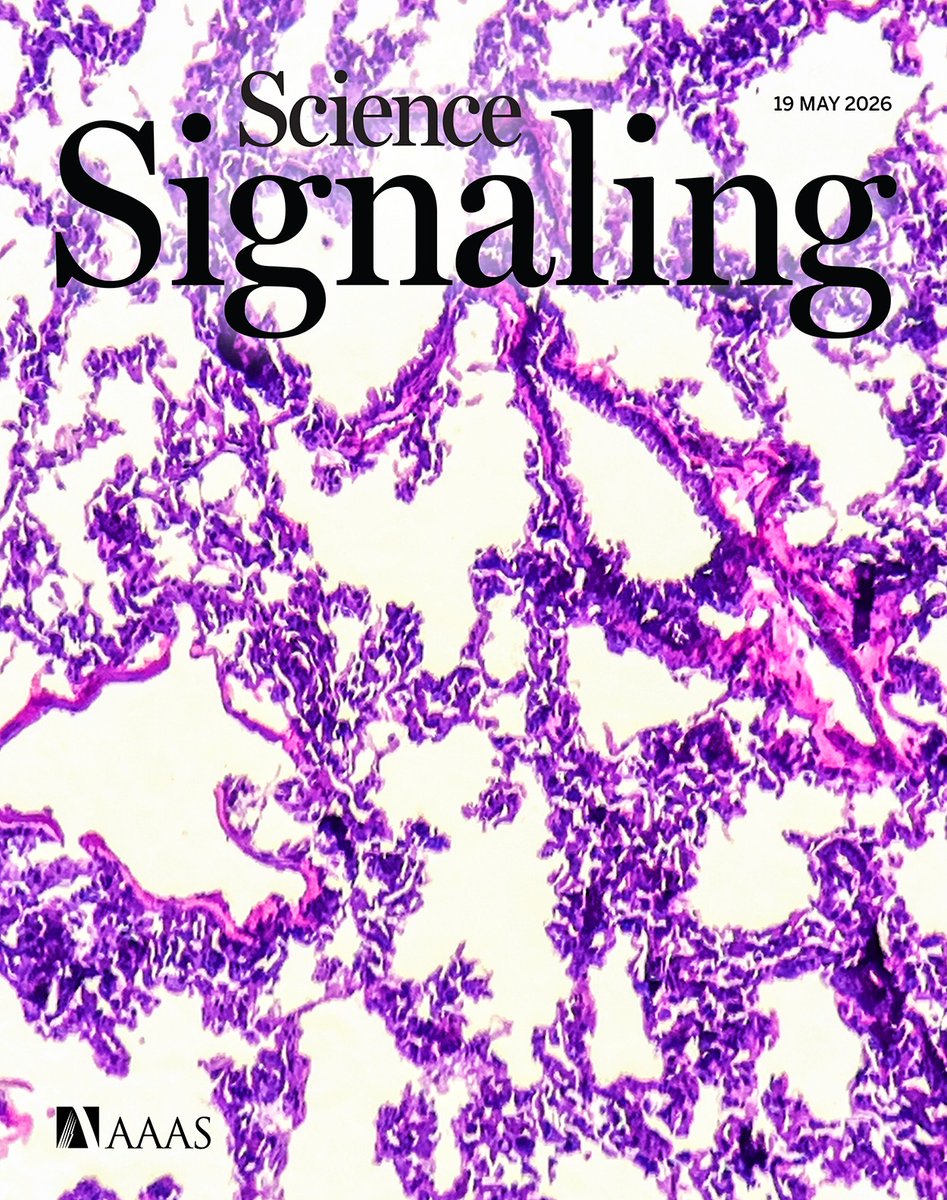
The dsDNA sensor #cGAS drives damaging immune responses and acute lung injury during infection via #phosphorylation triggered by double-stranded DNA, a rapid spike in Ca2+, and formation of cGAS condensates in endothelial cells. @dollymehtalab@uiccom https://t.co/W633uNrCA0
Recent work reveals how two proteins enhance signaling pathways mediated by receptor tyrosine kinases (RTKs) that drive many cancers and points to possible strategies to target RTK-driven #cancers that have developed resistance to RTK inhibitors. @CWRUSOM https://t.co/AokQiqBeRQ
In this week’s Editors’ Choice piece, we highlight a study by Torborg and colleagues in @Dev_Cell, revealing insights into how Wnt signaling regulates PDAC tumor growth.
Read a summary: https://t.co/Nuk2RfWuwT
Researchers have traced the molecular origins of severe pain in #neurofibromatosis—an inherited condition of tumors in the nervous system—and show that an FDA-approved drug can relieve pain in mice. @CincyChildrens@NamrataGRRaut@JankowskiLab https://t.co/bT1KlYZ0Zz
An in vivo and modeling analysis shows that activity of the vagus nerve has a more complex effect on insulin release than was previously thought, hinting vagus nerve stimulation may have unintended metabolic consequences. @KanazawaUniv_O@Tokushima_Univ https://t.co/h7x4FxGIQg
How does neurofibromatosis cause pain?
New work shows that #SchwannCells drive pain sensitivity in mice by secreting GDNF that activates GFR-alpha-1 on sensory neurons, which can be reversed with mirdametinib. @CincyChildrens@NamrataGRRaut@JankowskiLab https://t.co/bT1KlYZ0Zz
Scientists trace the molecular origins of severe pain in neurofibromatosis, surprising results in mice reveal how obesity alters how the vagus nerve regulates insulin release, and more this week in #ScienceSignaling. https://t.co/WCZT2slt1u
New work reveals how two proteins enhance signaling pathways mediated by receptor tyrosine kinases (RTKs) that drive many cancers and points to possible strategies to target RTK-driven #cancers that have developed resistance to RTK inhibitors. @CWRUSOM https://t.co/AokQiqBeRQ
Through structural and functional assays, scientists have revealed an important regulatory role for the transmembrane domain of the receptor for TNF, a clinically relevant inflammatory cytokine. @WEHI_research https://t.co/ScGUuHtzLe
A recent study visualizes the ebb and flow of receptors within neurons via the unusual process of #transcytosis—helping answer how these cells maintain their function and connectivity in vivo despite their spindly, elongated nature. @JohnsHopkins https://t.co/EL8DuNMk0O
New experiments performed in vitro and in mice clarify the molecular origins of uncontrolled inflammatory immune responses in the lungs—a common and severe complication of lung infections. @dollymehtalab@uiccom#InnateImmunity https://t.co/W633uNrCA0
An unbiased analysis of #ReceptorTyrosineKinase pathways in cell lines reveals that GOLPH3 and its binding partner MYO18 promote the movement of RTKs to the cell surface, poising them to respond to growth factors and amplify oncogenic signaling. @CWRUSOM https://t.co/AokQiqBeRQ
The dsDNA sensor #cGAS drives damaging immune responses and acute lung injury during infection via #phosphorylation triggered by double-stranded DNA, a rapid spike in Ca2+, and formation of cGAS condensates in endothelial cells. @dollymehtalab@uiccom https://t.co/W633uNrCA0
Don’t miss the new issue of #ScienceSignaling!
A new study reveals how the DNA sensor cGAS drives collateral damage in the lungs during infections, experiments delineate how a pair of proteins routes receptors for signaling in cancer cells, and more. https://t.co/lWqY7BTLc7
Through structural and functional assays, scientists have revealed an important regulatory role for the transmembrane domain of the receptor for TNF, a clinically relevant inflammatory cytokine. @WEHI_research https://t.co/ScGUuHtzLe
As we approach the 25th anniversary of #lipidomics, a Focus discusses how the community-driven databases, software, and educational resources at LIPID MAPS will propel further progress in this important research field. @CUSystemsImmu https://t.co/38cpjpL8KY
Employing protein tagging, scientists identify interaction networks centered on the #p38 homolog PMK-1 in C. elegans that facilitate phenotypic plasticity during development, in several tissue types, and in response to stresses and aging. @UTSWMedCenter https://t.co/QFzUV2lNpL