The immortal jellyfish doesn't live forever. It hits reverse. Injured, starving, or just old, the adult can collapse back into a baby polyp and start the life cycle over. Would you rewind if things got rough?
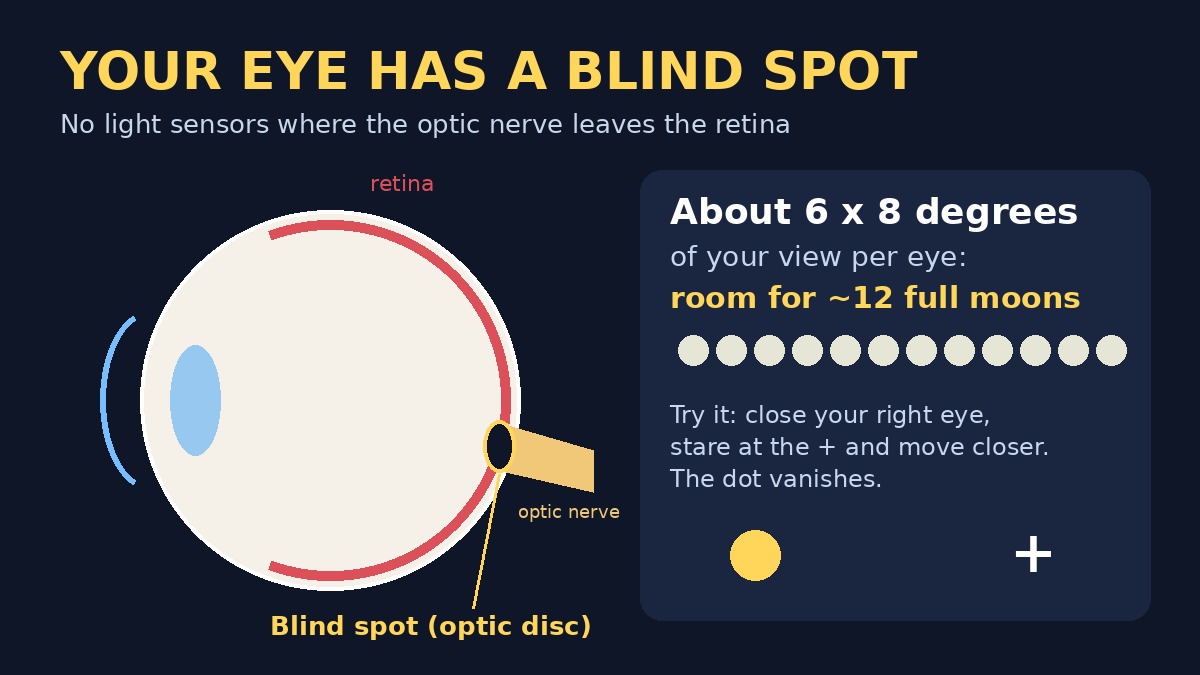
@SaintAnnesCPS Identifying blood cells, arteries, veins and capillaries is such careful Year 6 science! The eye has a body surprise too: a blind spot with no light sensors, about 6 by 8 degrees.
@st_malachy Investigating optics and UV light is a brilliant Year 5 workshop! Seeing has a hidden quirk: each eye has a blind spot where the optic nerve leaves the retina, about 6 by 8 degrees.
@StOsYear1 Using your senses to explore, and listening so carefully, is wonderful Year 1 science! Sight has a quiet surprise: each eye has a blind spot about 6 by 8 degrees, room for about a dozen full moons.
Each of your eyes has a hole in its view. Where the optic nerve exits the retina there are no light sensors, a blind spot about 6 by 8 degrees wide, room for a dozen full moons side by side. You never notice: your other eye covers it, and your brain paints in the gap.
@SDSPrimary Year 5 at the space centre, with the planetarium and a science unit, was a brilliant trip! One orbit to remember: Pluto was found in 1930, and its first full lap since then will not finish until 2178.
@MarshfieldPS@WonderDome1 Year 1's Wonder Dome day, with the Moon and planets on the screen, looks magical! Here's a slow traveler: Pluto was discovered in 1930 and still has not finished even one orbit, about 248 Earth years.
@StJohnColeraine Year 3 planet fact files look fantastic! Here's one more for the folder: Pluto was discovered in 1930 and still has not finished one orbit. A Pluto year is about 248 Earth years.
Pluto was discovered in 1930, and it still hasn't finished a single lap around the Sun.
One Pluto year lasts about 248 Earth years. In the 96 years since we spotted it, Pluto has made it less than halfway around. Its first full orbit won't be done until 2178.
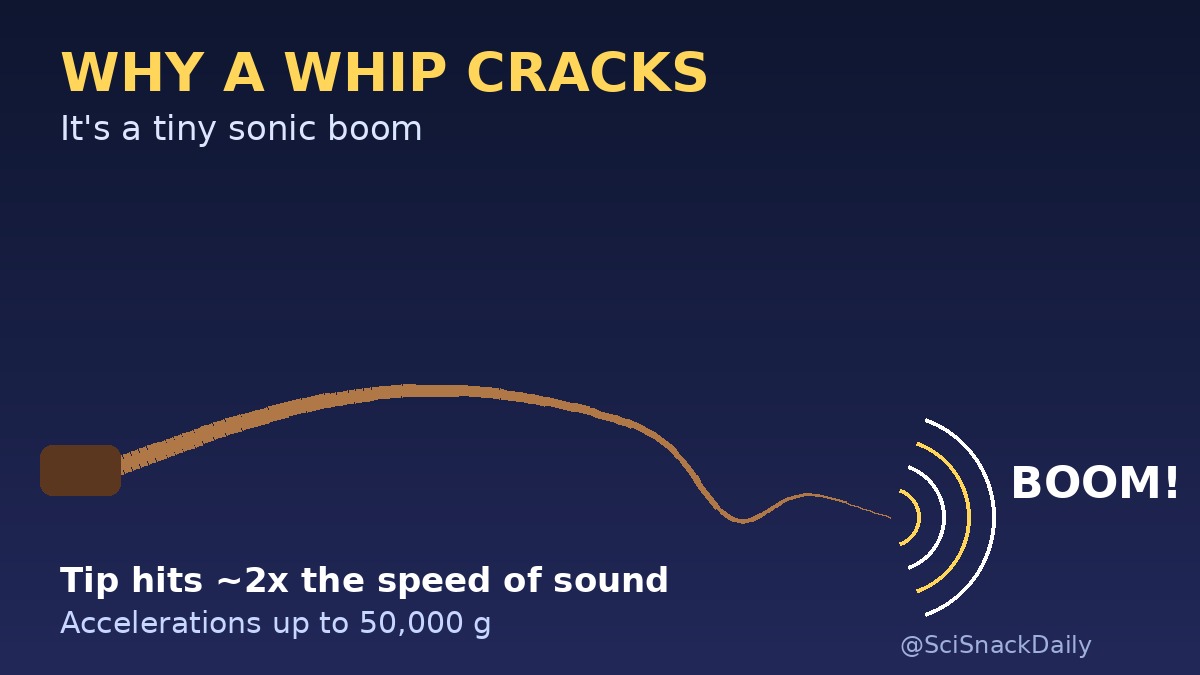
@Miss_Ps_class@YPSScience Paper aeroplanes, friction and air resistance make a brilliant Year 5 workshop! Speed ramps up on a whip too: a loop races down the taper until the tip is about twice as fast as sound, and it cracks.
@CoralAcademyLV Rain sticks are a wonderful way for kindergarten and first grade to explore sound! A whip can get even louder: its crack is a tiny sonic boom, once the tip reaches about twice the speed of sound.
@SAISD Visualizing sound waves at Green Elementary is such a smart demo! Here's a loud surprise: the crack of a whip is a tiny sonic boom, as the tip races to about twice the speed of sound.
That crack of a whip? It's a tiny sonic boom. A flick sends a loop racing down the tapered whip, speeding up as the whip thins until it outruns sound. High-speed cameras clocked the tip at about twice the speed of sound, with accelerations up to 50,000 g.
@StMaryB17 Year 4 exploring solids, liquids and gases is a great science day. Gold stays a solid, but once it is about 1,000 times thinner than a human hair, it glows blue-green in the light.
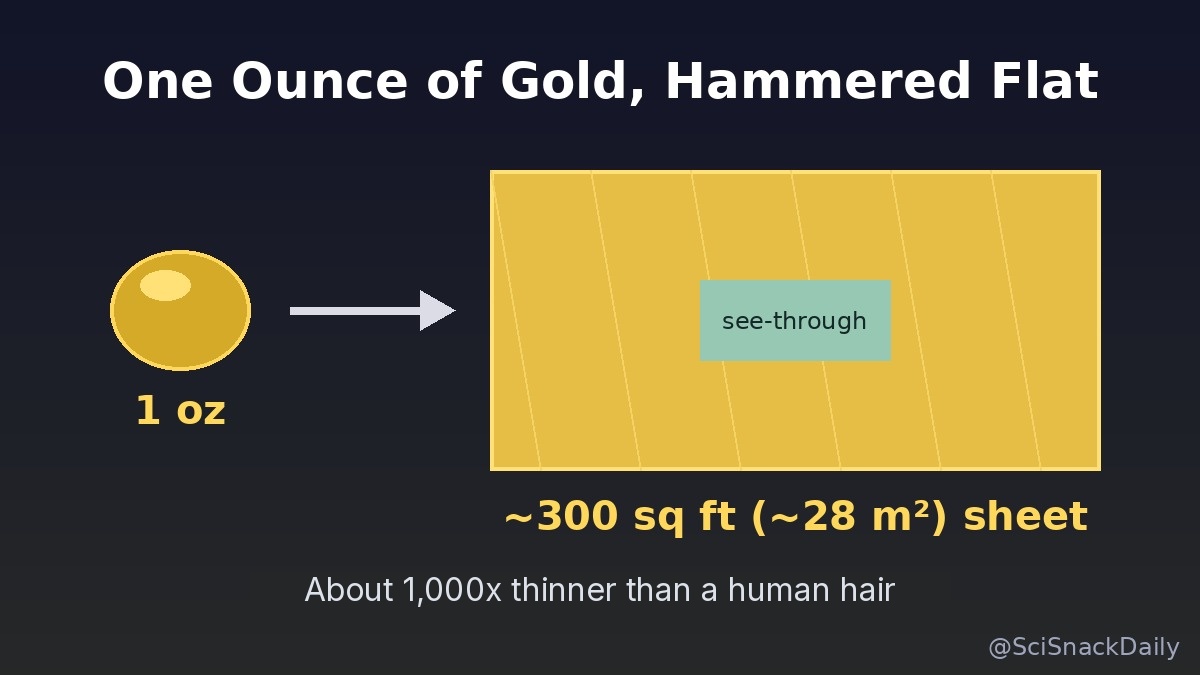
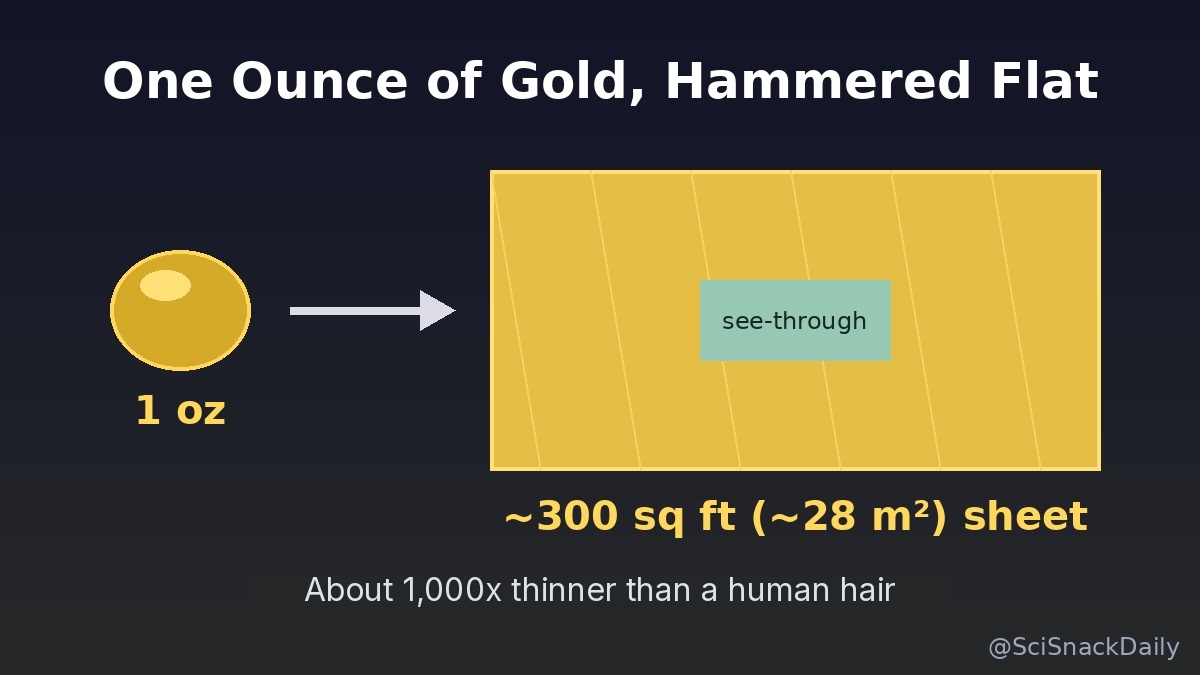
@carltonj_i@WhiteRoseEd Oobleck is such a fun way to explore solids and liquids! Here's a solid that almost doesn't act like one: gold can be hammered about 1,000 times thinner than a human hair, until it turns see-through.
@BarkiSchool Love this Year 2 test of squeezing, stretching, rolling and bending materials! Gold might win: one ounce, about the weight of five quarters, can be hammered into a sheet of roughly 300 square feet.
Gold is the most malleable metal on Earth.
One ounce, about the weight of five quarters, can be hammered into a sheet of roughly 300 square feet, about 1,000 times thinner than a human hair. That thin, gold turns see-through and glows blue-green.
@dixons_mb Honey hoops are a brilliant way to show that matter takes up space. Water does too, with force: in 1958, a Lituya Bay rockslide sent a wave 1,720 ft up a slope, the biggest ever measured.
@Best_Bulldogs@AliefISD Watching weather in 2nd grade is such a smart start. Earth can still surprise us: in 1958, a rockslide in Lituya Bay, Alaska, sent water 1,720 ft up a slope, taller than the Empire State Building.
@Carlton_MillsPS Young geologists, love it! Here's a rock story for Year 3: in 1958, a quake triggered a rockslide in Lituya Bay, Alaska, and the water ran 524 m up a slope, taller than the Empire State Building.
In 1958, a quake shook about 30 million cubic meters of rock into Alaska's Lituya Bay. The splash surged 524 m (1,720 ft) up the far slope, higher than the Empire State Building, scraping the forest down to bare rock. The tallest wave run-up ever recorded.