Science & Human Dimension Project #SHDP public engagement with science/tech Promoting dialogue between science, humanities, & arts . Based Clare Hall Cambridge
“If this is not the first pandemic to be solved by AI, then it will surely be the last to be solved without it.” @NathanBenaich
https://t.co/1tyirjIJzV via @financialtimes
1/3
Dr. Simone Schnall, Reader in Experimental Social Psychology, University of Cambridge
@SimoneSchnall#AIethics#AI#Religion
https://t.co/UMlF62saPb
contrasts two broad philosophical camps around right and wrong: the rational camp along the lines of Kant’s universal moral...
2/3
laws Hume’s morality based on sentiments. Her experimental research suggests the significance of sentiments in moral judgements, especially when it comes to disgust, which appears significantly to increase the harshness of moral judgements when present. ..
4/4
AI is best thought of as an ecosystem problem alongside global warming, loss of biodiversity and other such threat factors—because of its vast and accelerating significance, and the difficulty of making its technologies conform to our species’s basic goals and needs.
1/4
Steve Torrance Visiting Senior Research Fellow, COGS, University of Sussex
#AIethics#AI#Religion
https://t.co/UMlF62saPb
suggests a product cycle model for technology that starts with lab experiments, then moves through mass marketing to proliferation, and then to various
3/4
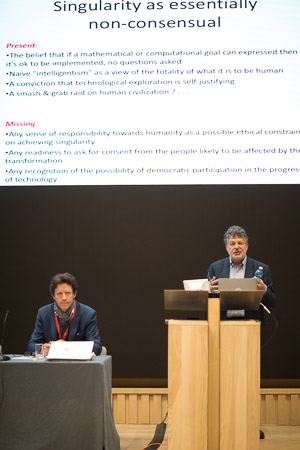
In an important sense, no, because there wasn’t a moment at which people were asked if they truly wanted the proliferation of such a product and its effects. ...
5/5
ethical possibility, then, is that we do so in some way other than mere making — a manner more akin to begetting, midwifery, or animal husbandry, in that we help bring about something that is not our
possession or technology, but a fellow creature worthy of our respect.
1/5
Dr Ron Chrisley, Dept of Cognitive Science, University of Sussex,
@RonChrisley#AIethics#AI#Religion
https://t.co/UMlF62saPb
addresses a paradox in the notion of ethical artificial intelligence, based on the distinction between “begetting” versus “making”. ...
4/5
it is truly intelligent—but its making cannot be ethical, because we cannot sufficiently know what it will do. So, making true AI ethically is impossible: if you have control, you haven’t made a free agent. The only...
4/4
no ethicists available who have all the skills and experiences necessary to address the interlinked implicated fields around AI ethics. The inescapable question is: is it merely power to enforce ethical norms or true ethical norms that we seek and need in our ethical norms?
1/4
Dr Daniel de Haan, Oxford University,
#AIethics#AI#Religion
https://t.co/UMlF62saPb
suggests that there was something fundamentally incoherent about key aspirations in AI ethics. If it is true that AI operationalises basic human values, ...
3/4
There are, however, no rational, obvious views that everyone rational being will agree to, so the idea of a single set of “basic human values” is a chimera. Moreover, there are ...
3/3
Yes, because our uniquely human ability to anthropomorphize renders us open to manipulation and deception—and because the idea of a machine truly providing care is a misnomer, representing the loss of something precious.
1/3
John Wyatt - Emeritus Professor of Neonatal Paediatrics, Ethics and Perinatology, University College London
@johnswyatt#AIethics#AI#Religion
https://t.co/UMlF62saPb
discusses the rise of digital assistants and human-seeming AIs together with...
2/3
the potential confusions this creates, especially in the context of healthcare and care. Does the encouragement of anthropomorphism by AI designers matter?...