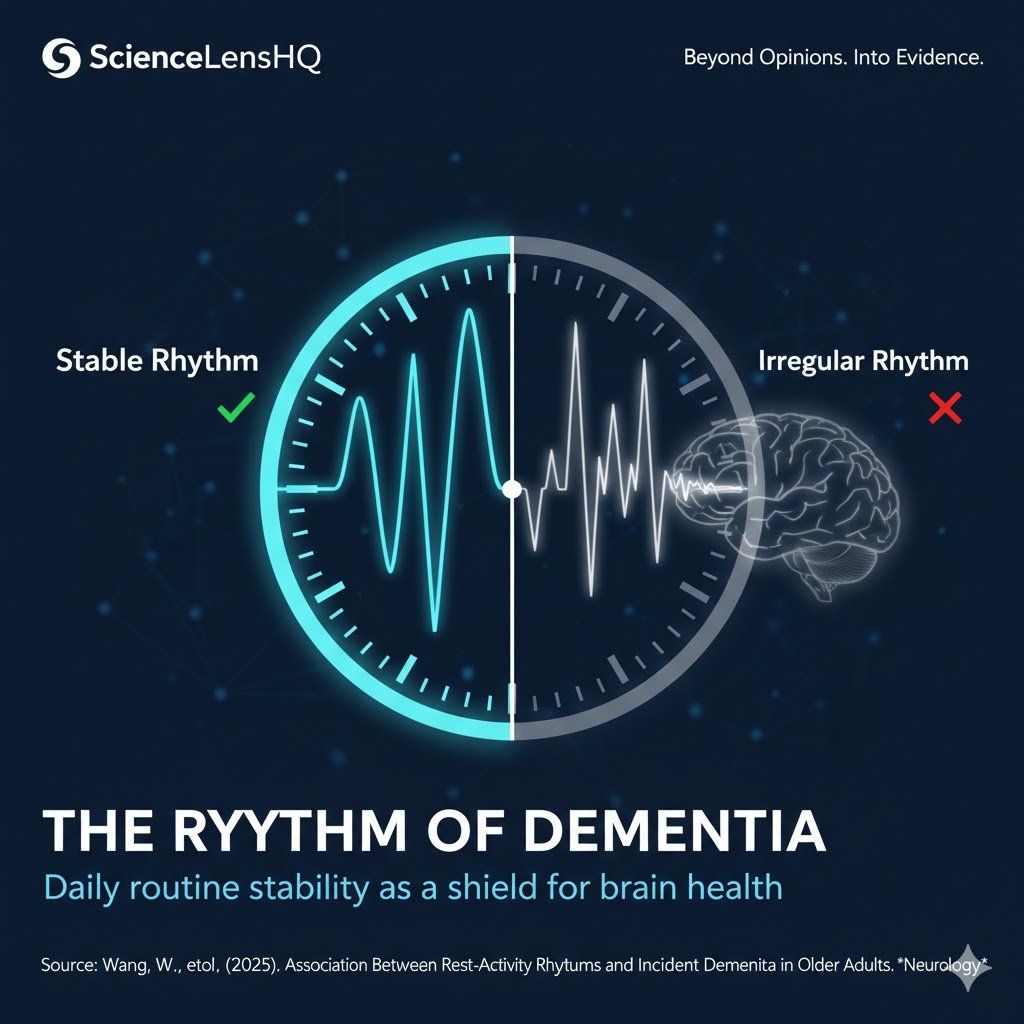
Circadian health — consistent sleep, activity timing, and exposure to light — may be more important for brain aging than previously thought.
Wearable devices might even help detect early dementia risk patterns in the future.
Your daily rhythm might predict your brain’s future.
New research (tracked over 2,100 older adults using wearable activity monitors) suggests that:
Weaker and more irregular sleep–activity patterns are linked to a higher risk of dementia in older adults.
For example:
Each standard drop in rhythm strength was linked to ~54% higher dementia risk.
More fragmented daily rhythms were also associated with increased risk.
Why might this happen? Circadian disruption may affect brain waste clearance and amyloid-β accumulation.
This discovery provides a biological blueprint for human connection: ✅ Your brain blurs the line between "self" and "other" at a fundamental sensory level. ✅ Watching others is not a passive observation; it’s a "vicarious physical experience" for your brain.
Why do you flinch when you see someone else get a paper cut? 🪡 Is it just "empathy," or is your brain actually simulating the physical touch on your own body?
A new study just revealed hidden "vicarious body maps" tucked away in your visual system. https://t.co/r4ESf1j4Rl
The surprise? When you watch a video of someone being touched, your visual system doesn't just process pixels. It uses these "vicarious maps" to mirror the touch as if it were happening to you.