Not bought - mined.
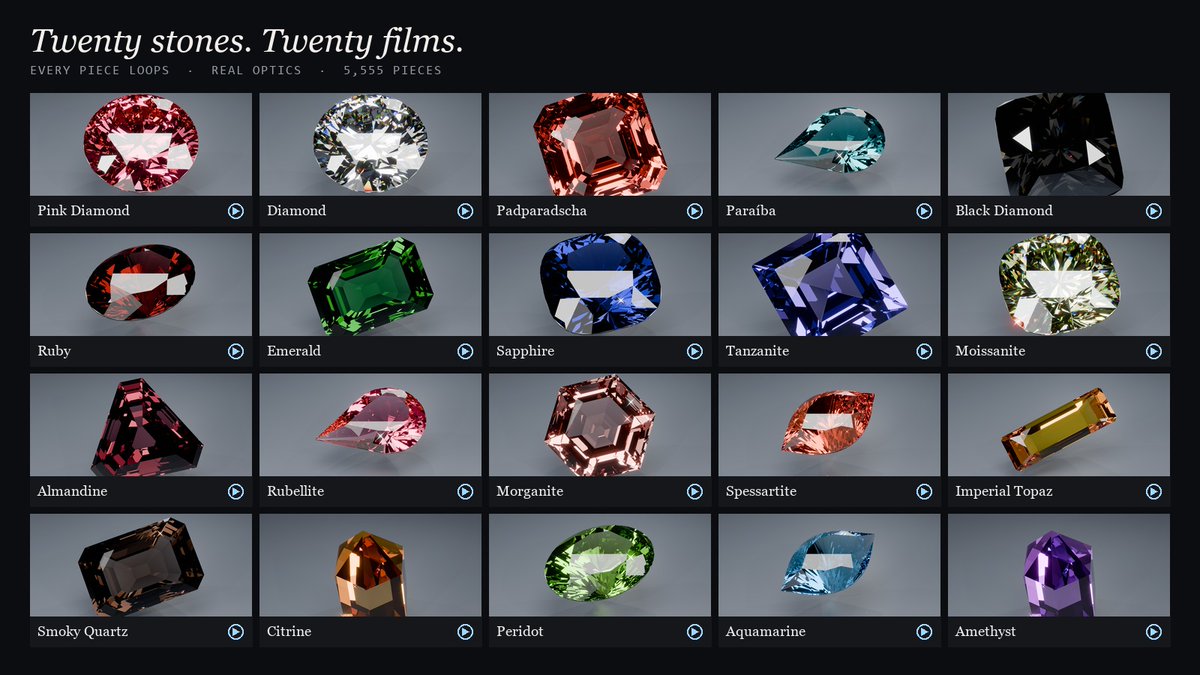
Twenty gemstones built to real cutting angles, with the refractive index and dispersion of the real stone. 5,555 pieces on Robinhood Chain.
No mint button. Your browser searches for a hash. The hash is the ticket.
Dig a sample now: https://t.co/ZQt0LzfLf0
I dug an almandine out of the Scintilla demo mine - 362 ms on 8 cores, real SHA-256 in a browser. Not bought - mined.
Twenty gemstones with real optics, 5,555 pieces, proof of work on Robinhood Chain. Dig yours and get on the list: https://t.co/phhuTa5Zd2 https://t.co/H6iCUI6A16
Not bought - mined.
Twenty gemstones built to real cutting angles, with the refractive index and dispersion of the real stone. 5,555 pieces on Robinhood Chain.
No mint button. Your browser searches for a hash. The hash is the ticket.
Dig a sample now: https://t.co/ZQt0LzfLf0
Good question, and it is the core of the design. We do not try to make every device equally fast. We make speed worth nothing beyond your own wait.
1. The target is fixed per layer and set low on purpose: a laptop clears it in seconds, a phone in under a minute. It never moves with the crowd, so a thousand people digging at once change nothing for each other.
2. Caps, not races. Founders get one stone each, the whitelist one or two (TBD), the open layer two a day per wallet. A faster machine cannot take a third.
3. The stone is drawn from the hash and a time bucket, never from speed. A phone's hash and a 32-core rig's hash have identical odds at a pink diamond. The last person to mine has the same odds as the first.
4. In the open layer every stone you take in quick succession doubles the work of your next one, cooling off every thirty seconds. Farming many stones with one big machine gets expensive fast.
5. The seed changes every ten minutes and the previous one is still accepted, so a slow phone is never too late with a hash it already found.
So a fast machine shortens your own wait from a minute to a second. It does not take anyone else's stone.
I dug a moissanite out of the Scintilla demo mine - 5.8 s on 8 cores, real SHA-256 in a browser. Not bought - mined.
Twenty gemstones with real optics, 5,555 pieces, proof of work on Robinhood Chain. Dig yours and get on the list:
https://t.co/4PyDvpW5ML https://t.co/h6vRbQn0ou
GIVEAWAY TIME!
I’ve been exploring @Scintillamine, and I’m bringing something interesting to the community.
Scintilla is building a gemstone mining experience on Robinhood Chain, where digital gemstones are mined through proof of work rather than simply bought.
Not bought. Mined.
With 20 gemstone types and a collection of 5,555 pieces, Scintilla is bringing a different approach to digital collectibles.
I’m giving away 5 GTD spots to 5 lucky community members.
How to participate:
Follow @Scintillamine.
Follow me @preciousprime07.
Repost Scintilla’s official post: Quoted post.
Like and repost this giveaway.
That’s all!
Duration: 48 hours from posting.
Winners will be selected after the giveaway closes.
Take a moment to explore what Scintilla is building:
Website: https://t.co/lCTwViCUtP
Launch date TBA, stay tuned.
Let’s discover something different in the Web3 space.
Good luck!
@authority_joel Gonna cook so much 🔥 To answer your question, for a normal laptop, 3-10 seconds. Difficulty will increase over phases of course, but if you get into Founders or Whitelist phases - you will be good 💎
In the open layer we can't stop ten wallets, and we don't pretend to: every stone costs the same price, gas and work, with the same odds, so splitting buys nothing.
The real defence is in the Founders and Whitelist layers: one handle, one wallet, a verified quote, a bot check, checked by hand.
On that way, big part of the supply goes to real users, and not to the bot farms.
Good question, and it is the core of the design. We do not try to make every device equally fast. We make speed worth nothing beyond your own wait.
1. The target is fixed per layer and set low on purpose: a laptop clears it in seconds, a phone in under a minute. It never moves with the crowd, so a thousand people digging at once change nothing for each other.
2. Caps, not races. Founders get one stone each, the whitelist one or two (TBD), the open layer two a day per wallet. A faster machine cannot take a third.
3. The stone is drawn from the hash and a time bucket, never from speed. A phone's hash and a 32-core rig's hash have identical odds at a pink diamond. The last person to mine has the same odds as the first.
4. In the open layer every stone you take in quick succession doubles the work of your next one, cooling off every thirty seconds. Farming many stones with one big machine gets expensive fast.
5. The seed changes every ten minutes and the previous one is still accepted, so a slow phone is never too late with a hash it already found.
So a fast machine shortens your own wait from a minute to a second. It does not take anyone else's stone.
@HOODdailyTK@arcus_xyz@rialto_xyz Good list. One more for the next one: Scintilla, twenty gemstones with real optics that you mine with your own processor instead of a mint button. The demo mine is already open. ⛏️💎
7/ How to get on the list:
1. Follow @scintillamine
2. Dig a sample stone in the demo mine (your CPU, real SHA-256)
3. Quote this post with the card the mine gives you
4. Claim your place with that link and your wallet
Start here: https://t.co/UdTKAFlRMm
Not bought - mined.
6/ On price: affordable the way a coffee is. The numbers come before launch, not after. Nobody should have to guess what a stone costs from a thread.
Secondary sales carry a 5% royalty, written into the contract.
5/ Three layers, one shaft.
Founders first: 555 stones, free, one each, partners (collabs), a two-hour window. Then the whitelist, two hours window or until the layer is gone, one price for the whole window. Then it opens to everyone.
The target never moves with the crowd.