Explore the latest SciStarter newsletter, featuring citizen science projects you can join from your backyard, community garden, local park, or favorite outdoor space.
This edition features @NovelEco, Nature's Notebook, Soil Testing USA, @PBudBurst, Naughtweed, and @Soldier2Science.
Plus, learn about SciStarter’s new global partnership with the @museumofscience, earn the Foundations of Citizen Science badge, and join us this Memorial Day in honoring and remembering those who gave their lives in service.
Read the newsletter: https://t.co/zc2efKly1e
Big news! 🎉 We’re teaming up with the @museumofscience to help turn curiosity into real-world action.
Together, we’ll connect millions of people discovering science online with opportunities to contribute to actual research projects: from biodiversity and space science to public health and more.
Science isn’t just something you view. It’s something you can do.
Explore projects and get involved: https://t.co/iABTGWGXIm
#CitizenScience
This Mother’s Day, celebrate the moms, mother figures, mentors, and encouragers who helped spark your curiosity.
SciStarter’s special Mother’s Day newsletter features citizen science projects you can explore together, from studying planets beyond our solar system to listening to soundscapes, documenting biodiversity, watching rare space clouds, and mapping the places we call home.
We’re also still in awe of what you accomplished during Citizen Science Month. This April, more than 422,000 volunteers from 140 countries contributed more than 4.7 MILLION Acts of Science. That is nearly double our goal of 2.50 million.
Featured Mother's Day projects include:
🔭 Exoplanet Watch (@DoNASAScience)
🔊 @SoundRndTown
🌸 @NatureSpotsApp
☁️ Space Cloud Watch
🗺️ CommuniMap
Read the special Mother’s Day newsletter: https://t.co/JrVKRXEkWN
#CitizenScience #SciStarter #MothersDay #ActsOfScience #CommunityScience #ParticipatoryScience
We did it.
During Citizen Science Month, people around the world came together to contribute to real research, one documented Act of Science at a time.
One classified image.
One transcribed historical document.
One identified species.
One blood vessel analyzed.
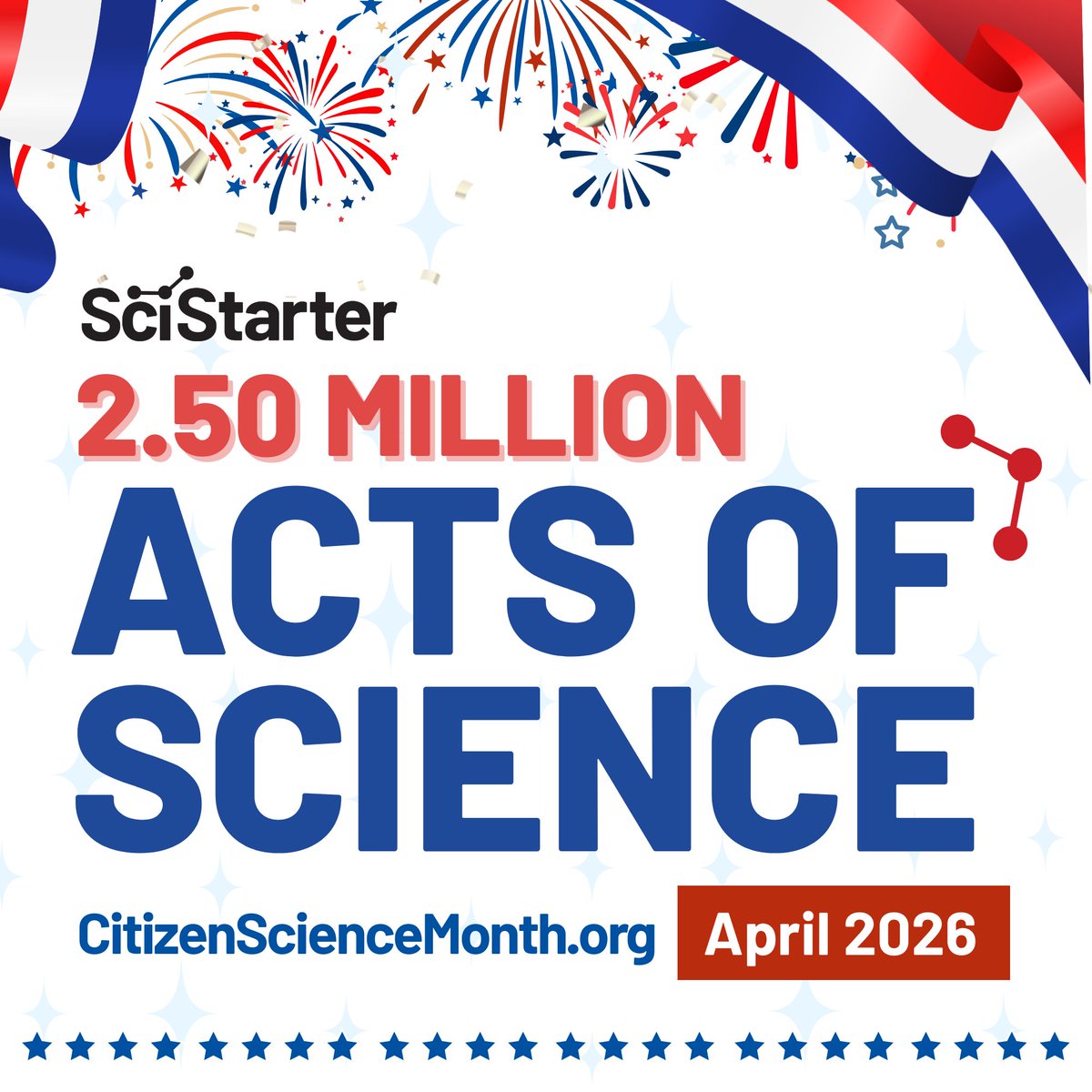
Each Act of Science helped us celebrate America’s 250th birthday with a shared goal of 2.50 million Acts of Science.
And together, we passed it.
This April, we reached over 4 million Acts of Science with contributions from more than 400,000 participants. Coordinated social media efforts with our partners reached 13 million people worldwide. More than 480 events took place, with about a third led locally by libraries and SciStarter Ambassadors.
From examining Mars imagery with @NASA@DoNASAScience, to transcribing Freedmen’s Bureau records with the @smithsonian, to analyzing microscopy images to help research on Alzheimer’s, to identifying animals in camera trap images to help wildlife conservationists (@the_zooniverse@WDNR); the work was real.
The numbers matter.
The collaboration matters even more. Here’s to all the partners who made this happen!
Thank you for contributing your Act of Science.
Explore the results: https://t.co/dcgjCBW7O8
🔊👂 Tomorrow is Sound Awareness Day!
Pause and listen: What sounds shape your day?
Join Sound Around Town on SciStarter and turn everyday listening into real research. Log what you hear and how it affects you to help scientists study noise, focus, and sense of place.
⏳ Plus—just 2 days left of Citizen Science Month! Make your Acts count. Sound Around Town is a SciStarter affiliate project, so your participation automatically counts toward the #CitizenScienceMonth Acts of Science total and a credit will appear on your SciStarter Dashboard!
Start now: https://t.co/oCJIzqtWdr
🎧 Listen. Reflect. Share.
#SoundAwarenessDay #CitizenScienceMonth #ActsOfScience
@SoundRndTown
During #citizensciencemonth, the impact of collective action becomes something you can truly measure—and in the case of Einstein@Home, it’s measured at supercomputer scale.
As Bruce Allen, Director of Einstein@Home, shares:
“Einstein@Home relies on thousands of volunteers who donate their computers’ idle processing power. During Citizen Science Month, our volunteers contribute a sustained computing power of around 16 petaflops. This makes Einstein@Home one of the 120 most powerful supercomputers in the world. It is driven entirely by everyday people around the world and conducts the most sensitive searches for continuous gravitational waves and has already discovered more than 90 new neutron stars.”
This is what citizen science makes possible. Everyday people, simply by sharing unused computing power, are helping power discoveries at a scale once reserved for elite research institutions.
More than 90 neutron stars discovered. One of the most powerful “supercomputers” on Earth. And it’s built not from a single machine—but from a global community.
That’s the story of Citizen Science Month: small individual contributions, #actsofscience, adding up to extraordinary scientific breakthroughs.
New publication out now 📚
“Embedding Citizen Science in Libraries: A SciStarter and Arizona State University Case Study of Adoption, Scaling, and Sustaining Participation” is live in Citizen Science: Theory and Practice (Association for Advancing Participatory Sciences). Co-authors are Tara L. Cox, Darlene Cavalier, Deron Ash, Emma Giles, and Caroline Nickerson, PhD.
This case study looks at how libraries across the U.S. are becoming hubs for citizen science. It breaks down what it takes to adopt, scale, and sustain these programs over time.
Key takeaway: libraries are powerful, trusted spaces for expanding access to science and building long-term community engagement.
Read it here: https://t.co/o9nqRvXsI4
Citizen Science Month happens each April — a nationwide and global celebration of public participation in research, presented by SciStarter and Arizona State University.
A featured live event series is Acts of Science: Connected — guided Zoom sessions where people contribute to real research together.
What’s an Act of Science? One measurable contribution to research. Our last sessions, on April 29, invite you to help NASA spot a comet: https://t.co/jEilXWQVZ2
Classifying an image. Transcribing a document. Identifying a species. Flagging a comet. Each action is counted and contributes to a shared goal.
We achieved 2.50 Million Acts of Science to celebrate America’s 250th birthday — highlighting how civic participation and science have always moved this country forward.
These events bring together partnerships across science, history, and community engagement — from NASA-supported planetary science to Smithsonian transcription, biomedical research through Stall Catchers, wildlife monitoring, and astronomy discovery.
When we’re all involved, the science is better.
#ActsofScience #CitSciMonth
On Wednesday, April 29: Join the Federal Citizen Science Community of Practice for a special Project Spotlights webinar featuring innovative projects from across federal agencies.
📅 April 29 | ⏰ 2 PM–3 PM ET
💻 Online (join from anywhere!)
Hear from project experts supported by NOAA and partners as they share exciting work—from water quality monitoring to tracking environmental health and improving national mapping data.
🔗 Save your spot: https://t.co/j4ixam9q0K
Perfect for anyone curious about how citizen science is shaping real-world research—don’t miss it!
#CitizenScienceMonth @NOAAeducation
🚨 We are in the Final Week of #CitSciMonth — Let’s Finish Strong!🚨
⚡ Want to speed up your Acts? Jump into these high-impact projects:
• Stall Catchers (fight Alzheimer's Disease)
• Snapshot Wisconsin (identify wildlife)
• Smithsonian Transcription Center (unveil history)
• Cloudspotting on Mars (find clouds in the Martian atmosphere)
• Dark Energy Explorers (find faraway galaxies)
• City Nature Challenge (today is the last day to make observations!)
✨ Try something different:
• Wicked Words (document language in everyday life)
• Project Sidewalk (find issues in pedestrian pathways)
Every click, classification, and contribution counts! Whether you’ve logged one Act or hundreds–this is your moment to go all in.
🔥 Let’s finish strong. Find all of these projects and so many more at https://t.co/DOiRgaeVty.
#CitizenScienceMonth #ActsOfScience
April 2026 is Citizen Science Month!
This initiative coordinated by @SciStarter invites everyone to take part in science projects.
🌐 Discover more: https://t.co/MQfPZtGyH2
📡 Learn more about how we will improve #6G connectivity: https://t.co/1aBydXzer3
#CitSciMonth
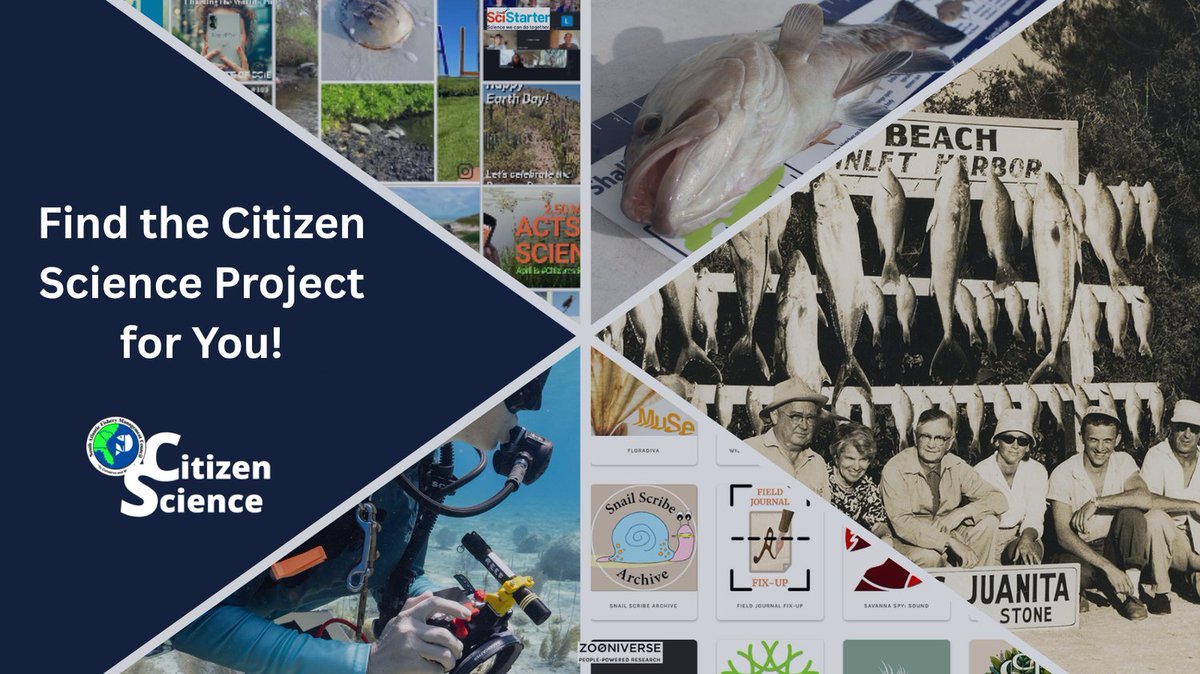
#CitizenScienceMonth is ending, but you can be a citizen scientist year-round! Discover projects on our Program webpage that help fill data gaps for South Atlantic fisheries. And find more projects on @the_Zooniverse and @SciStarter.
https://t.co/atqUVoU3B4
PC: R. Hudson, REEF
On April 29, you can help discover a comet.
Join us live with astronomers from the @VRubinObs and take part in Rubin Comet Catchers, a brand-new @NASA@DoNASAScience citizen science project.
Explore real data from Rubin’s massive sky survey. Scan telescope images. Spot comet activity and other active objects. Find clues that could lead to new discoveries.
With its giant mirror and unprecedented view of the night sky, Rubin is expected to find more comets than ever before—and volunteers like you make that possible.
Join us live and help uncover clues written across the cosmos.
Register today. https://t.co/K4GtyMmB0A
This live event is part of Acts of Science: Connected during Citizen Science Month, presented by SciStarter.
#ActsofScience #CitSciMonth
PS: You might recognize the narrator’s voice in this video…that’s longtime NASA communicator Charles Blue!
Big news and a moment worth celebrating!
Just 22 days into April, you made it happen. In celebration of America’s 250th birthday, we set an ambitious goal of 2.50 Million Acts of Science for Citizen Science Month, and citizen scientists around the world didn’t just meet it. You surpassed it.
Here’s what you’ve accomplished so far:
💙More than 200,000 volunteers across 159 countries have completed 2.50 MILLION Acts of Science through 413 citizen science projects and 285 events… and counting!
💙In 22 days, #CitizenScienceMonth, #SciStarter, and #ActsofScience have been mentioned more than 3,000 times, inspiring over 91,100 people to engage and help spread the movement to more than 9 million people worldwide.
And we’re not done yet.
Join us for our final Acts of Science: Connected event on April 29th with @NASA@DoNASAScience and @the_zooniverse, or discover more ways to participate at https://t.co/tr6xbx9XOF.
Keep the momentum going all year long. Invite friends, family, and colleagues to join SciStarter at https://t.co/Im30hpA3ri to find local events and projects happening near you and around the world.
We’ll share final numbers and celebrate everything we’ve achieved together on May 1.
Congratulations, team. You’ve made this Citizen Science Month and this Earth Day truly extraordinary.
Cheers!
The SciStarter Team
Big news and a moment worth celebrating!
Just 22 days into April, you made it happen. In celebration of America’s 250th birthday, we set an ambitious goal of 2.50 Million Acts of Science for Citizen Science Month, and citizen scientists around the world didn’t just meet it. You surpassed it.
Here’s what you’ve accomplished so far:
💙More than 200,000 volunteers across 159 countries have completed 2.50 MILLION Acts of Science through 413 citizen science projects and 285 events… and counting!
💙In 22 days, #CitizenScienceMonth, #SciStarter, and #ActsofScience have been mentioned more than 3,000 times, inspiring over 91,100 people to engage and help spread the movement to more than 9 million people worldwide.
And we’re not done yet.
Join us for our final Acts of Science: Connected event on April 29th with @NASA@DoNASAScience and @the_zooniverse, or discover more ways to participate at https://t.co/tr6xbxavEd.
Keep the momentum going all year long. Invite friends, family, and colleagues to join SciStarter at https://t.co/DOiRgaftj6 to find local events and projects happening near you and around the world.
We’ll share final numbers and celebrate everything we’ve achieved together on May 1.
Congratulations, team. You’ve made this Citizen Science Month and this Earth Day truly extraordinary.
Cheers!
The SciStarter Team
Looking for a new way to do citizen science?
Join Life in Motion: Charting the World’s Pulse by sharing short videos of your daily life, local places, and community moments. 🎥
What does everyday life look like where you are? Your clips help build a global, people-powered view of life—and support AI that better understands the real world.
Every moment counts 💫
🔗 Get started on SciStarter
@MinaAzimov
#CitizenScienceMonth #LifeInMotion #ActsofScience