Multi-threading: you write the what AND the how, then parallelise the execution.
#AgenticAI: you write the what, the agent figures out the how, and adapts when reality doesn’t match the plan.
https://t.co/dB4xnxPUj6
Manager: “I’ve noticed you’re quiet in meetings.”
Employee: “I’m just focused on execution.”
Manager: “You need to speak up more to get noticed.”
In too many workplaces, visibility beats value.
Introverts and deep thinkers get overshadowed by louder personalities.
But being outspoken doesn’t always mean being effective.
The best leaders recognize impact, not just volume.
If your promotion depends on performance plus politics, your culture has already failed.
Thoughts?
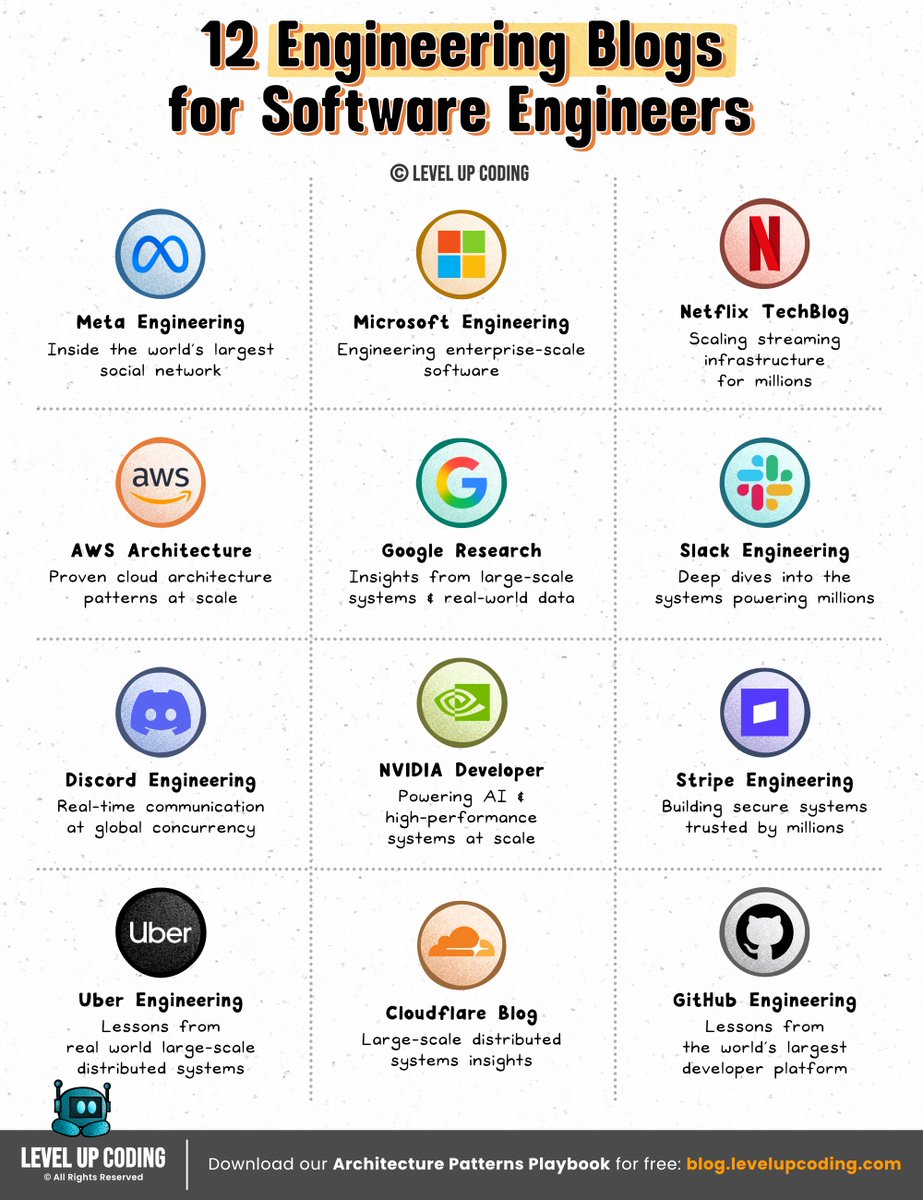
If you want to become a better software engineer (in 2026),
read these 12 engineering blogs:
1. Meta Engineering
↳ https://t.co/Gk1odu0G1G
2. Netflix TechBlog
↳ https://t.co/T3StVaZlCB
3. AWS Architecture
↳ https://t.co/kvBAMbpyvr
4. Microsoft Engineering
↳ https://t.co/zgLHpGKBRa
5. Google Research
↳ https://t.co/UUM2DzSKQR
6. Slack Engineering
↳ https://t.co/qT1O4xxSoc
7. Discord Engineering
↳ https://t.co/ne9lNeUeMX
8. NVIDIA Developer
↳ https://t.co/i9y3zNuNyC
9. Stripe Engineering
↳ https://t.co/w8c7fcJKgj
10. Uber Engineering
↳ https://t.co/beFKMaK5r1
11. Cloudflare Blog
↳ https://t.co/oSp5ALRFPT
12. GitHub Engineering
↳ https://t.co/83WGnNkagK
What other blogs should be on this list?
--
👋 PS: Want my System Design Handbook for free?
Want my Architecture Patterns Playbook for free?
Join my newsletter with 26,501+ software engineers: https://t.co/OQtXb4zMoe
--
📌 Save for later.
♻️ Repost to help others grow.
➕ Follow Nikki Siapno + turn on notifications.
Annual reports are packed with numbers but the smartest companies know that how you visualize those numbers often matters more than the numbers themselves - #Sankey diagram. #BI#Data#Visualization
https://t.co/I3h95tyFM5
The next wave of AI doesn’t just analyze, predict, or generate. It plans, decides, executes, and optimizes end to end. Traditional #AI to #GenAI to AI #Agents to #AgenticAI.
https://t.co/VQUkvn7W2x
In today’s #AI driven landscape, versatility and adaptability increasingly matter as much as deep technical depth. In the AI era, which matters more – deep specialization or broad generalization?
https://t.co/8XzIuaA6j5
How to be the Top 1% Learner?
Most people fail because they try to “jam and cram” information! To break into the top 1% of learners, you must stop hoarding information and start using the 3C Protocol: Compress, Compile, and Consolidate. https://t.co/uzJLGXEKg0
How to get ahead of 99% people?
Many people believe that to achieve massive success, they must outwork the entire world. However, you don’t actually need to beat billions of people. Learn at
https://t.co/P2GiRn4zjM
We’re proud to share that Databricks is a Leader in two 2025 @Gartner_inc Magic Quadrant™ reports for Cloud Database Management Systems and for Data Science and Machine Learning Platforms!
We believe this recognition highlights the strength of our open platform and new capabilities like Lakebase and Agent Bricks that help enterprises use their data to build and deploy AI with speed and confidence.
Download the reports to learn more: https://t.co/hL8LudlA0r
I finally understand the difference between LLMs, RAG, and AI Agents.
After two years of building production AI systems, I realized most people are treating them like competing tools when they’re actually three layers of the same intelligence stack.
1. The LLM is the brain.
It’s the reasoning engine. It understands language, writes, explains, and synthesizes ideas better than any system before it. But it’s frozen in time. GPT-4, for example, knows nothing past its last training update. Ask it about yesterday’s events and it’ll confidently make something up. LLMs can think, but they’re disconnected from the present.
2. RAG is the memory.
It’s what connects that frozen brain to live knowledge. Instead of retraining the model, RAG retrieves fresh information from your company’s data, APIs, or the web and feeds it to the LLM as context. Now the model reasons over real, up-to-date facts rather than outdated patterns. The best part? You can trace exactly which documents shaped each answer. It’s the difference between guessing and knowing.
3. AI Agents are the decision-makers.
They wrap a control loop around the system. The agent perceives goals, plans actions, executes tasks, and reflects on the outcome. It’s not just answering a question—it’s doing the work. Think of an AI that researches, drafts a report, sends an email, and iterates on feedback, all autonomously. That’s what an agent does.
Most “AI” demos stop at the LLM stage. Real production systems combine all three: the LLM for reasoning, RAG for accuracy, and the Agent for autonomy.
Use LLMs for pure thinking tasks writing, summarizing, explaining.
Add RAG when precision and truth matter like referencing internal documents or specialized data.
Deploy Agents when you need end-to-end action systems that decide and operate without manual input.
The future of AI isn’t one layer beating the others. It’s about architecting all three together.
LLMs think.
RAG remembers.
Agents act.
That’s the real intelligence stack.
A canary deployment is a progressive rollout strategy where a new version of an application (or data pipeline, model, etc.) is released to a small subset of users or systems first, before deploying it to everyone. https://t.co/Is6UzRKFv1 #DevOps#AIOps
Always-on digital enterprises, downtime and performance issues come at a steep cost. The modern DevOps philosophy has redefined how orgs build, test, deploy, and manage. Two terms: Shift-Left and Shift-Right capture this evolution perfectly. https://t.co/BJjlkCSl07
#DevOps#AIOps
In the world of data, modern enterprises wrestle with three big challenges: speed, accuracy, and usability. You want insights fast, you want them reliable.
That’s where #Databricks AI/BI #Genie comes in—a newer offering that blends BI with AI
https://t.co/AbYUZROYKi
Org constructs of scaled Agile delivery Tribes, Guilds, Pods, ARTs, PI Planning is critical. These define how data, analytics, and product teams operate together at scale under frameworks like #SAFe (Scaled #Agile) or Spotify Model
https://t.co/LZSlQquYYn
When Andrej Karpathy titled his recent keynote “Software Is Changing (Again),” it wasn’t just a nice slogan. It marks what he argues is a fundamental shift in the way we build, think about, and interact with software. #Programming -> #NeuralNetwork -> #LLM https://t.co/FqrlS691RV
Vibe Coding:
It focuses on intent-first interactions, where humans express their needs in natural language or even visual cues, and AI translates those “vibes” into functional code or workflows. #LLM#GenAI
https://t.co/4GhE0eZVsw
From BOT to Co-Innovation: Emerging Client–Service Provider Operating Models in IT and Analytics. This article explores some common & emerging operating models focusing on sustainability, strategic value, and growth
https://t.co/k9KhVJcWVw #GCC#COE#Analytics#GenAI
As #AI continues to dominate tech conversations, several buzzwords have emerged – #LLM, #RAG, AI Agent, and Agentic AI. But what do they really mean, and how are they transforming industries?
Read more at https://t.co/TqYxWR5WIE