📰JUST IN: For decades, Washington liberals like Bernie Sanders and Ohio’s former Senator Sherrod Brown voted to rain down taxpayer benefits like Social Security and Medicaid on illegal immigrants.
Click to read the full story.
Click to learn more.
@WVmotoguy Wow, I'm still wondering why I paid $3.80 yesterday in town and look across the street to see $4.29 at another station. It's not right either way.
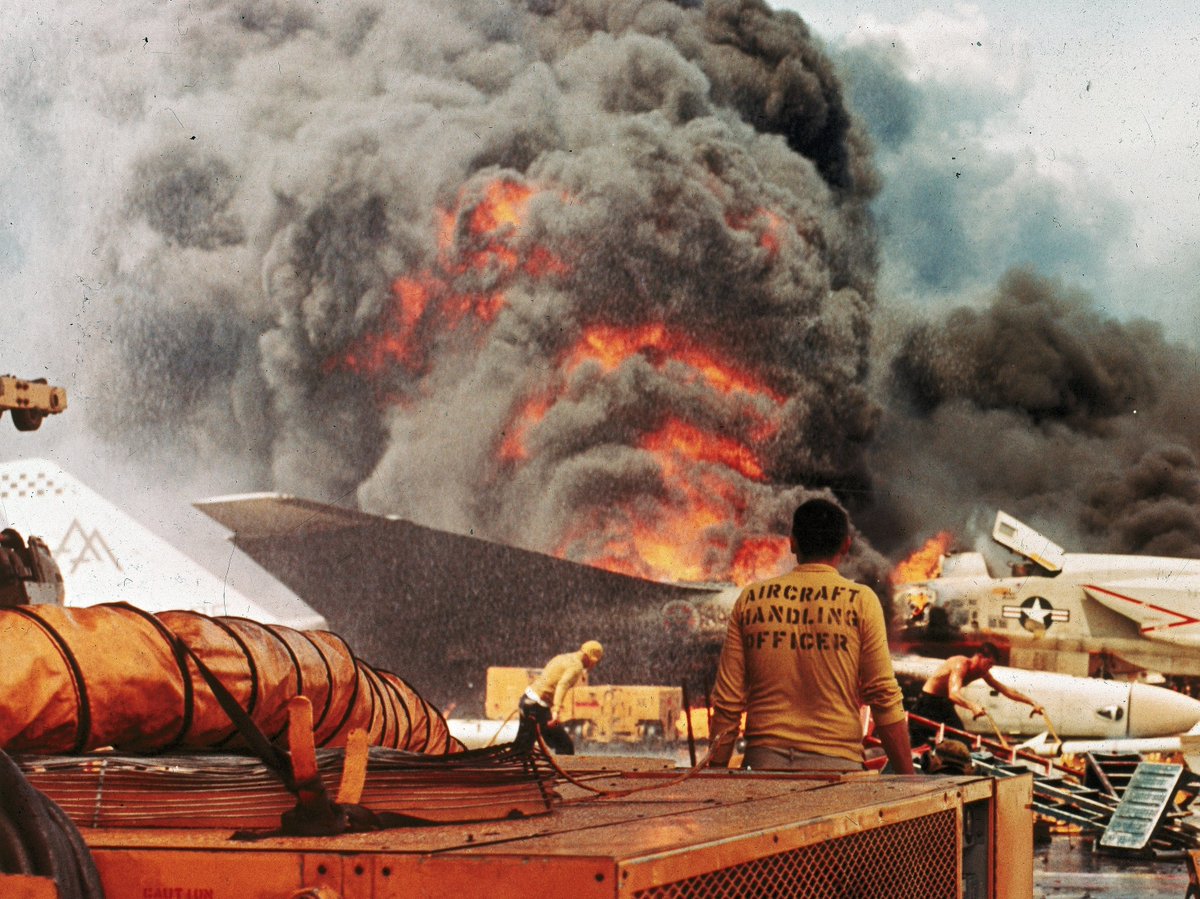
July 29, 1967. In the Gulf of Tonkin off the coast of North Vietnam, the aircraft carrier USS Forrestal was launching strikes when a freak accident set off one of the worst disasters in US Navy history. By the time the fires were out, 134 men were dead. Not one of them was killed by the enemy.
Start with the bombs, because they matter. The day before, an ammunition ship had handed Forrestal sixteen old 1,000 pound bombs, Korean War leftovers, some stamped 1953. They had been sitting in the open in the Philippines for years, and they came aboard rusty, moldy, and actually leaking, a sign the explosive filler inside had gone unstable with age. The ship's ordnance men had never seen bombs like them and begged to dump them over the side. The captain tried to trade them back and was told there was nothing else. He needed 1,000 pound bombs for the next day's missions, so he reluctantly kept them, and had them set apart on the deck, away from the magazines.
The morning of the 29th, the aft flight deck was jammed wing to wing with 27 fueled and armed aircraft waiting to launch the second strike of the day. At about 10:51, an electrical surge caused a Zuni rocket under one of the F-4 Phantoms to fire by accident. It shot roughly a hundred feet across the packed deck and tore open the external fuel tank of an A-4 Skyhawk. Hundreds of gallons of jet fuel gushed out onto the deck and ignited in an instant, whipped into an inferno by a 32 knot wind. One of the pilots sitting in that pack of Skyhawks was a young aviator named John McCain. He scrambled out of his cockpit, climbed down the refueling probe on the nose, and jumped through the flames to escape.
Then came the part that turned a fire into a catastrophe. In the years before this, the Navy had stopped training all its sailors to fight fires and instead relied on small teams of specialists. Forrestal's deck team was led by a chief named Gerald Farrier. They had been trained on film showing that a 1,000 pound bomb could sit in a fuel fire for a full ten minutes before anyone had to worry. But those test films used modern, heat resistant bombs. The rusty old bombs now cooking in the flames on Farrier's deck were nothing like them. Chief Farrier saw a bomb lying in the burning fuel, and rather than wait, he ran to it with a single hand held extinguisher and tried to hold the fire back with his own body to buy the trapped pilots time to get out. He had no protective gear on. The bomb's casing split, he shouted for his men to run, and it detonated about a minute and a half after the fire began. The blast killed Chief Farrier and nearly his entire firefighting team instantly. In one explosion, the ship lost almost every man trained to save it. John McCain, who had turned back to help another burning pilot, was thrown ten feet and cut with shrapnel.
After that, it was untrained teenagers against hell. More bombs cooked off, ten of them in all, some blowing craters straight through the armored flight deck. Around 40,000 gallons of burning jet fuel poured down through the holes into the berthing compartments below, where dozens of men from the night crew were asleep. Fifty of them died down there. The fire raged across the deck and burned deep in the ship's guts for hours. Sailors did unbelievable things. An explosive ordnance officer named Robert Cates defused smoking live bombs by hand and had himself lowered on a rope into a burning, smoke filled compartment to hook a line onto a bomb so it could be dragged out and thrown overboard. A destroyer, the Rupertus, pulled to within twenty feet of the blazing carrier and poured water on the flames for an hour and a half, an act the admiral called magnificent seamanship.
They did not get the flight deck fire under control until almost noon, and the fires deep in the lower decks burned until after midnight, roughly fourteen hours in all. When it was over, 134 sailors and airmen were dead, 161 were injured, and 21 aircraft were destroyed. It took nearly five months in the shipyard to rebuild the ship, replacing 175 feet of flight deck and some 200 compartments.
John McCain survived, and rather than go home he volunteered for another carrier. Three months later he was shot down over Hanoi and spent five and a half years as a prisoner of war. And the Navy learned. It went back to training every single sailor to fight fire, built automatic deck washdown systems into its carriers, and named its firefighting school in Norfolk after Chief Farrier, the man who ran at a live bomb with a fire extinguisher so his pilots could live. New sailors still watch the real footage of that day. The Forrestal was not lost to any enemy. It was lost to a spark, an old bomb, and a hard lesson written in the lives of 134 men.
Traces of Texas reader Jana Hinkley graciously shared this super photo of the Kandy Kitchen in Alpine, which was a candy/soda fountain in Alpine for 40+ years. Jana told this great story:
"For more than forty years, The Kandy Kitchen served the sweet-tooth of the people of Alpine and the Big Bend country. “The place where the live ones like to linger,” was established in 1911 by Shirley Scales and was co-owned later with his brother Otis Scales, who continued to operate the Kandy Kitchen after Shirley retired. This professional business photo, probably from the late 1920s, shows the two Scales brothers with one of their college-age employees. [My grandfather Lee Matt Smith worked here while he was in college at Sul Ross and, while this photo is from his collection, I’m not convinced that the employee in the middle is my grandfather.]
The Kandy Kitchen made most of the candies which were sold at the establishment but carried such brands as Whitmans, Saylor, Pangburns, Hoffmans and other well-known candies. The Kandy Kitchen also served their own homemade ice cream, a delight to ice cream lovers. They offered curb service and maintained a well equipped fountain with ample seating space to take care of large groups of college students at one time.
The Kandy Kitchen building, located “across from the Southern Pacific Depot” (as advertised in the El Paso Times), was built by William Daugherty, a building contractor, custom woodworker and cabinet maker. Daugherty built many of the early homes in Alpine as well as the First Christian Church and the Mitchell-Gillett building. He also drew the plans and supervised the construction of the original Masonic Temple in Alpine.
In the late 1950s Otis Scales sold the business to Jimmie Logan, who operated it for a few years, and then the Kandy Kitchen was closed out with a big auction sale which attracted much attention in Alpine for a number of days.
Note from Traces: I believe this building still stands on the southwest corner of 5th and Murphy in Alpine.
Thank you, Jana. This is a fantastic family artifact.


![TracesofTexas's tweet photo. Traces of Texas reader Jana Hinkley graciously shared this super photo of the Kandy Kitchen in Alpine, which was a candy/soda fountain in Alpine for 40+ years. Jana told this great story:
"For more than forty years, The Kandy Kitchen served the sweet-tooth of the people of Alpine and the Big Bend country. “The place where the live ones like to linger,” was established in 1911 by Shirley Scales and was co-owned later with his brother Otis Scales, who continued to operate the Kandy Kitchen after Shirley retired. This professional business photo, probably from the late 1920s, shows the two Scales brothers with one of their college-age employees. [My grandfather Lee Matt Smith worked here while he was in college at Sul Ross and, while this photo is from his collection, I’m not convinced that the employee in the middle is my grandfather.]
The Kandy Kitchen made most of the candies which were sold at the establishment but carried such brands as Whitmans, Saylor, Pangburns, Hoffmans and other well-known candies. The Kandy Kitchen also served their own homemade ice cream, a delight to ice cream lovers. They offered curb service and maintained a well equipped fountain with ample seating space to take care of large groups of college students at one time.
The Kandy Kitchen building, located “across from the Southern Pacific Depot” (as advertised in the El Paso Times), was built by William Daugherty, a building contractor, custom woodworker and cabinet maker. Daugherty built many of the early homes in Alpine as well as the First Christian Church and the Mitchell-Gillett building. He also drew the plans and supervised the construction of the original Masonic Temple in Alpine.
In the late 1950s Otis Scales sold the business to Jimmie Logan, who operated it for a few years, and then the Kandy Kitchen was closed out with a big auction sale which attracted much attention in Alpine for a number of days.
Note from Traces: I believe this building still stands on the southwest corner of 5th and Murphy in Alpine.
Thank you, Jana. This is a fantastic family artifact.](https://pbs.twimg.com/media/HOHQRInXMAAcbJW.jpg)





