Ninety-nine percent of people in the world are convinced they are incapable of achieving great things, so they aim for the mediocre.
The level of competition is thus fiercest for “realistic” goals, paradoxically making them the most time- and energy-consuming.
If you are insecure, guess what? The rest of the world is, too.
Do not overestimate the competition and underestimate yourself. You are better than you think.
Unreasonable and unrealistic goals are easier to achieve for yet another reason.
Having an unusually large goal is an adrenaline infusion that provides the endurance to overcome the inevitable trials and tribulations that go along with any goal. Realistic goals, goals restricted to the average ambition level, are uninspiring and will only fuel you through the first or second problem, at which point you throw in the towel.
If the potential payoff is mediocre or average, so is your effort.
The fishing is best where the fewest go, and the collective insecurity of the world makes it easy for people to hit home runs while everyone else is aiming for base hits.
There is just less competition for bigger goals.
In 2015 a writer named Tim Urban sat down and counted the days he had left with his parents. He was 34, healthy, both parents alive and well. The number came back around 300. Less time than he spent with them in any single year of his childhood.
The post is called The Tail End, on a blog called Wait But Why. The idea is to stop counting your life in years and start counting it in events. Reach 90 and you get about 4,680 weeks, and every one of them fits on a single sheet of paper. Maybe 60 more winters after that. If you read five books a year, that is 300 books, picked from every book ever written.
Those things at least spread out evenly. A third of the way through life means a third of the way through your pizzas. Time with the people you love does not work like that. Almost all of it sits at the very start. Then it is gone.
For your first 18 years you are around your parents nearly every day. Then you leave for college or a job in another city, and a normal adult sees their parents maybe 10 days a year. So the day you move out, you are already at 93 percent. Urban was living in the last 5 percent and had no idea until he drew the chart. He called it the tail end.
It does not stop at parents. His two sisters, after a whole childhood in the same house, had around 15 percent of their time together left. The four friends he played cards with most days in high school were down to their last 7 percent. Nobody had a fight. Nobody moved away angry. Life quietly spends the time for you while you assume there is plenty left.
You do not have to be old to be near the end with someone. If your parents are alive and you live in a different city, you have probably already used more than 90 percent of the days you will ever spend in the same room as them.
His one instruction is about that last stretch. When you are down to the final days with someone you love, treat that time like what it is, which is almost gone. The rest is the tail end, and it is much shorter than it feels.
@nateliason Nat, when you reflect on your journey are there moments that stuck out as turning points for your own brand? If you've written about this already plz link.
We're building a game studio at Founders School.
We want to teach 1,000,000+ teens business skills, and believe simulation games are the best way to bring our curriculum to those who can't attend the school.
I need help finding someone to lead it.
The ideal candidate:
- Has created & launched a popular game solo or on a small team
- Has experience managing other game designers / developers
- Is extremely enthusiastic about using AI as much as possible in the game development stack
- Believes teaching entrepreneurship and business skills is one of the best ways to improve the world
- Is excited to be on-site in NYC working with me and @CameronSorsby, plus the inaugural class of Founders School students.
If you know anyone who could be great for this, please send them my way.
As everyone watches the SpaceX IPO today, its worth remembering this advice from Buffett
"The idea that a newly issued security (IPO)—brought to market at a time of the seller's choosing and surrounded by massive hype—is the single best bargain among thousands of global businesses is absolute nonsense.
When an offering carries a ridiculous 7% commission just to incentivize salespeople, it simply cannot be the most attractive investment available.
While people easily get caught up in the excitement of a new launch, look at the reality: you have thousands of existing public companies whose prices are set by a natural auction market, free from aggressive promotion or hidden fees.
It makes no sense to buy a security precisely when an insider decides the timing is perfect to sell. Frankly, it isn't worth spending five seconds thinking about IPOs."
- Warren Buffett
What if your son could trade four stagnant years in lecture halls for four years of adventure, and come out the other side a debt-free EMT, licensed pilot, builder, sailor, fighter, and entrepreneur?
A lot of tough guys urge young people to "skip college," but rarely explain what they should do instead. That just changed.
The great and brilliant Doug Casey, who's visited 150+ countries and made a fortune as an investor, just wrote something every parent of a son needs to read.
I read it and immediately had a copy shipped to Dave Smith, with a note: You have a son, and for his sake you need to read this.
It's called The Preparation, though Doug tells me it was nearly called Renaissance Man.
Have your son pursue this, and he will emerge as the most interesting person everyone he meets will know, by a country mile.
It's a four-year, 16-cycle alternative to college that forges a debt-free EMT, pilot, builder, sailor, and entrepreneur -- oh, and someone who can prepare authentic Italian cooking because he learned it in Florence.
Your son will emerge not as a graduate with a degree and a loan balance, but as a young man who can fly a plane, save a life, build a house, and hold his own in any room.
He'll take courses, too, but not ones taught by crazy people who hate him.
So many young people these days are without direction, and in this AI world don't know what to do.
Doug Casey is training young men to be masters of the universe. (1/2)
I'm finally reading Dune. This quote, which is in the first few pages, hits hard:
"Once men turned their thinking over to machines in the hope that this would set them free. But that only permitted other men with machines to enslave them."
I think the challenge is that everyone can now build apps
But
1) almost nobody has distribution (like an audience), or
2) the money to pay for distribution (ads or UGC), or
3) the creative genius to get distribution for free (classically called guerilla marketing)
luckily bookmark rot is an easy problem to fix now
here's how to turn every X bookmark you've ever saved into a second brain your agent has full context on:
1. export your bookmarks. i use twitter-web-exporter (free userscript) or the BookmarkSave extension. you get one file with every bookmark + the full text + the author + the link
2. drop that file into a folder. if you already run an llm wiki / obsidian vault, drop it straight in so your bookmarks join the rest of your knowledge
3. point your agent at the folder (claude code, codex, hermes, whatever you run) and tell it: "read this export and turn every bookmark into its own markdown note with the original link and a couple of topic tags"
that's it, your agent has read all of it.
now you can ask "what have i saved about pricing" or "pull everything i bookmarked on claude code" and it answers across the whole pile
takes maybe 10 minutes
after that they actually get used, and every new bookmark folds into the same brain instead of rotting in a tab you never open again
An old man is selling watermelons by the side of the road.
His sign reads:
1 for $3
3 for $10
A young man stops and buys one watermelon.
“That’ll be $3,” says the old man.
The young man then buys a second watermelon. And then a third.
After paying another $3 each time, the young man picks up his watermelons and starts to walk away.
Then he turns back, grinning proudly.
“Hey old man,” he says, “you realize I just bought three watermelons for $9 instead of $10? Maybe business isn’t your thing.”
The old man smiles and shakes his head.
“Funny… every time somebody comes by, they buy three watermelons instead of one… and then try to teach me business.”
Uber blew through its entire 2026 Claude Code budget by April and is slowing hiring to cover the API bill. The COO admits the massive token burn isn't translating to shipped features. We didn't automate engineering. We just traded actual headcount for a while-loop with a corporate card.
@TDOT1991@MapleLeafs Lol this has got to be parody. They tried to re-sign Marner and the team has been awful in every statistical measure since Berube was the coach. Clearly not part of the solution.
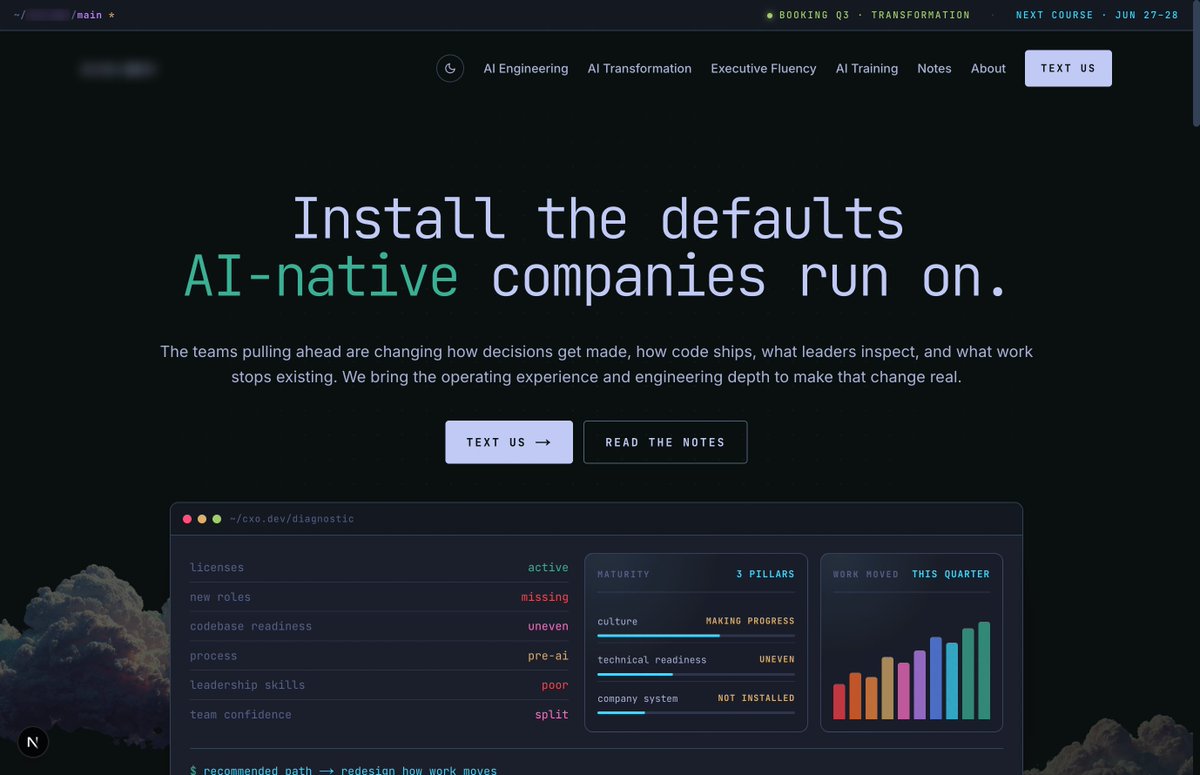
a small (elite) team and I have been working on a little something here
exec + eng focused
led by technical operators
actually know wtf we're talking about
$$$$ but worth it
a sneak peek ahead of launch 👇