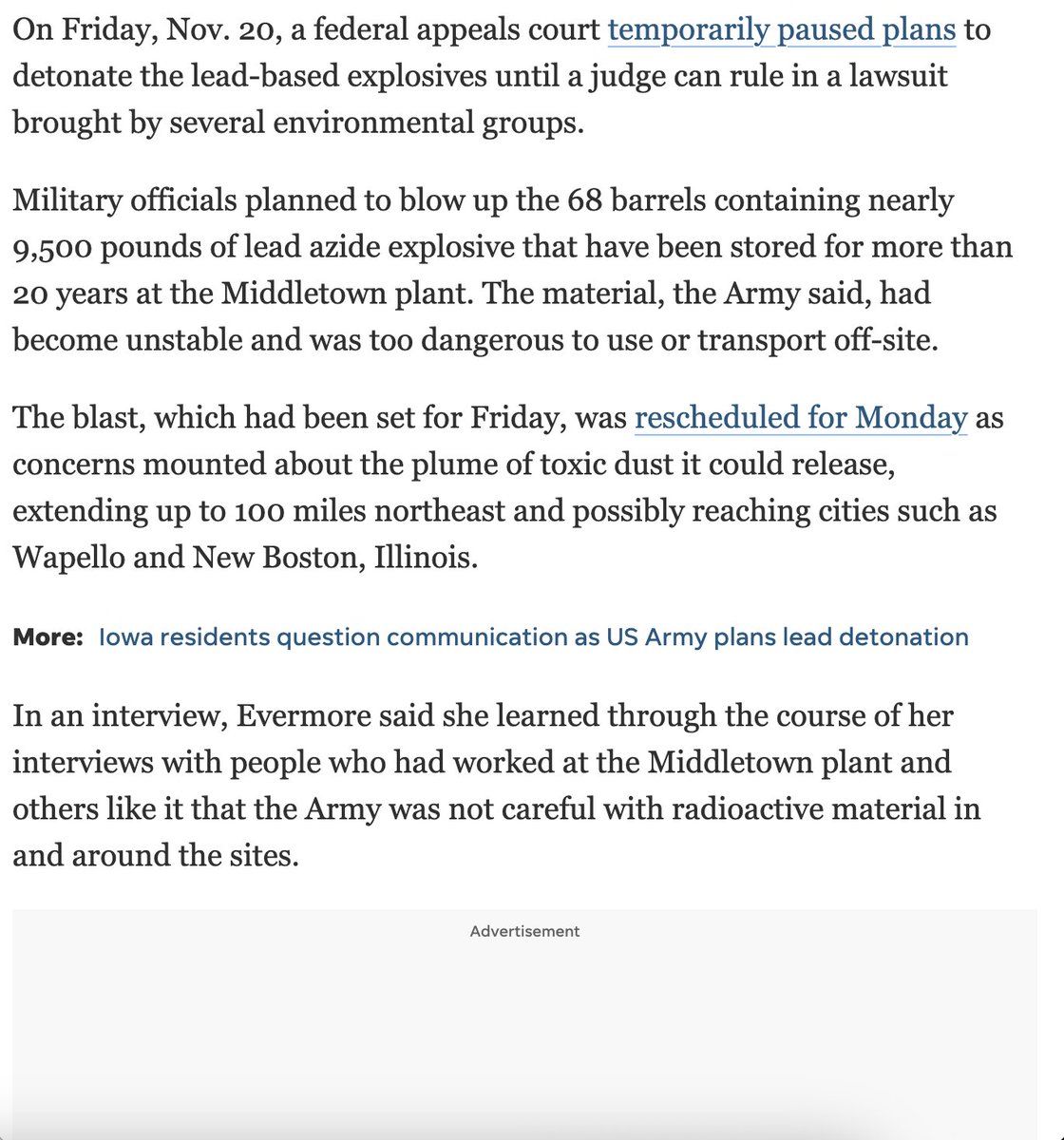
"Lead azide, which is used to initiate explosions in munitions, has been stored for years at the Iowa Army Ammunition Plant in Middletown, a community of a few hundred people.
On Friday, homes there had windows lined with tape and wrapped in plastic. Tarps covered air-conditioners. And a 6-year-old boy, Dawson Palmer, drove a toy car in circles in the grass. School was closed for the day, he said, 'because of the bomb.'"
Photo by Quinn Glabicki
Reporting by Quinn Glabicki, John Ismay, and Hiroko Tabuchi of The New York Times
NEW via The Des Moines Register (Lee Rood and Virginia Barreda):
"For one former Iowan who studied the history of the Iowa Army Ammunition Plant in southeastern Iowa, there is good reason for the groundswell of concern surrounding the planned detonation of tons of unstable lead-based explosives there.
Michele Evermore, now a senior director at the National Employment Law Project in Washington, D.C., wrote her master's thesis while a student at the UMass Amherst Labor Center in 2016 on the history and ongoing health threats posed at U.S. weapons plants used by the military, including the one in Middletown.
Evermore learned through her research hundreds of small manufacturing facilities involved in nuclear weapons work were exposed only after many former workers were poisoned with toxins from weapons making.
She said she interviewed Bob Anderson, a man who, along with three co-workers, developed non-Hodgkin’s lymphoma in 1987 after working at the Iowa plant. In 1997, Anderson reported what was happening there to a staffer of then-U.S. Sen. Tom Harkin, D-Iowa. Anderson worked at the plant from 1968 to 1973, and said he and his fellow co-workers were told to keep their work secret.
"When Bob’s letter initially got to Harkin’s office, a staffer named Tom Vinson read it and tried to research this nuclear weapons work but could not document Anderson’s claims. He escalated the letter to Harkin’s senior energy advisor, Peter Tyler, who contacted the Department of Energy," Evermore wrote in her thesis.
"The staffer he spoke with said that they had no records of nuclear weapons being manufactured in Burlington. Months later, however, on a routine staff outreach trip to the Iowa Army Ammunition Plant, Peter noticed a poster on a wall about building nuclear weapons in the past. He asked about it and was told 'Oh yeah, we made those bombs here.'
Tyler was subsequently taken on a 'windshield tour,' Evermore wrote, and saw a building in which the weapons were built. It was dome-shaped; in case something exploded, it was designed to collapse in on itself.
After Harkin's office became involved, Peter Eisler, then an investigative reporter at USA TODAY, spent months finding and exposing similar plants across the country run by private contractors. In his research, he discovered conditions at some plants with more safety problems than those uncovered at Burlington or major U.S. Department of Energy facilities. Eisler stayed in contact with Tyler as he uncovered more and more facilities around the country."
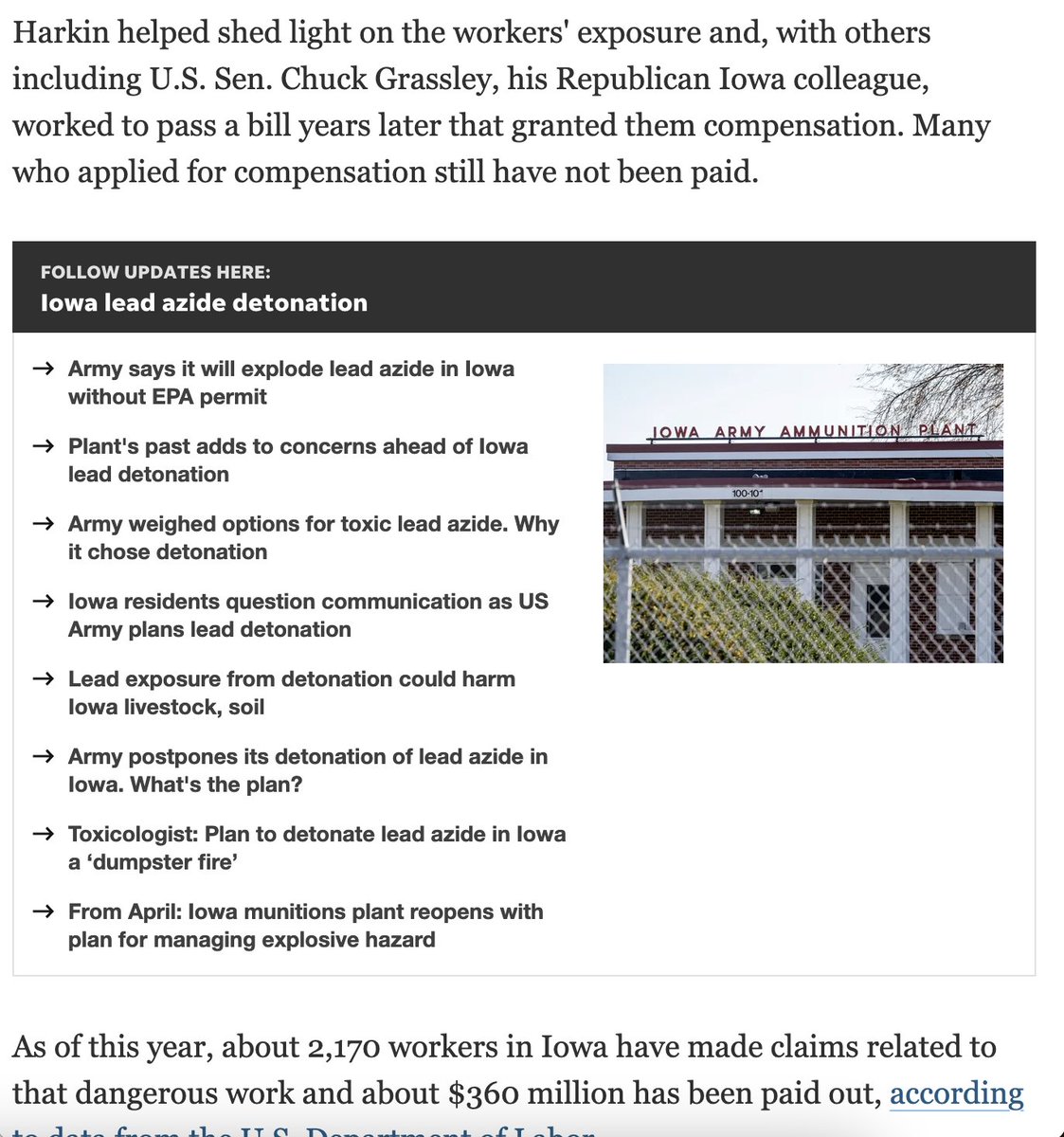
"Harkin helped shed light on the workers' exposure and, with others including U.S. Sen. Chuck Grassley, his Republican Iowa colleague, worked to pass a bill years later that granted them compensation. Many who applied for compensation still have not been paid."
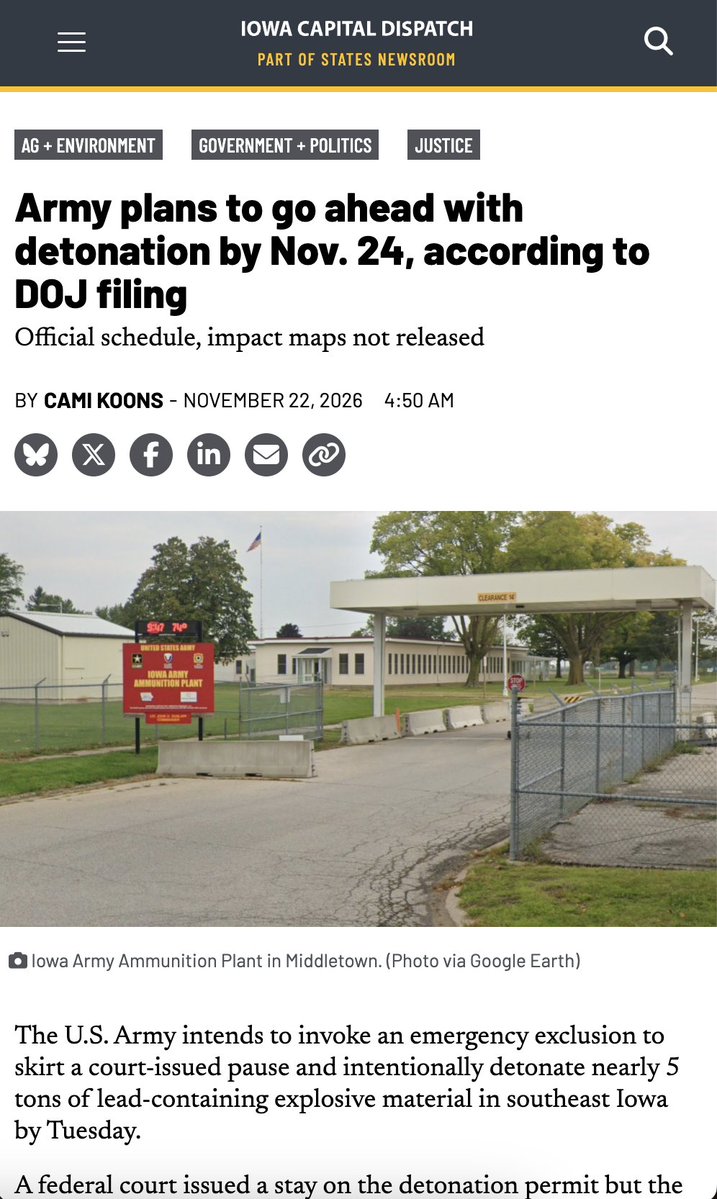
NEW via Iowa Capital Dispatch (Cami Koons):
"The City of Fort Madison posted publicly Saturday that it was informed the detonation would take place either Monday or Tuesday and shared a document with modeling from the National Weather Service..."
"'An uncontrolled detonation of nearly five tons of primary explosive would endanger soldiers, contractors, and the surrounding communities, all without many of the protective measures meant to minimize the risks from the blast—harm that cannot be undone,' the lawsuit said. 'The environmental and health interests Petitioners seek to protect plainly are better served by a controlled detonation than by an uncontrolled explosion.'
DOJ said that while the Army intends to operate without the permit, it will 'remain consistent' with the terms of the EPA emergency permit and its mitigation measures.
Part of the EPA permit required the Army to distribute plume impact estimates 48 hours before detonation, again 6 hours before and then every hour up until the detonation. Per this alert schedule, the Army should have issued new maps Saturday if it planned to detonate on Monday.
As of early Sunday, the Army had not provided updated maps nor the official time it plans to detonate.
The DOJ is expected to file a response in opposition to environmental groups’ lawsuit before noon on Sunday, per a request of the U.S. Court of Appeals for the Eighth Circuit."
KCRG Update: "In a federal court filing Saturday, lawyers for the Environmental Protection Agency (EPA) notified judges that the Army intends to invoke an emergency exemption in federal hazardous waste rules to destroy lead azide stored at the plant in Middletown, Iowa."
I have no knowledge of the impetus behind the City of Fort Madison issuing this addendum at 9:45pm on a Saturday night, but having served previously as an elected official or public servant in local, state, and national government previously, my educated guess is they got a stern talking to from some Very Important People™.
Nonetheless, kudos to the City of Fort Madison for erring on the side of transparency and openness for its citizens. There are many of us who are grateful for it.
The City of Fort Madison has issued a 9:42pm addendum to their earlier 11:50am update:
"The statement below is represented from information that is being circulated for our emergency planning and is not the final statement of the plans. As the City of Fort Madison, we feel it is important to openly communicate with our residents. The plans of IAAP have not been finalized. The court order is still in place at this time."
The City of Fort Madison states they've "been notified that the Iowa Army Ammunition Plant will most likely detonate the Lead Azide either on Monday, November 23rd or Tuesday, November 24th.
If this does not happen this week, another time will need to be arranged with additional planning.
The court order is still in place at this time that put a stay on the detonation for review of the Environmental Protection Agency's Permit."
I was also curious if we might get a new projected plume map today.
As of now (4:45pm CT on Saturday), I haven't yet seen one posted on the ASC Installation Community Notifications website: https://t.co/IIDL1iDTUc
Page 10 of EPA permit for the lead bomb requires the Army to “update and publicly distribute the plume impact estimate using forecasted weather conditions” 48 hours prior.
That would have been Noon today.
Perhaps I’m missing it but I haven’t seen any update from the Army.
NEW via The New York Times (Hiroko Tabuchi and John Ismay):
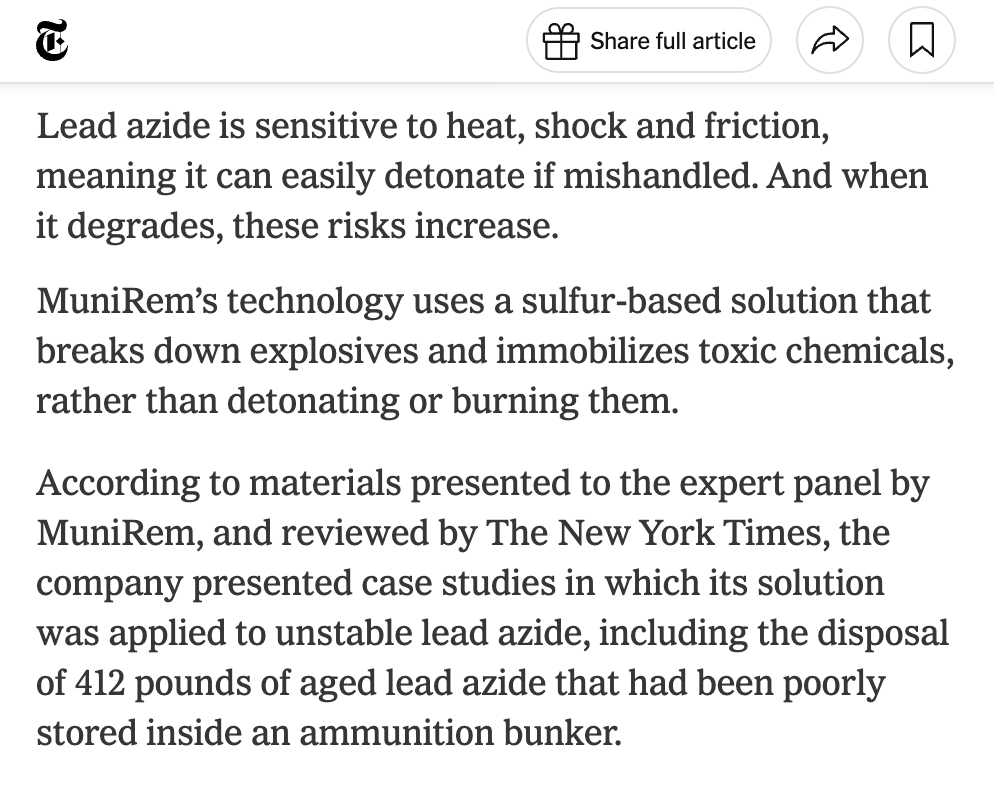
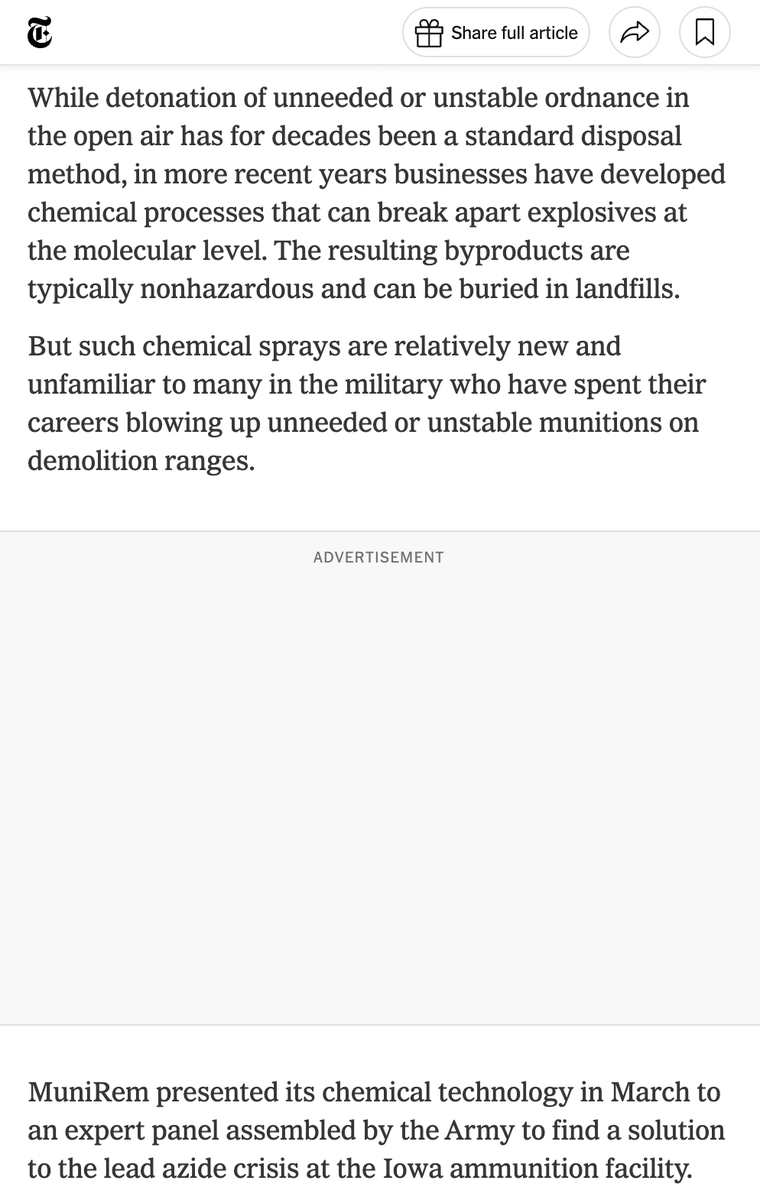
"In March, when the Army discovered nearly five tons of rapidly deteriorating explosives at an Iowa base, it faced two main choices: hire a company to safely dissolve the chemicals, or blow them up.
The Army awarded a contract to MuniRem Environmental, a Georgia-based firm that uses chemicals to neutralize munitions. But it canceled the deal two months later, citing safety concerns, opting to blow up nearly five tons of the material instead."
"The Army did not respond to questions about its canceled deal with MuniRem and why it chose to blow up the dangerous material. The details about the MuniRem contract have not previously been reported."
University of Iowa researchers are asking the public for help measuring lead from the planned detonation near Middletown, Iowa:
"We are looking for homes and properties where we could place air and dust samplers around the planned detonation at the Iowa Army Ammunition Plant in Middletown, IA.
Live or own property near Middletown, IA? Sign up below; it takes a few minutes.
Choosing good spots ahead of time is hard. The wind, the detonation date and time, and how much lead gets into the air all change from one forecast to the next, so the places worth sampling can shift right up to the day. If the detonation is rescheduled, we will not know which way the plume will go until a few days before, so we welcome sites in every direction from the plant. A list of willing hosts lets us move quickly when the forecast changes.
We will choose sites based on the final plume projection shortly before the detonation.
Signing up does not commit you to anything, and it does not mean we will ask to sample at your property. We will call you first, and you can say no at any time."
"Lead azide, which is used to initiate explosions in munitions, has been stored for years at the Iowa Army Ammunition Plant in Middletown, a community of a few hundred people.
On Friday, homes there had windows lined with tape and wrapped in plastic. Tarps covered air-conditioners. And a 6-year-old boy, Dawson Palmer, drove a toy car in circles in the grass. School was closed for the day, he said, 'because of the bomb.'"
Photo by Quinn Glabicki
Reporting by Quinn Glabicki, John Ismay, and Hiroko Tabuchi of The New York Times
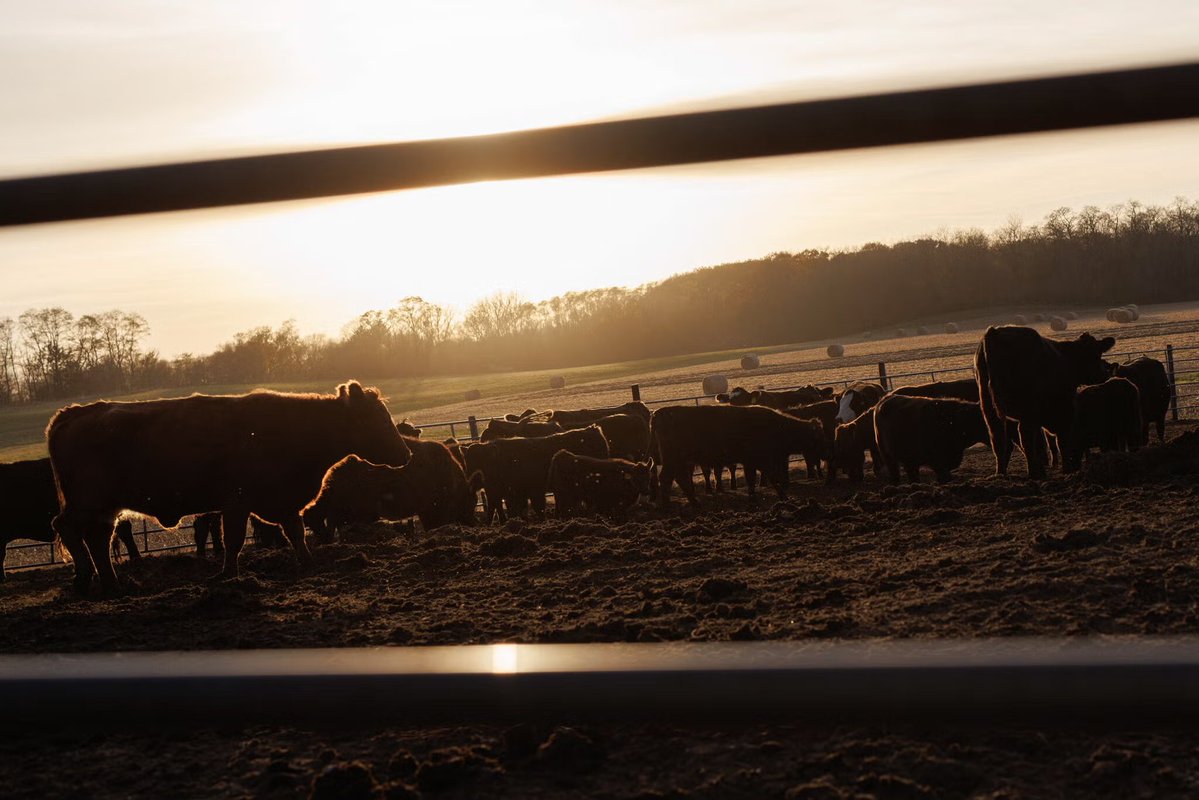
"When he heard about the blast a week ago, his family figured the soil would be exposed, but they tried to find a way to protect the cattle, which can fetch more than $2,000 a head for the family business. 'There’s not much a guy can do,' he said.
He had heard on the radio that maybe he could use a leaf blower to clean some of the lead dust off the hay. But one way or another, he figured the herd, and at least 24 calves, would be exposed to the toxin. 'To me, a calf that was born a month ago or two months ago — I mean, it’s really going to affect that entire system,' he said.
And any lead that falls on his land, he fears, would bind with the soil and impede next spring’s crop from taking up nutrients. 'We’re at the mercy of it all, unfortunately,' he said."