The ugly truth about France and some of the other European countries currently in turmoil - and which none of the politicians want to admit because it'd be political suicide - is that you can't solve the problem by going after immigrants (as the right asserts) or the rich (as the left asserts), but you could solve it by going after the old.
One extraordinary statistic for you: people over 60 in France, a quarter of the population, own 60% of France's wealth, non-financial and financial (https://t.co/IdJ5X7OO12).
And here is another crazy statistic:
that same quarter of the population, those above 60, receive nearly two-thirds of all social spending by the French government (https://t.co/deNRNevIwq) - which is famously among the highest in the world (France's government spending is an insane 57.3% of GDP).
Last statistic: they make up about 40% of voters because they're a third of registered voters (https://t.co/zTa4RnVOmT), and they turn out far more than anyone else (https://t.co/34V2xzs9jH).
Put our 3 statistics together and there's almost a bit of an apartheid situation here: the old own most of the country's wealth, collect most of the social spending and have the political power to keep it that way.
Which makes them a de-facto rentier class, living off assets and transfers paid for by younger generations.
And, of course, at the risk of stating a truism, the future is built by the young. Yet France keeps effectively taking money away from them to give it to those whose working lives are already behind them - and need the money far less since they already own the country's wealth.
What about inheritance, I hear you ask? That's the funniest/saddest aspect: given that life expectancy has kept rising, the French now inherit a home at 54 on average. The most common case is someone in their 80s leaving it to heirs in their 50s, in effect the very old transferring wealth to the about-to-be old (https://t.co/d2RPAqLJGR).
You can add this to our earlier apartheid statement: on top of all the rest, even when the old finally let go of their wealth, it stays within their own "camp".
That's my personal situation, incidentally: I'm 42, my father is 71 and he is starting to look at ways to pass things on to me and my siblings, when our professional lives are already well settled, so it'll arrive when it changes things the least, which is pretty much the French system in a nutshell.
Now, I get that there'd be some unfairness in going after them: they paid into the system their entire working lives, playing by the rules of a social contract that told them if they paid up they'd collect at the end. Changing the rules now means breaking that promise, which is admittedly unfair.
But there's no magic wealth tree in any society: you can only take it where it is. That's the way most major societal transformations end up happening. They're often triggered by a catastrophic event (the so-called "four horsemen": mass-mobilisation war, revolution, state collapse, plague) BUT what really drives change is a transfer: wealth gets pried from the privileged class who've been sitting on it and handed to those who'll build what comes next.
So, in theory and in an ideal world, you can do without the catastrophic event and directly proceed with the transfer...
The fact that in France, and elsewhere in Europe, it's the youth protesting is probably no coincidence - even though they don't frame it as a generational fight. And even though, cruel irony, the left politicians many of them march behind promise to bring the retirement age back to 60 (https://t.co/WrJOhpWqYR), which would make the situation even worse.
Let's say they understand intuitively that the system is stacked against them, even if they haven't yet figured out how. And politicians are obviously doing what politicians do, meaning pandering to the people who actually vote, while pointing the young towards easier - and politically convenient - scapegoats.
To be clear I'm not saying it's the only problem in France, VERY far from it. I'm also not saying that all old people in France live a lavish lifestyle at the expense of younger generations: there are also plenty of very poor retirees who, if anything, would deserve more.
What I am saying is that it's probably the biggest elephant in the room: everyone can see it, nobody dares mention it - no politician, from any side, wants to run on cutting grandma's pension - and it makes every other problem harder to fix.
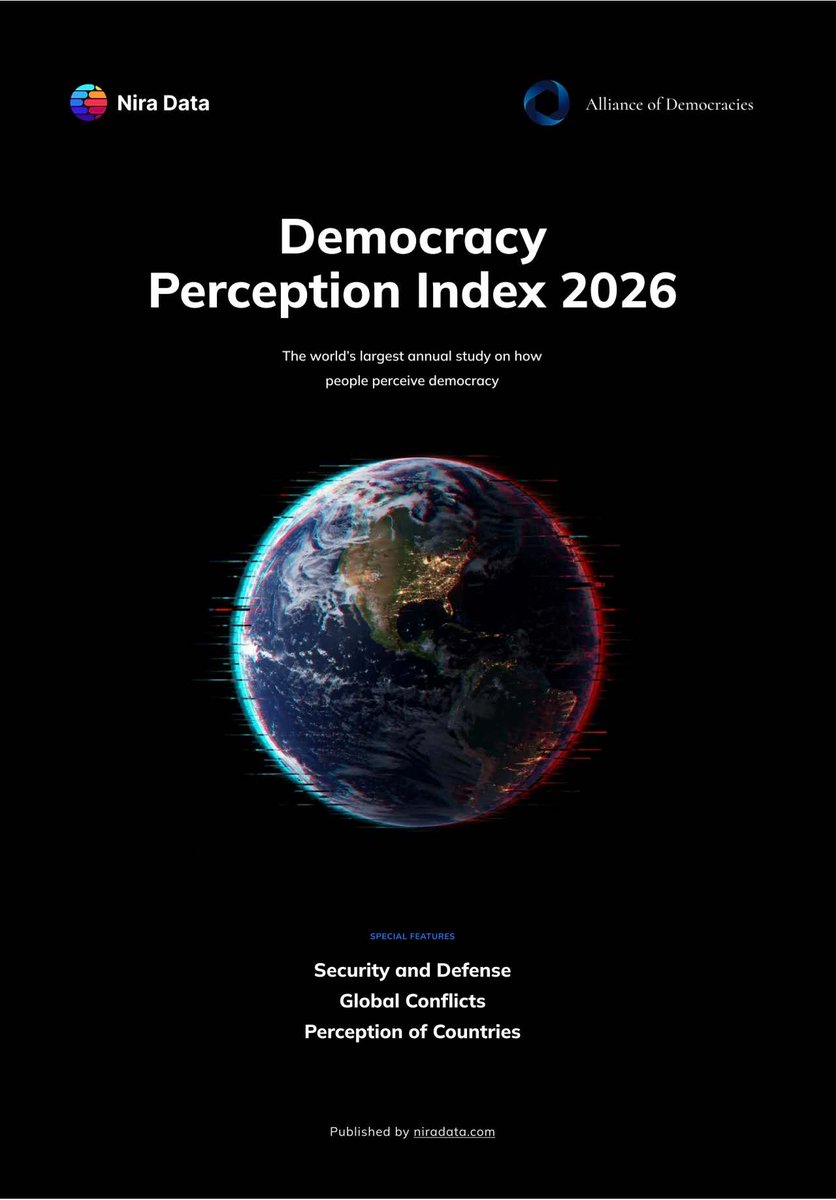
Every year, this has to be the one report I look forward to the most: the Democracy Perception Index, compiled by the Alliance of Democracies Foundation (in partnership with Nita Data).
In fact, my yearly thread on the report is apparently such a tradition that, this year, its lead researcher personally sent me the report with this message: "every year, I look forward to your thread about it!". That's how you start wondering whether you tweet too much 😅
Why do I like this report so much? A few reasons:
1) The Alliance of Democracies Foundation, the organization behind the report, cannot even remotely be suspected of being some sort of anti-West outlet: it was started by an ex-NATO Secretary General (Anders Fogh Rasmussen) and its stated purpose is "to unite world democracies"
2) It's surprisingly honest and the methodology is actually democratic. Unlike other reports on democracy the scoring isn't done by the report's authors (like the report by Freedom House or The Economist's "Democracy Index"). It simply asks people what they think and, when it comes to democracy, that's kind of the point 🤷♂️
3) I love the expression "perception is reality" because, like it or not, what people believe about their system is what determines its legitimacy. A democracy that nobody actually experiences as one can't credibly claim to be one. And conversely, a so-called "autocracy" that its people overwhelmingly believe is actually a democracy might... actually be a democracy.
Anyhow, this year's edition did not disappoint. The data is absolutely fascinating and frankly, a little terrifying. So here you go: my thread on the 2026 Democracy Perception Index 🧵
Alexander Solzhenitsyn gave the most controversial speech *against* Western Civilization at Harvard in 1978.
As a survivor of the Russian Gulags, they expected him to praise the West. Instead, he made a jarring accusation:
The West is a dying civilization. If it doesn't change its ways, it is doomed to collapse.
In fact, he said this has been the case for 500 years, when the West made a crucial mistake:
"How did the West decline from its triumphal march to its present debility?
...the mistake must be at the root, at the very foundation of thought in modern times. I refer to the prevailing Western view of the world which was born in the Renaissance…
I refer to humanism — the proclaimed autonomy of man from any higher force above him."
Solzhenitsyn said humanism made man autonomous from God, Truth, and objective morality.
If all morality is subjective, then man has nothing to live nor die for. Naturally, he loses his courage, embraces materialism, and grows effeminate to modern evils.
So, what is the solution?
A return to belief in a transcendental morality under God:
"If, as claimed by humanism, man were born only to be happy, he would not be born to die. Since his body is doomed to death, his task on earth evidently must be more spiritual…
The fulfillment of a permanent, earnest duty so that one’s life journey may become above all an experience of moral growth: to leave life a better human being than one started it."
All cultures live, or die, based on their respect of the True, Good, and Beautiful.
To save the West, Solzhenitsyn says start with beautifying your soul, for that is both how you live well, and begin to make civilization itself beautiful again.
So very concretely the outcome of the war so far is that Iran controls the world's most critical energy chokepoint, and Russia can now sell their own oil freely and at a premium.
I can't think of another U.S. war that's been such an obvious strategic disaster so quickly: normally it takes them a couple of years...
As a European, it is truly disheartening to watch our political leaders destroy the economy, security, political stability, autonomy, freedom of speech, international reputation, and the future of our continent — one stupid and reckless decision after another.
I wish all Europeans could watch this video to understand how pointless the sanctions against Russia have been.
This is Eyck Freymann, a Hoover Fellow at Stanford University, specialized in international trade, speaking a few days ago at Harvard university (full video here: https://t.co/Uc0kkjQBW9).
He did the research and not only does it show, in his words, that the sanctions were "a failure", but that in many ways Russia is doing better than before the war. They're taking in more oil revenue and ordinary Russians are "doing great", with significantly higher incomes (after inflation) than before the war.
Hard not to come to the conclusion that, in effect, Europe is punishing itself first and foremost with its sanctions, all the more because the second-hand effect is that we now need to rely on much more expensive US energy. It really raises the question: who exactly is sanctioning whom here? 🤔