3 new proposals today on Upwork.
Brings my September tally to 15 for the month.
Need to crank up the heat. Still no interviews from those 15.
Not discourage though!
I initially bought into the idea that AI was going to wipe out the content and writing industry.
But I am still seeing a ton of these gigs despite how much better AI gets.
Honestly seeing an increase in “we do not accept AI generated writing”
Interesting
Trying to get more organized.
Building out my ultimate freelance setup in VS Code.
Claude Code + ChatGPT + n8n + WordPress + Playwright + APIs + MCPs.
The mission: one AI-powered workspace for building websites, creating content, and automating business processes.
Less tool hopping. More building. 🚀
Right now I’m building my portfolio site on my MacBook
Using Claude + local + WordPress
Build the theme and then upload to my hosting plan.
Looking for other recommendations for building awesome websites
One of my main objectives for September is going to be mastering the art of boosting my proposals on UpWork.
Is it ALWAYS necessary or just sometimes?
How much should I set the bid at?
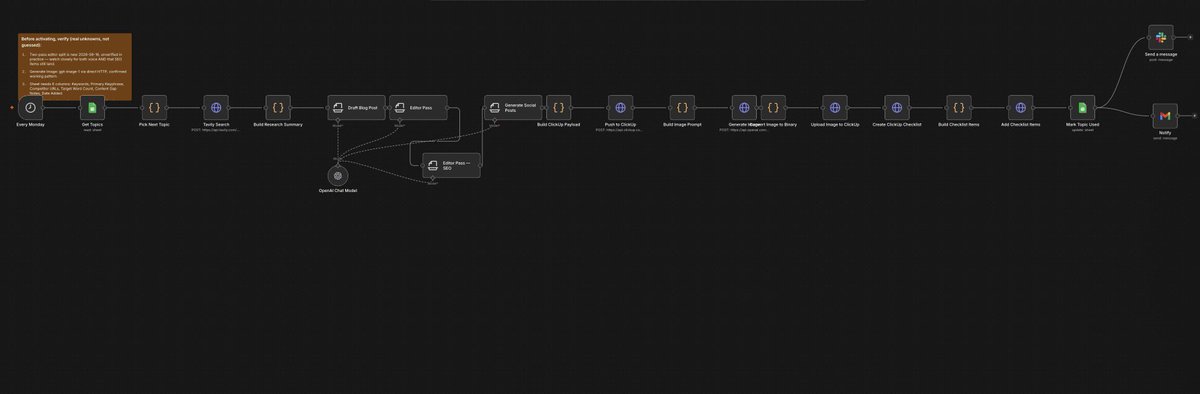
My newest workflow! Content creation with some SEO checks. Still needs some work but so far I like it!
Here’s the idea:
→ Pulls the next topic
→ Researches it with Tavily
→ Drafts the article with AI
→ Runs editorial + SEO review
→ Generates social posts
→ Creates the featured image
→ Pushes everything into ClickUp
→ Builds the publishing checklist
→ Notifies me when it’s ready
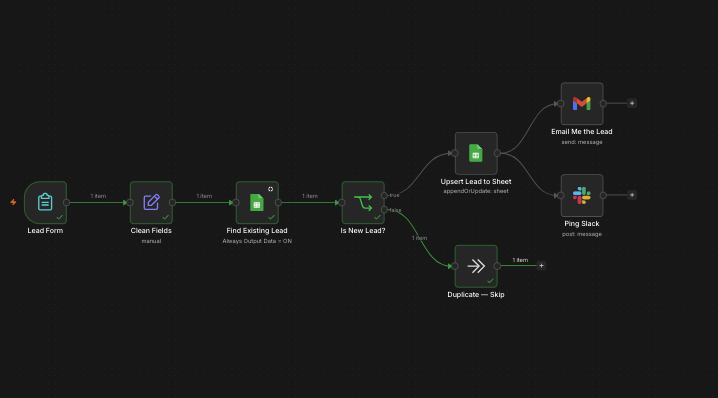
Finished my first n8n automation.
It captures a website lead, cleans the data, checks for duplicates, saves it to Google Sheets, then sends Slack and email alerts.
I also built an error workflow and tested to make sure it was working.
Pretty basic stuff but I'm proud of it.
@__spekulator__ Honestly I haven’t even considered it but it’s exactly the kind of feedback I’m looking for lol I do have an error handling workflow but I’m assuming you mean someone mistyping their own email address? What is your method for handling shared inboxes? Appreciate the feedback
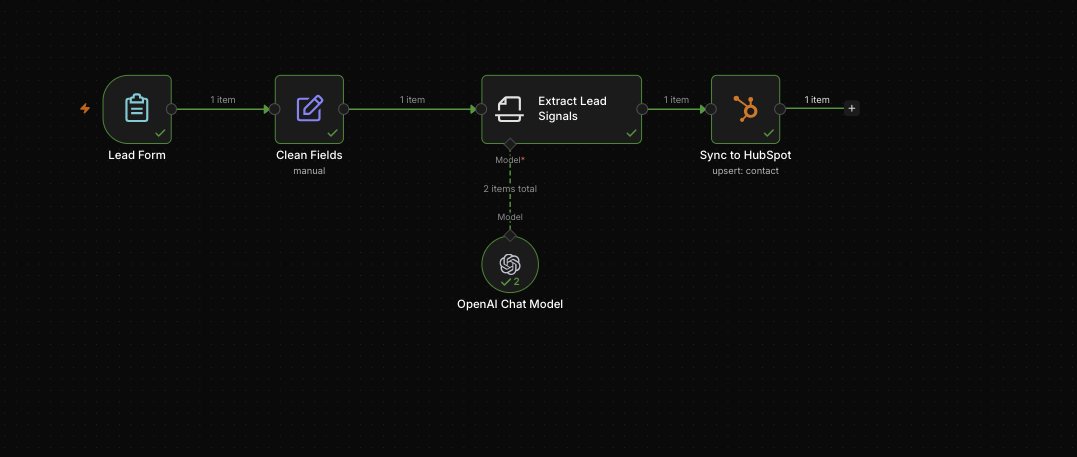
Boom! Second n8n workflow done.
- Form captures a lead + a free-text "what do you need" answer
- An LLM reads that text and scores it (1-10), tags it Hot/Warm/Cold, and writes a one-line summary
- Syncs straight into HubSpot as a contact, deduped on email
On to the next one.
She built 100+ agents for Anthropic and made $1.3M - and in 60 minutes leaked everything she knows at Stanford:
02:07 - her first agent for Anthropic brought her $1.3M
08:34 - agents replace a team of 50 engineers worth $200k a month
19:47 - one agent did overnight what the company planned for 5 years
after watching I launched my first agent - $7k in the first week and zero employees needed.
Save & watch - the article below is step by step how to build your first agent like hers.
6 agent patterns for AI engineers
most production agents are simple workflows with good error handling
prompt chaining:
split the task into fixed steps and check every handoff use it when the path is known and accuracy matters more than latency
routing:
classify the input first and send it to the right model or tool use it when requests fall into clear categories
parallelization:
run independent calls together and merge or vote once use it when the work can happen at the same time
orchestrator workers:
let one model create the subtasks and delegate them at runtime use it when you cannot list the steps before the run starts
evaluator optimizer:
one model writes and another grades until the result passes use it when the rubric is clear and iteration measurably helps
autonomous agent:
the model plans, acts, reads the environment, and chooses the next step use it when the path is unknowable and the blast radius is controlled
the first five are workflows - you wrote the path
only the last one writes its own
Anthropic mapped this whole taxonomy in their "Building effective agents" writeup
start with the simplest pattern that can do the job
🚨 Anthropic's CEO: "Software engineering will be fully automated in 12 months."
Two types of engineers right now:
Type 1: opens VS Code, writes code, closes laptop. thinks they're safe.
Type 2: sits inside a client's business, deploys AI into their operations, owns the outcome.
Type 1 gets surprised in 12 months.
Type 2 is already the most valuable person in the room (FDE)
No-BS guide to tech's hottest job ↓
Bookmark this. Read it today.