NOW AVAILABLE!
When were the angels created? What kind of fruit did Adam eat from in Paradise? What will the signs of the Antichrist be?
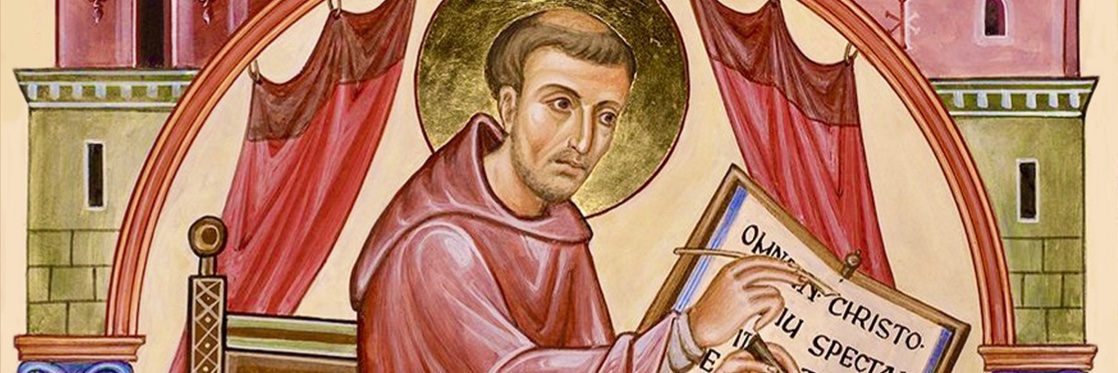
The most celebrated collection of its kind in the Middle Ages, the Questions and Answers to Antiochus the Duke leave no stone unturned. They are now made available in English for the very first time.
Also included in this edition is a translation of the Teachings to Antiochus the Duke, an adaptation of the Shepherd of Hermas for medieval monastics.
Get your copy now:
https://t.co/bvLm299IC6
I actually think this thread is extremely useful. It shows what the Byzantine theologians actually meant by the essence-energy distinction. It was not a real distinction in the sense that the essence and energies differed ontologically from one another, but neither was it a mere conceptual distinction (apparently this is close to what the Scotists believed, but I am not an expert on scholasticism, so I'll leave it to others to judge that):
https://t.co/ypLAltktWh
🧵On If There Is A Real Distinction Between The Divine Essence And The Divine Energy
I was asked to make thus thread, it will be long, beginning with the Fathers who used the terminology of real (πραγματι) and notional (κατ’ ἐπίνοιαν) distinctions. Firstly, St. Mark of Ephesus, in his second Tome against Manuel Kalekas:
“According to the theologians, the distinction is only notional, not real (´Η διάκρισις έπινοία μόνη κατά τούς θεολόγους, ού πραγματι)… God is not what is predicated of Him in a composite (σύνθεσιν) way, but He is said to be so and so according to diverse notions (´κατά διαφόρους έπινοίας)… However, the notion (έπινοία) is distinguished in such a way that it does not assert the same thing to be both energy and essence, as if it found 'essence' along with 'nature'… Further, we willingly accept the example of grain (Basil, Adversus Eunomium I.6,44-54), if by ‘thing’ the subjectum or the being existing per se is meant. For, in this sense, the divine predicates are not different realities (διάφορα πράγματα), namely, beings existing per se, or realities entailing composition.”
First Tome Against Manuel Kalekas’,
p. 228,19-27:
“’Being realities (πράγματα είναι)’ and ‘really differing from each other (πραγματικώς διαφέρειν)’ … is not the same. We, in accordance with the Doctors, declare and believe the former, by stating that they are naturally (φυσικώς) and substantially (ούσιωδώς) and uncreatedly inherent to the essence of God; yet we forbid to speak of ‘really differing from each other’, (πραγματικώς διαφέρειν) because this has to do with things that exist per se [i.e., the primary substances], not with things distinguished only conceptually (έπινοία μόνον διακτινομένοις).”
The terminology crystallizes in the fourth century:
"While present in the whole of Creation, He is at once distinct in essence (κατ' οὐσίαν) from the universe, and present in all things by His own powers." (Athanasius, On the Incarnation, 17)
"For these are the 'back parts' of God, which He leaves behind Himself as tokens of Himself, just as the shadows and reflections of the sun upon the water display the sun to our weak eyes, since we are not able to gaze upon that which defeats our perception with the purity of its light." (Gregory Nazianzen, Oration 28.3)
"He Who is invisible by nature (φύσει) becomes visible by His energies (ἐνεργείαις), being seen by those things that stand around Him." (Gregory of Nyssa, On the Beatitudes VI)
"We say that we know the greatness of God, His power, His wisdom, His goodness, His providence over us, and the justness of His judgement, but not His very essence (οὐσία)...The energies (ἐνέργειαι) are various, and the essence simple; but we say that we know our God from His energies, but do not undertake to approach near His essence. His energies come down to us, but His essence remains beyond our reach." (Basil, Epistle 234)
"This is why the Apostles were sent, to speak what they had heard, not to add aught from their own stock, and that we for our part should believe—that we should believe what?—'concerning His Name.' Not that we should be curious about His essence (τὴν οὐσίαν), but that we should believe on the Name." (John Chrysostom, Homily 1 on Romans)
The Palamite debates of the 14th century were largely debates over the proper understanding of the Dionysian Corpus. Everyone agreed that there was an essence-energy distinction within God, the question was mainly over whether these energies were "uncreated." Barlaam defended an extreme apophaticism under which we can only know God analogically through symbols; Palamas responded that we can have a positive knowledge of God through prayer and mystical experience.
Ironically, one of the critiques levelled against Palamas was that if the Taboric Light was indeed uncreated, then it could not be depicted, making Palamas an iconoclast!
Those who have been following the debate on icon veneration in history over the last 5 years (begun with Dr. Gavin Ortlund's presentations) might be interested in my latest video. It is linked below.
The presentation goes over a wide variety of points, but I wish to share one of the slides that highlights a notable observation by the Eastern Orthodox theologian Mark of Ephesus concerning the mysterious and providential character of doctrinal development.
Gregory Palamas was charged with innovation for his insistence on a real distinction between the divine essence and the divine energies (the essence–energies distinction, or EED). Even in the fourteenth-century East, the doctrine of divine simplicity was held so rigorously that many Greek theologians found themselves unable to affirm this real distinction. From the standpoint of the Palamites, such theologians were "Platonists!" Absorbed as they were in the absolute oneness of God—an emphasis more characteristic of Neoplatonism—they could not accept the essence–energies distinction, even while they readily affirmed the real distinction among the hypostases of the Godhead.
Mark of Ephesus reasoned that Palamas ought not to be pressed unduly for explicit patristic proof of the essence–energies distinction. In the wise providence of God, an explicit articulation of this doctrine was not yet sufficiently mature during the patristic era. The principal difficulty to be overcome in that period was the clarification of the hypostatic distinctions within the Godhead; an additional real distinction between essence and energies would have proved overwhelming to Christians still thinking in broadly Platonic categories—so much so that it would have been, in Mark’s words, “inopportune.”
In the presentation on icon veneration, I echo the late Jaroslav Pelikan’s observation that this practice underwent a threefold development: prohibition, permission, and obligatory command. In earlier centuries, the production and veneration of images of Christ and the saints was prohibited. Subsequently, a recognition emerged that the honor already rendered to Christ and the saints could fittingly be expressed through the visual medium of painted images—a practice that was then permitted and even encouraged. Finally, when iconophiles were accused of idolatry, the charge was understood to imply a denial of the Incarnation and of deification. At that point, the legitimacy of imaging God in the person of Christ, and of venerating the saints (who participate in divine grace) through images, became an essential doctrine. This final stage is that of “command,” formalized at the Second Council of Nicaea (787), because the denial of icon veneration was perceived as a direct threat to the Gospel itself.
This trajectory of development closely parallels the account given by Mark of Ephesus concerning the essence–energies distinction in light of "ultra-Platonism" in Christian theology. Initially, the absolute oneness of God held pre-eminence, and considerable time was required before the consubstantiality of the three Persons could be clearly articulated. That was a substantial theological hurdle.
In a similar manner, early Christian theologians largely rejected the use of images of Christ or the saints for veneration. While isolated instances may have existed, the practice appears to have been generally absent. Once the theology of the Word made flesh had been more fully assimilated, however, it became evident that the one who fills the members of his Body renders the material world—and especially the bodies of the saints—venerable. From this recognition it was a short step to pictorial media as vehicles for such veneration.
Finally, when opposition to icon veneration came to be seen as implying a denial of the Gospel—just as Mark of Ephesus understood a denial of the essence–energies distinction to entail a denial of the reality of God’s action in creation—the practice was elevated to the status of obligatory dogma, clarified and defined over time.
If Gavin Ortlund and Craig Truglia represent the two polar ends of this debate on icon veneration, I believe Pelikan's thesis and Mark of Ephesus's recognition of doctrinal development are a solid corrective to both Ortlund, who would say icon veneration cannot possess an obligatory character, as well as to Truglia, who thinks it is absolutely essential that the Apostles themselves were already teaching the full-blown production and veneration of images and instructed the Churches to do so.
https://t.co/tN2s3s2S4X
Also, we absolutely do find the essence-energy distinction "among the ancients", it's just not greatly developed:
"When, therefore, the soul that loves God seeks to know what the one living God is according to his essence (κατὰ τὴν οὐσίαν), it is entering upon an obscure and dark subject of investigation, from which the greatest benefit that arises to it is to comprehend that God, as to his essence, is utterly incomprehensible to any being...The appellations already mentioned reveal the powers (δυνάμεις) existing in the living God; for one title is that of Lord, according to which he governs; and the other is God, according to which he is beneficent." (Philo, De posteritate 14, De plantatione 86)
"Moses...represented God as unbegotten, and immutable, through all eternity; superior to all mortal conceptions in pulchritude: and, though known to us by his power, yet unknown to us as to his essence (κατ' οὐσίαν)." (Josephus, Against Appion 2.17)
"But to the Father of all, who is unbegotten there is no name given. For by whatever name He be called, He has as His elder the person who gives Him the name. But these words Father, and God, and Creator, and Lord, and Master, are not names, but appellations derived from His good deeds and functions." (Justin Martyr, Second Apology, 6)
"Neither Moses, nor Elias, nor Ezekiel, who had all many celestial visions, saw God but...what they did see were similitudes of the splendour of the Lord." (Irenaeus, Against Heresies 4.20.11)
"For as the soul in man is not seen, being invisible to men, but is perceived through the motion of the body, so God cannot indeed be seen by human eyes, but is beheld and perceived through His providence and works." (Theophilus, To Autolycus 5)
Holiday traditions I have created for myself over the years:
- visiting the town Christmas market
- attending a concert of Handel's Messiah
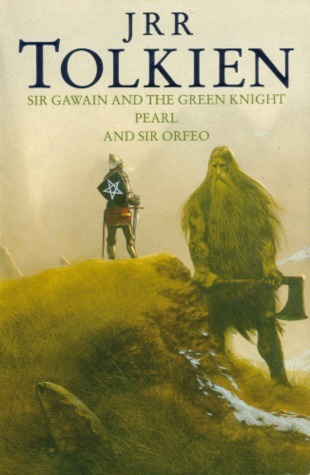
- re-reading Sir Gawain and the Green Knight
Any suggestions of things to add?
From Archbishop Macarius of Jerusalem's Letter to the Armenians (AD 335):
Q: And how shall the table of the sacrament be positioned, and the partitions also?
A: The table of expiation is behind the veil, where the Holy Spirit descends; and the font is next to it in the same compartment, and out of honour set up on the right hand. And the clergy in their several ranks shall worship (there), and the congregation outside the veil, and the catechumens at the door, listening. Lest these partitions be effaced by encroachments, let each remain in his own station irreproachable.
From an Anglo-Saxon mansucript and Utrecht Psalter, showing the sanctuary veil and the Altar. The first has either a bishop turning and giving the salutation. You can see the suspended lamp [or possibly tabernacle??] over the Altar.
@Hleowstede That's probable. A small chapel in a cave would only have the most basic furnishings, though we can expect that the basic structure remained the same.
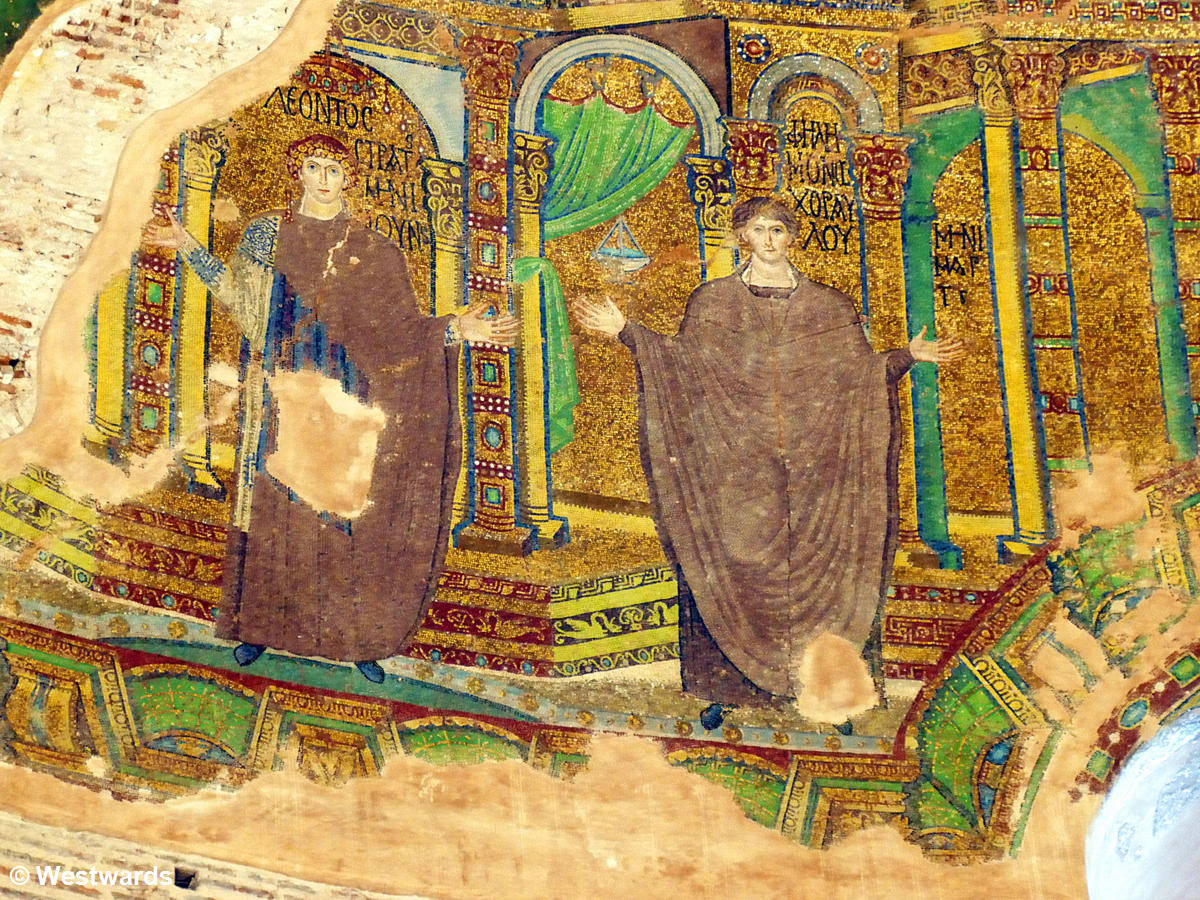
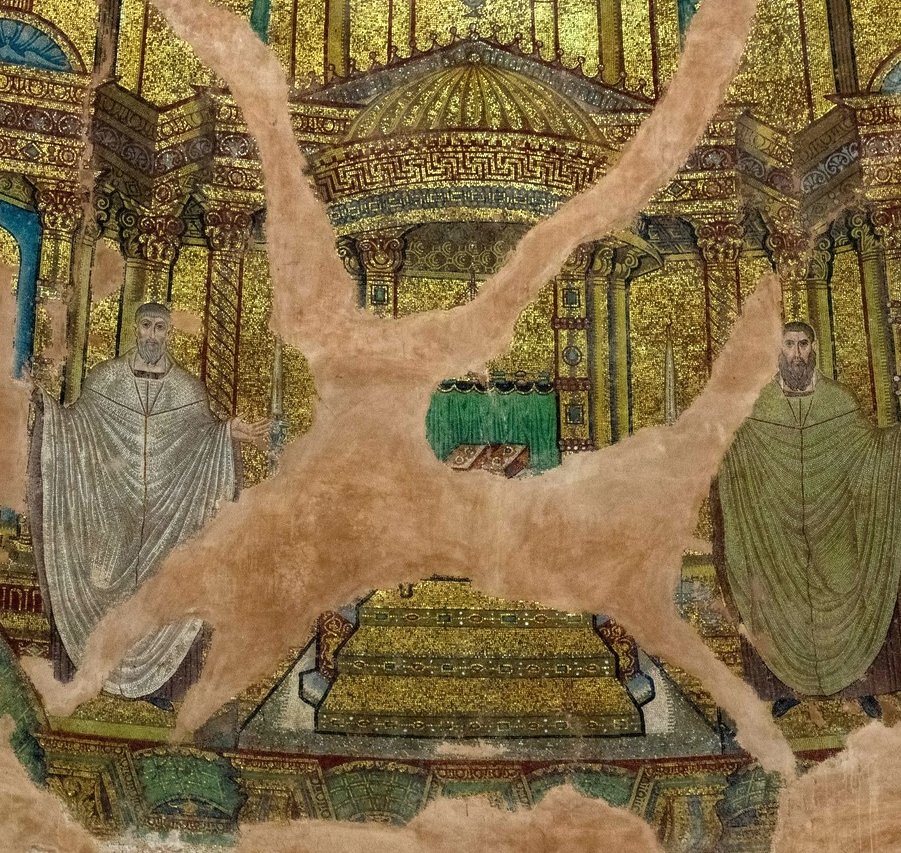
The oldest churches all had curtains (see the Rotunda of Galerius below). Synesius of Cyrene mentions the "mystic veil" of the altar in his 67th Epistle. The idea that the laity is entitled to see the holy of holies is antithetical to the spirit of ancient Christianity.
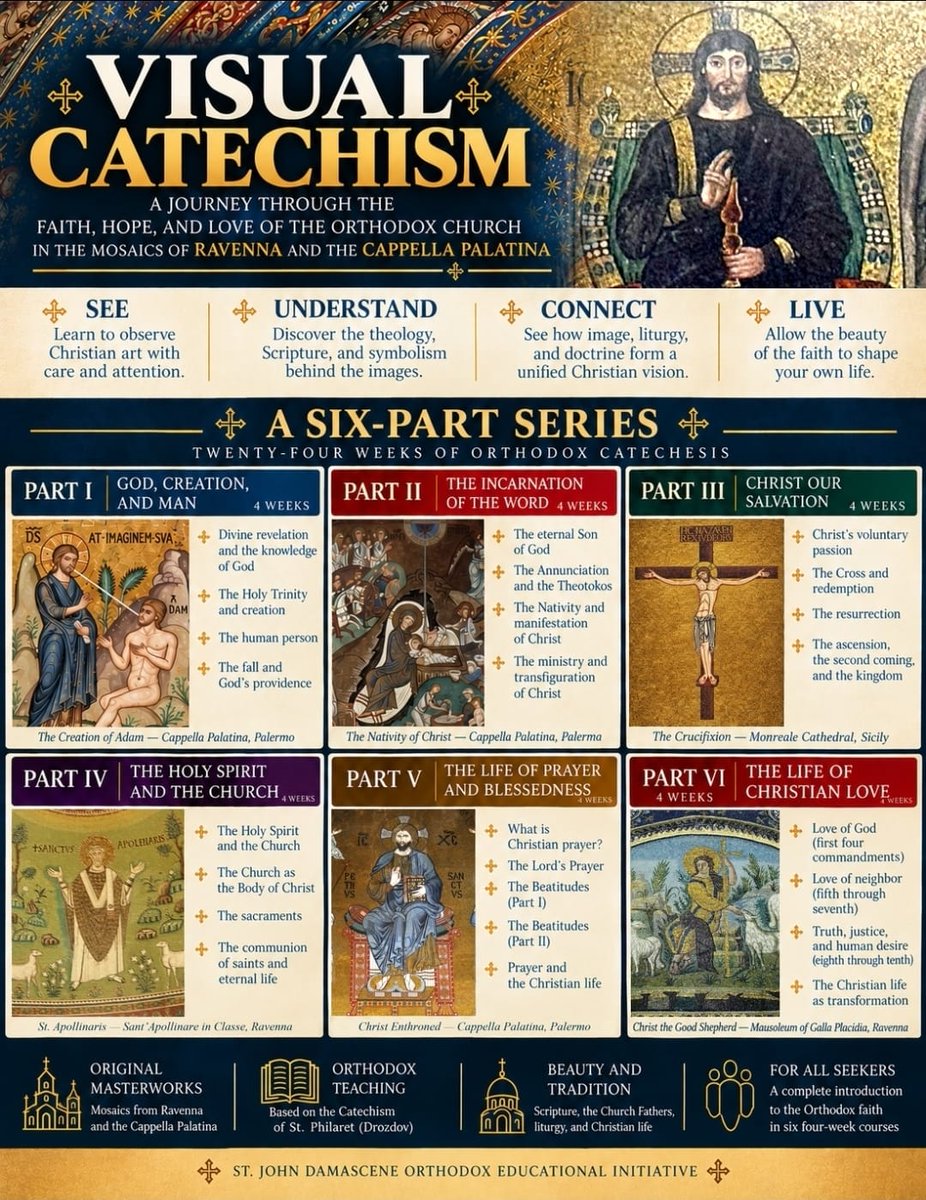
Highly recommend this upcoming catechism series touching on the theology of the Church expressed through the mosaics of Ravenna. Synchronous and pre-recorded options available. There is also a course on the theology of St. Athanasius:
https://t.co/HBieaYUJEO
100% of the proceeds go towards the student scholarship fund of the Saint John of Damascus Orthodox Initiative.
@twestrorthodoxy I'm curious, do we know if there would have been a curtain in the chancel arch/rood screen separating the nave from the altar in the Anglo-Saxon churches?
A friend of mine is currently teaching in Ireland and he just sent me this picture of the ruins of St. Declan’s monastery in County Waterford. Carved into the walls are depictions of Adam and Eve, the Judgement of Solomon, and the Adoration of the Magi.