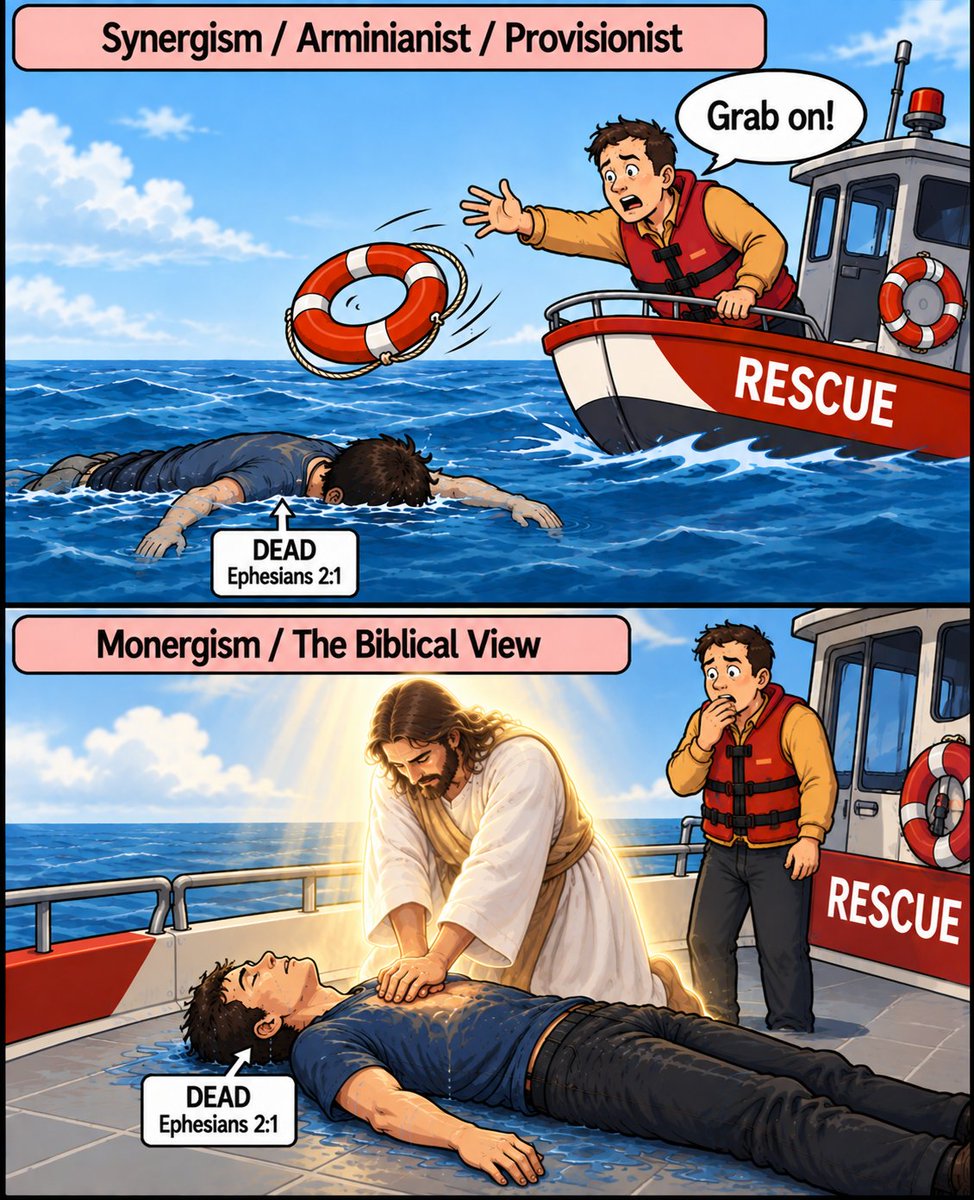
James 1:18 actually makes the Reformed point:
“Of HIS OWN WILL he brought us forth by the word of truth.”
WHO brings us forth? God.
According to whose will? His.
By what means? The Word of truth.
Calvinism doesn't separate regeneration from the gospel. God sovereignly gives life THROUGH the proclamation of His Word.
And John 20:31 isn't a problem either:
“By believing you may have life in his name.”
Yes! Faith receives eternal life in Christ. But John also tells us why anyone believes:
“Everyone who believes that Jesus is the Christ HAS BEEN BORN of God.” [1 John 5:1]
And Jesus says:
“It is the Spirit who gives life; the flesh is no help at all.” [John 6:63]
So the biblical picture isn't:
DEAD → independently believes → causes new birth.
It is:
GOSPEL PROCLAIMED → SPIRIT GIVES LIFE → SINNER BELIEVES → POSSESSES ETERNAL LIFE IN CHRIST.
The Word is the means.
The Spirit is the one who gives life.
Faith is the response and instrument, not the cause of regeneration.
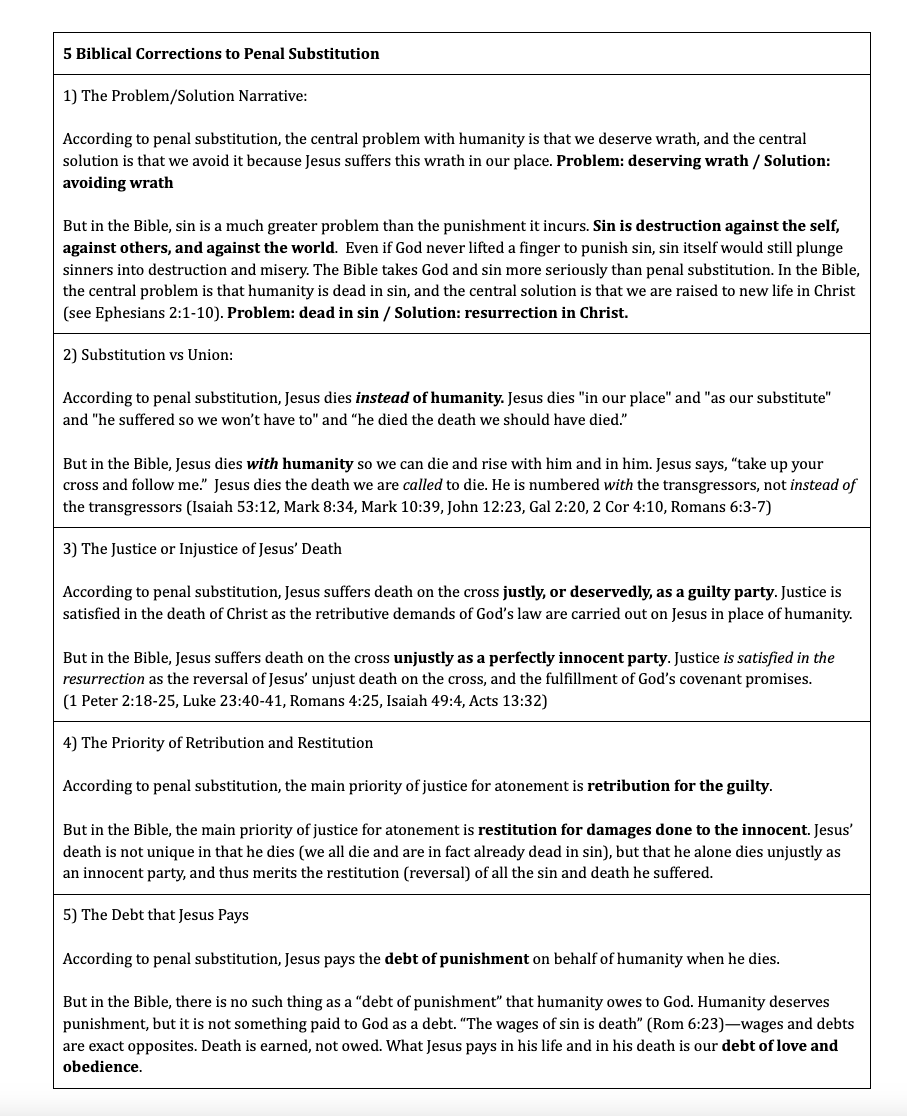
@MrTimothyRenfro@M_Christianity That's an ad hominem argument. It does address the points you made; you're too lazy to address the actual arguments in my chart.
You slipped “sick” into the argument as though Scripture calling sinners sick somehow changes what Paul means when he calls them DEAD.
It doesn’t.
Scripture uses multiple metaphors for sin because they illustrate different truths. Sin is a sickness needing a physician [Mark 2:17], slavery requiring liberation [John 8:34–36], blindness requiring sight [2 Cor. 4:4–6], and DEATH requiring resurrection [Eph. 2:1–5].
And notice Paul's solution to being “dead in trespasses”:
“But God… MADE US ALIVE together with Christ.” [Eph. 2:4–5]
Not: God offered medicine and waited for the sick person to take it.
He made the dead alive.
And Scripture explicitly describes inability:
“No one CAN come to me unless the Father… draws him.” [John 6:44]
The natural person “does not accept” spiritual things and “is NOT ABLE to understand them.” [1 Cor. 2:14]
The fleshly mind “does not submit to God's law; indeed, it CANNOT.” [Rom. 8:7]
So yes, “dead” is metaphorical. But the biblical metaphor is not merely “separated.”
It describes a condition requiring God to GIVE LIFE.
Two people stand before a judge, both guilty of the same offense. Both owe a $10,000 fine.
A citizen freely steps forward and pays the entire fine for ONE of them.
Was the first shown mercy? YES.
Was the second treated unjustly because no one paid his fine? NO.
He received exactly what justice required: the penalty he actually owed.
Mercy is not owed. If it were owed, it wouldn’t be mercy.
That’s the distinction people miss in the Calvinism debate.
The wonder isn’t that God doesn’t show saving mercy to every guilty sinner.
The wonder is that He shows saving mercy to ANY guilty sinner.
“I will have mercy on whom I have mercy.” Romans 9:15
Particular redemption is the opposite of boasting. The Calvinist isn’t saying, “Christ died for me because I was better than you.” We’re saying we deserved judgment just as much as anyone else, and salvation is entirely undeserved grace.
More importantly, Scripture itself speaks of Christ giving His life for a particular people:
“I lay down my life for the sheep.”
John 10:15
“Christ loved the church and gave himself up for her.” Eph. 5:25
“You shall call his name Jesus, for he will save his people from their sins.”
Matt. 1:21
@HwsEleutheroi Exactly. God is under no obligation to reveal every purpose behind His eternal decree. Our inability to answer “Why did God decree this?” doesn’t undermine His sovereignty. “He does according to His will” [Dan. 4:35]. Amen.
First of all, being called “blessed” does not mean Mary was sinless.
If it did, then Peter would also have been sinless:
“Blessed are you, Simon Bar-Jonah!” Matthew 16:17
Secondly, Mary is not excluded from the “ALL” in Romans 3:23:
“For ALL have sinned and fall short of the glory of God.” Romans 3:23
That doesn’t follow. Calvinism does NOT teach that the reprobate were already experiencing damnation or hardening before they existed.
It distinguishes between God’s eternal decree and its execution in time.
Romans 9 itself makes this distinction. Before Jacob and Esau “were born and had done nothing either good or bad,” Paul says God already had a “purpose of election” [Rom. 9:11].
Pharaoh’s hardening occurred IN TIME, but that doesn’t prove it was absent from God’s eternal purpose. Paul says:
“For this very purpose I have raised you up, that I might show my power in you” [Rom. 9:17].
Then Paul concludes:
“He has mercy on whomever he wills, and he hardens whomever he wills” [Rom. 9:18].
And Scripture explicitly describes events occurring in time according to what God had already determined beforehand [Acts 4:27–28].
So “it happened in time” is not an argument against an eternal decree. That confuses the decree with its fulfillment.
Galatians 3:26–29 tells us WHO Abraham’s offspring are; those who belong to Christ through faith. Agreed.
But you’re misunderstanding unconditional election.
Unconditional election does NOT mean people are saved without faith. It means God’s choice to save His people was not conditioned upon foreseen faith, works, or merit in them. God elects; in time, the elect are brought to faith in Christ.
That’s precisely Paul’s point in Romans 9. Before Jacob and Esau “were born and had done nothing either good or bad,” God distinguished between them “in order that God’s purpose of election might continue, not because of works but because of him who calls” [Rom. 9:11].
So yes, Abraham’s children are those who belong to Christ through faith [Gal. 3:26–29].
The question is WHY they come to faith. Paul grounds God’s purpose of election not in something foreseen in them, but in “him who calls.”
Exactly. Job makes the point crystal clear. Satan is powerful, but he is not sovereign. He could do nothing to Job apart from God’s permission, and he could go no further than the boundaries God established.
Not Job. Not Satan. Not a single molecule exists outside the sovereign rule of God.
@1984_nate That still doesn’t address the text.
Paul explicitly says, “The elect obtained it, but the rest were hardened” [Rom. 11:7].
So Romans 11:32 cannot mean every individual receives saving mercy. Paul’s distinction is right there in the same chapter.
That’s not 37 definitions. That’s you confusing different categories within one doctrine.
God’s decree is His eternal purpose concerning whatsoever comes to pass.
But decree ≠ command.
God can decree that an event occur without morally commanding the creature to perform the evil involved.
The clearest example is the crucifixion:
Jesus was “delivered up according to the definite plan and foreknowledge of God,” yet those who crucified Him acted “with lawless hands.” [Acts 2:23]
And Herod, Pilate, Gentiles, and Israel did “whatever your hand and your plan had predestined to take place.” [Acts 4:27–28]
One event.
God predestined it.
Men wickedly performed it.
God’s decree determined that the event would occur; His moral law did not command their wickedness.
So “decree” doesn’t keep changing definitions. You’re being shown distinctions that prevent you from confusing God’s sovereign decree with God’s moral commands.
You’re simply repeating the claim without dealing with the text I cited.
Yes, Romans 11 celebrates God extending mercy to the Gentiles. I agree completely.
But that does NOT mean God extends saving mercy to every individual.
Paul says in the very same chapter:
“There is a remnant, chosen by grace.” [Rom. 11:5]
“The elect obtained it, but the rest were hardened.” [Rom. 11:7]
And regarding Israel, Paul says he desires to “save SOME of them.” [Rom. 11:14]
So your interpretation of 11:32 has to account for 11:5–7 and 11:14.
The “all” of 11:32 occurs in a Jew/Gentile argument: Gentiles received mercy despite their former disobedience, and mercy also extends to Israel despite their present disobedience [11:30–32].
That’s mercy extending to BOTH groups; not a declaration that every individual receives saving mercy.
And ironically, your last sentence ignores Paul’s own distinction:
“He has mercy on whomever he wills, and he hardens whomever he wills.” [Rom. 9:18]
I have no objection whatsoever to God showing mercy to Gentiles.
My point is that Paul explicitly says God decides whom He shows mercy to.
You’re presenting a false choice: either Romans 9 concerns Israel/Gentile inclusion, or it concerns God’s sovereign election of individuals. Paul’s argument includes BOTH.
Yes, Genesis 25:23 says, “Two nations are in your womb.” But Paul deliberately applies that history to the twins themselves:
“Though they were not yet born and had done nothing either good or bad; in order that God’s purpose of election might continue, not because of works but because of him who calls…” (Rom. 9:11)
Notice Paul’s emphasis: BEFORE THEY WERE BORN and BEFORE THEY HAD DONE ANYTHING GOOD OR BAD.
If Paul merely wanted to establish which nation would carry the covenant line, why explicitly ground the distinction in God’s purpose of ELECTION being “not because of works but because of him who calls”?
And Paul’s next example makes the point even clearer:
“So then it depends not on human will or exertion, but on God, who has mercy.” (Rom. 9:16)
You’ve inserted “ancestry and law-keeping” into a sentence where Paul contrasts God’s mercy with HUMAN WILLING and RUNNING.
Then:
“He has mercy on whomever he wills, and he hardens whomever he wills.” (v.18)
And notice the objection Paul anticipates:
“Why does he still find fault? For who can resist his will?” (v.19)
That objection follows naturally from Paul saying God sovereignly has mercy on one and hardens another. If Paul’s point were simply, “God includes Gentiles who believe and hardens Jews because they refuse to believe,” the objection loses its force. The obvious answer would be: “God finds fault because they freely refused to believe.”
But Paul doesn’t answer that way.
He says:
“But who are you, O man, to answer back to God? Will what is molded say to its molder, ‘Why have you made me like this?’” (v.20)
That is significantly stronger than merely saying God rearranges national roles.
Jeremiah 18 doesn’t overturn this. Paul is free to employ Potter/clay imagery in his own argument, and Romans 9 explicitly speaks of ONE LUMP from which the potter makes “one vessel for honorable use and another for dishonorable use” (v.21).
Then comes the decisive contrast:
“vessels of wrath prepared for destruction”
versus
“vessels of mercy, which he has prepared beforehand for glory” (v.22–23).
Yes, Paul immediately identifies God’s called people as coming “not from the Jews only but also from the Gentiles” (v.24). Reformed theology agrees completely. Election crosses ethnic boundaries.
But “Jews and Gentiles are both included” does not answer WHY these particular Jews and Gentiles constitute God’s called people.
Paul already told us:
“It depends not on human will or exertion, but on God, who has mercy.”
Romans 11 doesn’t undo Romans 9 either. Paul explicitly says:
“So too at the present time there is a remnant, CHOSEN BY GRACE. But if it is by grace, it is no longer on the basis of works…” (Rom. 11:5–6)
Then:
“The ELECT obtained it, but the rest were hardened.” (Rom. 11:7)
That is precisely the distinction you say Paul isn’t making.
And Romans 11:23 does not say the elect can become reprobates or that vessels of wrath become vessels of mercy by autonomous choice. Paul is discussing the historical olive tree and warns Gentiles against presumption while affirming God’s ability to graft Jews back in.
So yes; the larger context concerns Israel, Gentiles, covenant history, and the faithfulness of God’s Word.
But Paul’s explanation for WHY God’s Word has not failed begins with this:
“Not all who are descended from Israel belong to Israel.” (Rom. 9:6)
The corporate argument doesn’t eliminate individual election.
It depends upon it.
No, that reverses Paul’s argument.
Paul’s point is NOT, “The Jews wrongly thought mercy was only for a preselected group, but actually saving mercy is for everyone.”
He explicitly says:
“He has mercy on whomever he wills, and he hardens whomever he wills.” Rom. 9:18
Then Paul distinguishes “vessels of wrath” from “vessels of mercy, which he has prepared beforehand for glory”
v. 22–23.
And who are those vessels of mercy?
“Us whom he has called, not from the Jews only but also from the Gentiles”
v. 24.
That’s the point: God’s elect are not restricted to ethnic Israel. They include both Jews AND Gentiles.
Gentile inclusion destroys ethnic exclusivism. It does not destroy election.