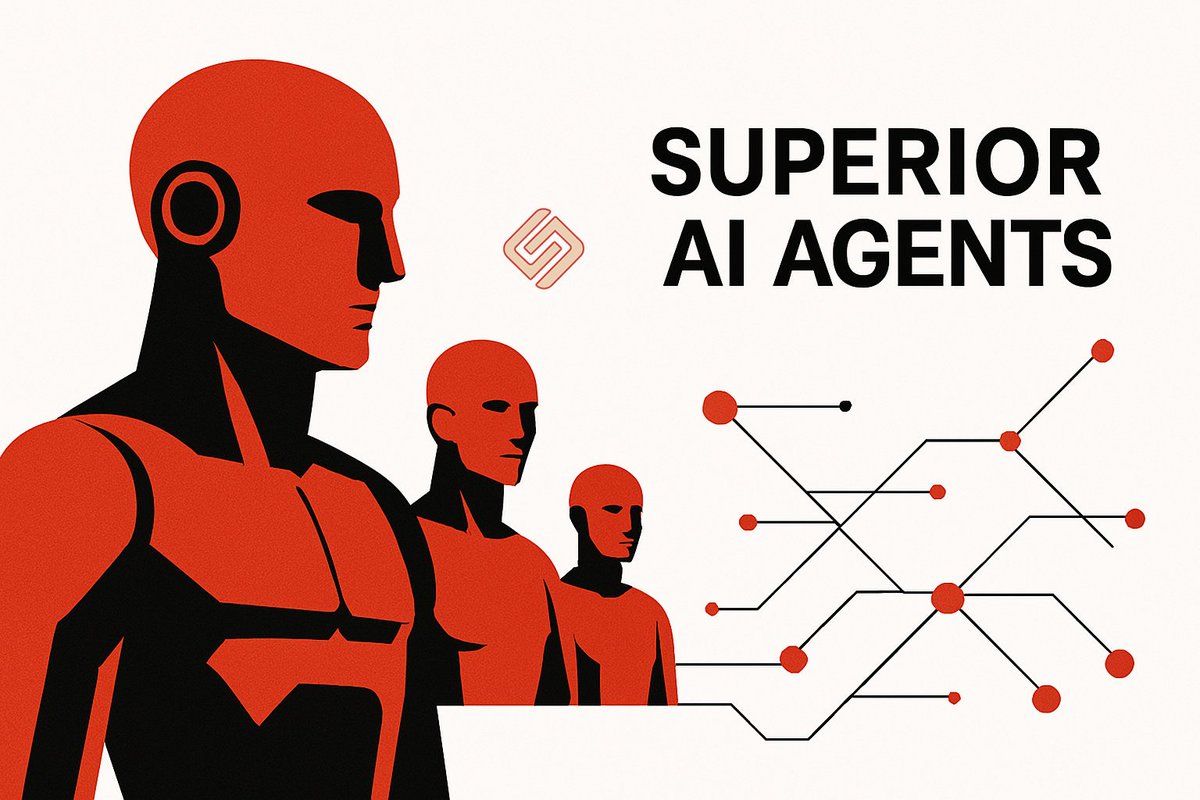
Our vision of SUPERIOR AI AGENTS
In a world where centralized AI dominates, Scroll AI is building something different:
⚙️ Decentralized networks
🧠 Autonomous agents
💡 Powered by unused compute
🌐 Open. Scalable. Secure.
🦾 With Scroll AI network, underutilized hardware powers cutting-edge AI agents, securely and efficiently.
It’s a glimpse into the future we’re enabling —where intelligence runs freely, without borders 🤖.
See the future ▶️ https://t.co/E9HJzQqUeg
#ScrollAI #AIagents #DecentralizedAI #Web3 #LLM
New Anthropic research: Do reasoning models accurately verbalize their reasoning?
Our new paper shows they don't.
This casts doubt on whether monitoring chains-of-thought (CoT) will be enough to reliably catch safety issues.
ScrollAI breaks the monopoly of traditional cloud computing! Through a decentralized architecture, everyone can create, deploy and monetize exclusive AI agents, truly realizing "your data, your rules".
💡Traditional cloud computing faces challenges such as cost, privacy, and portability in the era of AI agents? ScrollAI uses high-performance cross-platform runtime + fine-tuning LLM to redefine flexibility and security!
#AI #DecentralizedAI #FutureTech #Web3
🚀 What’s Coming Next?
✅ ScrollAI Runtime × Theoriq Engine — natively integrated
✅ First-of-its-kind dev tools for tracing agent logic paths
✅ Open-source collabs on Explainability, Reasoning, and LogicOps
✅ Rollout of human-AI dashboards that don’t just say what — but why
This is how we build machine logic for real-world decisions 🤘🔥.
#TrustLayer #AutonomousSystems #AI #Tech #AIEngineering
Partnership Unlocked!
🚨 Big Move in AI: ScrollAI has officially partnered with @TheoriqAI!
🤝❌This isn't just another handshake. It's a fusion of cutting-edge AI agents and the sharpest logic-based intelligence engines in the Web3! 🤖
🌐🦾 Code meets cognition. Agents meet reasoning. The future of explainable AI starts here. ⤵️
Follow us to uncover more insights! 🤳
#Partnership #AIInnovation #ScrollAI #Theoriq #AGI #Tech
🔍 What Makes This Partnership Game-Changing?
🧬 ScrollAI is building the infrastructure for autonomous AI agents that think, act, and scale.
🧠 Theoriq is redefining how machines understand logic, causality, and meaning.
Together, we’re aimed at enabling:
🔺AI agents that can explain themselves in real time
🔺End-to-end traceability in critical workflows
🔺Zero-black-box policies for enterprises & developers
This partnership is about trust, logic, and next-level autonomy — not just speed or scale 🛠.
#AI #Infrastructure #TrustworthyAI #AI4Enterprise
🧠 Discover AI Agents with External Knowledge Bases
🌐⚙️With Scroll AI, we’re building a decentralized network of autonomous agents that can reason, act, and grow — powered by external data sources and open knowledge systems.
Why Scroll AI?
🌐 External knowledge? ✔️
🧠 Autonomous reasoning? ✔️
🔓 Permissionless + open? ✔️
🚫 No centralized gatekeepers? ✔️✔️✔️
With Scroll AI, you don’t just build AI —
👉 you unleash it.
🔥 Power up agents that think, adapt, and connect with the world in real-time.
💥 Plug into a modular stack that respects your privacy and puts YOU in control.
💡 Whether you're building a smart assistant, a research tool, or multi-agent systems — Scroll gives you the freedom to deploy intelligent agents on your terms.
Intelligence without limits. Explore the next generation of AI: 🌐 https://t.co/O1cceLeoOG
#ScrollAI # #AutonomousAgents #Web3 #OpenSourceAI #Future
Human generated data has fueled incredible AI progress, but what comes next? 📈
On the latest episode of our podcast, @FryRsquared and David Silver, VP of Reinforcement Learning, talk about how we could move from the era of relying on human data to one where AI could learn for itself.
Watch now →
00:00 Introduction
01:50 Era of experience
03:45 AlphaZero
10:19 Move 37
15:20 Reinforcement learning and human feedback
24:30 AlphaProof
29:50 Math Olympiads
35:00 Experience based methods
42:56 Hannah's reflections
44:00 Fan Hui joins
Ready to be part of the decentralized AI revolution?
Set up your ScrollAI node today and join a growing network of innovators shaping the future of AI.
It's quick and easy to get started: https://t.co/GWbh4e8ngh
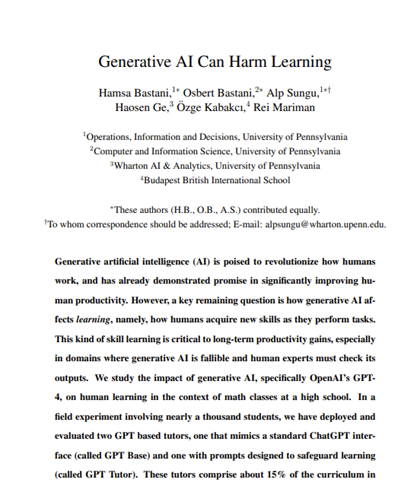
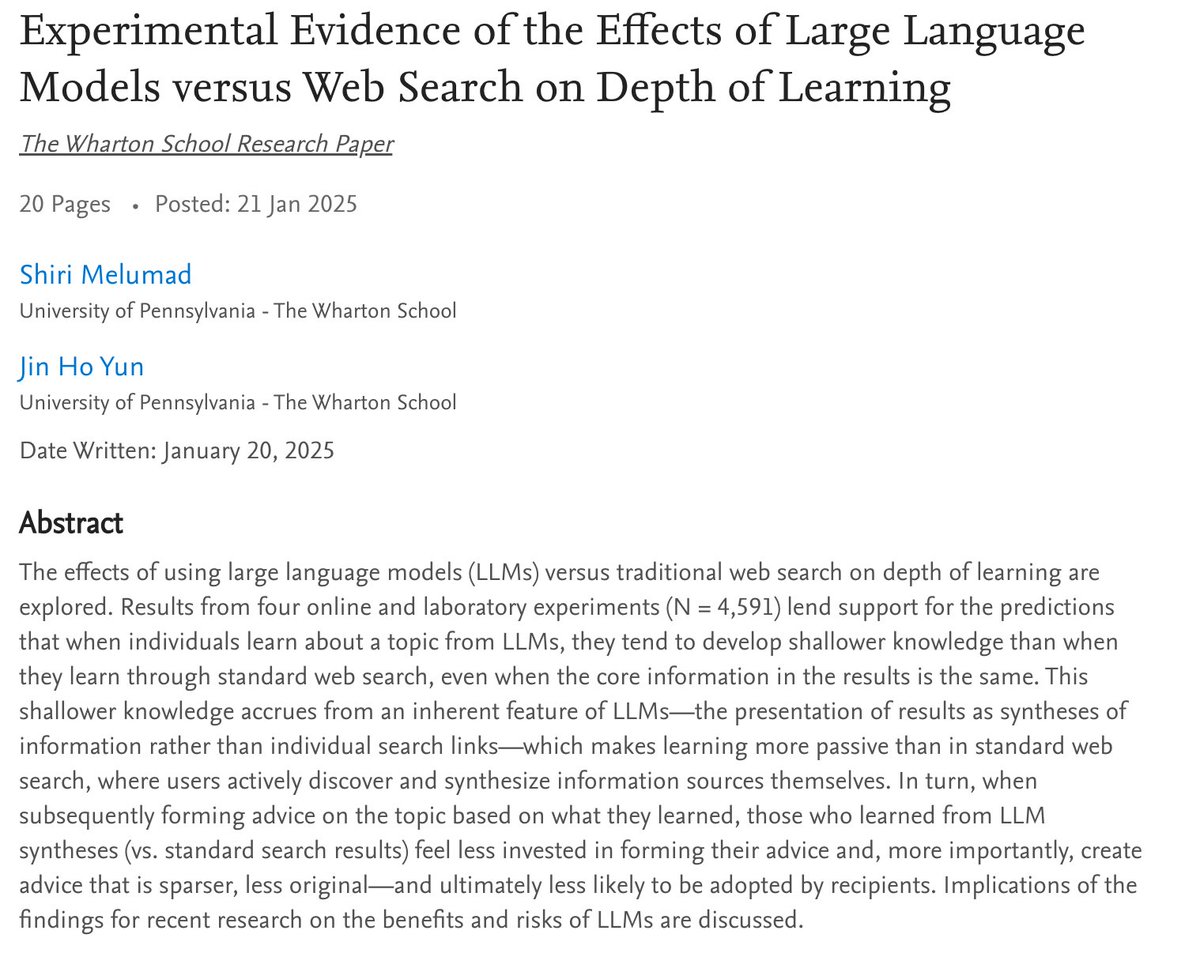
Excellent new paper on depth of learning from LLMs. Studies using large samples show LLMs like ChatGPT leads to shallower learning compared to using more traditional means like web search. When people rely on AI-synthesized answers, they develop less knowledge depth.🧵
Our vision of SUPERIOR AI AGENTS
In a world where centralized AI dominates, Scroll AI is building something different:
⚙️ Decentralized networks
🧠 Autonomous agents
💡 Powered by unused compute
🌐 Open. Scalable. Secure.
🦾 With Scroll AI network, underutilized hardware powers cutting-edge AI agents, securely and efficiently.
It’s a glimpse into the future we’re enabling —where intelligence runs freely, without borders 🤖.
See the future ▶️ https://t.co/E9HJzQqUeg
#ScrollAI #AIagents #DecentralizedAI #Web3 #LLM
The current AI model is broken. Either hand over your expertise to Big Tech or give it away for free.
Subject matter experts deserve better. ScrollAI is providing that alternative they need.
Build and monetize your knowledge with our decentralized network, designed to protect your IP and reward your contributions fairly.
Get started now: https://t.co/2DOWYk67Xe
OpenAI leaked Q* so let’s dive into Q-Learning and how it relates to RLHF.
Q-learning is a foundational concept in the field of artificial intelligence, particularly in the area of reinforcement learning. It's a model-free reinforcement learning algorithm that aims to learn the value of an action in a particular state.
The ultimate goal of Q-learning is to find an optimal policy that defines the best action to take in each state, maximizing the cumulative reward over time.
Understanding Q-Learning
Basic Concept: Q-learning is based on the notion of a Q-function, also known as the state-action value function. This function takes two inputs: a state and an action. It returns an estimate of the total reward expected, starting from that state, taking that action, and thereafter following the optimal policy.
The Q-Table: In simple scenarios, Q-learning maintains a table (known as the Q-table) where each row represents a state and each column represents an action. The entries in this table are the Q-values, which are updated as the agent learns through exploration and exploitation.
The Update Rule: The core of Q-learning is the update rule, often expressed as:
\[ Q(s,a) \leftarrow Q(s,a) + \alpha [r + \gamma \max_{a'} Q(s', a') - Q(s, a)] \]
Here, \( \alpha \) is the learning rate, \( \gamma \) is the discount factor, \( r \) is the reward, \( s \) is the current state, \( a \) is the current action, and \( s' \) is the new state. (See image below).
Exploration vs. Exploitation: A key aspect of Q-learning is balancing exploration (trying new things) and exploitation (using known information). This is often managed by strategies like ε-greedy, where the agent explores randomly with probability ε and exploits the best-known action with probability 1-ε.
Q-Learning and the Path to AGI
Artificial General Intelligence (AGI) refers to the ability of an AI system to understand, learn, and apply its intelligence to a wide variety of problems, akin to human intelligence. Q-learning, while powerful in specific domains, represents a step towards AGI, but there are several challenges to overcome:
Scalability: Traditional Q-learning struggles with large state-action spaces, making it impractical for real-world problems that AGI would need to handle.
Generalization: AGI requires the ability to generalize from learned experiences to new, unseen scenarios. Q-learning typically requires explicit training for each specific scenario.
Adaptability: AGI must be able to adapt to changing environments dynamically. Q-learning algorithms often require a stationary environment where the rules do not change over time.
Integration of Multiple Skills: AGI implies the integration of various cognitive skills like reasoning, problem-solving, and learning. Q-learning primarily focuses on the learning aspect, and integrating it with other cognitive functions is an area of ongoing research.
Advances and Future Directions
Deep Q-Networks (DQN): Combining Q-learning with deep neural networks, DQNs can handle high-dimensional state spaces, making them more suitable for complex tasks.
Transfer Learning: Techniques that enable a Q-learning model trained in one domain to apply its knowledge to different but related domains can be a step towards the generalization needed for AGI.
Meta-Learning: Implementing meta-learning in Q-learning frameworks could enable AI to learn how to learn, adapting its learning strategy dynamically - a trait crucial for AGI.
Q-learning represents a significant methodology in AI, particularly in reinforcement learning.
It is not surprising that OpenAI is using Q-learning RLHF to try to achieve the mystical AGI.
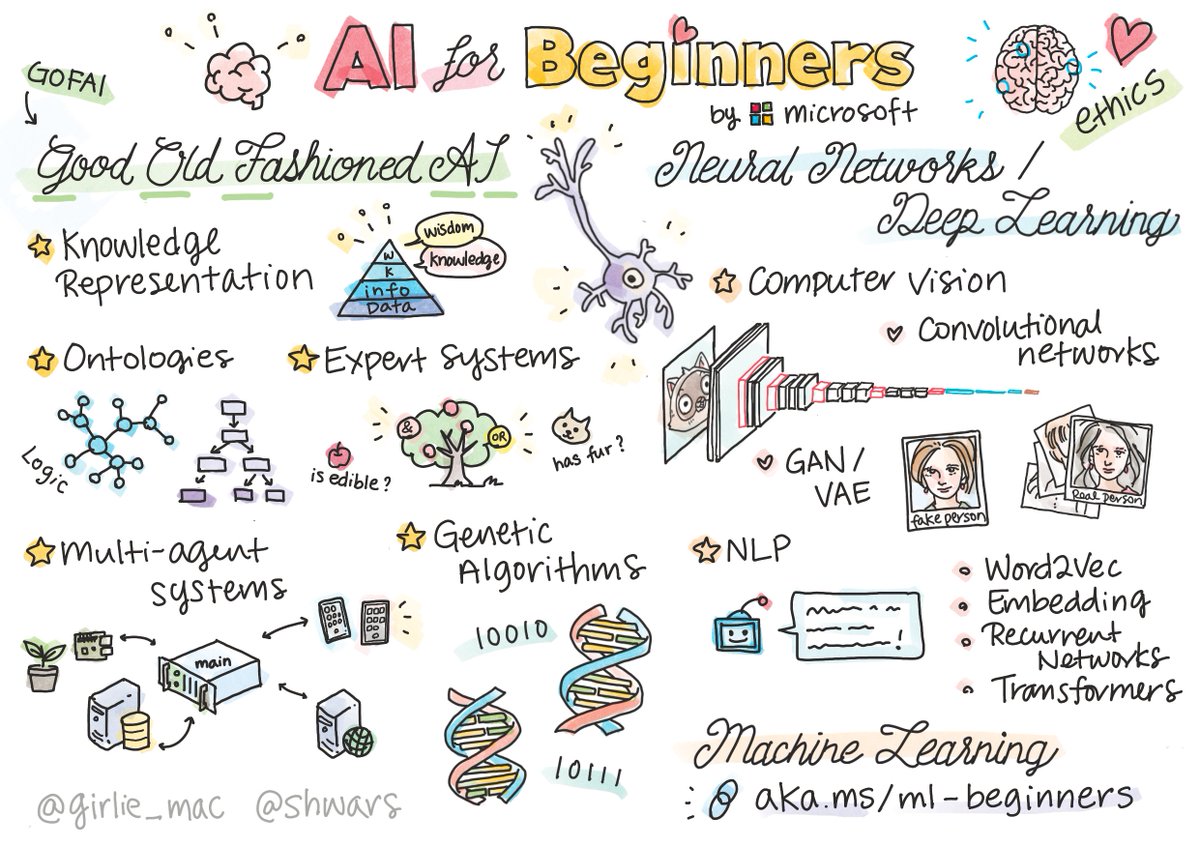
A complete curriculum for beginners that want to learn Artificial Intelligence.
You will learn:
• Neural Networks and Deep Learning
• Neural Architectures for working with images and text
• Genetic Algorithms and Multi-Agent Systems
https://t.co/XODmEg4uFg
Flexible AI as Never Before
🧠 🦾 We're thrilled to unveil our latest initiative: the Decentralized Scroll AI Agents Network. This groundbreaking network empowers individuals to deploy AI nodes effortlessly, utilizing underutilized hardware to perform AI inferencing.
By decentralizing AI inferencing, we eliminate single points of failure and control, ensuring a more robust and resilient AI ecosystem.
⚙️Key Features:
✅ Versatility: Supports a variety of agents running different models and nodes, accommodating over 2,000 models from Hugging Face, including Llama 2-7B, Gemma-2B, and Mistral-7B.
✅ Censorship Resistance: Open-sourced in open network settings, promoting transparency and freedom.
✅ Privacy Centric: Personal data is protected within a distributed and decentralized open network.
Bricks
✅ Limitless Possibilities: Unlocks unlimited AI applications, from educational tools to commercial AI characters.
🗒 Check for more at: https://t.co/O1cceLeoOG!
🤘 Join us in revolutionizing the AI landscape. Explore the potential of decentralized AI with Scroll AI.
#ScrollAI #DecentralizedAI #TechInnovation #LLM #AIRevolution
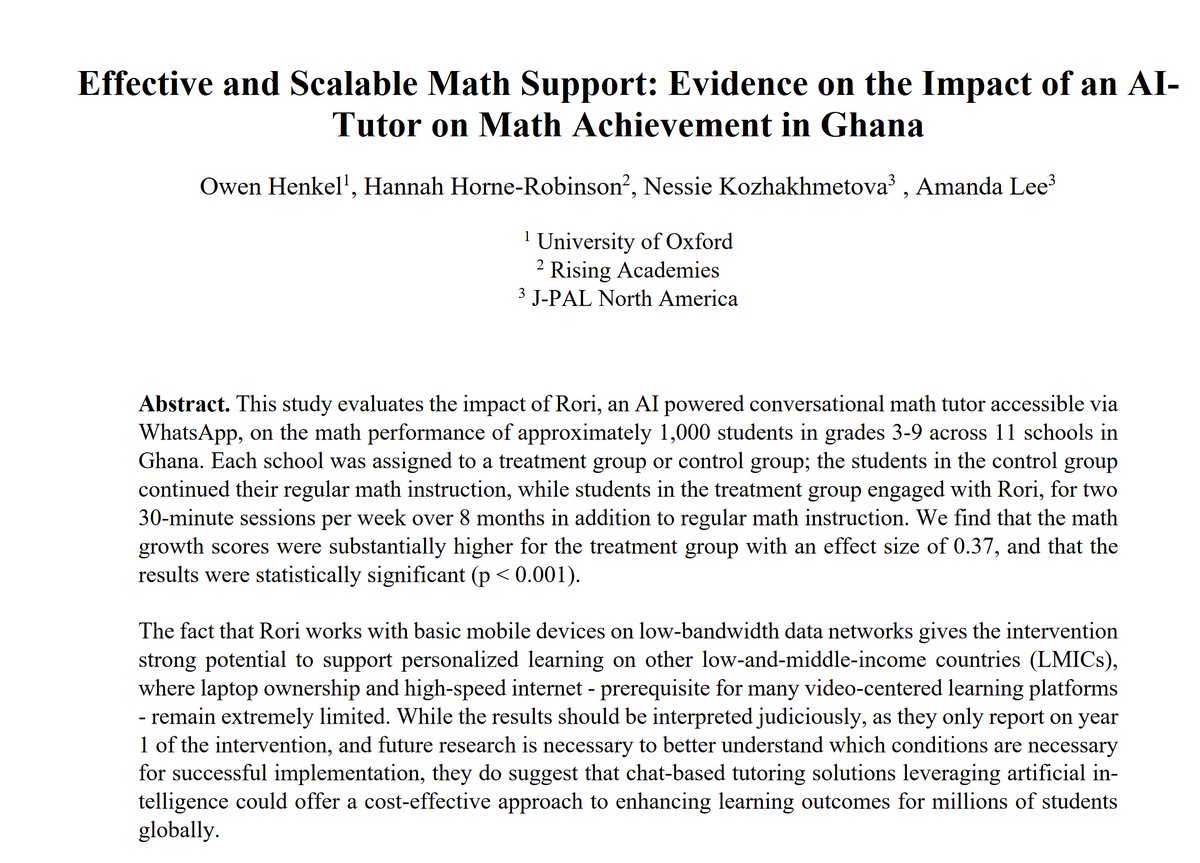
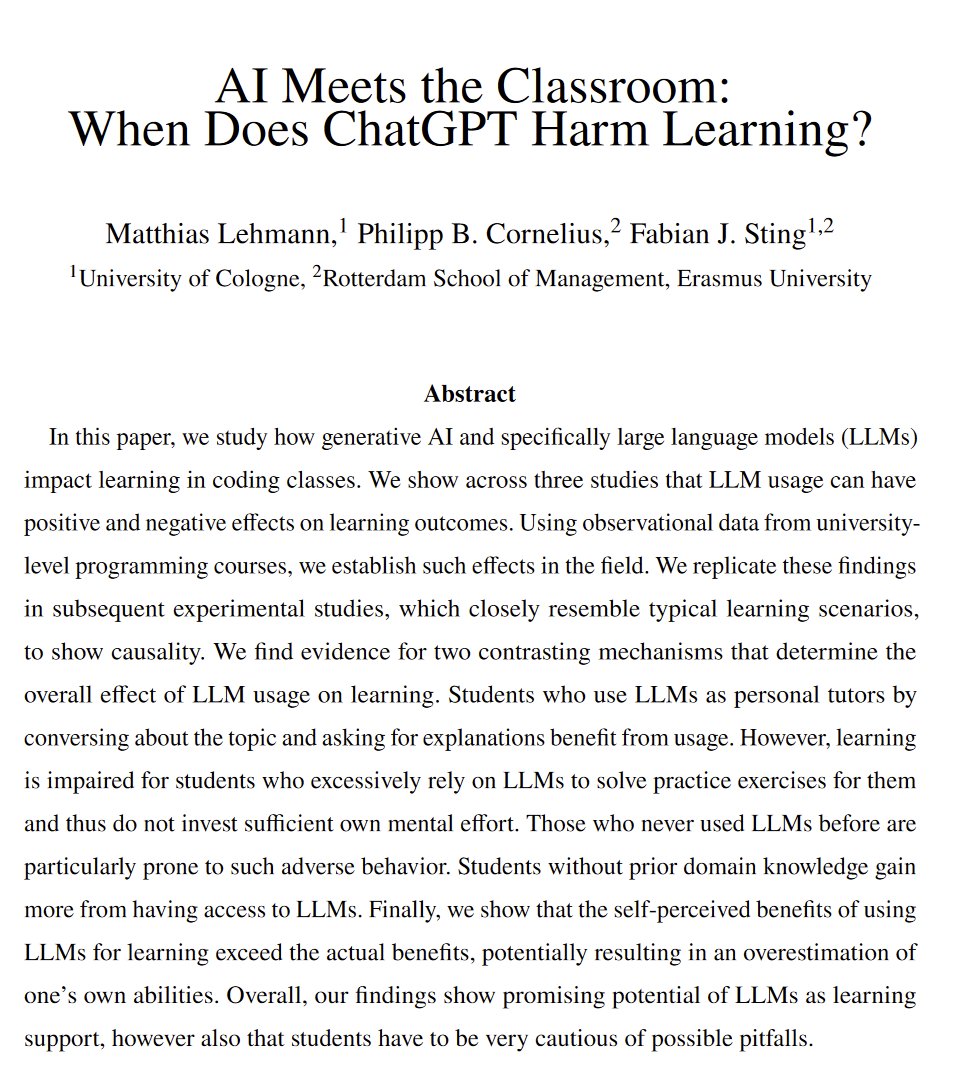
AI can help learning... when it isn't a crutch.
There are now multiple controlled experiments showing that students who use AI to get answers to problems hurts learning (even though they think they are learning), but that students who use AI as a tutor perform better on tests.
Supporting Global Decentralization
🔥 Scroll AI team isn’t just building tools — we’re helping to decentralize the future!
Intelligence should be free. Borders should be broken. Power should be shared 🤘.
That’s why we stand for:
⚡️ Open infrastructure
🌐 Permissionless AI
🧠 On-chain intelligence
🌍 True global access
👉 The world is watching — we’re building. Check it out: https://t.co/2DOWYk67Xe
🛠 Supporting Global Decentralization Is Our Mission!
#ScrollAI #Web3AI #Permissionless #ScrollChain #FutureIsNow







![BrianRoemmele's tweet photo. OpenAI leaked Q* so let’s dive into Q-Learning and how it relates to RLHF.
Q-learning is a foundational concept in the field of artificial intelligence, particularly in the area of reinforcement learning. It's a model-free reinforcement learning algorithm that aims to learn the value of an action in a particular state.
The ultimate goal of Q-learning is to find an optimal policy that defines the best action to take in each state, maximizing the cumulative reward over time.
Understanding Q-Learning
Basic Concept: Q-learning is based on the notion of a Q-function, also known as the state-action value function. This function takes two inputs: a state and an action. It returns an estimate of the total reward expected, starting from that state, taking that action, and thereafter following the optimal policy.
The Q-Table: In simple scenarios, Q-learning maintains a table (known as the Q-table) where each row represents a state and each column represents an action. The entries in this table are the Q-values, which are updated as the agent learns through exploration and exploitation.
The Update Rule: The core of Q-learning is the update rule, often expressed as:
\[ Q(s,a) \leftarrow Q(s,a) + \alpha [r + \gamma \max_{a'} Q(s', a') - Q(s, a)] \]
Here, \( \alpha \) is the learning rate, \( \gamma \) is the discount factor, \( r \) is the reward, \( s \) is the current state, \( a \) is the current action, and \( s' \) is the new state. (See image below).
Exploration vs. Exploitation: A key aspect of Q-learning is balancing exploration (trying new things) and exploitation (using known information). This is often managed by strategies like ε-greedy, where the agent explores randomly with probability ε and exploits the best-known action with probability 1-ε.
Q-Learning and the Path to AGI
Artificial General Intelligence (AGI) refers to the ability of an AI system to understand, learn, and apply its intelligence to a wide variety of problems, akin to human intelligence. Q-learning, while powerful in specific domains, represents a step towards AGI, but there are several challenges to overcome:
Scalability: Traditional Q-learning struggles with large state-action spaces, making it impractical for real-world problems that AGI would need to handle.
Generalization: AGI requires the ability to generalize from learned experiences to new, unseen scenarios. Q-learning typically requires explicit training for each specific scenario.
Adaptability: AGI must be able to adapt to changing environments dynamically. Q-learning algorithms often require a stationary environment where the rules do not change over time.
Integration of Multiple Skills: AGI implies the integration of various cognitive skills like reasoning, problem-solving, and learning. Q-learning primarily focuses on the learning aspect, and integrating it with other cognitive functions is an area of ongoing research.
Advances and Future Directions
Deep Q-Networks (DQN): Combining Q-learning with deep neural networks, DQNs can handle high-dimensional state spaces, making them more suitable for complex tasks.
Transfer Learning: Techniques that enable a Q-learning model trained in one domain to apply its knowledge to different but related domains can be a step towards the generalization needed for AGI.
Meta-Learning: Implementing meta-learning in Q-learning frameworks could enable AI to learn how to learn, adapting its learning strategy dynamically - a trait crucial for AGI.
Q-learning represents a significant methodology in AI, particularly in reinforcement learning.
It is not surprising that OpenAI is using Q-learning RLHF to try to achieve the mystical AGI.](https://pbs.twimg.com/media/F_mE_1obsAAVRW6.jpg)