Fear is the mind-killer. Fear is the little-death that brings total obliteration. I will face my fear. I will permit it to pass over me and through me.
If you take profit and later see price run, you will regret it
If you hold the trade, and price retraces, you will regret it
Bank it or hold it, there will always be regret
But having one of those regrets is better than having the other
Altseason is a mind virus for newbies.
The basic assumption is: Bitcoin runs, then consolidates; the liquidity that accumulated in BTC rotates downward. If you want to be specific, you could even say first into majors, then through mid-caps, and eventually into the long tail of small-caps and absolute shitters. It's a sequential, almost mechanical picture of capital flowing through the market. Holding your favorite shitters through this period is, in effect, holding a lottery ticket on a hypothesized regime change.
Strip the narrative away, and what people actually *want* but never really articulate is: exposure to trending altcoins. Trend is the actual unit of return. If you want exposure to trending altcoins, the right object of analysis is trend itself. Concretely: identify what is likely to trend in the near future based on observable signals rather than on a thesis about a project's fundamental future.
TL;DR: Fuck altseason. Be in trend when it's present and out of it when it isn't, and size accordingly.
My Favorite Quotes on CT
@thiccyth0t: Playing a game that wasn’t meant for you is a common tragedy in this industry.
@maybeltr: Optimism isn’t naivety. It's a strategic and necessary response to techno nihilism.
@0xaporia: It's less about outsmarting everyone and more about having the risk tolerance to step in where others won't.
@LomahCrypto: Concede unfavorable situations.
@gammichan: Happiness is relative, a man in a jail cell is joyous to just see sunshine for 5 minutes.
@herxbt: Self-confidence is the most important quality to becoming a successful trader.
@apewoodx: There's alpha in doing things others cant and wont do
@Trader_XO: The waiting game is what many screw up.
@0xkyle__: I have become an infinitely better trader trying to be less smart, top blasting, and feeling the vibes.
@dawnnitee: Money compounds quickly when continually making the correct choices instead of hyper-gambling chasing making it all in one play.
@tulipking: Writing is thinking made visible. Every incoherent trade thesis you have seems brilliant until you try to explain it in writing.
@Stoiiic: Grit is a prerequisite.
@ferbsol: Not losing is winning.
@CryptoCred: Survival is an actual edge in crypto, but you need to stick around long enough to make the most of it.
@redphone: Risk isn't the Enemy. Servitude is.
@howdymerry: Your tech is worthless if no one cares.
@EmperorBTC: Trade everyday like it's a new market cycle, needing new reading and forget all opinions.
@mellometrics: The best trades usually feel uncomfortable, that’s why most people miss them.
@crypticd22: The market is always right.
@Grantblocmates: If something’s polarising, it’s worth paying attention to. whether it makes sense or not.
@TraderMercury: Remind yourself that opportunity is abundant.
The Pareto Principle changed how I trade.
I stopped trying to win every trade and focused on surviving long enough for the big ones to land.
Here's the "80/20 Rule" and how it works:
Psychology → Execution → Understanding → Edge
Beginners treat edge as an emergent property, something that magically appears through the process of having the right mindset, execution and practice. They believe that if they just control their emotions better, enter trades more precisely, and stay disciplined long enough, profitability will naturally result from this combination of soft skills. It makes edge feel mystical and unquantifiable, the product of too many intangible variables (confidence, intuition, experience, etc.) to ever pin down definitively.
The tragic flaw is that they're trying to become profitable through self-improvement without ever proving that what they're improving at actually works. Think of someone optimizing their workout form and motivation while following a fitness program proven to cause injury. Their dedication accelerates movement toward the wrong outcome.
Edge → Understanding → Execution → Psychology
People I find to be successful treat edge as the prerequisite: a clear, testable hypothesis about market behavior that must be validated with data before anything else matters. They identify where edge should exist (a specific factor, inefficiency, etc.), gather evidence for it, and only then worry about implementation. Psychology isn't the driver of edge but rather the maintenance tool for executing something already proven, dealing with the emotional difficulty of following rules during drawdowns that your data confirms are normal. Edge is concrete and measurable from day one; psychology is just the final friction point between knowing what works and actually doing it consistently.
Good Morning
The first time I realised my brain was not built for trading, I was staring at a red candle that felt like it was staring back. My chest tightened. My mouse hand twitched. Somewhere inside, the old caveman who once ran from tigers started yanking at the steering wheel. Get out. Now. Survive.
That part of you is loud. It is ancient. It is ninety five percent emotional and it does not care that this is only a chart on a screen. Loss is loss. To your nervous system, money leaking from an account feels a lot like status leaking from a tribe. Power slipping away. Safety threatened. So the emotional brain floods the system. The rational voice gets pushed to the corner, hands up, pretending it is still in charge.
If you are a non trader trying to become profitable, this is the fight you are actually in. Not against the market. Against the wiring. You do not out argue that wiring. You retrain it.
Good news. Brains change. New connections start forming within hours of new practice. You can feel small shifts in four to six weeks. Give it three to nine months of repetition and those new routes start to feel like home. Give it one to three years of real work and you can become consistently profitable. Give it two to five and you can become the calm one in the storm, the trader people think was born with ice in their veins. You were not. You built it.
Here is the usual arc I see and lived
Zero to six months
You build the basics. Market structure. Risk. Position sizing. You learn why the stop goes where it goes. You discover that journaling is not homework. It is the mirror that keeps you honest. You still flinch at every flicker on the screen. That is fine. You are laying track.
Six to twelve months
You start to see patterns in your own behaviour. You catch yourself moving a stop and you write down exactly why you did it. You trade small or you trade demo because the point is not to make money yet. The point is to train responses. Reps over results. You begin to notice that some urges can be watched without being obeyed. That is neuroplasticity at work even if you never say the word.
One to three years
Consistency starts to show up. Not perfect days. Boring days. Rule following days. Days where you exit because the plan said exit, not because fear screamed and you obeyed. You size correctly. You skip the trade that does not fit. You lose and you do not spiral. Your identity shifts from outcome chaser to process keeper. That is when the equity curve quietly begins to bend.
Two to five years
Mastery is not fireworks. It is stability. You have a playbook and you keep it tight. You add slowly. You know which environments are yours and which ones you let pass like a bus you were never meant to catch. You can watch price run without you and feel nothing more than a note to self. You become the trader who looks lucky because their preparation is invisible.
How do you speed it up
Tell the truth on paper
Every trade. Entry. Exit. Emotions. Triggers. Lies you told yourself in the moment. The journal is where you see the wiring you are trying to change.
Use rehearsal like an athlete
Replay charts. Speak your rules out loud. Walk through the what ifs before the bell. Your brain needs thousands of stress free repetitions so it has somewhere safe to go when the heat turns up.
Trade small enough that you can think
If the size makes your heart rate climb, you are not training your rational brain. You are feeding the caveman.
Automate decisions that emotions love to hijack
Hard stops. Predefined risk per trade. A fixed number of trades per day. The more you can move from willpower to structure, the faster the rewiring sticks.
Study your own tilt
Everyone has a signature mistake. Revenge trading. Moving stops. Taking profits too early. Name it. Build a specific counter for it. One rule. One alarm. One accountability partner. Target the glitch.
Accept the timeline
You would not try to deadlift twice your body weight after four weeks in the gym. Treat trading with the same respect. Early wins happen. They do not mean you are done. Early losses happen. They do not mean you cannot do this. The brain is plastic but it is not instant.
If you are a non trader starting today, budget one to three years to become truly consistent. Some will do it faster. Many will need longer. The variable is not your intelligence. It is your willingness to practice the boring parts long after the excitement wears off.
Your caveman is not your enemy. He just needs a new job. Give him rules to guard. Give him a routine to enforce. Give him a journal to patrol. Over time he stops grabbing the wheel in panic and starts pointing at the dashboard, reminding you what the plan said.
You will know you are rewired the day you close a losing trade on plan, feel almost nothing, and quietly log it with the same care you give to your winners. That is not cold. That is freedom. That is the brain of a trader you built on purpose.
Breakeven trader?
Stuck in elo hell?
You don’t need new indicators.
You don't need a new system.
You need to make fewer unforced errors.
Error reduction is the fastest route to profitability.
--
Let's begin with a little honest self reflection.
Write down everything that you're bad at as a trader.
Every error. All of them.
Because that’s the only way you can figure out what you’re not completely shit at.
And I promise you, even if you're on full tilt, you still have a thing or two that you can do well.
I use a lot of tennis metaphors when I teach on stream, so here's another one:
Amateurs play a Loser’s Game → most matches are won simply by missing less than your opponent. Legit nothing fancy. You win by simply screwing up less.
Just put the damn ball in the court.
Pros play a Winner’s Game → most matches are won by out playing your opponent. You have to out think them, problem solve on the fly and aggressively close points.
Markets are the same.
Once you're a proven winner -> press size, use LTF or flow to snipe entries, execute when someone makes a mistake, apply game theory and out think your competition.
But if you're struggling, just put the ball in the damn court.
Chances are if you're still reading, you're not consistently profitable.
You may run up briefly, but you can't keep it.
You're not a pro.
You're an amateur.
So play like an amateur.
Have one setup that intuitively comes to mind as your favorite? It's probably your favorite bc it makes you more money than the rest of the shit you take.
Gather some stats.
I bet you that you're over 50% win rate with it.
If so...
Take that one stupid setup again and again... and again.
Display the discipline to avoid the rest.
You shouldn't care about getting better at them yet; they're -EV for you.
By adding more setups all you're doing is lowering your win expectancy once you understand what your strength is.
Think of it like a video game: You don’t split points equally across every skill tree. You focus on one and build around it.
Is there one coin you trade better?
> Stick to it. Remove the rest from the watchlist.
Better at trading ranges?
> Stop trading trends.
Trade better on H1?
> Stop yourself from trading other timeframes.
The more variance your remove from the equation, the better.
TL;DR;
Your desire to learn it all and participate in everything has prevented you from consistently doing the one thing you can probably already do well.
If you're an amateur.
Leave the ego at the door and play like an amateur.
Put the ball in the damn court.
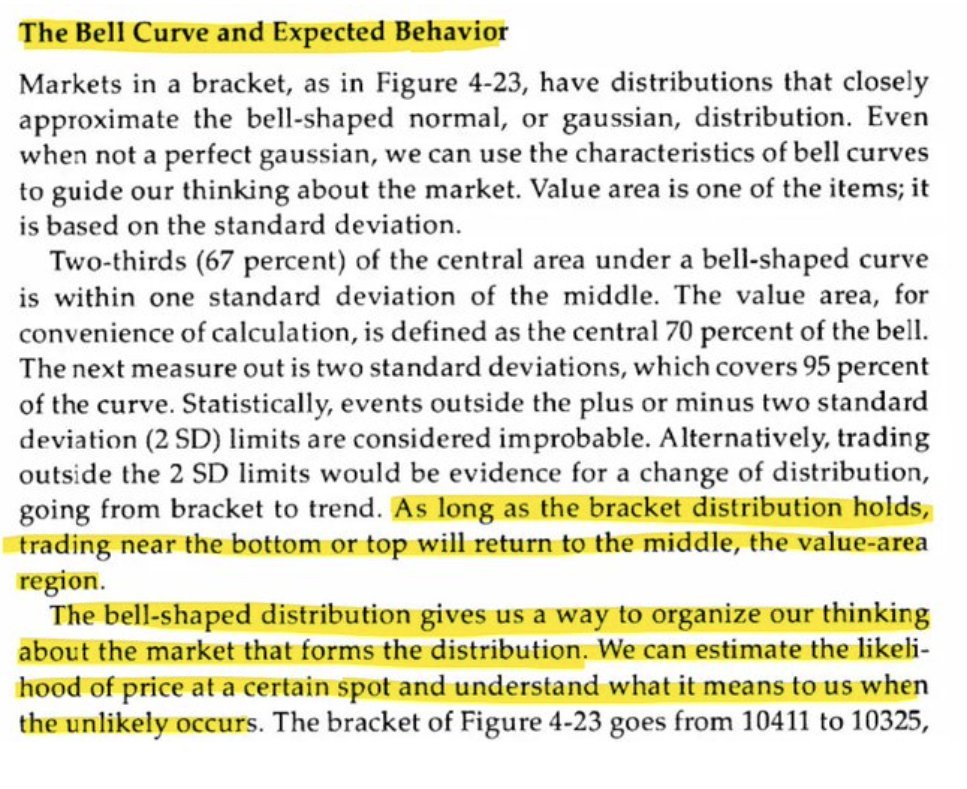
The bell curve/gaussian distribution is beautiful.
> establish normal
> determine when normal isn't happening.
> figure out if deviation from normal is temporary or presents opportunity for shift in normal.