There are two ways for a society to think about safety.
In the first one, safety is a public good. It belongs to everyone, rich or poor, regardless of what neighborhood you’re born into. This is the model that you see in countries like Japan.
In the second vision, safety is a private good. It’s something that you can purchase. If you can afford private security guards or membership in a gated community, you’ll be fine. Everyone else is on their own. This is the model you see in countries like South Africa.
Let’s think about Japan for a moment.
Tokyo is a city of 37 million people that sees a few dozen murders per year. If you walk through Shibuya at 2 am, you’ll see drunk salarymen stumbling home alone and women cutting through dark alleys without a second thought. When people lose wallets, they expect them back. You can watch Netflix’s Old Enough to see Japanese toddlers sent alone to the grocery store. For American parents, that’s an alternate universe.
Japan has made safety a universal good. It’s not safety-for-those-who can afford it. In Japan, safety is civic infrastructure—like clean water or good roads.
Compare that to South Africa.
South Africa has over 600,000 private security guards—more than twice the number of police and soldiers combined. The wealthy live behind nine-foot walls, electric fences, panic buttons. If you can pay, it works.
But if you can’t? Then no one is there to protect you. South Africa’s murder rate is one of the highest in the world. Cities like Johannesburg, Durban, and Cape Town are some of the most dangerous in the world. But South Africa muddles through, because the rich can afford to protect themselves.
Where’s America in this?
The U.S. is somewhere in between Japan and South Africa. We have hundreds of thousands of fantastic law enforcement officers who are dedicated to keeping our people safe. But everyone knows that the rich are safer than the poor. People in poor neighborhoods suffer from rates of crime that rich people can’t imagine.
You can see it in a single metro area. Drive across any major American city and the gap is staggering. In some neighborhoods, you can’t walk outside at night, leave anything in your car, or expect the police to show up in time if something happens. In others, home values stretch well into the millions, police are abundant, and residents can rely on cameras, gates, and private security to keep them safe.
That’s South Africa lite. If you’re poor, you make do with spotty public order. But if you’re rich, you protect yourself with walls, gates, cameras, and guards.
Flock Safety exists to make America’s public safety more like Japan’s and less like South Africa’s. Our vision is simple—every American, no matter where they live or how much money they have, should have access to the same sense of security that the richest Americans have today. There’s no reason that only people in the richest neighborhoods should enjoy freedom from crime.
Everyone deserves to be safe.
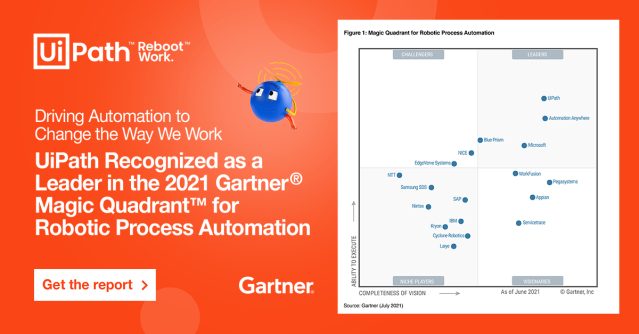
2021 @Gartner_inc Magic Quadrant™ for Robotic Process #Automation is out. See what makes @UiPath once again the #RPA vendor positioned highest for its ability to execute. https://t.co/saaKrcWGVx
Honored Today to celebrate women around the world - I’m honored to work alongside and learn from the incredible women @Uipath and with our partners and clients! We have some important work to do and to continue to make steps forward to eliminate gender bias and inequality!!
.@VMware is using #RPA to accelerate their digital transformation. How about you? Register today to learn the best practices at #UiPathRebootWork - https://t.co/VRKZoZB2CO #UiPathEmployee https://t.co/0xfopcfb4t
🎡How do you become a fully automated enterprise ready to win?
Get on board by following @bpatrick001's four definitory pillars for full #automation. Hear them on Dec. 15, at the #UiPathRebootWork Festival – https://t.co/x28qakpglJ.
.#Automation is taking the main stage at the #UiPathRebootWork Festival. Pick your ground for each region of the world and tune in for real use cases on how Spotify, Cleveland Clinic, and Schneider Electric use #RPA to reinvent the way... #UiPathEmployee https://t.co/a59SsllVc8