How do you know this is an artist residency?
Since arriving at VSC, I have had a strong feeling that I am living in a nursing home. On the surface, it is because three meals are provided at fixed times every day, and time stretches out endlessly.
I am reminded of visiting my grandmother at the care home where she lived. I often carried an enormous sense of guilt inside me. But I did not recognize it at the time, because I was afraid of remembering. I pretended not to know.
Later, as I grew older, I realized that the most frightening thing in life is time. To escape its endless judgment, we are willing to pay any price. In some sense, an artist residency is my way of resisting time. I have to tell myself that, as a maker, I am still doing something.
But when I discovered that I could still feel lost even within a residency, the enormous shadow inside me suddenly surfaced. I wanted to prove that I was not in a nursing home, but at an artist residency.
VSC = Vermont Studio Center.
https://t.co/2Sf9HdVLJa
What Do We Mean by Western Art?
Time passes quickly in New York. In the blink of an eye, three months have gone by. I've been going to exhibitions almost every day, without being selective. I've seen shows at commercial galleries in Chelsea, student graduation shows, and experimental spaces in Brooklyn filled with things I couldn't make sense of. I've seen works displayed like furniture in luxury homes and reception rooms tucked away in buildings, used only for meetings with collectors. I've also seen deadly serious work at research institutions and art fairs that nearly put me to sleep. If New York represents the center of Western art today, it doesn't actually have a single center. It's made up of many different circles. So when we talk about learning from the West or resisting the West, it doesn't mean very much. We're not even sure which West we mean.
There are even several pieces of this colorful mosaic that Taiwan doesn't have at all. For example, Taiwan has no experimental art scene. Sure, every exhibition open call we put out stresses experimentation. But when you see cut-out lettering on the walls and cables neatly tidied away on the floor, you know this is something different from experimentation in New York. There is also a kind of performance we don't have in Taiwan. It's neither theater nor performance art, but something I have no way of classifying. I've noticed that the resident artists here all love going to these performances. Another rarity in Taiwan is a kind of institution-led research exhibition. I know we have some major research-based exhibitions in Taiwan, but they feel different from the ones here. The former feel more like exhibitions supported by research; the latter present research as the exhibition itself.
I have a strong sense that the art we know comes from just a few particular sources. We see international biennials, exhibitions in Chelsea, and works at MoMA and the Whitney, and take these as models of good art. Yet in New York, these are only particular kinds of art. By "particular," I mean that they involve many considerations beyond art itself.
Art seen through this filter shapes us deeply. Holding an exhibition in Taiwan often feels a little like imitating a major gallery or museum abroad: the space needs to be thought through as a whole, there has to be a statement, the works have to be substantial enough to hold the room, and there has to be cut-out lettering.
Another example is the art fair and the taste it brings with it. I find that when I visit an art fair, I unconsciously expect the work to hit me. In principle, there's nothing wrong with that. Don't we all want art to move us? But this art-fair way of looking goes further. It means expecting a strong impact, preferably a sensory one, or otherwise one delivered through the subject matter. I can even start judging works without understanding them at all: this one looks very European; that one doesn't look fully resolved.
The thought brought me out in a cold sweat. This way of appraising art combines sensory impact, execution, the atmosphere of the space, and subject matter, and turns them into expertise in art. For art, this is the most dangerous way of looking. It leaves us caring only about taste and effect, and the more exhibitions we see, the more entrenched it becomes.
My time in New York has changed my idea of a healthy art world. An ideal art world isn't one with lots of good works, but one with different kinds of good work. Getting there doesn't depend on putting on a few successful major exhibitions. It depends on every kind of exhibition being able to be interesting. I think this is the hardest thing for Taiwan to achieve. We might put on a successful biennial, but it's hard for us to have interesting experimental shows, exhibitions in luxury homes, and creative-industry shows all at once. The reason isn't complicated. We simply don't have that many people working in art, so we can only put all our energy into catching up with the best art.
But this is bound to be futile. The biennials, art fairs, and major commercial galleries we learn from are often the furthest behind aesthetically. Their value lies in perfecting an already settled aesthetic. Beyond that, there isn't much else. Looking at this art makes us think art is a game of execution. This is why the Asian artists I see here are all more certain than the Western artists, and why the average standard among young Taiwanese artists is usually higher. We've memorized the textbooks and the works in major institutions. We're sure the answers to art are there. In the end, though, this is like marking the side of a boat to remember where a sword fell into the river, then looking for it at that mark after the boat has moved on.
Why Do We Keep Dividing Art into Concept and Technique?
Arguments about art, whether in photography, painting, or sculpture, are often reduced to an opposition between “concept” and “technique.” For example, A accuses B of having no technical skill and talking only about concepts, while B accuses A of having no ideas and clinging to convention. This framework clearly comes from avant-garde art. Throughout the twentieth century, we see new artistic movements repeatedly trying to abandon earlier techniques and establish new aesthetics. We can imagine that, at the time, there must also have been people criticizing the new movements for focusing solely on subversion, while others accused traditional schools of painting of being all technique.
But does this framework also apply in the twenty-first century? For example, can we say that contemporary art is all subversion and nothing but concepts? We do indeed see many people making this criticism, but they are applying the logic of avant-garde art to contemporary art. For the latter, subversion is not so important, because contemporary art simply no longer believes in a movement that comes progressively closer to the essence of art through continual subversion. By comparison, bringing different traditions and techniques into play is closer to what characterizes contemporary art. Likewise, it is hard to keep criticizing conservatives for clinging to convention, because the path of art whose aim is innovation no longer exists. You can criticize them for failing to realize that aesthetic sensibility and technique are themselves constructed, but you are unlikely to claim that this makes you any closer to the essence of art.
If we spend even a little time on it, we will find that many problems are not problems of “concept vs. technique” at all. Why, then, do people keep repeating this pattern? I think it is because this model simplifies art, as though all art fell into just two categories: one concerning images, intuition, sensuousness, technique, and continuity with tradition; the other concerning process, critique, rationality, concepts, and subversion. In other words, technique and concept are not themselves the point. What really matters is the whole set of values attached to each label. For example, when people see conceptual art, they assume it emphasizes rationality and stands in opposition to intuition.
Sometimes this “concept vs. technique” model even shifts depending on whom someone is speaking to. For example, an artist might emphasize concepts when speaking to A but technique when speaking to B. This suggests that “concept vs. technique” is less an aesthetic problem than a question of positioning. When you say, for instance, that an artist has “nothing but concepts,” you are often implicitly positioning yourself as an artist who can balance concepts and images. But when you face another artist who seems even more “balanced” than you, you may turn around and emphasize your own leaning toward concepts, then criticize the other person for having “nothing but technique.” Concept and technique thus become not only descriptions of works, but also coordinates that artists use to distinguish themselves from others in the art world.
I think “approach” might be a better way of talking about this. It is hard to find an exact Chinese equivalent for this word; for now, we might understand it as “a method of making art,” “a way of proceeding,” or “a working method.” It refers not to a single concept or an individual technique, but to a system that an artist gradually develops. Rationality, intuition, images, concepts, techniques, and other elements may all exist within this system. The key is how they are arranged and organized.
Of course, you could also say that this way of looking itself still favors concepts. But what “concept” means here is no longer a single element set against technique. It is a system that organizes concepts, techniques, intuition, and form at a meta level. The art that emerges from this system can be highly conceptual and can also be highly sensuous.
New York Residency Notes: May 23, 2026
Translated in full from my original Chinese essay.
Today was the exhibition opening, but of course the weather had to be miserable, with cold wind and rain. Fortunately, everyone was kind enough to see this awkward event through with me. The work came out of my wish to put on an exhibition in New York, followed by the realization that I simply could not afford to rent a venue. Then I remembered that I already had an exhibition on in Taiwan. Why not project images from Taiwan in New York and hold the opening during the daytime in Taiwan? Initially, I planned to project a live feed from the exhibition space in Taiwan onto my studio wall. But I changed my mind and projected the image directly onto New York, as though I were holding an exhibition across the whole city.
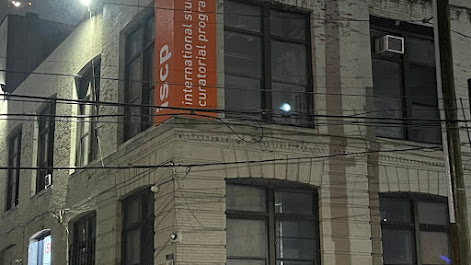
I’m quite pleased with this work. On the surface, it’s because it touches on a certain institutional issue. For instance, when I was putting on this exhibition, ISCP told me I had to state that it was not an exhibition organized by ISCP, but one taking place at ISCP. Yet when I write “Venue: ISCP” in my CV or in publicity for the exhibition, that distinction cannot be conveyed. To some extent, this exhibition is just a simple language game.
Beyond that, another reason is that it fits my own definition of art: bringing different things together to make one thing. I happened to have an exhibition in Taiwan. I happened to have a studio facing the street. I happened to have made a work about an exhibition opening, and the projection on the window happened to look a lot like an “aura.” The key is that these things must have an internal connection, or, to put it another way, form a system of their own. This allows me to reduce my role as the creator.
But I find it difficult to get other people to understand this. To me, this is the most frustrating thing about making conceptual art. People can accept that a work is conceptual, but they cannot accept that it does not have a strong connection to its maker’s intentions. In the contemporary world, intention serves as the final guarantee of art’s meaning: a good work must be one in which intention and means are consistent. This idea is reinforced in critiques at art schools.
Another challenge is that people all too easily understand conceptual art as a joke. Then they say, “I get it,” implying that they think art needs to offer something more. To respond to this, we have to distinguish between a joke in conceptual art and something that is simply a joke. I start to feel a little foolish when I get to this point. My aim is not to make people laugh and then feel that something deeper lies beyond the joke. Instead, some kind of profundity seems to have collapsed, so all we can do is laugh awkwardly.
Still, when I think back to the exhibition I held in New York ten years ago, I feel as though I have made some progress. After all, ten years ago I would never have put on an exhibition like this. At the same time, I realize that this progress does not matter to New York. It occurred to me that another reason I did this was that I happened to be reading Paul Auster’s fiction. He likes to describe a situation in which you watch someone opposite through a window, and as you keep watching, you seem to become that person. I thought of this as I stood in the street looking at my own studio. I thought of how many artists had come here before me and how many would come after me, and how, standing in the street, they too would think of all the artists who had once been here.
Work documentation: https://t.co/5cjEjWzoGt
An Artist Who Uses Photography, Rather Than a Photographic Artist
A complete English translation of my original Chinese essay.
I think the biggest difference between who I am now and who I was ten years ago is that I want to become an artist who uses photography, rather than a photographic artist. The difference is like that between Robert Rauschenberg and Hiroshi Sugimoto. I had actually noticed my preference for the former earlier. I remember finding a book of Rauschenberg’s photographs in a bookshop when I first got into photography, and loving it. I knew nothing about conceptual art at the time. Later, after I had spent some time studying photography, I tried to suppress my love of this kind of photography because, like many others, I believed in “pure photography” rather than photographs taken by artists. Those artists merely used photography as a tool, rather than making the most of photography’s own qualities.
But several more years passed, and I slowly came to understand that pure photography, or the qualities of photography itself, is really just a product of modernist aesthetics. It came to be treated as the sole representative of photography because historians of photography had constructed a canon along modernist lines: from Eugène Atget to August Sander, then Alfred Stieglitz, Paul Strand, and Henri Cartier-Bresson. The photographers within this system represent photography itself. Those outside it, such as László Moholy-Nagy, Man Ray, and even Robert Rauschenberg, together with Surrealist photography and conceptual art photography, are seen as side branches of photography. But this clearly does not fit the facts. For example, when we look back at photography in the early twentieth century, we see how deeply Surrealism influenced photographers. Not to mention how extensively conceptual art engages with photography’s indexicality.
I understand people’s aversion to artists using photography, but the problem is not that they do not understand photography. It is that they assume photography is a certain way. This mindset also appears among defenders of the fundamentals of photography. They too believe photography ought to be a certain way. So the real divide is not artists versus photographers, nor using photography versus starting from photography. It is outside the frame versus inside the frame. None of the photography by artists that I love places its emphasis on the image. It deals instead with actions, processes, indexicality, visual systems, and so on. Opposed to it is photography that works on form within the frame.
You can see two sets of concepts emerging here: one concerns form, images, intuition, and art itself; the other concerns matter, action, technology, and social context. It is easy to feel that this is the difference between modernist art and contemporary art, and to some extent, that is true. But thinking this way can easily overlook photography’s place. I think the real value of photography by artists is not that these artists belong to the anti-modernist camp, but that they are anti-art. This is also what distinguishes them from pure photographers. The latter always want to prove that photography is art, while the former want to use photography that is not art to challenge existing art. If photography has any essence, they would say that photography is a provocation.
The Works I Don’t Understand Make Me Miss New York More (3/3)
8. Eloise Hess
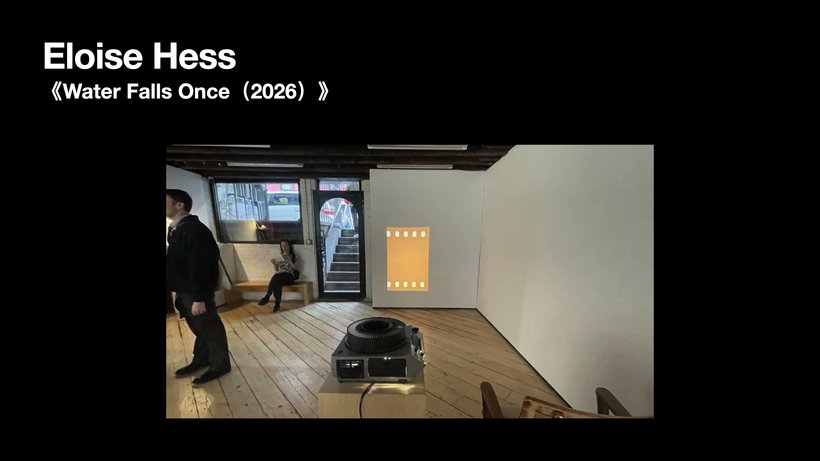
Photographing a waterfall at a fast shutter speed, making the images into slides, then showing them with a slide projector. Conceptually, it is about three kinds of time, but visually it is boring in the extreme.
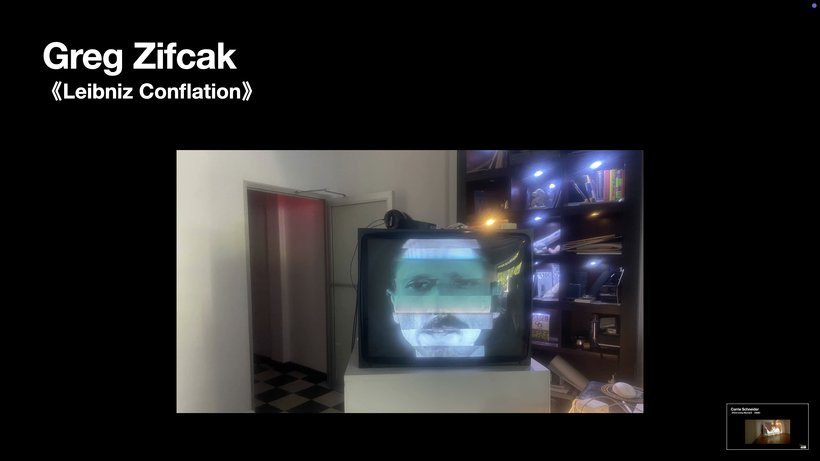
9. Greg Zifcak
It has the feel of underground art made with technology. Compared with the technological art in museums, the process and the outcome of these works form a single whole.
10. Sue Tompkins
It feels like performance art carried out with letters on paper.
It is not that I cannot be bothered to explain these works. I do not know how to explain them. But this does not mean that the works simply engage my senses or produce visual pleasure. On the contrary, many are very boring, and they do not look good either. So when language is set aside, sensory experience does not simply emerge.
The Works I Don’t Understand Make Me Miss New York More (1/3)
Translated from my original Chinese essay. Complete text in three posts, with all ten original images.
Since returning to Taiwan, I have shared my experiences in New York a few times. I have tried to make sense of current trends there and introduce my favourite works. But I have found it hard to feel enthusiastic. At first, I did not know why. Then it suddenly occurred to me that what had really interested me in New York was not the things that were so meaningful, but the baffling works. So I went through my photo albums and gathered the especially strange ones. And then I felt as though I were back in New York.
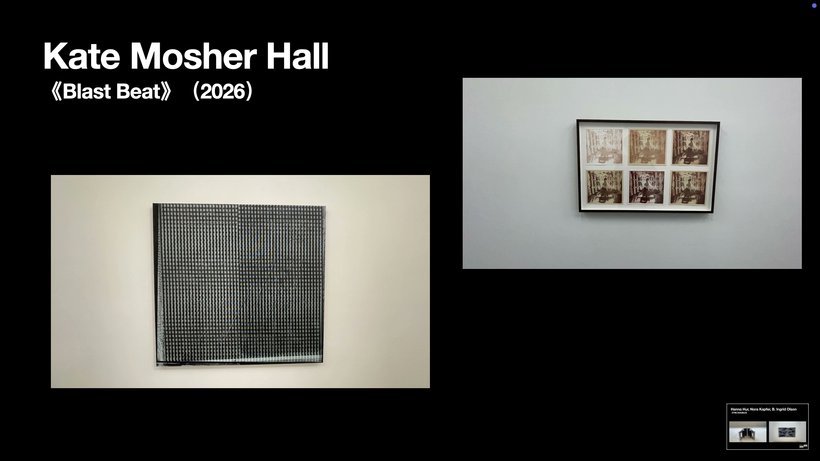
1. Kate Mosher Hall
This work starts with photographs of very ordinary things, then turns them into prints or halftone reproductions. I have absolutely no idea what the work means, and I cannot say the images look beautiful either. But I stood in front of these two images for a long time, because there was a very strange feeling. I think this was the first time I felt that texture could have such tremendous force.
2. Gorgona
Yugoslav conceptual art. A group of people exchanging hats at an opening, or looking up at the sky.
3. Tinmatis
A gallery that finds work on Instagram. The works look incredibly strange, as though they depict creatures that are neither human nor animal.
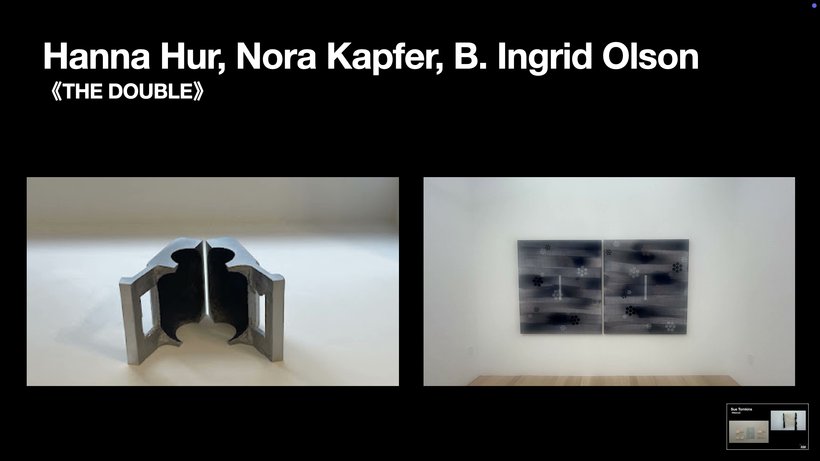
4. Hanna Hur, Nora Kapfer, B. Ingrid Olson — The Double
Working with the concept of the double. Entirely philosophical.
The Works I Don’t Understand Make Me Miss New York More (2/3)
5. Karla Black
Baroque-style mirrors reflect the viewer, echoing the way Baroque art made the secular world its subject.
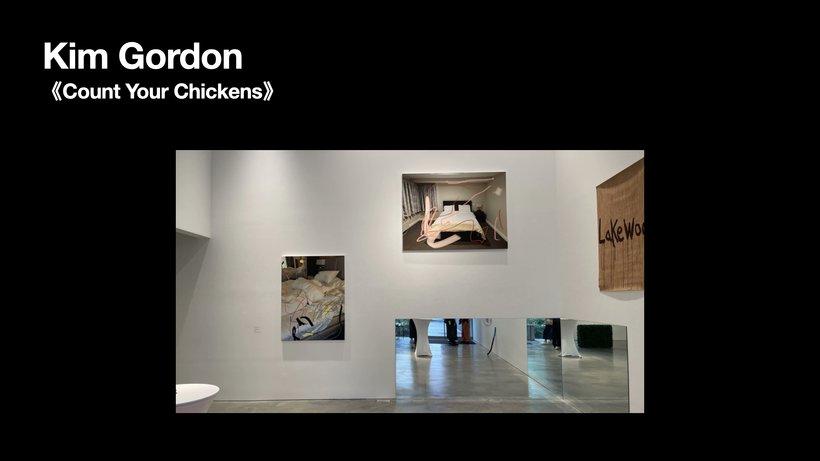
6. Kim Gordon
Kim Gordon is just cool. Casual phone photographs of hotels, with hand-drawn marks added. As though she were annotating a brief stay. There is a sense of something private intruding into a neutral space.
7. Josephine Sales
Lights connected to a timer. Perhaps this is about some way in which people are conditioned.
New York Residency Notes: July 22, 2026
Translated from my original Chinese essay.
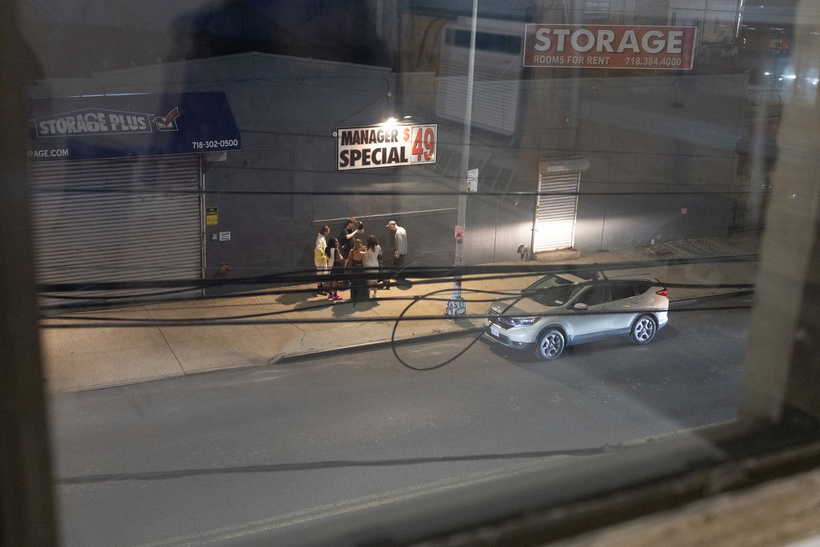
At my last open studio at ISCP, I packed all the photographs I had taken into boxes and left them by the roadside. Visitors could look through the window at these things I had cleared out. The work is called “How long does it take to move a box from here to there?”
This work made me begin to recognize the direction of my own practice. It is a little embarrassing to admit, but I had never really known what my method was. I would tell people that I made conceptual art, but that was too broad a description. During these six months in New York, perhaps because I saw accomplished artists from abroad every day, I began to want to establish a direction of my own. What I want to work with is “ready-made actions.”
I should explain. We all know about ready-mades. They seem to be an especially important method when we talk about conceptual art. But I think ready-mades have lost their force, because they are now regarded as art. This is not entirely because institutions have absorbed ready-made art. A ready-made is, after all, a physical object, so it is easy for people to discuss its visual presentation: to admire, for instance, the beautiful curves of Duchamp’s urinal.
Conceptual art can, of course, also involve actions. But early performance art was too performative: combining choreography with diagrams, pushing the body to its limits, repeating images from mass media. For me, all of these risk becoming a source of stimulation. People would certainly not call this retinal art, but some organ inside them is still being stimulated.
For me, a more workable approach is to carry out an action unrelated to art. At least, the action does not begin with art. It begins with trying to solve a problem that has nothing to do with art. I find that when I attend to the task seriously, almost foolishly, art happens. To clear out my studio, I cleared out my studio. To see exhibitions in New York, I went to openings every day. To have an exhibition in New York, I put on an exhibition. There is ultimately nothing special about these actions, just as there is nothing special about objects that have already been manufactured. That is why I call them “ready-made actions.”
In this way, we can remove the superfluous elements of conceptual art: stimulation, training, violence, performance, and so on. All that remains in art is choice. An action becomes art because I choose to call it art. It does not become art because it has artistic qualities, a profound metaphor, or a connection with an audience. I also want to avoid the ritual quality of an action. I know that when an artist concentrates on an action, however ordinary it may be, it can take on a sense of ritual. To me, this is unnecessary.
I will still use photography, but my aim is not to make photographic art. I like the cheap illusions that images create. I have noticed that my work in recent years has all had something to do with this kind of illusion. This is also why early conceptual art used photography. Photographs introduce a displacement into every action. In modernist photography, this displacement becomes the decisive moment. In conceptual art, it creates a gap between the self and reality. This experience is hardly unfamiliar: we often know something is false and still believe it to be true. For me, this is where all art begins.
Work documentation (2026):
https://t.co/H41wugEbbQ
New York Residency Notes: June 3, 2026
English translation of my original Chinese essay.
We often argue about “representation” today. Why write about Japanese food rather than resistance to Japan? Why write about China rather than Taiwan? Why present these identities and leave out those? On a visit to the Brooklyn Museum, I happened to find a few examples that might help us think through these questions.
First, I noticed something distinctive about New York’s museums: they display historical artifacts and art together. An exhibition of African artifacts, for example, might include a contemporary sculpture. Conventionally, museums present historical artifacts, while art museums present art. Yet at both the Metropolitan Museum of Art and the Brooklyn Museum, I saw exhibitions with a strong artistic character.
There may be several reasons for this. Museums want to make their exhibitions a little livelier, rather than simply presenting cold, impersonal artifacts. They also want to put objects from the past into dialogue with the present. But the most fundamental reason is that museums want to move away from a Western perspective on other cultures. The best solution is to let non-Western artists express their own agency through their work: to represent themselves. This also creates a problem, though. People visiting such exhibitions may come away with even less understanding of an unfamiliar culture, because the exhibitions do not provide a relatively objective historical context.
The same problem appears in exhibitions about America itself. On the top floor, for example, there was an exhibition of American painting. It addressed representation by rearranging the works: putting paintings of Washington in a corner and works by artists from minority groups at the entrance. You could clearly feel that what the exhibition presented was how to arrange paintings, rather than the paintings themselves. This overt maneuver made me uneasy, as though the historical and artistic relationships between works had given way to a reversal of power.
Another example is Judy Chicago’s classic work The Dinner Party. It consists of an enormous triangular dining table, with each place setting representing an important figure in feminist history. The work was later criticized for not being representative enough, because Black women were underrepresented. This brings the problem I mentioned into focus. When curating is devoted to correcting inequalities in the world, artistic considerations give way to representation.
I am not arguing that art and advocacy are opposed. There is a difference between advocacy through art and representation in the world beyond it. Chicago’s work is certainly concerned with “representation,” but its concern is with artistic representation rather than representation in the real world. These require different kinds of thinking. The latter calls for techniques of investigation and sampling; the former works to overturn a subtle structure of thought.
I felt this especially strongly while looking at Chicago’s work. As I walked around the table, I realized that the individual place settings were like units of time. The triangular structure as a whole could therefore be understood as a new conception of time, set against the Western linear conception that had prevailed: there was no beginning and no end. When we argue about representation in the real world, this more radical disruption can easily be overlooked.
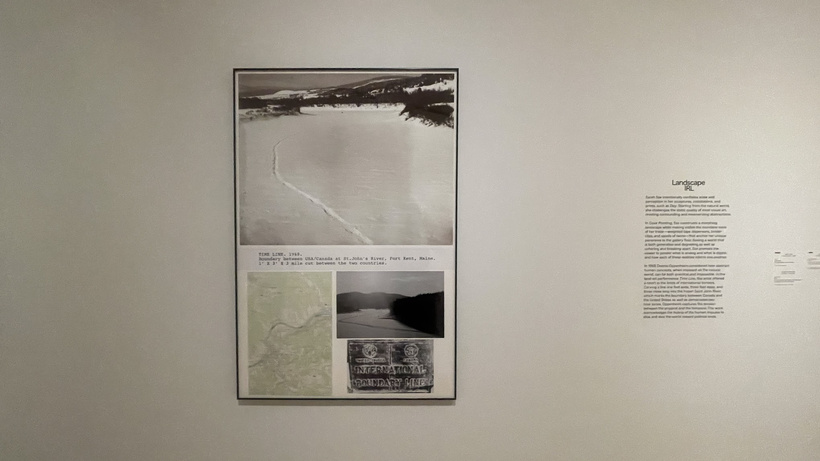
Dennis Oppenheim — Time Line
I came across some conceptual photography and took a quick photograph. For this work, Dennis Oppenheim cut a trench at the border between Canada and the United States. The trench represents both the geographical boundary between the two countries and the boundary between the time zones on either side. It reminded me of something. In the past, when I looked at land art, I tended to concentrate on the landscape. In this work, what really matters is the connection between the abstract world and the physical world.
Jennifer Rubell — Baller
This exhibition was interesting. It had three parts. One was hundreds of beachballs, some with signatures on them. The second was a newly released app called Attune, which reorganizes a message you are about to send to someone into something more suited to social interaction. The third was a man sitting on the floor, constantly scrolling on his phone. Visitors could send him messages; he could reply if he wanted to, or use Attune if he did not. Essentially, the exhibition was about masculinity. The beachballs, for example, represented its most overt image, while a Black man scrolling on his phone represented another kind of masculinity, disconnected from the world. The app seemed to offer these men a way to relate to the world. There were subtler aspects, too. When I walked among all those beachballs, I found myself wanting to kick them aside, or else follow the gaps that had already formed. Both impulses reflected something about how people behave online. On the whole, I thought it was a very precise and engaging work.
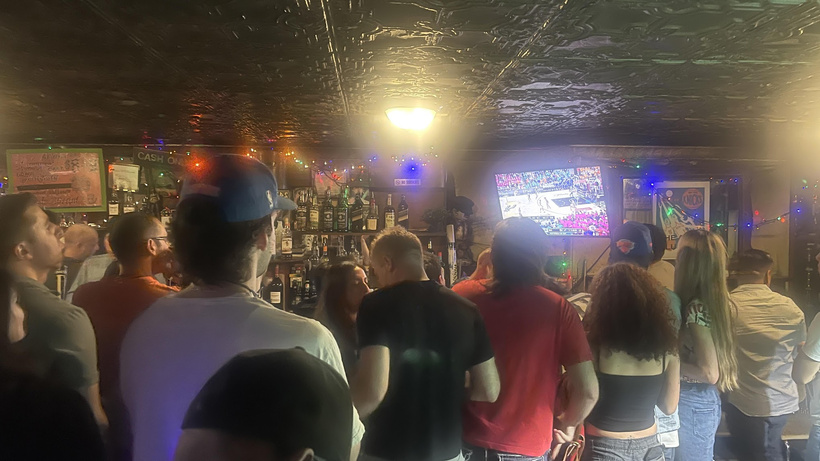
Finally, a photograph of a very straight-guy scene: a group of people watching Game 1 between New York and the Spurs.
Editorial clarification: Meredith Rosen Gallery’s caption describes Baller as thousands of beachballs hand-stamped with the Attune logo. The original essay’s description is retained above.
New York Residency Notes: July 24, 2026
English translation of my original Chinese essay.
During this residency, I met a Spanish artist called Carol, who also works with conceptual photography. We have had some similar experiences, such as not knowing how to introduce ourselves. If you say you are a photographer, people assume you photograph portraits or landscapes. Calling yourself a contemporary artist seems to leave out the role photography plays in your work. So we thought perhaps we could put on an exhibition together. We first approached RU, where I had previously been in residence, and they were unwilling to host it. Later, though, they agreed. My guess is that they wanted to build a relationship with Taiwan's Ministry of Culture through me. In this capitalist world, everything really does seem to come down to an exchange.
The exhibition actually brings together two projects. One is Imaginary. Carol discovered a small island in New York that had been covered with a kind of cactus. This cactus was later classified as a harmful plant and even became a political metaphor. In the 1970s, however, the site was turned into an amusement park, and all the cacti were cut down. It later became social housing, and then a parking lot. My project concerns a child I met ten years ago. I wanted to find her again, but ran into all kinds of problems.
These two projects seem to have little to do with each other. They did have very little to do with each other to begin with. Yet when the two works are placed together, I feel that a shared theme might emerge: how we represent something that belongs to the past, whether an island or a person. Earlier documentary photography tried to use form to evoke an abstract truth through metaphor. Contemporary art relies on extensive background knowledge, or archives, to support a context that extends beyond the image. Another approach is to build a narrative by arranging multiple photographs in a sequence.
But perhaps there is another way. Looking at Carol's photographs, I felt that she was allowing social issues to settle into an image made through a historical photographic process. I had actually seen a few similar exhibitions in New York. Carol said this way of working was already quite common in Europe. A photograph, then, can tell a story through the actions involved in making it, beyond what the image depicts. When a photographer works through an elaborate craft process, the aim is to fold time into the photograph, rather than to produce a finely detailed image. To take this a little further, that time has two parts: time from the past, as in making paper out of cactus, and time in the present, the photographer's life as it is being lived.
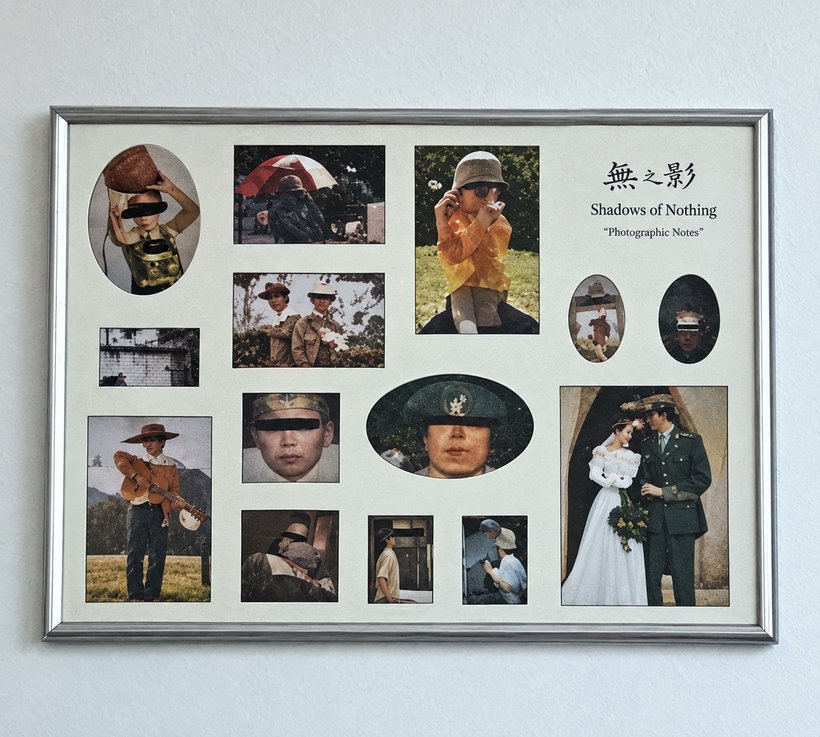
I want to use my own work to explain how this operates. My work also consists only of photographs: one is pixelated, and the other uses AI to generate a version without the pixelation. The images themselves are not particularly beautiful, but they point to time. Ten years ago, these photographs could not have existed. I don't think I had been aware of this aspect before. Photography is about more than the past. Much of the time, it reflects our present circumstances through changes in photographic technology.
Another thing I find interesting is that, when a little girl's story is placed alongside an island's history, they seem to occupy two different states of time. Many artists try to bridge the gap between them. The work then begins to lean in one direction. Viewers might be led to understand, for instance, that the exhibition uses the little girl's story to tell a larger history, or the other way around. This exhibition does not do that. It feels more like two things pieced together. I think this might actually be a way to approach my project about the little girl, because I have never wanted to use her to tell some grand historical narrative. Of course, the main reason is that we never seriously discussed how to connect the two projects.