🧐Research doesn’t have to be a solo suffering.
Join WisPaper Discord — share papers, rant about unread PDFs, and discover hidden research gems with people who actually get it.
https://t.co/MjCslwNgNX
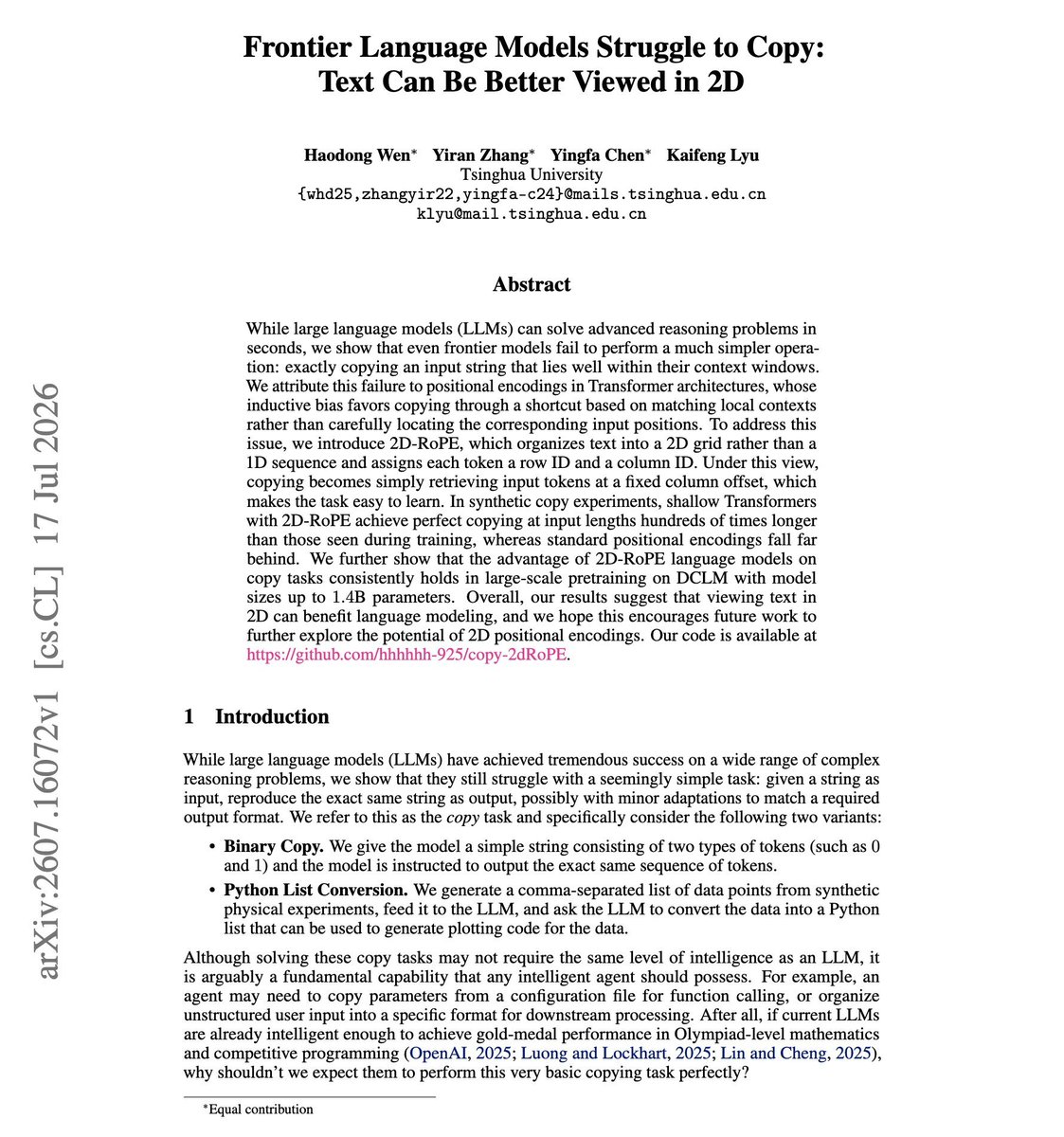
Tsinghua University researchers have introduced 2D-RoPE, a positional encoding scheme that addresses why frontier language models fail at verbatim text copying.
Imagine trying to locate a specific desk in a massive open office building by counting step-by-step through every single row instead of using a simple floor and seat number. Standard 1D positional encodings make models rely on local context shortcuts that break down when copying long text with repetitive patterns. 2D-RoPE solves this by arranging text into a 2D grid with row and column coordinates, turning copying into a straightforward retrieval task at a fixed column offset.
By structuring position in two dimensions, 2D-RoPE enables Transformers to achieve perfect copying at lengths hundreds of times longer than seen during training, with consistent gains holding up in large-scale pretraining on DCLM at 1.4B scale.
https://t.co/aquXL14zR4
https://t.co/aquXL14zR4
Anthropic has introduced Jacobian Lens (J-lens), an interpretability technique revealing a privileged representation space termed J-space that acts as a global workspace inside large language models.
Imagine a busy company where thousands of employees work in isolation, making it impossible to see how ideas develop until the final project is delivered. Traditional language models operate like these hidden offices, keeping their internal reasoning steps completely opaque. J-space functions like a shared central whiteboard, capturing concepts the model is poised to express and allowing researchers to inspect and manipulate hidden reasoning before the final output appears.
The study shows that J-space represents only a small fraction of internal activations, yet editing its representations causally redirects decisions with concept swap success rates up to 70% across Haiku 4.5, Sonnet 4.5, and Opus 4.5.
https://t.co/e3G9zu5E81
Baseten has investigated whether Large Language Models can effectively learn and retain facts within their weights through sequential fine-tuning.
Imagine saving documents on a hard drive where the data remains intact, but the computer loses the file paths, meaning you can no longer click open the files. This study demonstrates that when a model fine-tuned on Qwen3-4B appears to forget, the knowledge isn't actually erased from its weights. Instead, incoming writes break the internal routing mechanisms, making the stored information behaviorally unreachable.
By proving that forgetting is an access failure rather than erasure, the work highlights that context remains fundamentally more reliable than weights for long-term fact survival.
https://t.co/ds5elTBlwU
BJTU and ByteDance have introduced UniVR, a unified multimodal framework designed for complex visual-space reasoning, long-term planning, and fine-grained physical dynamics.
Imagine a child learning to stack blocks purely by watching how they fall, rather than having someone explain the laws of gravity in words. Traditional systems rely on language labels to decipher the world, but UniVR learns complex reasoning directly from pure visual demonstrations.
Leveraging the VR-GRPO reinforcement learning paradigm, this approach secures up to a 25% performance boost on the VR-X benchmark, establishing a new SOTA in non-linguistic world modeling.
https://t.co/7Bo8VxUNtj
FAIR at Meta and Inria have introduced FlowWM, a stochastic world model that performs flow matching directly in high-dimensional pretrained feature spaces.
Imagine trying to predict where cars will go by sketching full, blurry cartoon movies instead of just tracking the coordinates of the vehicles on a map. Traditional world models rely on heavily compressed VAE spaces that muddy downstream tasks. FlowWM skips VAE compression entirely, applying flow matching directly to rich DINOv3 features to model multiple plausible futures.
By utilizing wide heads and task-aware losses, it achieves SOTA results on the FuturePerception benchmark for long-horizon object detection and depth forecasting.
https://t.co/tjnyjTakfO
UW–Madison and Microsoft Research have introduced TRACE, a dense credit-assignment framework for training long-horizon agents using Reinforcement Learning.
Imagine a detective who investigates hundreds of clues but only gets graded at the very end of the case. They would never know which specific clue cracked the mystery and which was a dead end. TRACE solves this bottleneck by assigning precise credit at individual tool-call boundaries, evaluating whether each turn moves the agent closer to or further from the correct answer.
By scoring tool-call transitions with a frozen reference model, TRACE substantially improves long-horizon search, achieving SOTA results on BrowseComp-Plus.
https://t.co/QGxH2PsxQI
Oxford and MPI for Intelligent Systems & ELLIS Institute have introduced Mechanistic World Models (MWMs), shifting AI from predictive forecasting to autonomous scientific discovery.
Imagine a weather app that accurately predicts rain but cannot explain the physical laws of atmospheric pressure causing it. Traditional models only map patterns without understanding cause and effect. MWMs solve this by organizing knowledge around reusable computational mechanisms instead of monolithic mappings.
By focusing on these modular mechanisms, this paradigm successfully bridges the gap between prediction and explanation.
https://t.co/UGOUcOQCXM
Google and Stony Brook University have introduced Self-Correcting Coupled Markov Jump Processes (SC-CMJP). This framework enables concurrent image understanding and generation using Masked Diffusion Models.
Imagine a writer and an illustrator trying to collaborate while locked in separate rooms. Traditional models generate text and images in isolated branches. SC-CMJP solves this by letting both modalities actively negotiate and self-correct together in a single pass.
Using the training-free CO2Jump sampler, this system achieves synchronized multimodal generation where text reasoning and image synthesis actively align.
https://t.co/s3qZ7s1ueH
Jilin University, KAUST, University of Alberta, and the Swiss AI Lab IDSIA have introduced a systematic framework for modern self-improving agents.
Imagine an apprentice who improves either by studying to upgrade their brainpower, or by organizing their physical toolbox. This survey defines agents as a coupling of a cognitive core and an operational scaffold, formalizing self-improvement as an update that can modify either component.
By categorizing advancements into foundation model and scaffolding improvements, this survey establishes a roadmap for agents achieving autonomous evolution across software engineering and scientific discovery.
https://t.co/ITks33Nt6p
ETH Zurich and Stanford have introduced the Invariant Manifold of Inductive Reasoning (IMIR), a theoretical framework unifying diverse inductive tasks.
Imagine trying to track a spacecraft flying through a chaotic universe, only to realize it travels along one flat, predictable groove. Instead of calculating millions of variables, IMIR shows training dynamics are confined to a simple, low-dimensional subspace.
By reducing millions of parameters to a few interpretable coordinates, this framework makes analyzing circuit formation and Transformer dynamics highly tractable.
https://t.co/cGqu6r5rzH
The Allen Institute for AI, UW, and an independent researcher have critically re-evaluated automatic harness evolution for LLM agents.
Imagine a teacher rewriting a textbook just to fit one specific exam. The student passes, but they only memorized the test instead of actually learning. Harness evolution has the same blind spot, often overfitting to the benchmark rather than improving agent design.
Using Terminal-Bench 2.1, the study shows harness evolution fails to beat simple test-time scaling and generalizes poorly to new tasks.
https://t.co/gjqpuDep8a
Shanghai AI Lab, Fudan, and ZJU have introduced Proxy-guided Update Signal Transfer (PUST), a framework that decouples RL exploration from policy alignment using lightweight proxy models.
Imagine a surgeon wasting hours on basic lab trials. Traditional post-training forces huge models to run expensive trial-and-error exploration. PUST solves this by letting a small assistant model do the search, transferring only the key lessons to guide the large model.
By transferring relative improvement signals, this reusable method lets small models search once to guide larger ones, achieving SOTA results on Qwen3 across math and coding.
https://t.co/SKO6xS8MaW
Renmin University of China, Ant Group, and Tsinghua University have introduced Ring-Zero, scaling Zero RL to a 1-Trillion parameter MoE model.
Imagine teaching a student to solve complex puzzles purely through trial and error rather than handing them a step-by-step manual. Traditional reasoning models depend heavily on expensive human-annotated templates. Ring-Zero solves this by enabling the model to develop highly efficient, comprehensible reasoning traces entirely on its own using pure reinforcement learning.
Using a multi-stage pipeline and minimalist optimizations, this approach achieves SOTA mathematical reasoning, scoring 93.2% on AIME 2024.
https://t.co/8EJCLVnrW3
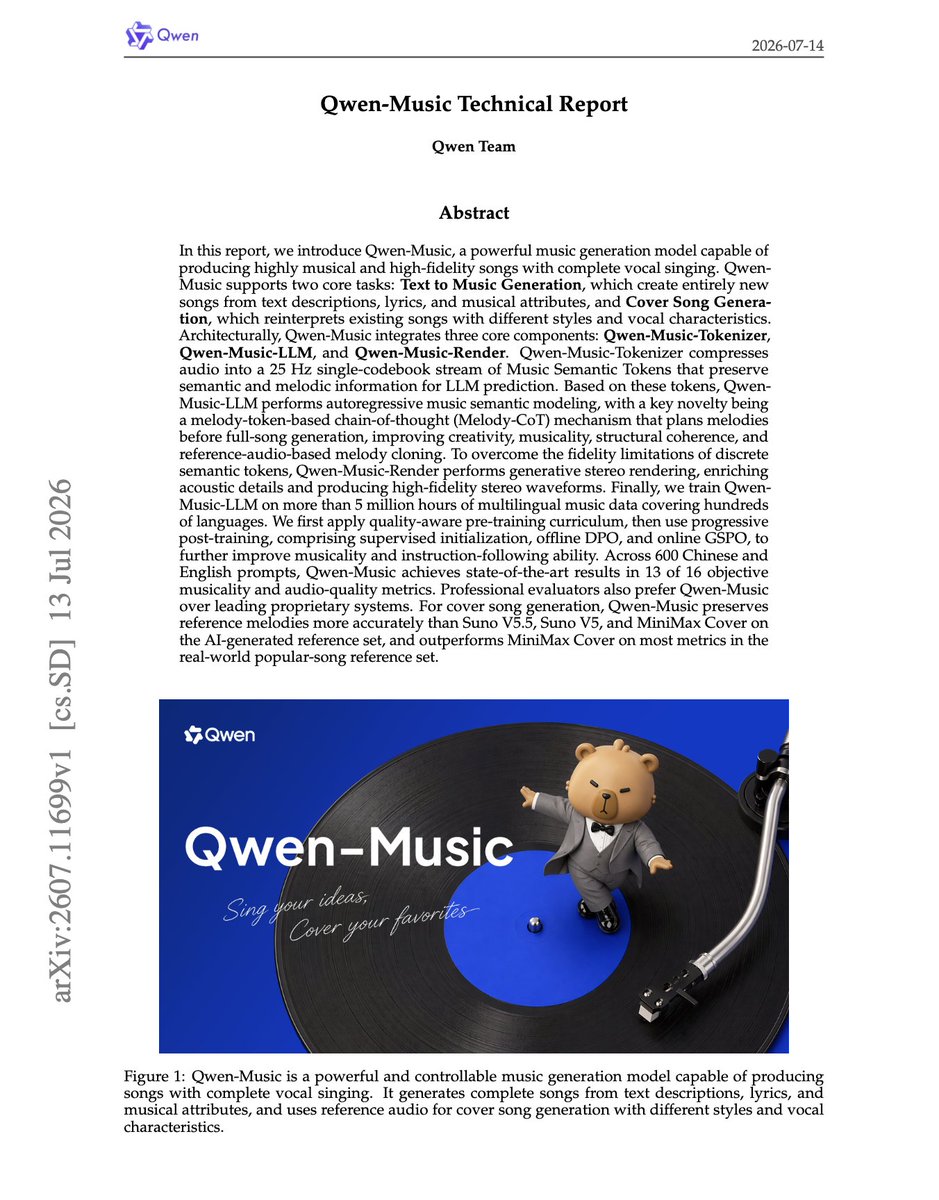
The Qwen team has introduced Qwen-Music, a large-scale music generation system that produces high-fidelity songs with full vocals, supporting both Text-to-Music and Cover Song generation.
Imagine a composer trying to write a complex symphony and perform it perfectly on stage at the exact same time. Traditional AI music tools struggle by attempting to handle musical structure and studio-quality rendering simultaneously. Qwen-Music solves this by splitting the process: it first plans the music using compact semantic tokens via a Melody-CoT reasoning mechanism, then passes the planned melody to a dedicated diffusion renderer.
By separating composition from synthesis, this three-part architecture achieves SOTA performance across 13 of 16 evaluation metrics.
https://t.co/uhGA7U07zS
Google DeepMind, University of Toronto, and UCL have introduced GenCeption, a unified general-purpose vision model that repurposes large-scale text-to-video diffusion backbones (like WAN 2.1) into efficient feed-forward perception engines.
Imagine a filmmaker who has spent years observing how light, motion, and depth interact to create realistic scenes. Instead of asking them to shoot a new film, you ask them to use that deep spatial intuition to instantly sketch a 3D blueprint of a room. GenCeption does this by taking the spatiotemporal world priors locked inside generative video models and utilizing them directly to perceive and map physical environments.
By leveraging these rich generative priors, GenCeption achieves SOTA performance across tasks like depth estimation and 3D keypoint prediction, outperforming specialized models like DepthAnything3 and SAM3.
https://t.co/NR37s1kvTw
Microsoft Research, ETH Zürich, and KRAFTON have introduced LOTUS (Looped Transformers with parallel supervision on latents), the first latent-CoT method to bridge the accuracy gap with explicit Chain-of-Thought (CoT) at the 3B scale.
Imagine a thinker who must write out every single messy, intermediate draft on paper before arriving at a final answer. Forcing models to generate explicit, readable tokens for every reasoning step is incredibly slow. LOTUS solves this by letting the model think silently inside its own continuous hidden states, refining its reasoning steps in parallel.
By utilizing a looped padded Transformer, this latent-CoT approach achieves up to a 6.9x speedup during the reasoning phase without sacrificing accuracy.
https://t.co/k28BGJv1Ig
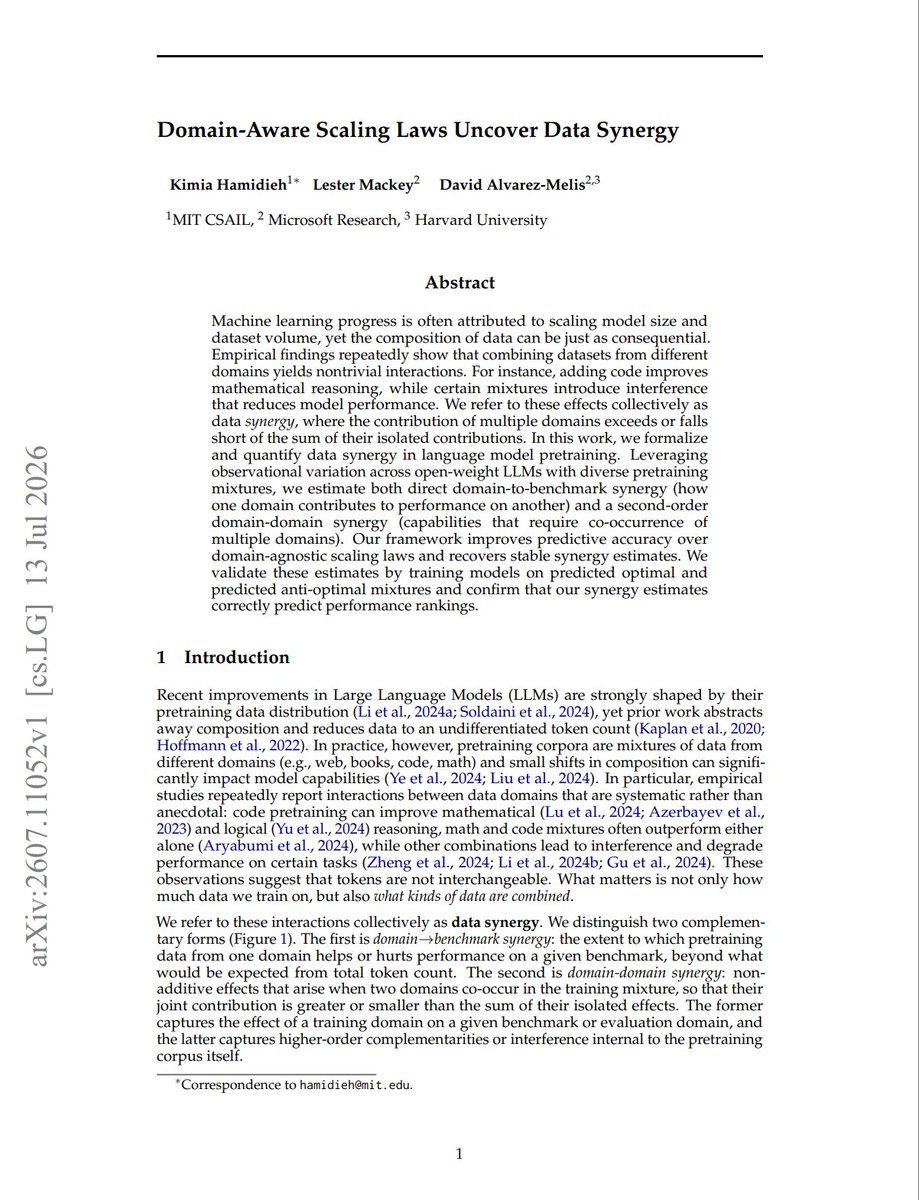
MIT CSAIL, Microsoft Research, and Harvard have introduced Domain-Aware Scaling Laws to quantify data synergy in LLM pretraining.
Imagine a chef who only measures ingredients by total weight, ignoring how flavors interact. Traditional scaling laws treat training data as a uniform mass, overlooking non-linear synergy. This framework solves this by measuring how domain co-occurrences, like Math and Code, non-linearly boost performance.
By analyzing 52 open-weight models, this domain-aware approach significantly outperforms domain-agnostic Chinchilla baselines in predictive accuracy.
https://t.co/AtlJPTXfNU
Yale and UCI have provided the first comprehensive taxonomy and literature review of Metacognition in LLMs, defining the Monitoring-Control loop for AI.
Imagine an overconfident student who blurts out answers instantly without pausing to evaluate their own understanding. Traditional models lack this self-awareness, leading to confident hallucinations. Metacognition solves this by defining a reflective loop that monitors internal uncertainty and actively controls when to halt, search, or self-correct before responding.
By categorizing advancements in self-awareness, internal state reporting, and metacognitive prompting, this unified framework helps models achieve SOTA performance in reasoning, reliability, and human-AI collaboration.
https://t.co/RyV0VhZ9fw
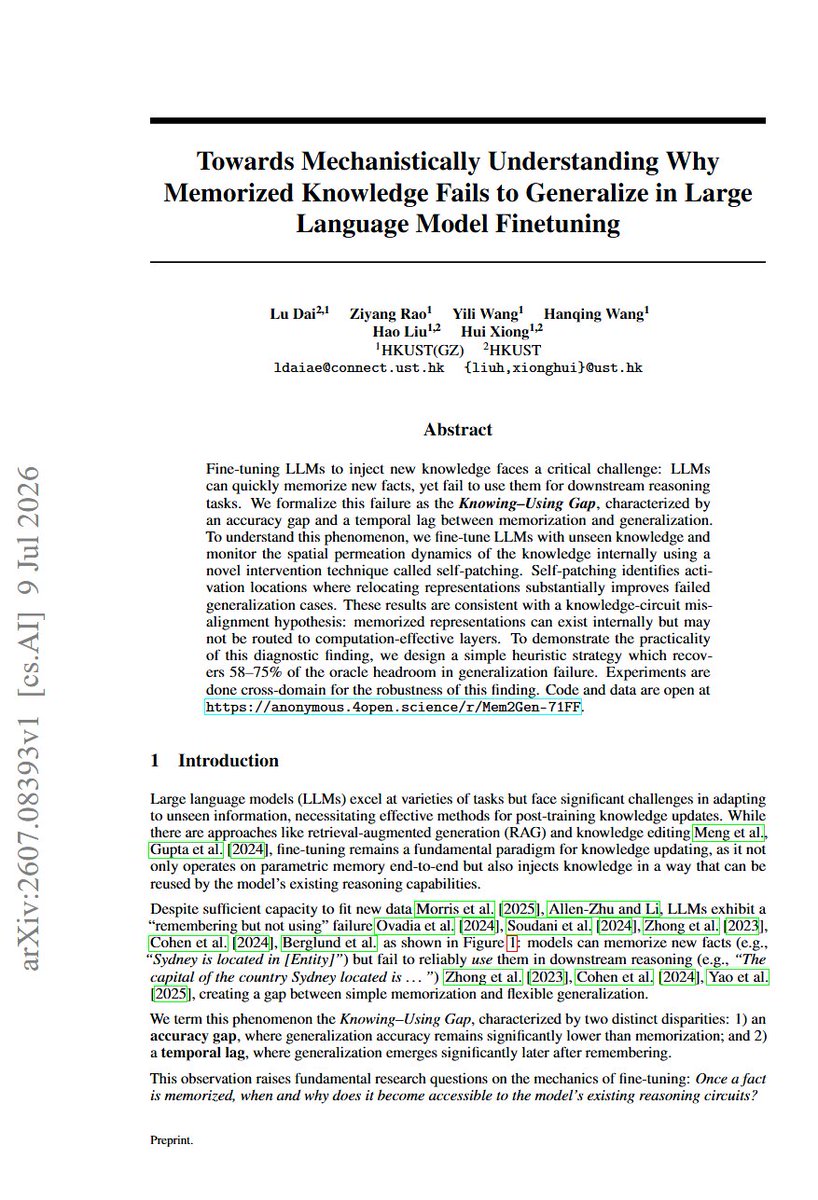
HKUST have investigated the Knowing–Using Gap in Large Language Models, where models memorize new facts during fine-tuning but fail to apply them in multi-hop reasoning.
Imagine a student who flawlessly memorizes a textbook recipe but completely freezes when asked to use those same ingredients to bake a cake. The raw information is stored in their head, but the cognitive pathways required to apply it are disconnected. The authors propose a knowledge, circuit misalignment hypothesis and introduce self-patching, which strategically relocates internal representations to bridge this gap.
By directly repairing these misaligned pathways, this intervention technique successfully restores 58–75% of generalization performance.
https://t.co/eXtpd1EzJ3
NYU and CMU have introduced Requential Coding, a novel model compression framework that encodes generative models by compressing their training trajectory rather than raw parameters.
Imagine trying to share a master chef's entire recipe book by copying down every single exact ingredient and physical motion. Standard compression tries to compress this massive final record, which remains highly complex. Requential Coding solves this by only recording the key corrections and feedback the chef received during culinary school, drastically reducing the needed storage space by focusing only on the learning trajectory.
By utilizing Relative Entropy Coding (REC) and a teacher-student distillation setup, the framework achieves state-of-the-art compression rates for LLMs, reaching approximately 1 bit per parameter.
https://t.co/BwNKSDd1Xi