A British kid became a chess master at 13, then a bestselling video game designer at 17, then a PhD neuroscientist at 33, then the CEO of the AI lab that won the 2024 Nobel Prize in Chemistry.
People called him unfocused for twenty years. He was running the most deliberate career plan in modern science.
His name is Demis Hassabis, and the thing almost nobody understood while he was doing it was that every single step was feeding the same underlying obsession.
Here is the thread that connects the whole career, and why it matters for how anyone should think about building toward a hard goal.
The chess came first. He was born in London in 1976 and started playing at age four. By eight, he was the London champion for his age group. By thirteen, he had an international master rating that put him in the top fifty players in the world under his age bracket. He was on a track that would have made him a professional player for the rest of his life.
He walked away.
The reason he gave later, in interview after interview, is the part most people miss. He said chess forced him to think constantly about thinking itself. Every move required him to simulate what his opponent was simulating about him. He became fascinated not with winning the game, but with the process the human brain was running in order to play it. He decided chess was too small a container for the real question he wanted to answer, which was how intelligence actually works.
The video games came next. He used the money he won from chess tournaments to buy a ZX Spectrum. He taught himself to code. By seventeen, he was a lead programmer on a game called Theme Park that sold millions of copies. He could have stayed in that industry and built a career as one of the top game designers in Britain.
He walked away from that too.
He went to Cambridge, did a double first in computer science, and then made the move that looked like the strangest pivot of his life. He enrolled in a PhD in cognitive neuroscience at University College London. He was thirty. His peers from Cambridge were already running companies. He went back to graduate school to study how the human hippocampus builds memories and imagines future scenarios.
His 2007 paper on the link between memory and imagination was named one of the top ten scientific breakthroughs of the year by Science magazine. But the paper was never the point. The point was that he had spent three decades quietly building the exact combination of skills nobody else in the world had put together.
Deep intuition for how intelligent agents behave in complex systems, from a lifetime of chess. Hands-on engineering fluency, from years of shipping commercial software. And a rigorous scientific understanding of how biological brains actually produce cognition, from a PhD in neuroscience.
In 2010, he used that combination to co-found DeepMind with Shane Legg and Mustafa Suleyman. The mission statement he wrote was two sentences long and sounded absurd to most people who heard it. Solve intelligence. Then use it to solve everything else.
For the first six years, DeepMind worked almost entirely on games. Atari. StarCraft. Go. People outside the field could not understand why a lab that claimed to be building artificial general intelligence was spending hundreds of millions of dollars teaching computers to play Pong.
Hassabis kept explaining the reason in interviews and almost nobody was listening. Games were not the goal. Games were a controlled environment where you could iterate on general-purpose learning algorithms fast, measure their progress precisely, and prove to yourself that you had built something that could transfer between domains.
In 2016, AlphaGo beat Lee Sedol, the world champion at Go, in a match that had been considered decades away. And the day after that match ended, Hassabis sat down with his team lead David Silver and asked what they should do next.
The answer was the thing he had been working toward his entire life.
They turned the same deep reinforcement learning approach at a problem biology had been stuck on for fifty years. Protein folding. Given an amino acid sequence, predict the three-dimensional shape the protein would fold into. Every drug discovery effort in the world depended on it. The best computational methods could only solve a small fraction of proteins. Experimental methods took years per structure and millions of dollars per protein.
AlphaFold2 was released in 2020. Within a year, it had predicted the structure of almost every protein known to science. Two hundred million structures. Made freely available to the entire research community. More than two million researchers from a hundred and ninety countries have used it since.
In October 2024, Demis Hassabis and John Jumper were awarded the Nobel Prize in Chemistry for that work.
The line almost nobody quotes from his speeches is the one that explains the whole career. He has said, many times, that he did not build AlphaFold to solve protein folding. He built AlphaFold to prove that the approach he had been developing for thirty years could actually work on a real scientific problem. Protein folding was the demonstration. AGI was always the goal.
The chess taught him how to think about adversarial systems. The games taught him how to ship software. The neuroscience taught him how the only existing example of general intelligence actually worked. DeepMind used all three to build a method that could transfer between domains the way the human brain does. And the moment the method was ready, he pointed it at the single most important unsolved problem he could find in a domain where a breakthrough would save millions of lives.
Most people looking at his career from the outside, at any point before 2016, would have called it scattered. A chess prodigy who gave up chess. A video game designer who walked away from a gaming career. A computer scientist who detoured through neuroscience. A startup founder who burned six years on board games.
From the inside, it was the most focused career in modern science. Every step was quietly answering the same question. How does intelligence actually work, and what would it take to build one that could solve problems humans have not been able to solve alone.
The people who change a field are almost never the ones who looked focused along the way.
They are the ones who were obsessed with a single question so deep and so long that the path they took to answer it looked like chaos from the outside and like a straight line from the inside.
And they almost never get credit for the plan until decades later, when the Nobel Committee calls.
Dans vos communications avec SEAL 911 en cas de demande de rançon précisez bien toutes les adresses crypto - elles resteront confidentielles et c'est essentiel pour que l'information circule le plus vite possible et augmenter les chances de bloquer les fonds.
🚨 Update on @Aave's Internal "Civil War" Situation
Aave is at a "Break it or Make it" moment.
Whatever happens next won't just define the future of crypto's largest bank, it'll also set a precedent for the entire industry.
What changed since yesterday 👇
– Voting went live today
– Stani voted against (nay) with ~333k (~33% of total voting power so far)
– @Marczeller voted abstain, as publicly stated
– Major CT voices like @DefiIgnas also chose abstain
Current scoreboard:
– 62.76% against Aave DAO (Nay)
– ~33.18% abstain
– Only ~4.06% in favor (Yea)
Translation: the DAO is almost certainly losing.
If this passes against the DAO, things can get messy.
Possible outcomes 👇
A. Scenario 1:
Aave DAO forks the frontend and runs independently.
This lets the DAO route surplus fees to the treasury, but it comes with massive responsibility around security, updates, maintenance, infrastructure, and ops.
It also splits the user base (and trust?) overnight.
B. Scenario 2:
A full-blown legal tussle between Aave DAO and Aave Labs, potentially in Wyoming, exactly as @tulipking predicted.
C. Scenario 3:
Nothing happens. The DAO accepts the result and moves on, since it doesn't own the brand, IP, socials, GitHub, npm, naming rights, etc.
Also, many won't want a long, public DAO vs. Labs war anyway. A prolonged standoff risks bleeding revenue and weakening the ecosystem further.
But, every scenario creates a crack between Aave Labs and Aave DAO.
And that's dangerous.
Because Aave didn't survive multiple cycles alone.
Service providers like @chaoslabs LlamaRisk, BGD Labs, TokenLogic, and @Aavechan are a huge reason Aave not only grew, but also stayed dominant through multiple cycles.
For Aave to remain the dominant player, DAO alignment isn't optional, it's existential. And this conflict has to be resolved or decisively settled.
Until then, everything is uncertain and the market is already reacting.
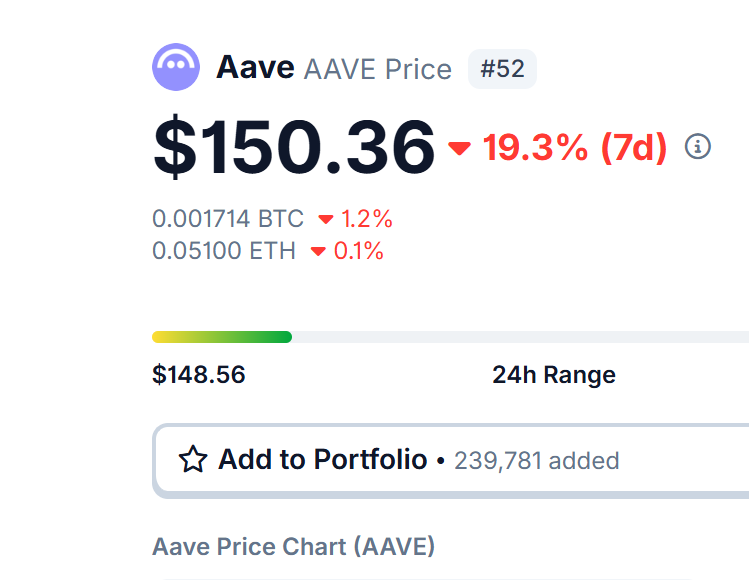
AAVE is down ~18% in 7 days, despite the SEC officially ending its investigation on Dec 17.
But if we zoom out, this vote answers something bigger:
1. Token vs. equity
2. Governance as 'utility'
3. Who actually owns a protocol?
This industry has argued about this for years.
Aave is about to give us the answer, whether it wants to or not.
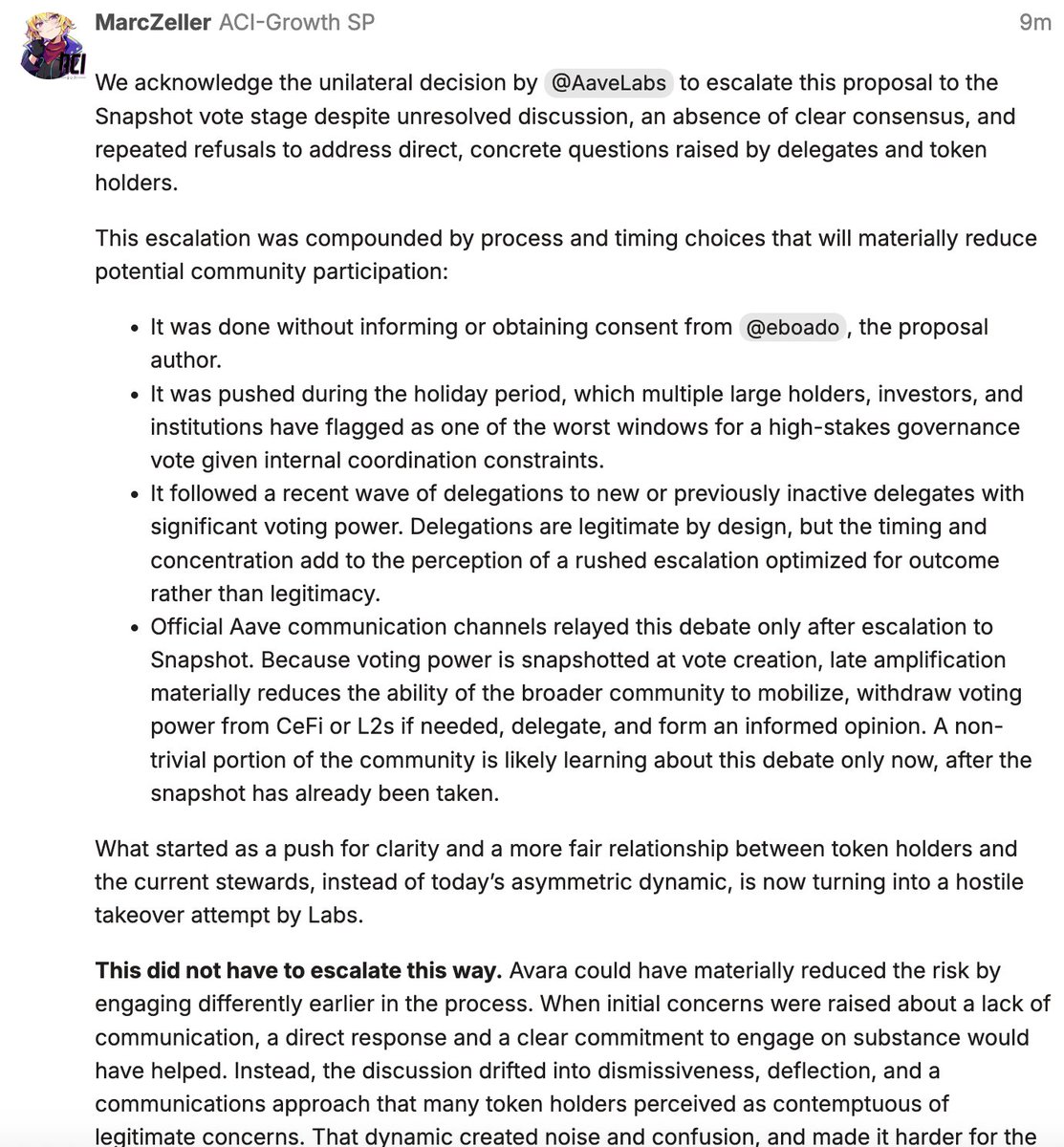
We acknowledge @aave unilaterally escalated the proposal to Snapshot without resolving discussion, without clear consensus, and without consent from @eboadom
We’ve posted our position in response to this unprecedented interference in the DAO governance process.
Worst outcome that was entirely preventable.
L’ensemble des collaborateurs de Paymium, comme toutes les personnes travaillant dans le secteur des cryptomonnaies aujourd’hui en France, ont été particulièrement touchés par la tentative d’enlèvement qui s’est produite le mardi 13 mai 2025 en plein Paris, et fait suite à une série d’événements similaires.
L’entreprise ne fera aucun commentaire sur l’affaire, pour laquelle une enquête est en cours. Nous adressons tout notre soutien aux familles des victimes et remercions les forces de l’ordre et les enquêteurs qui font un travail remarquable. Nous prions les media de bien vouloir garder la confidentialité sur l'identité des victimes.
Nous tenons cependant à rappeler quelques éléments plus généraux que nous estimons fondamentaux :
D’abord, les médias et politiques jouent un rôle important par leur traitement de l’information sur les cryptomonnaies. Les fausses idées fréquemment disséminées, entre richesse supposée et fantasmes criminels, participent malheureusement à alimenter la désinformation et créer un climat délétère. Paymium est à la disposition des journalistes et des politiques qui souhaitent mieux comprendre ces sujets, afin d’informer le grand public avec justesse et de prendre les bonnes décisions.
Ensuite, nous tenons à réaffirmer l’importance du respect des libertés fondamentales telles que la vie privée et la confidentialité, qui sont par ailleurs reconnues par tous les spécialistes du numérique comme des mesures de sécurité nécessaires. Si le risque zéro n’existe pas, il est possible de se protéger en adoptant des bonnes pratiques de discrétion.
A cet égard, nous alertons à nouveau sur le caractère gravement dangereux de certaines réglementations financières récentes et en cours d’élaboration. Par l’organisation inédite d’une collecte massive et disproportionnée de données personnelles, les pouvoirs publics contribuent à mettre en danger physique les millions de détenteurs de cryptomonnaies en France, et plus largement en Europe, dans un contexte d’intensification de fuites de données et de cyberattaques.
Nous pensons qu’il est nécessaire d’envisager un moratoire sur l’application de certaines de ces réglementations, notamment TFR et AMLR6 en Europe, ainsi que le volet crypto de la loi Narcotrafic en France, tant qu’elles n’auront pas été sujettes à une analyse d’impact des politiques publiques, et de compatibilité avec les libertés fondamentales, car elles privent les citoyens de moyens de défense contre les malfaiteurs.
Enfin, nous appelons les autorités à prendre des mesures immédiates pour contribuer à la protection des collaborateurs des entreprises du secteur.
Nous tenons à remercier Monsieur le Ministre de l'Intérieur de nous recevoir pour discuter de l’ensemble de ces points prochainement.
Who decides what goes into the Ethereum forks’ package? Does Ethereum have gatekeepers?
Recently, there were various takes on why Ethereum's Pectra doesn’t have RIP-7212, aka passkeys. This was being questioned by some builders, asking who chose to add EIPs to Ethereum, as there is no formal process overseeing such decisions.
The answer is, there is no single person, no single official entity, no CEO—everyone can. But not everyone has the same influence.
Contributing to Ethereum’s upgrades and direction is open and transparent, but the most critical decisions are still made by the OG devs who show up, code the clients, and maintain the network’s infra.
Ethereum is decentralized? Technically, yes.
Its decision-making? Distributed influence on it? Not quite. There is no formal process. Just rough consensus.
And that’s not necessarily a bad thing. Sometimes, having someone who knows what they're doing is better than handing the steering wheel to whales with tokens and opinions. Or is it? Decide for yourself at the end of the post.
How is this open, transparent... and a bit uneven process?
Ethereum Improvement Proposals (EIPs) are the core mechanism for protocol upgrades.
It works as:
• propose: post an EIP on GitHub.
• discuss: debate it on forums, core dev calls, GitHub, or even X.
• rough consensus: if most devs agree and objections are handled, it moves forward.
• implement: client teams code the changes.
• adopt: node operators decide whether to update.
Technically, anyone can jump in.
But practically? Most proposals are shaped by a small group of well-established contributors. See the numbers from the past years.
A small but mighty crew:
According to research by Fracassi, Khoja, and Schär (January 2024), Ethereum’s governance has some pretty clear bottlenecks:
• 10 individuals proposed 68% of all implemented Core EIPs.
• The distribution of influence had a Gini coefficient of 0.62. This coefficient measures inequality—0 means perfect equality, 1 means absolute concentration. Ethereum's Core EIPs was sitting well above 0.6.
Why does this happen?
Because protocol-level changes are technical as hell.
Writing an EIP that actually makes it into the network isn’t just about having a clever idea.
It requires deep protocol knowledge, the ability to navigate complex discussions, and arguably a bit of social capital.
The study found that EIPs authored by devs with larger followings and more GitHub clout receive significantly more engagement.
If you’ve got a strong network, your ideas get more attention.
And if you’re part of the inner technical circle, your odds of success go up.
The client side:
Even when the community rallies around an EIP, it’s client devs who make it real.
Ethereum runs multiple clients: Geth, Nethermind, Besu, Erigon. But just like EIP authorship, client development used to be heavily concentrated:
• 80% of all code changes came from about 10 developers per client.
• In mid-2023, Geth alone was powering 85% of Ethereum’s nodes. Today, that’s around 50%, with Nethermind as the runner-up at about 23%. There’s more balance here now.
Essentially these client teams don’t just write code,they’re effectively the final filter on protocol changes.
Fat-tail influence risk no one wants to talk about:
Even if the devs implement a change, the ecosystem still hinges on two other key players: stablecoin issuers and oracles.
In early 2023, USDC and USDT accounted for 90% of the stablecoins used on Ethereum. Today, they are even more dominant as the go-to stablecoins across whole crypto. If Circle or Tether refuse to recognize an upgrade, it instantly loses massive liquidity.
Ethereum prides itself on being permissionless, but when it comes to protocol-level decisions, the support of a few centralized services can make or break a fork.
So is this bad?
It depends.
You need to understand the thesis behind it and the reasoning for opposing any form of on-chain governance at Ethereum's base layer.
This difference in governance philosophy is actually one of the fundamental reasons that separated how Gavin Wood and Vitalik Buterin saw the future of Ethereum: who should hold the keys?
Gavin’s argument:
“Why not adapt our blockchain tech so that consensus dictates not just what happens on the chain, but also what happens with the chain itself?”
In other words, use the same decentralized decision-making process that secures and validates transactions to also provide governance for the network.
Vitalik’s view:
Base layer should be minimal and ossified, like the internet’s TCP/IP layer.
It should remain simple, stable, and predictable.
Introducing OpenGov-like mechanisms or complex governance frameworks at the core would turn Ethereum into a perpetual social experiment with unpredictable outcomes and systemic risks.
In short:
• Base layer: Keep it minimal, neutral, and predictable.
• Rollups & apps: Go nuts with DAOs, futarchy, and prediction markets.
Market-based governance = Plutocracy risk?
Polkadot’s OpenGov uses token-based voting with conviction weighting.
The idea: those with the most skin in the game get the biggest say because they have the most to lose.
Vitalik’s counter:
“The more we rely on markets in base layer governance, the closer we get to plutocracy.”
He isn’t against market dynamics tho. He just thinks applying them at the base layer could turn governance into a token-driven oligarchy.
But Vitalik loves prediction markets?
Yes.
He’s written extensively about prediction markets as truth-seeking tools.
But he sees them as advisory mechanisms, like weather forecasts, useful for insights, not for decision-making at the protocol level.
OpenGov treats governance like a continuous, dynamic process.
Ethereum treats it like software maintenance. Govern only when necessary protocol changes arise. Make it rare and boring.
Polkadot with 1400+ proposals and counting, like a parliament in permanent session.
So, who decides the next Ethereum fork?
Definitely not the entire community or tokenholders.
It’s decided by those active in the trenches, coding clients and keeping the network running.
Mostly the same group of people, year after year.
The Gav-Vitalik Meetup (ETHPrague 2024)
Last year at ETHPrague, @gavofyork and @VitalikButerin were asked about their latest takes on on-chain vs. off-chain governance, after seeing the implications of both having it and not having it.
In his response, Vitalik expressed that Ethereum's base layer indeed needs tools that provide signaling for its decision making in a much more democratic manner.
And, Gav actually stated that the base layer tech should be maximum minimal and opinionless and thus not a target for upgrades, at least not in the long term.
This actually aligns with Vitalik's view.
But the only thing is, to get to that point, there is a long way to go. And to reach that point, certain decisions still have to be made.
And the question remains, who should make those decisions?
• A few core devs, relying on nebulous consensus?
• Or tokenholders with skin in the game?
From this talk, and considering what Polkadot becomes with JAM, it will be like giving devs subatomic particles (the fundamental building blocks) so granular that base-layer governance becomes irrelevant.
JAM will essentially function like the internet’s TCP/IP layer, remaining simple, stable, and predictable, while the governance layer will operate on the services level.
On the Ethereum side, I can really see that once there is enough data, services, and tools for futarchy, it will likely be implemented to provide a healthy signal regarding Ethereum's direction.
If you're curious more, check out the ETHPrague panel short clips below.
https://t.co/DTFjR607Fh
🇫🇷 Nous sommes profondément soulagés d’apprendre la libération de David et sa femme et de les savoir sains et saufs. J’ai pris contact avec David, et nos pensées vont avec lui et sa famille. Nous partageons aussi l’émotion des membres de notre équipe, et en particulier de celles et ceux qui ont travaillé avec lui chez Ledger jusqu’en 2021. Nous remercions les forces de l’ordre pour leur intervention rapide. Notre priorité absolue a toujours été de leur permettre de faire leur travail et de protéger l’intégrité de l’enquête. Conformément aux directives des autorités, nous avons préservé la confidentialité des éléments clés de l'enquête en cours. Nous saluons la coopération des médias qui ont également respecté cette consigne. Je tiens à remercier personnellement Eric pour son courage face à une telle situation, que nous espérons ne se répètera pas. Merci à tous ceux qui ont veillé sur David et lui ont adressé des messages de soutien. Soucieux de préserver l'intimité de David et de sa famille, nous ne ferons aucun autre commentaire.
🇺🇸 We are deeply relieved that David and his wife have been released, and are now safe. I have reached out to David, and our thoughts continue to be with him, his family, and the members of our team that worked with David while he was at Ledger. We’re grateful to law enforcement for their swift action. Our top priority was always to allow law enforcement to do their jobs and protect the integrity of the investigation. We respected law enforcement requests around safeguarding critical details of the ongoing investigation and appreciated members of the press who did the same. I’d like to personally say a word to thank Eric for his bravery in the face of such a traumatic situation that we hope will never be repeated. Thank you to everyone who pushed for David’s safety and sent well wishes. To that end, and to continue to protect David and his family’s privacy, we will not be commenting further.
From our DeFi Renaissance Thesis published on 14 Oct
"The growth and success of DeFi have been largely overlooked recently given the challenging market conditions and industry environment, however, that is set to change when DeFi protocols continue to grow at a breakneck pace and return those growing value to token holders such as what Aave have done with their recent token economics change proposal. Market participants will come to further recognize the fundamentals and potential of DeFi and reallocate their capital accordingly.
We expect this DeFi assets’ share of the total crypto market cap to grow from 1.4% to 10% within the next 2 years as DeFi continues to grow and the market wakes up to its latest traction and renewed potential.
Make DeFi great again."
https://t.co/SdqWvqxK5u
Which #Bitcoin bear market was the worst? My vote is 2014-2016.
- Not enough history of cycles to know for sure it was coming back
- Rage quit from a prominent developer in a very public way
- Looming block size war and contention about what #Bitcoin actually was.
Imagine this:
You're placing limit orders on Mangrove's order book, but at the same time, your liquidity is earning yield on platforms like @aave. 👻🌳
This is not just a concept; it's the imminent reality with Mangrove v1.
Read on: 🧵👇 (1/6)
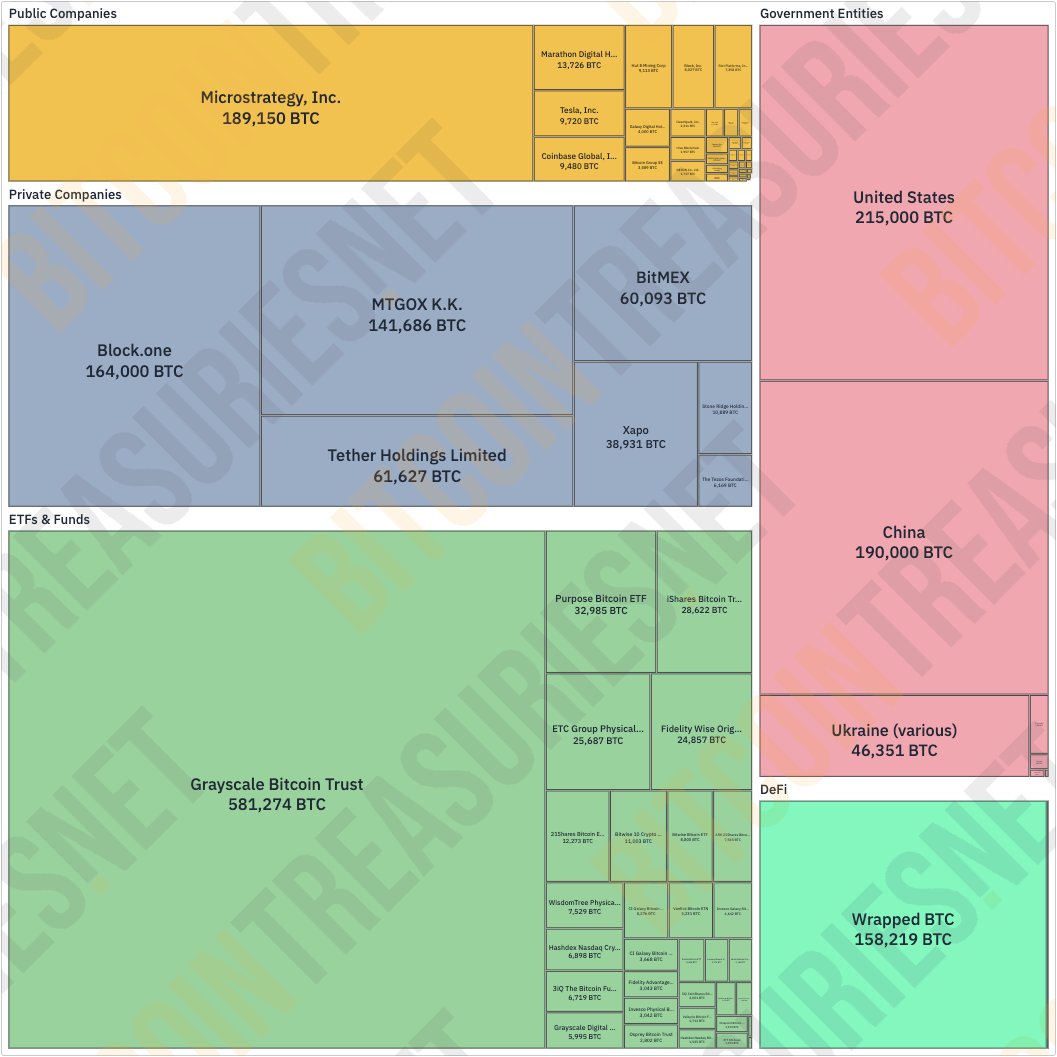
Where is all the #Bitcoin?
Between ETFs, funds, private and public companies, governments and even DeFi🤮, it only comes out to 2,170,327 BTC or ~10.33% of total supply.
The remaining BTC is in the hands of individuals or lost for good. Stay strong, hodlers.💪
Today, demonstrates the unstoppable power of Bitcoin and the inability of the establishment to stop it. They tried to fight it for over a decade and finally capitulated. Bitcoin won. It broke the establishment. The @SECGov lost and proved that it's a failed institution.