Could solar cells simply by removing energy, which otherwise would be converted into heat, reduce the temperature and evaporation enough to turn deserts green?
The law of mass action may be the strangest empirical relation I have encountered. Then seeing it pop out of statistical mechanics as a consequence of how Gibbs’ free energy varies with the partial pressures is really rewarding! https://t.co/VD9wX2wE7n
For buildings that need air conditioning, there should be a double benefit to using solar panels. The generated electricity can be used to power air conditioning, but just capturing the sunlight should help cool the building too. Does anyone know how big the second effect is?
It’s impressive how accurate measurements were possible already two hundred years ago. Regnault’s measurements from the 1840’s were accurate enough to determine the absolute zero to within 0.074 Celcius. Makes me think about the perfectionists
https://t.co/dNheaz2yuO
Somewhere counter intuitive. Fill a cylinder with gas, put it in vacuum, and maintain the pressure through a weight mounted on a piston. If the cylinder is expanded in the directions perpendicular to the piston, the pressure will reduce but the piston will stay in place.
Carnot considered his cycle to be performed in such a way that vaporization and condensation occur at the high and low temperatures, or vice versa, not just expansion and contraction. I find this to be making his arguments a lot easier to understand.
Something that passed me completely during analytical mechanics is its emphasis on finding families of solutions differing only by initial conditions. Treating perturbations as evolutions of initial conditions rather than modifying the solutions. The classical Heisenberg picture.
I was reminded twice during the past year that Newton’s laws do not imply conservation of angular momentum. For that an additional assumption such as the law of the lever or that all forces are (in principle) derivable from a potential function is required.
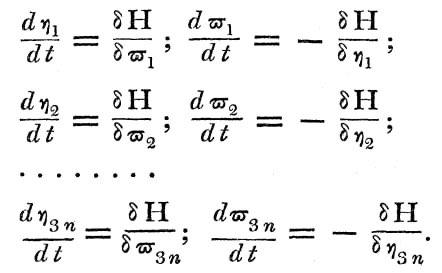
Oh the irony! Although the Hamiltonian plays an important role in Hamiltons work, it seems that he himself saw the action (here V) as the central quantity of his method.
That’s certainly one way to formulate yourself!
It’s also interesting to see how much of the terminology now associated with Einstein was present already here in James C. Maxwell’s “Matter and Motion” from 1877.
Came across some spherical trigonometry while reading Lagrange, of which I was ignorant.
Turns out it’s not commonly taught any longer, but Isaac Todhunter published a beautiful book on the topic in 1859. https://t.co/ta9vGM0fOe
If I came across this anywhere else, I would assume the author didn’t have a clue what they were doing.
However, this is from Lagrange’s Analytical Mechanics and it makes me realize that there are aspects of differential calculus that are never touched upon in modern treatments.
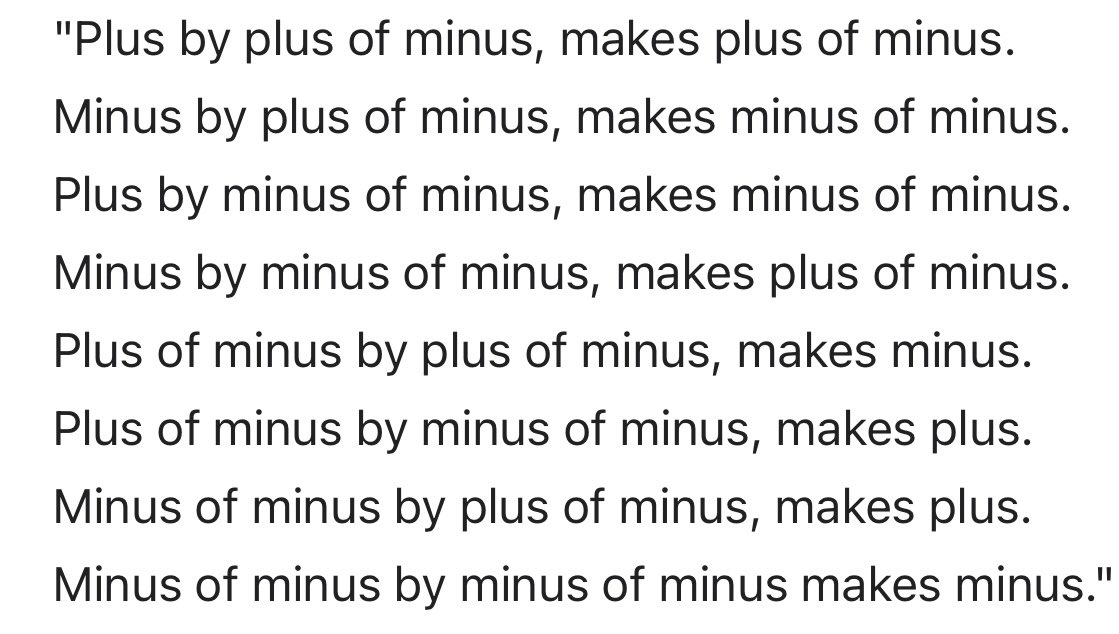
In 1572, Rafael Bombelli published L’Algebra Opera. There he outlined the algebra of complex numbers and used “plus of minus” and “minus of minus” to refer to what is now usually labeled i and -i. https://t.co/ijYERIMwPl