🇸🇻 THIS WEEK IN EL SALVADOR | VOL. 10
$3 billion annually for education.
50,000 scholarships.
$107M in diaspora investment.
Exports above $4 billion.
Tourism revenue above $2.1 billion.
204 homicide-free days.
And a new book examines the security transformation that helped make this next chapter possible.
From security to opportunity — here are the stories shaping El Salvador this week. 👇🇸🇻
#ElSalvador #ThisWeekInElSalvador #Education #Investment #EconomicGrowth
🇸🇻 THIS WEEK IN EL SALVADOR | VOL. 10
August 22–28, 2026 | The Stories Shaping the New El Salvador
This week, one announcement stood above the rest.
El Salvador is preparing to make one of the largest commitments to education in its history.
But look beyond that headline and a larger picture emerges.
Diaspora investment is generating new projects and jobs. Exports have surpassed $4 billion. Tourism revenue continues climbing. The electricity grid is preparing for future demand. New medical technology is entering public healthcare.
And while the country looks toward its next stage of development, a newly released book is examining the security transformation that helped change what was possible in the first place.
This is the week in El Salvador.
🎓 EL SALVADOR MAKES A $3 BILLION BET ON EDUCATION
President @nayibbukele announced that El Salvador plans to allocate more than 8% of GDP — approximately $3 billion annually — to education.
The announcement came alongside another major initiative: 50,000 scholarships for Salvadoran youth, supported over the long term by a $100 million agreement with the Inter-American Development Bank (IDB).
The scholarships are intended to open access to university degrees, technical education and vocational training, while additional virtual opportunities will allow Salvadorans to study through international institutions without having to leave the country.
The message is significant.
After years in which security dominated El Salvador's national transformation, human capital is increasingly becoming part of the country's next major investment.
🌎 SALVADORAN DIASPORA COMMITS $107.1 MILLION TO NEW INVESTMENT
The Salvadoran diaspora is increasingly becoming an investment force at home.
According to Invest's activity report, Salvadorans abroad have committed $107.1 million across 19 investment projects.
Those projects are expected to generate approximately 2,474 jobs.
For a country with one of the world's largest diasporas relative to its population, the development represents something larger than capital inflows.
The traditional relationship between El Salvador and its diaspora has long been defined by remittances.
Increasingly, another word is entering that relationship:
Investment.
📈 EXPORTS SURPASS $4 BILLION
Salvadoran exports reached approximately $4.04 billion between January and July 2026, an increase of 4.4% compared with the same period in 2025, according to Central Reserve Bank figures.
Coexport described July's performance as one of the country's strongest export results of the past decade.
It is another indicator of expanding economic activity as Salvadoran companies compete for markets beyond the country's borders.
🏖️ TOURISM GENERATES MORE THAN $2.1 BILLION
Tourism continues to establish itself as an important source of foreign currency.
El Salvador generated more than $2.1 billion in tourism revenue during the first half of 2026, according to Tourism Ministry statistics.
That represents approximately 10% growth year over year and 58.3% of the government's full-year target.
The numbers reinforce how dramatically the country's international image has changed alongside its security environment.
📊 INDUSTRIAL SECTOR FORECASTS 4.5% ECONOMIC GROWTH
The Salvadoran Association of Industrialists (ASI) is forecasting 4.5% economic growth for El Salvador in 2026, highlighting the economy's current dynamism and predicting that the country could record the highest growth rate in the region.
This is an ASI forecast, rather than an official government projection.
Separately, EMFI forecasts growth of 3.9%, citing momentum in consumption, construction and remittances.
Different forecasts, but both point toward continued economic expansion in 2026.
📖 ZERO CRIME: DOCUMENTING EL SALVADOR'S SECURITY TRANSFORMATION
A new book is putting El Salvador's security transformation into historical perspective.
Cero Crimen (Zero Crime), written by Yossi Abadi and Sharon Gal-Or, examines the country's transformation through statistics, interviews and testimonies from Salvadorans describing what life is like after years of gang insecurity.
Vice President @fulloa51 participated in the book's presentation and described its arrival as timely, arguing that El Salvador is now experiencing an economic takeoff and entering another stage of its economic development.
The significance goes beyond the book itself.
For years, the central question surrounding El Salvador was whether the country could regain control of its territory and dramatically reduce violence.
Today, another question is emerging:
What can El Salvador build with the security it has achieved?
🛡️ 204 HOMICIDE-FREE DAYS IN 2026
The security numbers continued moving this week.
Thursday, August 27 ended with zero homicides nationwide, bringing El Salvador to 204 homicide-free days during 2026.
Security remains one of the foundations underlying the country's tourism, investment and economic strategy.
⚖️ MAJOR MS-13 CASE MOVES TOWARD COURT RULING
Beginning August 31, Salvadoran courts are expected to begin issuing rulings in proceedings involving 485 MS-13 leaders and members.
Among the defendants are 22 members of the so-called Ranfla Histórica, identified by prosecutors as part of the gang's senior leadership.
Prosecutors have brought more than 47,420 criminal counts related to alleged crimes committed between 2012 and 2022.
The proceedings represent another major chapter in El Salvador's continuing judicial campaign against the country's former gang structures.
🏥 NEW ROSALES HOSPITAL PERFORMS FIRST ROBOTIC SURGERY
Technology is also changing Salvadoran healthcare.
The new Rosales Hospital performed its first operation using the Versius robotic surgical system.
The technology allows specialists to conduct less-invasive procedures with greater precision and can contribute to smaller incisions and faster patient recovery.
It is another example of advanced medical technology being incorporated into the country's public healthcare infrastructure.
⚡ EL SALVADOR PREPARES ITS ELECTRICITY GRID FOR 2035
ETESAL presented its electricity transmission expansion plan through 2035, designed to respond to rising power demand while creating additional capacity for future investment.
At the same time, El Salvador and the Kuwait Fund for Arab Economic Development formalized cooperation for a new photovoltaic solar plant in San Matías, La Libertad.
Approximately $9.7 million in financing will support the project, which will eventually connect to the national electricity grid.
Energy capacity matters because economic expansion ultimately requires infrastructure capable of supporting it.
🇸🇻 THE BIGGER PICTURE
Look at the week's stories together:
$3 billion annually planned for education.
50,000 scholarships.
$107.1 million in diaspora investment.
2,474 projected jobs.
$4.04 billion in exports.
$2.1+ billion in tourism revenue.
4.5% growth forecast by ASI.
A power grid expanding toward 2035.
Robotic surgery entering public healthcare.
204 homicide-free days.
These aren't all the same story.
But they increasingly fit within the same national trajectory.
For years, El Salvador's greatest challenge was restoring basic security.
Security created something the country had been missing for decades:
Predictability.
Predictability creates confidence.
Confidence encourages investment.
Investment creates jobs and economic opportunity.
And education prepares the next generation to participate in what comes next.
Perhaps that is why the arrival of Zero Crime is particularly fitting this week.
One story documents how dramatically El Salvador has changed.
Another — a multibillion-dollar commitment to education — asks what the country intends to do with that transformation.
Security changed the present.
Education is a bet on the future. 🇸🇻
El Salvador on X — Explaining El Salvador to the World.
#ElSalvador #ThisWeekInElSalvador #Education #Investment #EconomicGrowth #Security #Tourism #Infrastructure
@nayibbukele Some international headlines call it a dictatorship.
30,000+ young Salvadorans told a very different story. 🇸🇻
No fear. No oppression. Just a generation excited about its future.
🇸🇻 SECURITY & JUSTICE UPDATE — ISSUE NO. 003
El Salvador has recorded 196 homicide-free days in 2026.
So why is the State of Exception still in place?
This week may help explain the government's answer.
🏘️ Police went house to house searching for gang remnants attempting to hide.
🚔 A MS-13 member with a criminal record dating back years was captured in San Salvador.
⚠️ Another gang member was arrested after authorities said he was attempting to reorganize MS-13 and intimidate residents.
🔫 Special Forces were attacked during an operation by individuals armed with firearms. A wanted MS-13 suspect died after being wounded in the confrontation; police personnel were unharmed.
⚖️ 131 MS-13 members were sentenced to as much as 75 years in prison.
⚖️ Another 87 Barrio 18 members were ordered to stand trial—and some defendants remain fugitives.
El Salvador has become extraordinarily safe.
But being safer doesn't necessarily mean the threat has disappeared. It may mean the threat has been suppressed.
Issue No. 003 asks the question:
If El Salvador is already safe, why does the government say the State of Exception is still necessary?
👇 Our Wednesday Security & Justice Update.
#ElSalvador #Security #Justice
🇸🇻 EL SALVADOR ON X
Explaining El Salvador to the World.
SECURITY & JUSTICE UPDATE
Issue No. 003 | August 19, 2026
IF EL SALVADOR IS ALREADY SAFE, WHY IS THE STATE OF EXCEPTION STILL NECESSARY?
El Salvador has recorded 196 homicide-free days in 2026.
According to official figures, the country has accumulated 1,298 homicide-free days since the beginning of the Plan Control Territorial.
The gangs that once controlled neighborhoods, imposed invisible borders, extorted businesses and dictated who could enter or leave entire communities no longer exercise anything resembling their former territorial power.
So an obvious question follows:
Why is the State of Exception still necessary?
Critics have been asking that question for years.
The emergency measure has remained controversial because of concerns surrounding due process, prolonged detention and extraordinary government powers.
Those concerns deserve to be part of the discussion.
But there is another part of the story.
This week, police searched neighborhoods for gang members allegedly hiding among residents.
Authorities arrested a MS-13 member they say was attempting to reorganize the gang and intimidate a community.
A suspected Barrio 18 hitman with a lengthy criminal history was captured at a vehicle checkpoint.
And Special Forces searching for wanted individuals were attacked with gunfire during an operation.
Meanwhile, organized-crime courts continue processing hundreds of defendants—and some alleged gang members remain fugitives.
El Salvador may have won territorial control.
Authorities argue that keeping it is the next battle.
HOUSE BY HOUSE
One image from this week's police operations may explain the government's position better than any speech.
In San Rafael Cedros, Cuscatlán, National Civil Police officers moved through neighborhoods house by house, verifying documentation associated with occupied residences.
The PNC explained the objective bluntly:
The communities had already been cleared, authorities said, and they would not permit gang remnants to hide there.
That operation illustrates how El Salvador's security strategy has evolved.
The massive territorial confrontation with organized gangs that characterized the beginning of the State of Exception has diminished.
What remains is increasingly targeted.
A fugitive.
A suspected gang member hiding in a community.
An individual attempting to intimidate residents.
An old criminal record discovered during a checkpoint.
A structure prosecutors are still trying to bring completely before the courts.
The enemy authorities describe today isn't necessarily an organization openly controlling an entire neighborhood.
It is the remnant attempting not to be found.
"LUNÁTICO": AN ALLEGED ATTEMPT TO REORGANIZE
Police reported another case in Santa Ana.
Authorities arrested Diego Armando Magaña Serrano, 24, alias "Lunático," whom they identify as an MS-13 member.
According to the PNC, Magaña Serrano wasn't simply displaying old gang symbols.
Police said that he was attempting to reorganize the gang and generate fear among residents.
Authorities said he had painted gang-related graffiti in the Jardines de San José neighborhood of Cutumay Camones.
Police also reported finding a notebook containing threatening messages.
He is expected to face proceedings for membership in a terrorist organization.
The significance of the case extends beyond one arrest.
Gang graffiti once served a specific purpose in El Salvador.
It wasn't merely vandalism.
It marked territory.
It communicated control.
It warned residents who controlled the neighborhood.
That makes attempts to restore those symbols particularly sensitive in communities that lived under gang domination for decades.
FROM GANG WALLS TO ART
And that brings us to perhaps the most human story of this week's report.
The same walls that once marked gang territory are being painted again.
But now they're covered with jaguars, flowers, birds and faces.
Urban artists participating in the Pigmen Trip festival have created more than 200 murals around El Salvador.
Artists interviewed by AFP described how different their work once was.
Painting in neighborhoods controlled by gangs required knowing exactly where you were, who controlled the territory and whether entering that neighborhood could put your life at risk.
Some areas were effectively inaccessible.
Today, artists describe entering communities that once had notorious reputations and painting freely.
Festival founder Isaac Sosa summarized the transformation in five words:
"We've won the walls back."
That statement captures something homicide statistics cannot.
Security isn't only about whether someone gets killed.
It is about whether an artist can enter a neighborhood carrying spray paint without wondering which gang controls the street.
It is about whether a family can walk past a wall without seeing the symbol of the criminal organization that dictates their lives.
And it is about replacing symbols of intimidation with expressions of community.
This may be one of the clearest examples of what Salvadorans mean when they talk about reclaiming territory.
BUT THE REMNANTS HAVE NOT COMPLETELY DISAPPEARED
Another incident this week demonstrates why authorities say complacency would be dangerous.
In Santa Isabel Ishuatán, Sonsonate East, Special Forces officers were conducting patrols and verifying information received through public complaints when, according to the National Civil Police, several individuals attacked them with firearms.
Police returned fire.
One MS-13 member was wounded and later died at the hospital.
Authorities identified him as José Manuel Navarro Pérez, alias "Chucha."
According to police, Navarro Pérez had an outstanding judicial arrest warrant for aggravated extortion and aggravated robbery.
No police officers were injured.
This was not an arrest involving an old photograph on a telephone.
It was an armed confrontation involving an individual actively wanted by the justice system.
And it happened in August 2026—more than four years after the State of Exception began.
OLD RECORDS. NEW ARRESTS.
Authorities also arrested Ludwin Ottoniel Quehl, known by the aliases "Only," "Lola" and "Largo."
Police identify him as an MS-13 gunman associated with the Villa Mariona Locos Salvatruchos clique.
When officers checked the government's ONI information system, they reported discovering a criminal history dating back to 2008.
Authorities list allegations or records involving homicide, aggravated homicide, extortion, illicit association, drug trafficking and receiving stolen property.
He will now face proceedings for membership in a terrorist organization.
Another Barrio 18 hitman, Manuel Adán Hernández Barrera, was also captured at a vehicle checkpoint.
Police say Hernández Barrera had attempted to conceal gang tattoos by covering them with other designs.
His reported criminal history includes aggravated homicide, illicit association, threats, injuries and violence against women.
He is expected to be incorporated into a consolidated organized-crime proceeding.
These cases illustrate another challenge:
Some of the individuals being captured today aren't new gang recruits.
Authorities say they are members whose criminal histories stretch back many years.
131 MS-13 MEMBERS SENTENCED
Captures are only one part of the security strategy.
The courts continue processing the structures already dismantled.
This week, 131 members of the MS-13 "Teclas Locos Salvatruchos" structure received prison sentences of up to 75 years.
The defendants were prosecuted for offenses including illicit association, drug trafficking and firearms-related crimes.
The convicted group included leaders, full-fledged gang members, lookouts, observers, support members and collaborators.
According to prosecutors, some members had attempted to leave El Salvador but were later captured and returned to face proceedings.
The convictions illustrate what has become the second major phase of the State of Exception.
First came mass arrests.
Now comes the enormous judicial process of determining criminal responsibility and sentencing defendants across consolidated organized-crime cases.
87 BARRIO 18 MEMBERS HEAD TO TRIAL — SOME REMAIN FUGITIVES
Another case is even more relevant to this week's central question.
The Second Organized Crime Court in San Salvador ordered 87 Barrio 18 members to stand trial.
Prosecutors accuse members of the "Tayni Locos" structure and another group operating around Nejapa of crimes including illicit association, aggravated extortion, illicit trafficking, aggravated theft and conspiracy connected to homicide.
According to prosecutors, the structures terrorized communities through extortion, threats, killings and drug trafficking.
Of the 87 defendants:
72 are currently imprisoned.
The others are classified as fugitives.
That single detail matters.
More than four years after the beginning of the State of Exception, prosecutors are still attempting to bring every alleged member of some criminal structures before the courts.
It is one reason authorities reject the idea that the security operation is finished.
NOT EVERY HOMICIDE IS A GANG HOMICIDE
There is another important distinction.
El Salvador's dramatic dismantling of gang structures does not mean homicide itself has disappeared.
Police arrested Jairo Humberto Alfaro Gutiérrez, 37, after his partner was killed with a bladed weapon following what authorities described as an argument while alcohol was being consumed.
Police said the suspect fled San Salvador and was subsequently captured in Sonsonate.
He is expected to face aggravated-homicide proceedings.
In another case, authorities arrested Oswaldo Alcides Reyes, 28, who was wanted under warrants involving aggravated homicide and attempted homicide.
Police credited an alert generated by the ONI system with helping identify him.
These cases matter because they demonstrate the difference between gang violence and ordinary violent crime.
No security strategy eliminates human violence entirely.
The test increasingly becomes what happens after a homicide occurs.
Is the suspect identified?
Is the suspect captured?
Does the case reach court?
That is a different security challenge from the one El Salvador faced when organized gangs controlled territory and murder could function as an instrument of criminal governance.
THE CORVETTE CASE: FROM SOCIAL-MEDIA ACCUSATION TO COURTROOM EVIDENCE
A story we covered last week has now advanced.
After a fatal collision involving a Chevrolet Corvette in San Salvador's Zona Rosa generated widespread speculation on social media, police identified Francisco Javier García Hernández as the driver.
This week, a court ordered García Hernández to remain in provisional detention.
Prosecutors allege that he had consumed alcohol before driving the Corvette the wrong way at excessive speed and striking a motorcycle delivery worker.
The victim died.
According to the prosecution, video and expert evidence presented to the court included footage of the defendant consuming alcohol before the collision and evidence concerning the vehicle's speed.
The court determined there was sufficient evidence for the case to proceed and ordered provisional detention because of concerns about flight or interference with the investigation.
Last week, this case illustrated the danger of reaching conclusions through social-media speculation.
This week, it illustrates what should happen instead:
Evidence enters a courtroom.
DRUG TRAFFICKING: FROM INTERCEPTION TO DESTRUCTION
The justice process was visible elsewhere this week.
Authorities destroyed 1,362 kilograms of cocaine, valued at approximately $34.24 million.
The shipment had been intercepted by El Salvador's Tridente Naval Task Force approximately 947 nautical miles southwest of the country's coast.
Two Ecuadorian nationals arrested aboard the vessel are facing illicit-trafficking proceedings.
The destruction was carried out under court authorization.
In another operation, police arrested four men during Operation Sweep, seizing approximately 30 kilograms of drugs valued at more than $106,000.
Additional anti-narcotics operations resulted in arrests involving marijuana distribution.
The pattern is becoming familiar:
Detection. Seizure. Prosecution. Destruction.
SECURITY IS ALSO WHAT PEOPLE CAN DO AGAIN
Security statistics tell us how many crimes occurred.
Sometimes ordinary life tells the story better.
Artists painting in neighborhoods they once feared entering.
Children growing up without gang graffiti marking invisible borders.
Businesses operating without someone standing outside demanding extortion.
Residents reporting suspicious activity to police rather than remaining silent out of fear.
These are difficult things to place on a spreadsheet.
But they are among the reasons Salvadorans describe the country's transformation differently from observers who know El Salvador primarily through political debate.
SECURITY BY THE NUMBERS
August 19, 2026
🇸🇻 196 homicide-free days in 2026
🇸🇻 14 homicide-free days during August
🇸🇻 1,298 accumulated homicide-free days since the start of @NayibBukele Plan Control Territorial.
⚖️ 131 MS-13 members sentenced in the Teclas Locos Salvatruchos case
⚖️ Sentences reaching 75 years
⚖️ 87 Barrio 18 members ordered to trial
🚔 72 of those 87 defendants currently incarcerated; others remain fugitives
💊 30 kg of drugs seized during Operation Sweep
🔥 1,362 kg of cocaine destroyed following a previous maritime seizure
💰 Estimated cocaine value: $34.24 million
SO WHY DOES THE STATE OF EXCEPTION CONTINUE?
There is no serious dispute that El Salvador today is dramatically safer than it was before 2019.
The harder question is what comes next.
Critics argue that extraordinary emergency powers should not become permanent and continue raising concerns involving due process, wrongful detention and civil liberties.
Those concerns deserve examination.
The Salvadoran government's argument is different.
Authorities contend that dismantling gang territorial control does not mean every gang member has been captured, every structure completely prosecuted or every attempt at reorganization eliminated.
This week's events provide examples supporting that argument:
Gang remnants allegedly hiding in communities.
Fugitives still missing from organized-crime proceedings.
An alleged attempt to reorganize MS-13.
An armed confrontation involving a wanted gang suspect.
Individuals with criminal histories dating back more than a decade still being captured.
At the same time, courts continue processing hundreds of defendants from structures dismantled during previous operations.
Perhaps the question, then, isn't simply:
"Is El Salvador safe?"
It clearly is much safer.
The more difficult question is:
What happens if the pressure that produced that security is removed before authorities believe the remaining structures have been completely dismantled?
That is ultimately the argument behind the continued State of Exception.
Whether one agrees with that policy or not, understanding the debate requires understanding both sides of the equation:
The extraordinary powers being used.
And the criminal remnants authorities say they are still finding.
El Salvador has reclaimed its neighborhoods.
It has reclaimed its parks.
Artists have even reclaimed the walls.
The government's position is that it intends to make sure the gangs never reclaim them again.
EL SALVADOR ON X
Explaining El Salvador to the World.
SECURITY & JUSTICE UPDATE — ISSUE NO. 003
Next Issue: Wednesday, August 26, 2026
🇸🇻 Introducing our new weekly series.
Every Wednesday, El Salvador on X will publish Security & Justice Update—a weekly report covering the latest developments from El Salvador's courts, law enforcement, and anti-narcotics operations.
While headlines often focus on politics, this series will focus on measurable outcomes: convictions, investigations, dismantled criminal networks, homicide trends, and the ongoing work of the justice system.
Issue No. 001 includes:
⚖️ Major gang convictions with sentences of up to 1,048 years.
📉 A national homicide average of 0.17 per day.
🚔 15.6 metric tons of drugs seized in 2026, valued at $388.3 million.
📊 The latest Security by the Numbers, including 184 homicide-free days in 2026 and 1,286 accumulated homicide-free days since the launch of the Plan Control Territorial.
Our goal is simple:
To explain El Salvador through facts, context, and verified results.
Welcome to Security & Justice Update.
🇸🇻 Issue No. 001 is now available.
#ElSalvador 🇸🇻 #Security #Bukele
🇸🇻 EL SALVADOR ON X
Explaining El Salvador to the World.
SECURITY & JUSTICE UPDATE
Issue No. 001 | August 5, 2026
While much of the international media continues to debate El Salvador's security policies, another story continues to unfold every week inside the country's courts, police investigations, and anti-narcotics operations.
It is a story measured not by headlines, but by convictions, dismantled criminal networks, solved homicide cases, and communities that continue moving further away from the violence that once defined daily life.
This is the first edition of Security & Justice Update, a weekly report highlighting the latest developments inside El Salvador's justice system.
Justice Continues Inside the Courts
Courts across El Salvador continue handing down significant prison sentences against members of MS-13, Barrio 18, and organized criminal networks.
This week alone, 53 MS-13 members operating in the departments of Usulután and San Miguel were convicted for crimes including aggravated homicide, illicit association, and terrorism-related offenses. Several received sentences ranging from 44 to 60 years in prison, while others were convicted for the 2014 murder of a public transportation fare collector who was killed as part of an extortion campaign against bus operators.
In western El Salvador, 32 members of the MS-13 "Cobras Locos Salvatruchos" clique were sentenced to prison terms ranging from 35 to 324 years after being convicted of multiple aggravated homicides, conspiracy to commit murder, and illicit association. Among the victims were the brother of a National Civil Police officer and a member of the Salvadoran Naval Force.
Two additional MS-13 members were sentenced to 85 years in prison for the 2015 murder of National Civil Police Officer Nelson Panameño and the attempted murder of another officer during an armed ambush in Usulután.
Meanwhile, another criminal organization known as "El Gremio" received some of the longest sentences issued this year. Thirty-eight members involved in cocaine trafficking, money laundering, and organized crime were convicted, with the principal leaders receiving prison terms of up to 1,048 years after being found responsible for dozens of criminal offenses accumulated over multiple cases.
These rulings are part of a broader judicial process that continues across the country. Between December 2025 and June 2026, specialized Organized Crime Courts have already convicted members from 59 different MS-13 and Barrio 18 criminal structures, including more than 100 gang leaders, while thousands of additional cases continue moving through the courts under El Salvador's organized crime reforms.
Homicides Remain at Historic Lows
Between January 1 and August 3, authorities recorded 37 homicides nationwide, representing an average of just 0.17 homicides per day.
Security officials report that most of these cases were solved through the rapid identification and arrest of the alleged perpetrators under the National Civil Police's Homicide Resolution Protocol (PRHO), a coordinated response that mobilizes multiple specialized investigative units immediately after a homicide is reported.
According to authorities, this rapid-response system has significantly improved homicide investigations while ensuring suspects are brought before the courts quickly.
The latest figures continue one of the lowest homicide trends recorded in modern Salvadoran history.
Drug Trafficking Networks Continue to Be Dismantled
Security operations also continued targeting organized narcotics trafficking.
Authorities dismantled a drug distribution network operating in La Libertad that allegedly trafficked cocaine, marijuana, and methamphetamine throughout several municipalities. Prosecutors also announced possible money laundering charges after investigators identified financial transfers linked to the organization.
Meanwhile, El Salvador's Naval Force recently intercepted 1.36 tons of cocaine approximately 947 nautical miles southwest of the country's Pacific coast. Authorities estimate the shipment was worth approximately $34 million and represented more than four million individual doses removed from international drug markets.
With this latest seizure, El Salvador has confiscated 15.6 metric tons of narcotics in 2026, valued at approximately $388.3 million.
Since June 2019, Salvadoran authorities have seized 90.1 metric tons of drugs, representing an estimated street value of more than $2.1 billion.
Officials also emphasized that international traffickers captured in Salvadoran waters continue to face prosecution inside El Salvador's justice system.
Preventing Criminal Regrouping
Authorities also continued taking action against attempts to revive gang activity at the local level.
Police arrested individuals accused of displaying gang hand signs associated with the 18th Street gang on social media after residents alerted authorities.
In a separate operation, three juveniles were detained after surveillance cameras recorded them painting MS-13 graffiti in San Juan Opico. Police stated that the graffiti was immediately removed and reaffirmed that authorities will not allow criminal organizations to reestablish territorial control or intimidate local communities.
Under El Salvador's legal framework, prosecutors continue bringing charges of illicit association and participation in terrorist organizations against individuals believed to be actively supporting gang structures.
Security by the Numbers
August 5, 2026
✅ 184 homicide-free days recorded in 2026.
✅ 1,286 cumulative homicide-free days since the launch of the Plan Control Territorial.
⚖️ 37 homicides recorded nationwide between January 1 and August 3.
📉 National homicide average: 0.17 per day.
⚖️ More than 100 gang leaders convicted in organized crime courts since December 2025.
⚖️ Members from 59 gang structures already convicted through organized crime proceedings.
🚔 15.6 metric tons of drugs seized during 2026.
💰 Estimated value of narcotics confiscated this year: $388.3 million.
🚢 90.1 metric tons of drugs confiscated since June 2019.
Why It Matters
For many years, El Salvador's justice system struggled against criminal organizations that exercised territorial control, extorted businesses, restricted freedom of movement, and carried out thousands of acts of violence.
Today, the country's security story extends far beyond arrests. It is increasingly reflected in criminal investigations completed, convictions secured, organized crime networks dismantled, and long prison sentences imposed through the courts.
These proceedings rarely receive the same international attention as political debates.
Yet week after week, they continue shaping a different reality for the millions of Salvadorans who now live in communities once dominated by organized crime.
This is Security & Justice Update.
We'll be back next Wednesday.
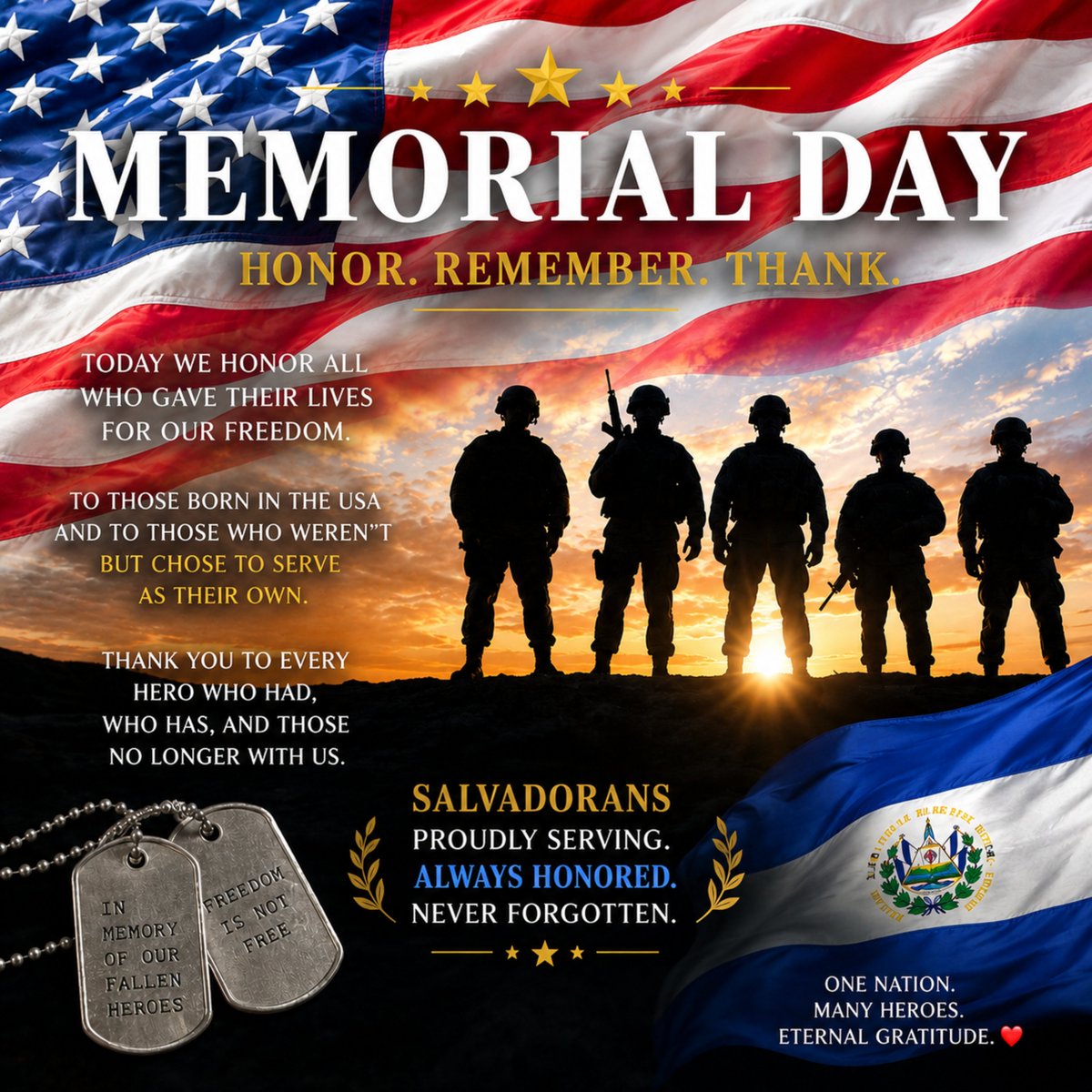
Memorial Day: A Nation Built by the Brave
Today, on the American Memorial Day, we honor the heroes who gave everything for freedom. Men and women who wore the uniform with pride, defended a flag with courage, and made the ultimate sacrifice so future generations could live in peace.
But this day is also for those who were not born on American soil… yet chose to serve this nation as if it were their own.
Among them are hundreds of Salvadorans.
From the streets of El Salvador to neighborhoods across the United States, Salvadorans have answered the call of duty with honor, loyalty, and courage. Many arrived seeking opportunity. Many came escaping war, violence, or poverty. But when America called, they stood up and defended the country that opened its doors to them and their families.
Some returned home wearing medals.
Others returned wrapped in the American flag.
And some never returned at all.
Today, we remember every fallen hero — American-born and foreign-born alike — because bravery has no accent, no color, and no border.
The Salvadoran community has proudly served in every branch of the U.S. military, proving that patriotism is not defined by where you were born, but by what you are willing to sacrifice for others.
This Memorial Day is not just about mourning the fallen.
It is about honoring their legacy.
A legacy of courage.
A legacy of freedom.
A legacy carried by generations who believed that something greater than themselves was worth fighting for.
To every hero no longer with us:
Thank you.
America remembers you.
El Salvador honors you.
And history will never forget you. 🇸🇻🫡
#MemorialDay 🇺🇸 #FreedomIsNotFree #UnitedBySacrifice #SalvadoransInUSA 🇸🇻🇺🇸 #NeverForgotten
@USArmy @DeptofDefense @NayibBukele@SaraCarterDC 🇺🇸🇸🇻
@TranslatingES Una oportunidad que el presidente @nayibbukele nos ofrece: cerrar el círculo, traer con nosotros a nuestros hijos y a los hijos de ellos; a todos aquellos que nacieron lejos por un mero giro del destino. Es una oportunidad para reconectar con nuestras raíces.