Twenty five years ago today, six firefighters slowed down for the slowest person in the stairwell, and that is the only reason any of them are alive.
Josephine Harris was 59 years old. A widow and a grandmother from Brooklyn. A bookkeeper for the Port Authority who worked on the 73rd floor of the North Tower.
When the building was hit she started walking down. She was still recovering from an accident and her legs were bad, and she was descending a smoke filled stairwell with thousands of other people. She made it more than fifty floors on her own, which is an achievement most people reading this could not manage on a good day.
Somewhere around the 20th floor she stopped. She could not go any further. She was exhausted and crying and people were flowing past her.
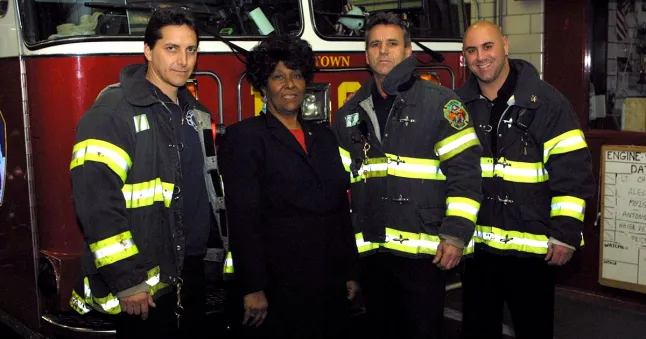
Captain Jay Jonas and Ladder Company 6 were going the other way. They had climbed to the 27th floor when the South Tower came down at 9:59, and Jonas understood immediately what that meant for the building they were standing in. He turned his men around and started them down.
Then they found Josephine Harris.
They could have gone past her. They had every operational justification. The building they were in was going to fall and they knew it, they had their own men to get out, and she could barely stand.
Instead Bill Butler put her arm over his shoulders and they went down at her pace. Step. Rest. Step. Rest. Six firefighters in full gear, descending a skyscraper they expected to lose, at the speed of a 59 year old woman with bad legs.
They got to the fourth floor and she stopped completely. She could not take another step. They were still trying to move her when the North Tower came down at 10:28 in the morning.
One hundred and ten stories collapsed on top of them.
And a short section of Stairwell B, right there in the core, between roughly the second and fourth floors, did not collapse. It held. Fourteen people inside it lived. Jonas and his men, Chief Richard Picciotto, Port Authority officer David Lim, firefighters from other companies, and Josephine Harris.
They were buried, in the dark, listening to the building settle. Bill Butler got a call out to his wife to tell her where they were. After a while the dust began to drift and clear, and sunlight came down through the stairwell from above, which is how they finally understood that there was no longer any building over their heads.
They were pulled out hours later.
Here is the arithmetic those men have lived with ever since. Ladder 6 was moving fast. If they had not stopped for Josephine Harris, they would have been in the lobby or out on the street when the tower came down, and the lobby and the street were killing fields. Her exhaustion held them in the exact place, at the exact minute, where the building chose not to fall.
They had a jacket made for her. It said Josephine, Our Guardian Angel, with the Ladder 6 patch. It is in the 9/11 Museum now.
She stayed close with those men for the rest of her life. When she died in 2011, the firefighters of Ladder 6 carried her casket.
Three hundred and forty three firefighters died that day running toward people they had never met. Six of them lived because they refused to leave one woman behind, and she saved them right back.
On September 11, a police officer looked into the eyes of his dog, closed the kennel door, and made a promise.
"You stay here. I'll come back and get you."
He came back four months later. His dog had waited.
His name was Officer David Lim of the Port Authority Police. His partner was a five-year-old yellow Labrador named Sirius. Badge number 17.
Sirius was an explosives detection dog. He and Lim worked the World Trade Center together. Their job was to sniff every truck that came into the loading docks under the towers. If somebody tried to bring in a bomb, they were the ones who would find it.
Sirius did not sleep at a kennel at night. He went home with Lim. Lim's kids, twelve and fourteen, played with him. He slept in the living room. When the shift ended, he was not a working dog. He was the family dog.
On the morning of September 11, Lim and Sirius were in their office in the basement of the South Tower when the building shook.
Lim heard the radio call. An explosion up in the North Tower.
His first thought, he said later, was that he had failed. That he and Sirius had missed something. That a bomb had gotten past them.
He decided he could move faster up the stairs without the dog. He turned to Sirius and said what he always said when he had to step away for a minute.
"You stay here. I'll come back and get you."
He closed the kennel door and ran.
He got up to the 44th floor of the North Tower. He was pushing people down the stairs. Making them move.
At 9:59 the South Tower fell. Sirius was in it.
Lim did not know that yet. There was too much smoke, too much noise. He kept moving people.
At 10:28 the North Tower fell on top of him.
He was buried in Stairwell B. He is one of only sixteen people who were inside the tower when it came down and lived. He and the firefighters of Ladder 6 and a bookkeeper named Josephine Harris, all in the same pocket of surviving concrete.
He was trapped for five hours in the dark. Under a hundred stories. Choking on dust. And the whole time, he said later, he was thinking about the dog.
They dug him out. He came up into the daylight cut, bleeding, his uniform destroyed.
The first thing he said was, take me to the basement. My dog is down there.
They put him in an ambulance instead. He had broken bones. He was not walking anywhere.
He tried the next morning. He tried to get onto the pile. They stopped him. There was no basement anymore. There was no floor. There were sixteen acres of steel and fire.
He waited.
For four months.
On January 22, 2002, workers digging in what had been the South Tower's basement found a kennel.
Sirius was still inside it. He had been killed instantly when the tower came down. He had never left the spot where his officer told him to stay.
They radioed Lim. He was there within the hour.
Then something happened that had never happened for a dog on that site.
Everything stopped.
Every crane. Every backhoe. Every torch. All the terrible machines of Ground Zero went silent.
Hundreds of workers, men who had lost their own friends in those buildings, formed two lines along the ramp that led out of the pit. They took off their hard hats.
Four Port Authority officers carried a stretcher up the ramp. Sirius was on it, draped in an American flag. The same honor given to a fallen officer.
They walked him past the lines of silent men, all the way to the top, to a waiting truck.
Lim walked behind his dog.
He said it afterward, plainly.
"I fulfilled my promise to him. I came back. And I took him home."
That April, more than a hundred police dogs and their handlers came from across the country to a memorial in New Jersey. Bagpipes. A 21-gun salute. The flag that had covered Sirius was folded into a triangle and presented to Lim.
Then they brought out one more thing. Sirius's metal water bowl, dented, recovered from the rubble.
They handed it to Lim, and he broke down in front of all of them.
Lim served thirteen more years. He retired in 2014 after 34 years on the force. His last assignment was the K-9 unit at LaGuardia Airport. With another dog.
A dog run in Battery Park City has Sirius's name on it.
A dog trusts you completely. That is the entire arrangement.
Sirius was told to wait. He waited.
David Lim was buried alive under the North Tower, and what he was thinking about was a dog in a kennel two buildings away.
Some promises take four months.
He kept it. 🇺🇸
The rubble at the scene of the World Trade Center collapse is filled with the sounds of “PASS devices,” or emergency signals attached to firefighters when they are no longer moving.
The scale of overlapping PASS alarms bespeaks the horrible death toll that must have taken place here.
Yet worse - the alarms can’t be stopped because the bodies haven’t been found.
At Ground Zero, after the last living person was pulled out, the search dogs stopped eating.
So the police did something nobody had written down in any manual.
They climbed into the rubble, lay down, and pretended to be alive.
More than 300 dogs worked the World Trade Center site. They came from every corner of the country, on trucks and in cargo holds, with handlers who had been trained to do one thing. Find people who are still breathing under the ground.
That is what a search and rescue dog is built for. Not bodies. Life. They are trained on live human scent. When they find it, they bark, they dig, they light up, and the handler rewards them, and the whole thing means something.
The last living person recovered from Ground Zero was a woman named Genelle Guzman-McMillan. She had been buried for 27 hours. A dog found her.
She was the last.
After that, the dogs kept going out on twelve-hour shifts, across sixteen acres of smoldering steel, at temperatures that burned their paws, and they found nobody.
Nobody.
Day after day.
The handlers noticed it first. The dogs were changing. Their tails were down. They were not eating. They would come off the pile and lie flat and not look at anyone.
A veterinarian named Cindy Otto, who spent ten days there working night shifts to care for the animals, put it plainly. The dogs had been sent to find life, and every day they were finding the opposite.
It was breaking them.
An NYPD officer named Famiglietti described what happened next.
They pulled everybody off the rubble. Then they asked for volunteers.
The volunteers, police officers, went out into the debris and hid themselves. Under beams. In voids. Curled up in pockets of concrete. They were told to lie down like they were hurt. Then the handlers sent the dogs in.
Picture that.
A grown man with a badge, a man who had spent the last week pulling friends out of that same pile, lying down in it on purpose. Face down. Holding still. Waiting for a dog.
And the dog comes over the top of the wreckage, and catches the scent, and barks, and digs, and finds a person who is warm and moving and alive.
And the handler says good girl, good boy, and the whole team celebrates.
They called them mock finds.
They did it for the dogs.
They did it so the dogs would remember what they were for.
One of those dogs was a two-year-old golden retriever named Bretagne. She came from Texas with her handler, Denise Corliss. It was her first deployment. They worked ten days at Ground Zero. They found no survivors.
But firefighters would come off the pile, stone-faced, not speaking, and see the dog, and something would break open in them. They would kneel down. They would put their face in her fur.
One day a man walked up to Bretagne and started petting her. He told Corliss his best friend loved golden retrievers.
Corliss asked where his friend was.
The man pointed at the pile.
"He's in there somewhere."
He kept petting the dog.
Bretagne went on to work Hurricane Katrina and Rita. She retired at 10. She was the last known surviving search dog of 9/11.
On June 6, 2016, at age 16, she was carried into a veterinary office in Texas to be put to sleep.
Outside, a dozen firefighters from her fire department stood in a line in their dress uniforms, in the heat, and saluted as she went past.
They draped her in an American flag on the way out.
Three hundred dogs went into that pile looking for the living.
They found one.
And when they could not find any more, the men they worked beside laid down in the rubble and let themselves be found, so the dogs would not lose heart.
That is the whole story of Ground Zero, really.
Nobody could save the dead.
So they saved each other. 🇺🇸
飼育員の鹿野さんは、ご飯を配る前からパンチくんの異変に気づいていたのかもしれません。不安でパニックになるパンチくんと、彼を優しく見守る鹿野さん。二人の深い絆に胸が熱くなります。🥺💔
It seems Shikano-san knew something was wrong even before feeding time. Watching Punch-kun panic from fear while Shikano-san quietly looks out for him really shows the deep bond they share. Truly heartbreaking yet heartwarming 🥺💔
#パンチくん #がんばれパンチ #今日のパンチ #市川市動植物園 #punch #HangInTherePunch