The traffic you prayed for shows up — and it's the same traffic taking you down. Your audit passed. Your dashboard reads green. Your users are stuck on a loading screen, asking if it's down.
None of it touched your code. It broke on the layers underneath — the capacity, the keys, the AI bill, the infrastructure nobody checks until it's the reason you're offline.
That's the layer we hold up. 30+ Tbps of attack traffic absorbed before it reaches a user. AI costs metered so a spike scales instead of eating your margin. Keys and infrastructure hardened before anyone finds out they were exposed.
200+ teams trust us with the launch they can't afford to get wrong.
SecureAI — cloud, AI, and security for onchain and AI teams.
#Cloud #AIagent #AI #Security
Paying for AI is still built around a credit card and a monthly bill. If your treasury lives onchain — or the thing doing the spending is an agent with a wallet, not a person with a card — you're stuck improvising.
We built SecureAI's token service so both lanes just work: sign in with a wallet signature or a Google account, top up by card, WeChat Pay, Alipay, or straight from a chain, with blockchain settlement underneath. One credit balance covers the whole lineup — the GPT-5 family up to 5.5, Claude from Haiku 4.5 through Opus 4.8 and Fable 5.
Switching models shouldn't mean switching payment stacks. With us it doesn't.
Cloudflare's CEO said the crossover already happened: bots now drive more internet traffic than humans. Their own forecast put it at the end of 2027. It arrived eighteen months early — and his five-year bet is machine traffic passing 1,000× human.
The mechanics are simple. You shop for a camera, you check five sites. Your agent checks five thousand. Same task, a thousand times the requests, and your infrastructure serves every one of them.
But the sharpest line in that interview wasn't about traffic. It was about security: AI is now good enough at finding vulnerabilities that he expects a Log4j-class bug every week for the next two years. So the math changes twice at once — far more machines knocking on your systems, and far more holes for the hostile ones to find.
Your defenses were sized for human traffic. Humans are now the minority of what knocks. And the uncomfortable part: a good agent and a bad bot make the same request — telling them apart at the door is becoming the core competency of running anything online. More machines means more security. There's no version of this where it means less.
The ratio is the story. Contract bugs led the count — 85 incidents — but twenty bridge exploits took $346M, over a third of all losses, with Kelp DAO alone at $292M. That's roughly $4M per DeFi incident against $17M per bridge incident. And incidents rose 50% while total losses fell 60%: the industry is learning to cap what a bad contract can lose. It hasn't capped what a bridge or a compromised key can lose. The frequent failures live in code. The catastrophic ones live in infrastructure.
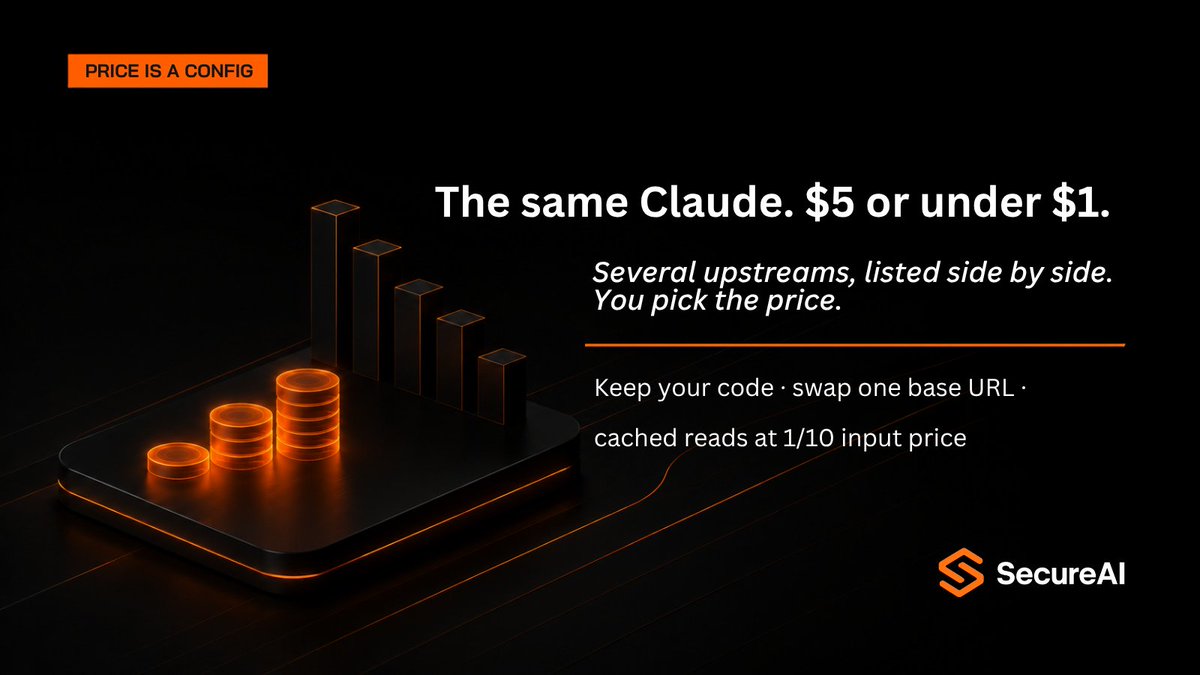
The same Claude model can cost $5 per million tokens from one upstream and under $1 from another. Most teams never find out, because they're wired to whichever provider they signed up with first.
We put those listings side by side — same model, several upstreams, real prices — GPT-5.4, Claude Opus through 4.8, the new Gemini 3.1 previews. Everything speaks OpenAI's format: keep your existing code, point it at the SecureAI endpoint, done. Cached reads bill at a tenth of input price, which quietly matters once an app has real traffic.
You shouldn't have to change your code to change your price.
"Great for memes" is the quote. The bigger story: a broker with tens of millions of funded accounts just became an execution layer. Chains used to earn users wallet by wallet — this one ships with its users preinstalled. Which moves the hard problem from marketing to infrastructure: retail shows up in market-open bursts, not steady streams, and the chains that died under their own launch traffic never got a second look. Memes get people in the door. What's underneath decides whether they stay.
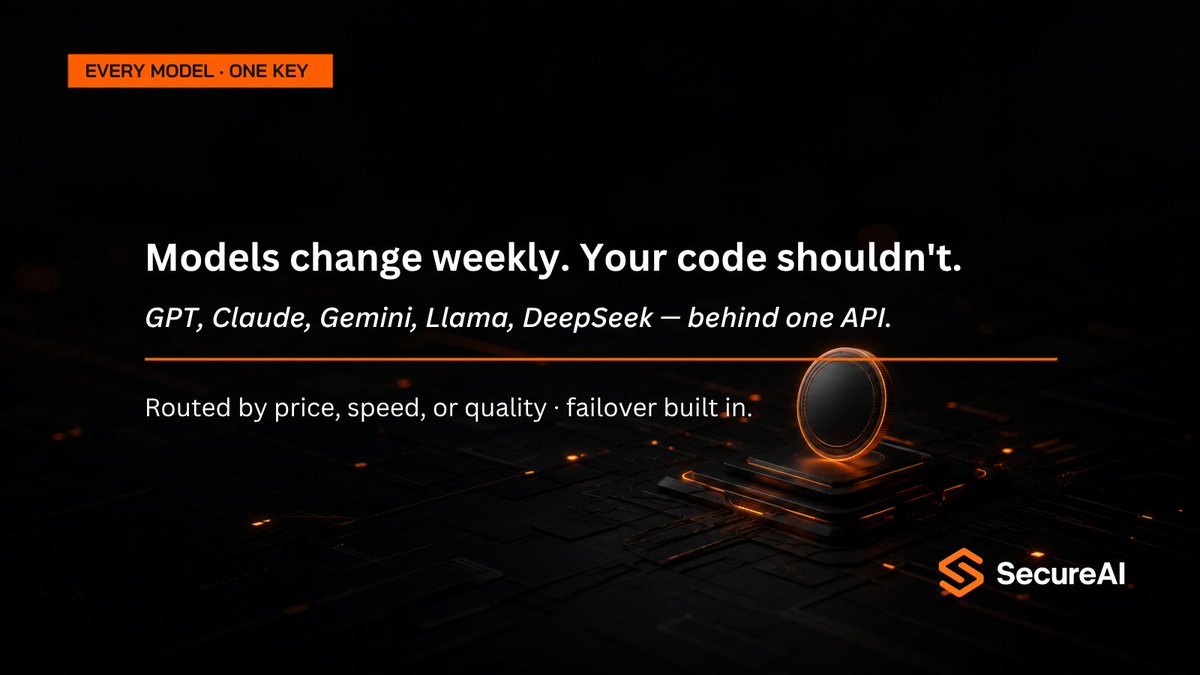
Six months ago you picked a model provider and wired your app to its SDK. Now a different model tops the benchmarks, costs have doubled, and the migration is three sprints nobody has.
That's the problem our endpoint was built around. One OpenAI-compatible API, one key — and behind it GPT, Claude, Gemini, Llama, DeepSeek, routed by price, speed, or quality, your call. When a provider has a bad hour, the request falls over to the next one and your user never notices.
With SecureAI, switching models is a config change. The next time the leaderboard flips, it costs you an afternoon, not a quarter.
Honestly, it's the stuff nobody thinks about until it's the only thing still working. Anycast reroutes you around a dead node before you feel it. DNS keeps resolving while a region is down. And a failover fires somewhere with no human awake to approve it. Real resilience almost never looks like one impressive system — it's a pile of boring parts that hand off before anyone sees the seam. Good question, @Cloudflare.
The detail that stings: the vault that got drained was the "Lower Risk" one. But the attack didn't come from inside it — it came through what it composes with. A $65M flash loan from Morpho, Curve pools bent out of shape, and the vault pricing off manipulated numbers. Three protocols chained into one exploit. "Low risk" described the strategy, not the composability underneath it. The code you audit is never the whole attack surface when your yield depends on three other systems you don't control.
Right problem to be pointing at. Proving who stands behind an agent is step one — the harder half is what that identity is allowed to do once it's verified. An agent can have a perfect, attributable identity and still drain a wallet if nothing scopes what it can sign, spend, or call. Identity answers "who." You still need policy for "how much" and "what," plus a way to revoke it mid-action when the agent goes off-script. Accountable and controlled are two different problems, and autonomy needs both.
$820K out of Hinkal, and the money was gone before the alert even cooled — 410 ETH through Tornado, the rest bridged ETH→BTC on Thorchain in the same window. The exploit gets the headline, but the cross-chain exit is the real problem: by the time a team confirms the breach, the funds are on another chain and unfreezable. Detection speed is the only thing that competes with laundering speed now. Post-mortem forensics won't bring it back.
This is what teams actually ran through us this week.
Gemini 3 Pro led at 156.7B tokens. Claude Opus 4.7 was right behind at 114.1B — and the fastest of the three at 2.6s. GPT-5.2 Thinking took 39.7B.
The number that matters isn't the ranking. It's how fast it moves: Gemini down 14% week over week, GPT-5.2 down 25%, Claude flat. The "best model" is a moving target, and it moves weekly.
If your app is wired straight into one provider's SDK, every one of those swings is a migration. Through one SecureAI endpoint, it's a config change — route to the model winning this week on price, latency, or quality, without touching your code.
One endpoint. Every model. Follow the best one, not the first one you integrated.
x402 finally giving 402 a job is the right rail — paying per call in stablecoin beats API keys and monthly invoices for anything an agent drives. The half that's still open is control. Once an agent can pay per call on its own, spend becomes a runtime problem: one loop, one bad tool, and it burns a month of budget before anyone looks. Programmatic payment needs programmatic limits next to it — per-agent caps, and a stop before the money's gone, not a receipt after. Pay-per-call is solved. Spend-per-agent is the part that decides if this is safe to turn on.
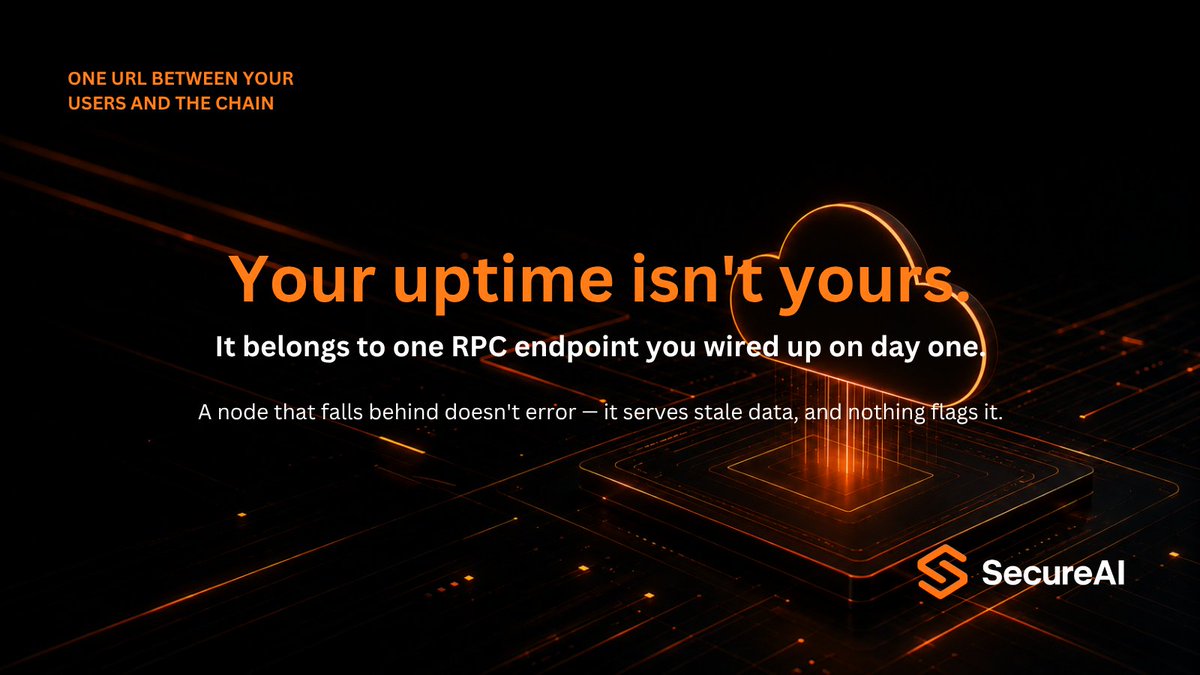
The chain almost never goes down. Your users still hit "network error" — because they never touch the chain directly. They reach one RPC endpoint you wired up on day one, and everything rides on it having a good day.
Rate-limit that endpoint and every user behind it stalls at the same second. Worse: when the node falls behind the chain head, it doesn't throw an error. It answers — with stale balances, old prices, a transaction that already settled. Down trips your alerts. Degraded just lies, and nothing on your side flags it.
Most teams inherit this the moment they paste in a provider URL, and never look at it again. One dependency. No failover. No second opinion.
We run the RPC and node layer for onchain and AI teams — several providers behind a single endpoint, health-checked and failed over automatically. So one provider's bad hour never becomes your users' bad hour.
#Cloud
Controlled scaling handles the growth you can see coming. The load that breaks launch day is the spike you don't schedule — a listing, a viral clip, a bot swarm all hitting one endpoint in the same minute. You can't slow-scale through traffic you didn't plan for. That's why capacity and edge protection get sized for the spike, not the average.
The headline is $81.7M. The lesson is the category breakdown: wallet compromise is the top loss driver and phishing alone is $12.7M. Most of June's money didn't leave through a contract bug — it left through stolen keys and someone clicking the wrong thing. The code keeps getting audited. The credentials around it don't.
Your AI costs used to land once a month, on an invoice. Now an agent does the spending — it calls a tool, pulls data, pays another API — and it doesn't wait for the invoice to tell you.
One agent stuck in a loop can run through a month of budget overnight. You find out when the bill lands, or when the provider cuts you off in the middle of a launch. Run a fleet of them and the spend moves faster than anyone can keep an eye on.
Most teams give an agent the power to act and never give it a budget. That's the gap. We show you what every agent is spending while it spends it, cap each one, and stop it before the money's gone — not after.
A runaway agent should cost you that agent's budget, not the quarter's.
#AI #AIagent
Good guardrail to start with — most agent mistakes on AWS trace back to stale or guessed knowledge. The next one, as coding agents move from suggesting to running things: authority. What an agent is allowed to touch in a live account, and with what spend and blast-radius limits. Up-to-date docs keep it correct. Scoped permissions keep a wrong call from becoming an expensive one.
The brutal detail: it runs at npm install, before your code ever executes. A clean codebase and a passing audit mean nothing — the credentials walk out during the build. And it's not just npm tokens; it's the AWS, GCP, Azure, and CI keys a build machine holds. Supply chain is the one attack surface you inherit instead of write. Rotate everything the build can see, not just what looks compromised.
The machine-to-machine web is arriving faster than its security model. When the users are agents, not people, the question stops being "who logged in" and becomes "which machine is allowed to act, and with what limits." Most agents today run on a stealable API key and a prayer. Identity and policy — not bigger models — are what make an autonomous internet safe to switch on. Glad to be building that security layer alongside @Cloudflare.
What happens when the Internet is no longer mostly used by humans, but by bots, AI agents, and machines?
Cloudflare co-founder and CEO Matthew Prince joins Matt Turck on The MAD Podcast to break down the shift to a machine-to-machine web.
Watch the full conversation: https://t.co/VbqkEg89FI