We just shipped Regression Guard for SeekSpeed Terminal.
What that means: pin a baseline, schedule recurring runs, and get alerted the moment latency drifts — before your users notice.
No more "deploy and pray." Now you know if that new prompt template or model version actually made things slower.
Built with DeepSeek. Tested against DSpark. Coming for every LLM stack next.
https://t.co/V1l94FCI2F
The next three updates to SeekSpeed Terminal are going to change how teams ship AI agents.
We're bringing load & soak testing, public shareable reports, and a golden-dataset correctness harness — so you can prove speed and accuracy before every deploy.
No more "works on my machine."
Built with DeepSeek. Battle-tested against DSpark.
→ https://t.co/zmUu1VAUis
GM
We finally wrote down exactly how we benchmark DeepSpec/DSpark:
The 3 vLLM /metrics counters that actually matter
Acceptance rate breakeven math (not marketing curves)
How to read Welch's t-test output
Reproduce the numbers. Don't trust the README.
→ https://t.co/oKQtDmd9mX
$SST
A performance terminal for AI agents. It focuses on benchmarking latency (TTFB, total time), identifying bottlenecks (prompts, tool calls, model backends, etc.) and optimizing real agent workflows with features like prompt slimming, model routing, parallel tool calls, semantic cache, and Spec Lab for speculative decoding on self-hosted models.
It focuses on real, measurable wins instead of marketing claims like “80% faster.”
Many developers like this ��no cope” approach
It tells you when something (like speculative decoding) actually works or just wastes GPU.
NFA !
3pcyHwoo61bQCfjRZpZugXNu1XB8A7KMEWPyiHsqpump
We used DeepSeek-V4-Pro as the target model and DeepSpec-Draft-V3 as the speculative decoder. Then we wired vLLM's /metrics endpoint directly into our benchmark rig: live counters for spec_decode_num_accepted_tokens, spec_decode_num_draft_tokens, and emitted tokens per step.
No marketing slides. Just distributions. We run Welch's t-test on every A/B comparison — baseline vs speculative — and measure TTFT (time-to-first-token) separately from decode throughput because spec decoding only accelerates one of those.
The Bottleneck Panel scores four failure modes: draft overhead, prefill share, batch pressure, and the actual acceptance rate (α). If α drops below 0.4, the breakeven curve drops under 1× and you're literally slower than running vanilla vLLM.
We built the whole terminal on TanStack Start + Postgres, probe vLLM/TGI/llama.cpp adapters at runtime, and export JSON/CSV/HTML reports. DeepSeek models power the stack — but the numbers expose when DSpark (or any speculative setup) is actually worth the GPU cost.
If your AI agent is "too slow," don't guess. Measure. Spec decoding isn't free — draft models burn compute. Know your acceptance rate before you believe the README.
Built with DeepSeek. Benchmarked with DeepSpec. No cope.
New in SeekSpeed: DSpark / DeepSpec is now a first-class connector.Plug in your target + baseline vLLM, pick the adapter, set num_speculative_tokens — Test probes vllm:spec_decode_* for live acceptance + tokens/step. Spec Lab imports it in one click.
No more guessing if DSpark is actually helping.
https://t.co/GM00LlqBMK
This is exactly why we built SeekSpeed Terminal.
Marketing says 60–85% faster. Our Spec Lab says: prove it on your own endpoint.
We probe DSpark deployments, pull real acceptance rates + tokens-per-step from vLLM metrics, and run the same prompt against both speculative and vanilla baselines. No hand-waving. Just Welch's t-test on actual latency distributions.
The scheduler trimming low-confidence drafts before verification is the smart bit — but it only wins when (a) your draft/target alignment is tight, (b) batch pressure stays below the saturation knee, and (c) prefill doesn't dominate your latency budget. Miss any of those and the headline number collapses.
Want to see what DSpark actually does on your stack? → https://t.co/IB6i3cEggc
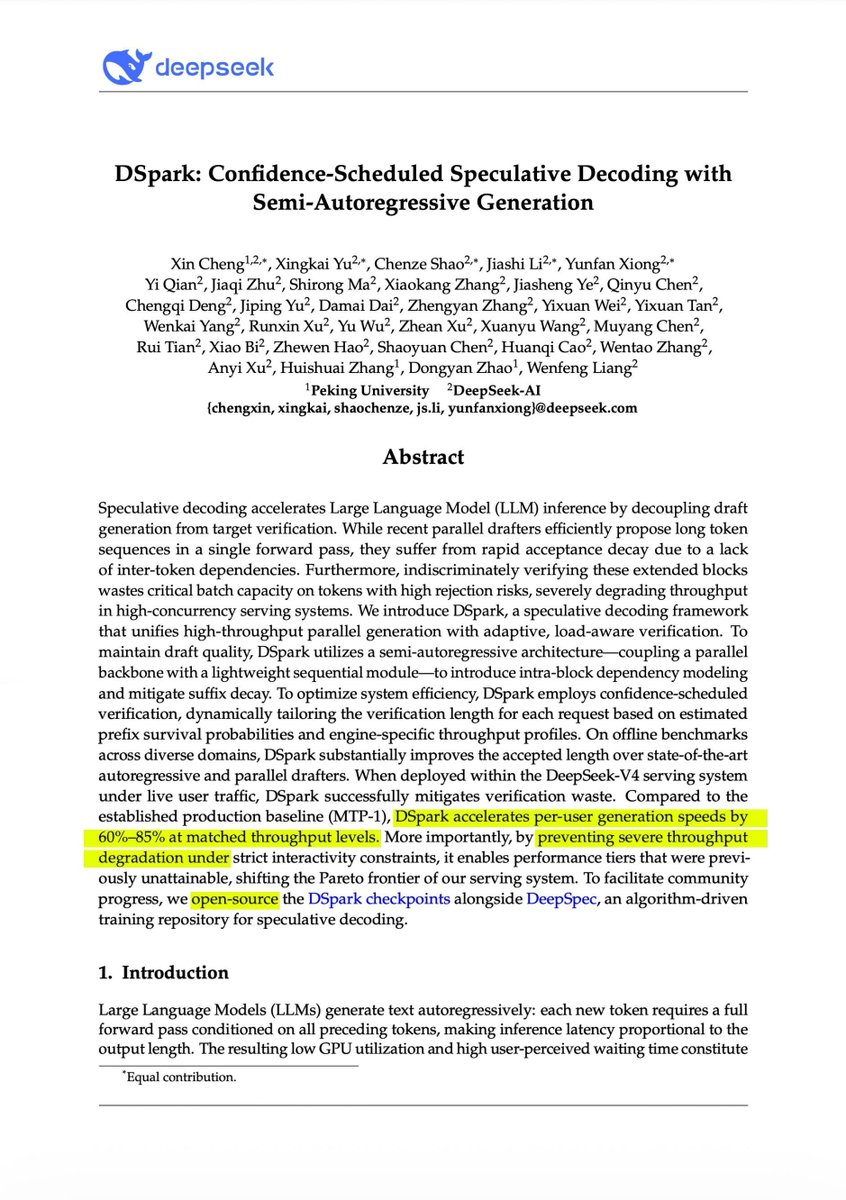
DSpark → 60-85% faster generation at matched throughputs.
@deepseek_ai dropped a new open source framework for dramatically improving speculative decoding by combining parallel token generation with lightweight sequential modeling and a hardware-aware scheduler.
How the draft stage works:
> Parallel backbone generates a block of candidate tokens in one forward pass, and a small sequential head adjusts those candidates based on local context.
> Confidence estimator then predicts which draft tokens are likely to survive verification. Rather than always submitting the full draft for verification, a scheduler uses those confidence scores alongside current system load to trim low-confidence tokens before they consume batch capacity.
> Target model then verifies the trimmed draft in parallel as normal.
The system essentially stops wasting verification compute on tokens likely to be rejected, and dynamically scales verification length up or down based on load. This leads to:
> 16-30% longer accepted token runs per decoding round over prior drafters
> 60-85% faster per-user generation in live serving (while holding throughput stable under load conditions where baseline approaches degrade)
Framework + paper on GitHub → https://t.co/u5xISxZjRy
Your AI agent reads one word at a time, then writes one word at a time. It's slow because it keeps stopping to think. DSpark is a cheat code: a tiny "draft" model guesses the next few words in advance, and the big smart model only checks if the guesses are good. If they are, you skip ahead. If not, you correct and keep going.
I wired this into SeekSpeed so you can actually see if the draft is helping or just adding noise. Probe your endpoint, run real prompts against it, and watch the acceptance rate. No marketing numbers. Just "is my agent actually faster or did I install a draft model that wastes GPU cycles?"
https://t.co/Dah0PTdDWW
I spent a week in the DSpark speculative-decoding internals and it rewired how I think about speed.
I started by pulling raw vLLM metrics: spec_decode_num_accepted_tokens_total vs draft_tokens_total. The numbers were brutal—most production configs I tested had acceptance rates below 40%. That means the draft model is guessing wrong more than half the time, and every miss is wasted compute + cache pressure.
The deeper I went, the clearer the pattern became: speculative decoding isn't a speed switch. It's a conditional accelerator that wins only when (a) your draft model is tightly aligned to the target distribution, (b) batch pressure is low enough to absorb the overhead, and (c) your prefill share doesn't dominate the latency budget. Violate any one of those and your "2× speedup" turns into a 0.8× regression.
The inspiring part? DSpark exposes the metrics to prove it. Acceptance rate, tokens-per-step, draft overhead—it's all there in the Prometheus counters if you know where to look. You can't optimise what you can't measure, and most people are flying blind while claiming speed they never hit.
So I built SeekSpeed to surface those numbers honestly. No marketing tok/s. Just milliseconds, acceptance curves, and the truth about where speculative decoding actually wins.
Built end-to-end with DeepSeek.
SeekSpeed Terminal
ca: 3pcyHwoo61bQCfjRZpZugXNu1XB8A7KMEWPyiHsqpump
I spent months building AI agents for real-time work and kept losing to latency I couldn't see. Bloated prompts. Wrong model routing. Zero visibility into TTFT vs throughput vs speculative decoding overhead. I was flying blind while the clock ticked.
So I went deep. Hooked up vLLM, TGI, and DeepSeek's DSpark speculative decoding endpoints. Started measuring what actually matters — not marketing tok/s numbers, but real milliseconds to first token, acceptance rates, draft overhead, cache behavior. The gaps were brutal. Same workload, 3x swings just from routing wrong.
I realised the agents themselves could be trained on speed — not just bigger models, but smarter routing, slimmer prompts, and speculative decoding that actually wins in production. But you can't optimise what you can't measure.
SeekSpeed is what I wish existed: a terminal that benchmarks any OpenAI-compatible stack with statistical rigor (p50/p95/p99, Welch's t-test), applies optimization variants, re-runs until it proves speedup, and tells you exactly where DSpark wins or loses. Honest numbers only where closed-weight marketing fails. No slides, just milliseconds and proof.
Built end-to-end with DeepSeek.
Docs: https://t.co/Dah0PTd67o
GM.
Just locked connector reliability across the board in SeekSpeed.
One-click test on any OpenAI-compatible endpoint — Azure, Together, Groq, self-hosted vLLM — with provider-specific header presets baked in. No more "works on my machine" when the prod key has the wrong API version header.
Plus the new connector table is fully relational now. API keys stay server-side, RLS scoped per workspace, and the benchmark runner pulls credentials from the DB at runtime. Clean separation, zero leakage.
Wiring the last touches on the command palette next. ⌘K to jump between agents, runs, and optimizations without touching the mouse.
Just locked in the optimization engine's full lifecycle on SeekSpeed.
Apply a recommendation → auto-generates an agent variant → re-run benchmark → Welch's t-test on latency delta → accept or reject with statistical significance.
No more "this should be faster" without proof. The loop closes today.
GM World — today we're shipping the bottleneck panel for speculative decoding in SeekSpeed.
Real vLLM /metrics ingestion, draft overhead scoring, and the acceptance-rate breakeven curve — so you stop guessing whether DSpark is helping and start proving it with p-values.
Plus: Solana wallet auth is live, the command palette is wired, and every optimization now runs through a proper apply → benchmark → accept/reject loop with Welch's t-test baked in.
No more benchmarking from the README.
Just shipped the final wiring on SeekSpeed Terminal — real-time TTFT tracking across OpenAI, Azure, Groq, and self-hosted vLLM endpoints. SSE streaming to measure first-token latency, concurrency sweeps to find the breaking point, and Welch's t-test baked in so every "optimization" actually proves itself.
Solana wallet auth works end-to-end now too. Sign a nonce, verify server-side, deterministic session — no email required. Plus the Spec Lab is pulling live acceptance rates and tokens-per-step from vLLM /metrics instead of faking it.
Still stress-testing the bottleneck panel. DSpark speculative decoding looks great in the README until you see draft overhead eat 30% of your gains. That's the whole point — measure the speedup, don't trust it.
Next: polish the command palette and call it a v1.