> be Leonard Susskind
> start working life as a plumber in New York
> enroll in college as an engineering student
> discover theoretical physics
> become fascinated by the deepest questions in the universe
> teach himself the mathematics needed to understand them
> become a theoretical physicist
> work on quantum field theory
> become one of the founders of modern string theory
> realize black holes create a fundamental problem for quantum mechanics
> ask what happens to information when something falls into a black hole
> argue that information cannot simply disappear
> challenge Stephen Hawking's claim that black holes destroy information
> spend years defending quantum information conservation
> become one of the central figures in the black hole information debate
> develop the holographic principle
> propose that the information inside a region of space can be encoded on its boundary
> help connect gravity, quantum mechanics, and information theory
> work on special relativity and general relativity
> teach theoretical physics at Stanford
> realize most people interested in physics never get access to the mathematics behind it
> decide to change that
> write The Theoretical Minimum series with George Hrabovsky
> explain classical mechanics from first principles
> then quantum mechanics
> then special relativity and electromagnetism
> then general relativity
> then cosmology
> turn graduate-level physics into something determined students can actually learn
> continue explaining the deepest ideas in physics without hiding behind simplified analogies
> become one of the most influential teachers of modern theoretical physics
> go from fixing pipes in New York
> to explaining the mathematics of spacetime, quantum mechanics, and black holes
India's 5G towers run on chips from Taiwan. India's defence radars run on chips from America. India spent ₹300 crore and 18 years at IISc building the alternative. AGNIT Semiconductors is what that research finally became.
The technology is Gallium Nitride, and it is not the semiconductor you know. Silicon powers your phone. GaN powers what your phone connects to: the 5G base station on the rooftop, the fast charger on your desk, the radar on a fighter jet. GaN handles power and frequency in ways silicon cannot, and India, until AGNIT, was importing 100% of it.
Hareesh Chandrasekar did not invent GaN in a garage. He commercialised 18 years of research at IISc's Centre for Nanoscience and Engineering, funded by India's Ministry of Electronics and IT with approximately ₹300 crore. The research existed. Twenty-plus patents existed, covering the entire GaN value chain, before a single venture capital rupee arrived. AGNIT built a company on what Indian public money had already paid to create.
"This marks an extraordinary five-year journey," Chandrasekar said, "where we've pioneered Gallium Nitride technology to revolutionise specialised applications, augmenting traditional silicon."
AGNIT is India's only vertically integrated GaN semiconductor startup, building everything from the substrate to the final device in-house. It signed an MoU with the Ministry of Defence under iDEX to co-develop GaN RF transmitters. 3one4 Capital, which led the $3.5 million seed round, confirmed that AGNIT's chips have already been piloted on Indian strategic platforms.
Not in a lab. On deployed systems.
AGNIT has raised $7.4 million across two rounds. The 100,000-chip target is next.
India invested ₹300 crore in 18 years of research. AGNIT built the company. The chips are on Indian strategic systems. If India scales this to 100,000 units and beyond, GaN becomes the first semiconductor category where India is not in the import queue.
It is in the supply chain.
@Kul_Mimansaka Absolutely, it shouldn’t be done solely for aesthetics. Bhagwan too won’t like if there is no beauty in something. If one expects that Mathura is where krishna resides despite so much ugliness there, that would be stupid too.
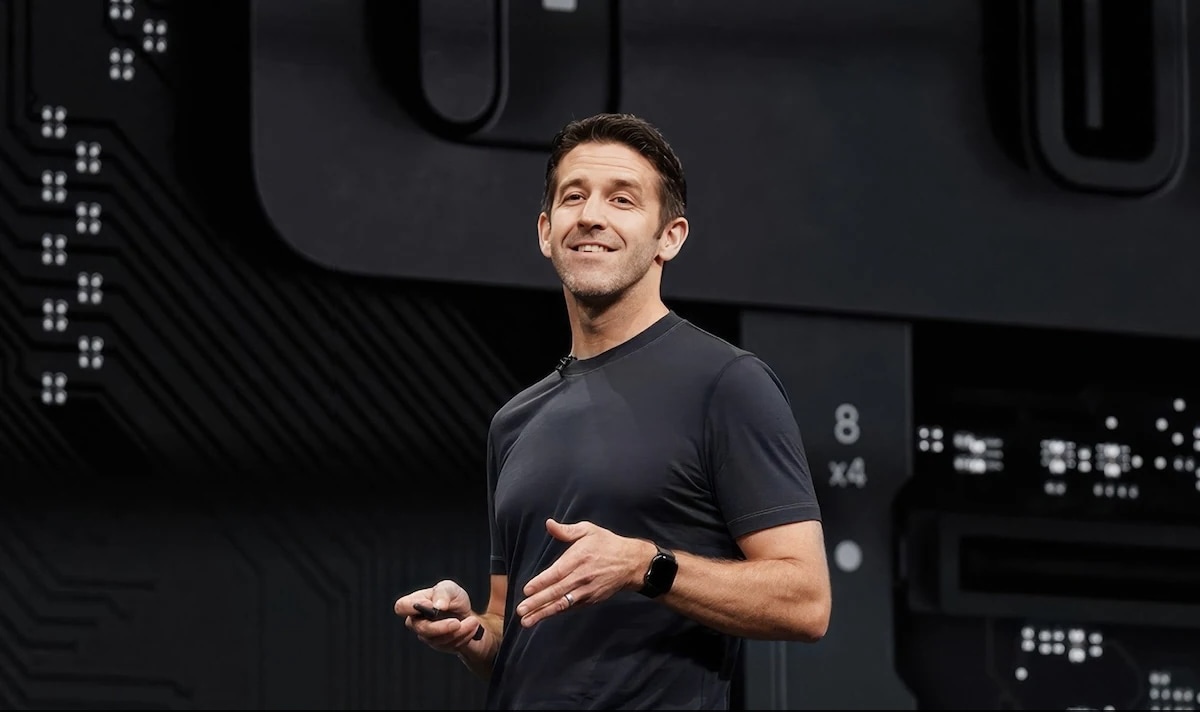
>be John Ternus
>2001
>26 years old
>nobody at Apple
>flown to a factory in Asia to check screws
>spec says 25 grooves
>supplier made 35
>no human being will ever see this
>lose your mind at them anyway
>win
>spend 25 years doing exactly that
>403 patents
>rip Intel out of every Mac
>build a phone 5.6mm thick
>watch the finance guys take over design
>watch every great designer quit
>watch Apple ship the same watch nine years straight
>watch $3499 ski goggles flop
>watch OpenAI walk off with 400 of your engineers
>September 1 2026
>they hand you the whole company
>kill Vision Pro 2 by lunch
>sue OpenAI by dinner
>mfw you inherit a $4 trillion machine and spend day one deleting your predecessor's legacy
@ericweinstein This is how you know physics has been played out for several decades: even silly theories with no testable predictions still get time in the spotlight
Gavin, spot on.
AI is bringing manufacturing back to America and reindustrializing the nation after decades of offshoring.
AI is creating demand that drives investment in our aging power grid and sustainable energy, powered by market forces, not subsidies.
AI is creating construction and manufacturing jobs across energy plants, chip fabs and data centers.
AI is creating new companies and industries. $400 billion has been invested in AI startups in the past six months alone.
Builders must partner with communities to build in their hometowns, earn trust and create local benefits.
We have an opportunity to create lasting benefits for communities across America and help America lead the next industrial revolution.
The brain is a biological computer. Just like silicon computers, some brains have more processing power or specialist skills than others and this varies tremendously in humans.
The probable capabilities of any given brain can be determined with high accuracy from an MRI. At Neuralink, we obviously have to understand brains extremely well to interface with them effectively, so there is no room for nonsense.
@pratiktwts That is because of the Jain/vaishnav dominated culture in gujarat. Though some fishermen communities do exist near the coast who do fishing business and make non-veg food. But no distinct cuisine has been developed for it.
Consensus estimate is that ~15GW of AI compute produced in 2027 cannot be turned on in 2027.
This is harder than just finding power, as you also need to build out all the transformers, wiring, liquid-cooling, (massive) chillers & complex networking. https://t.co/cRXJ1Wrkri
Elon is coming for the entire value chain! Elon confirms even with rapid renewables buildout, nat gas is needed for the data center buildout in the interim
SpaceX is standing up in-house single-crystal blade/vane casting so xAI data centers are not gated by Howmet / Precision Castparts / Doncasters / CPP, who are sold out into the early 2030s. The foundry work is in Bastrop, Texas. SpaceX has been hiring for it since April