Interesting $FSLY finding from testing Meta Muse.
Through a series of hundreds of tests, it appears that the $FSLY role with Meta Muse is greater than analysts have noted
Over the past week, I created several test websites and ran 738 controlled tests to send traffic from Muse agents to my websites
I set up analytics on my website, and I was able to track things like IP address, user agent, operating system, etc
From the IP addresses, across the 738 tests, Muse sent traffic from:
-Cloudflare: 37.0%
-Fastly: 29.3%
-Meta: 19.4%
-AWS: 14.4%
Cloudflare is not a surprise – as there has been a lot of analyst commentary about Muse using Cloudflare. Fastly, on the other hand, was a surprising result
I ran many different situations and tasks to try to understand why, or when, Muse sends traffic through Fastly – or others. And when I looked deeper, Muse used Fastly for 100% of the tests when browser navigation was required (e.g., “go to my favorite restaurant’s website and find me the menu”). And when Muse was requested to navigate on a website (e.g., make me a doctor appointment), Fastly was used in 100% of tests
Then in other situations, for example when an API is involved or a curl request required, Cloudflare was used in 100% of tests
Lastly, when requesting Muse to search the web, Muse split traffic through Fastly, Cloudflare, Meta directly, and AWS
Over the next few years, as frontier labs see their pricing power diminish with the proliferation of cheaper, smaller models & open-source, the most capable, cutting-edge AI models will be gatekept from the general public, and be reserved for extremely high-paying enterprise customers. The price-driven exclusivity of these higher tiers will reinforce their pricing power, provided they stay sufficiently far ahead of the broader competitive ecosystem.
Today, anyone with a few thousand bucks can access the best models because the frontier labs haven’t fleshed out their business models yet, and are subsidizing lower tiers at massive cost while they attempt to maximize market share capture, ascertain the most productive applications, and identify the strongest demand vectors. Not to mention, simply “showing off” for the purposes of inflating their valuations. That won’t be the case in the future.
The reality is that far less sophistication is needed for most consumer-facing tasks, such as shopping, trip-planning & basic medical inquiries, compared to much greater sophistication required for enterprise-facing tasks like curing diseases, solving complicated math & designing complex physical products.
The realization that there is both far less ROI available, and far less capability required, on the consumer-facing side will force a triaging of both training & inference compute resources which will encourage this outcome.
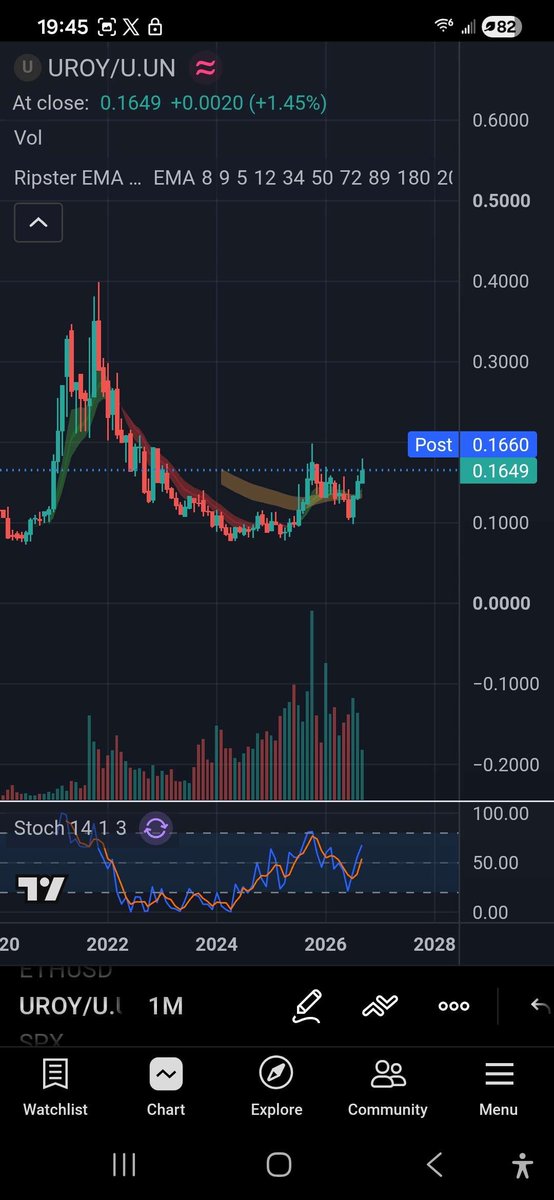
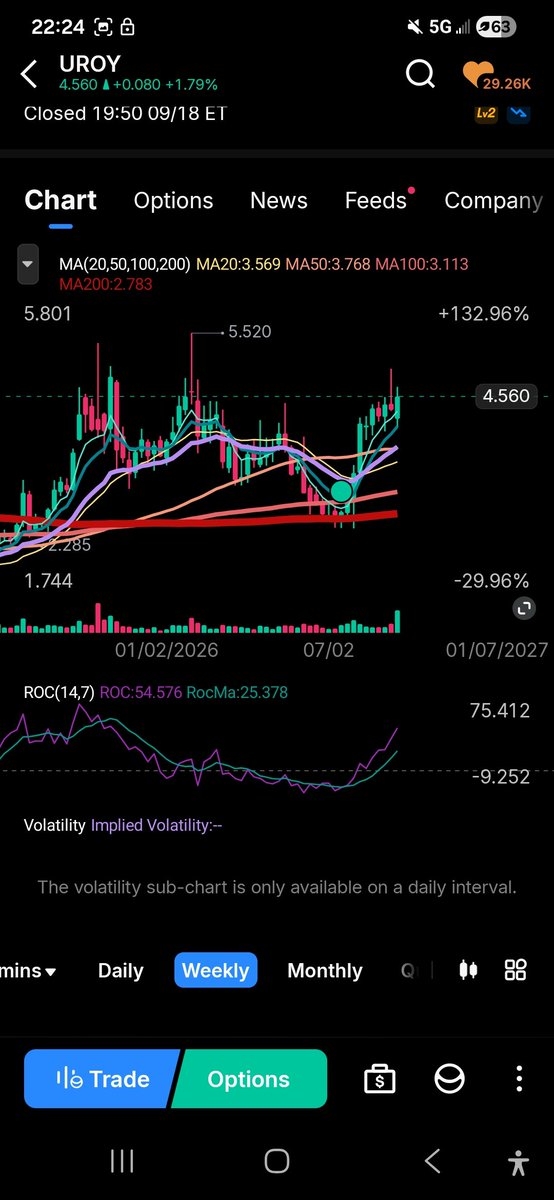
I took a starter in $UROY on Thursday because it has had breakaway relative strength compared to the rest of the uranium/nuclear theme. It is coming into a major resistance zone where a recent breakout failed as it approach the $5 mark, but price is defending the mid 4s well, which has been a major prior resistance area.
Of particular interest to me is UROY's price ratio to uranium itself, which has formed a very nice rounding bottom and bullish stochastics on the MONTHLY timeframe, which is very interesting, especially as the price of U3O8 looks to be gearing up for a historical breakout as major producers like $CCJ have been stockpiling it hand over fist and utilities are starved for it compared to what they'll need this cycle. @quakes99, would be grateful to get your opinion on this UROY analysis.
UROY had a very strong close on the week. MAJOR volume on a bullish engulfing weekly candle.
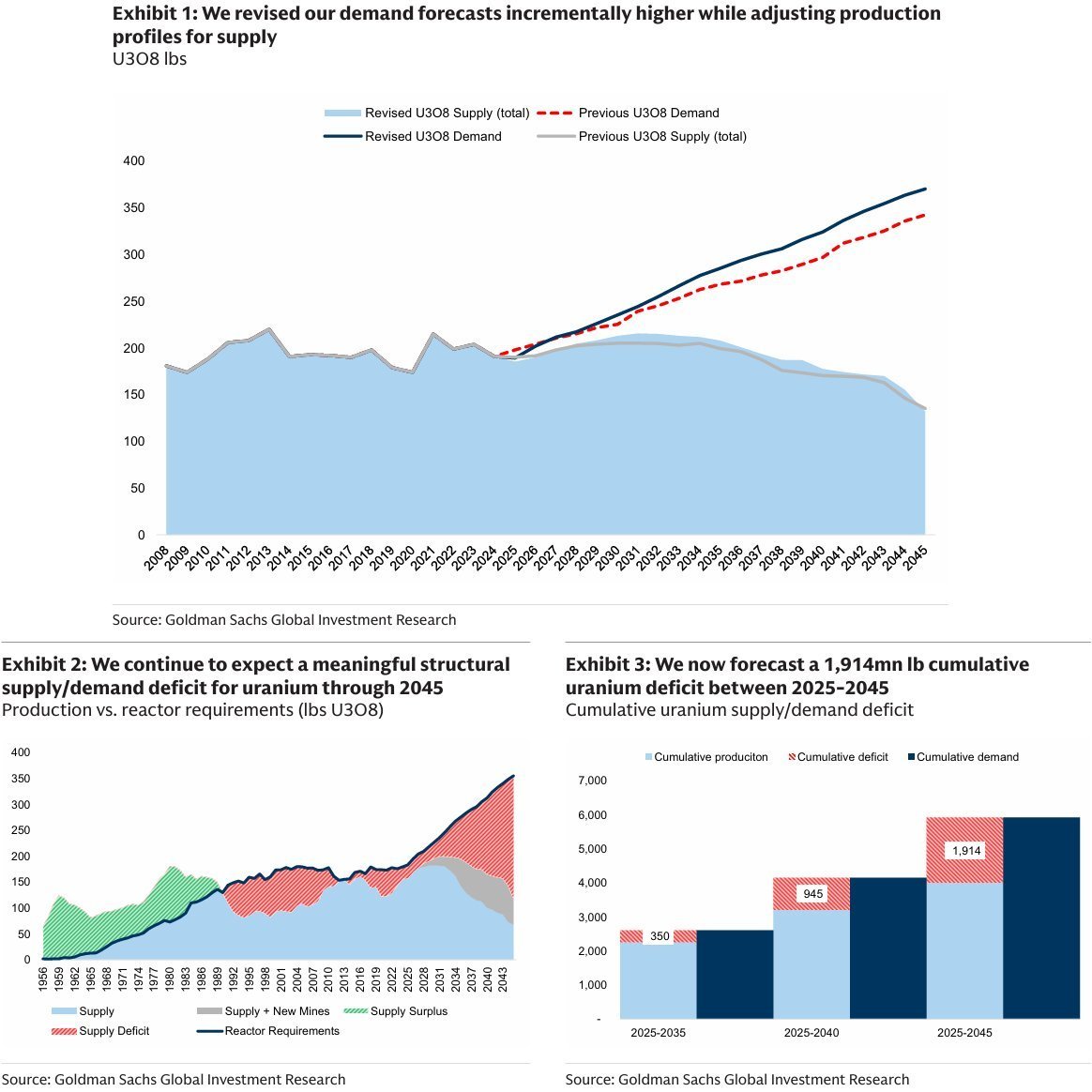
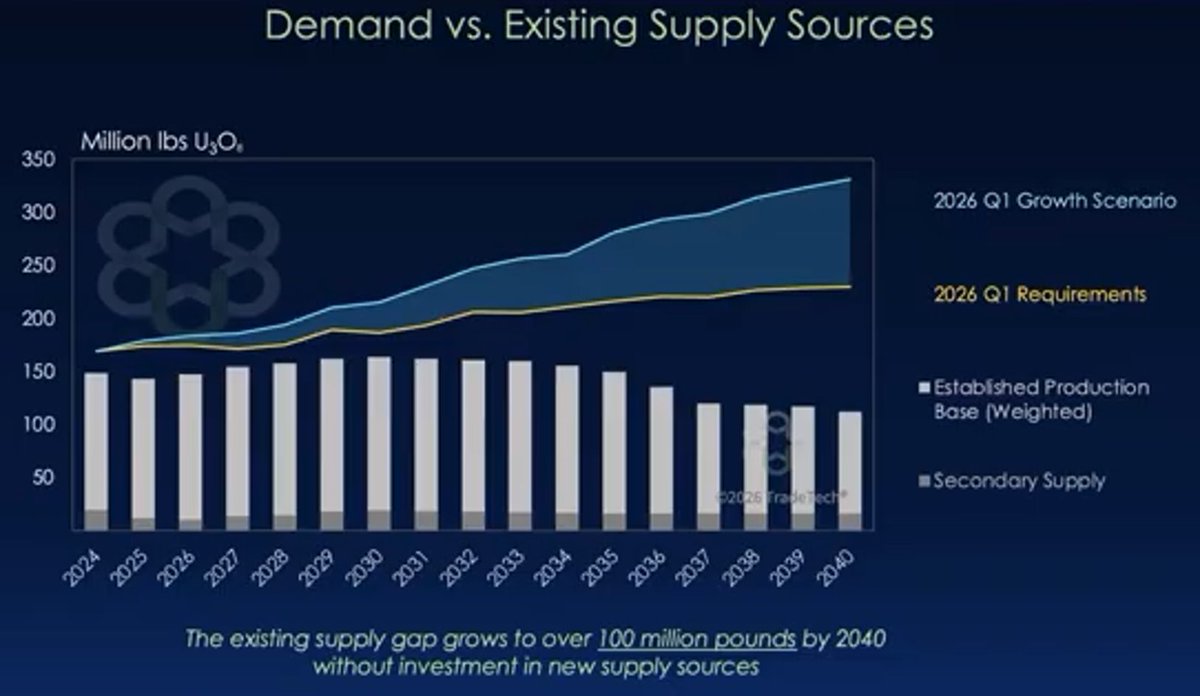
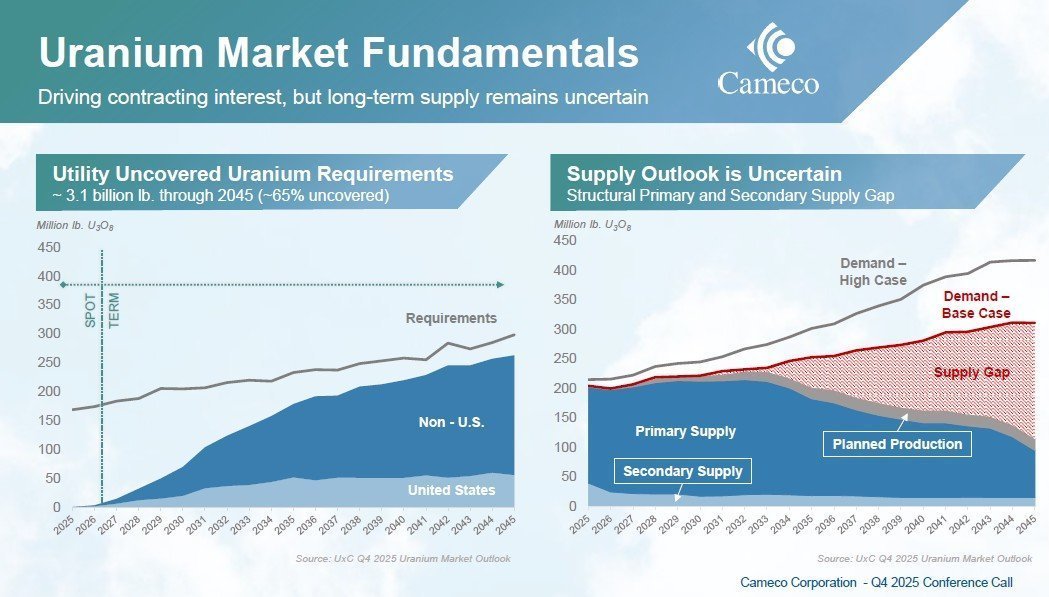
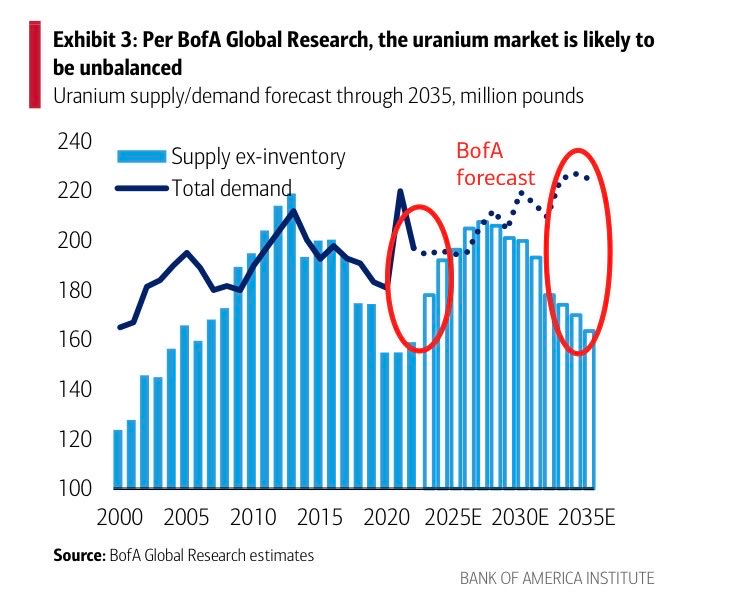
Hiding in plain sight!🐘 There's now broad consensus from #Uranium sector consultants & analysts that a widening gap between soaring #Nuclear fuel demand & mined U3O8 production has created a deep structural supply deficit this decade & beyond!↕️⚛️⛽️🗜️🤠🐂 #RideTheNuclearWave🌊🏄
A strategy that has worked well for me this past week is buying weekly and intra-weekly calls on the $SLV dips, then selling higher strike calls on top when I see a local high forming with volume dying down. This creates a call debit spread.
This is more profitable than opening a call debit spread from the beginning because on the wave up, you do not have a short call working against you. I also managed these by buying to close the short call once I see a local bottom has formed and buying volume has returned. This is intuitive — optimal hedging begins and ends at inflection points. And yes, I typed that em dash (alt+0151). This turns call debit spreads into a managed, intertemporal strategy, where the terms "long" and "short" truly earn their namesakes.
A great thing about this strategy is even if you leave the short call open, if you selected a strike price at or above where SLV ends up at expiration, they expire worthless. The theta decay on such short dated call debit spreads works extremely well in your favor, especially if you can identify local tops.
Churning weekly $SLV calls made my 2025. I learned a lot during that run and I'm looking to take even better advantage of the next leg up in silver's long term uptrend, which may be starting now. I really like the look of intra-weekly, weekly, and monthly call debit spreads on SLV for targeting 4x to 20x per winning trade. When silver has momentum, this is a repeatable and scalable strategy. Watching support and resistance levels and buying the dips are key, of course.
For intra-week plays, another important thing with SLV is that most of the money is made overnight: scaling in on the intraday dip, scaling out on the same day and next day's rips.
Naked calls also work, but only while IV remains compressed (I wouldn't buy naked calls around 50%+). Momentum will kill expected returns on naked calls as it forces IV higher. LEAPS and weekly lottos on dips, otherwise too high a chance of getting stuck in the middle.
It looks like there's a high chance of SLV recapturing the weekly 21EMA today, a high signal that the next wave up has begun.
$AVPT
The Baseline Moat: AvePoint has constructed a cost-of-displacement moat rooted in deep workflow embedment within the Microsoft 365 ecosystem and, increasingly, in multi-cloud environments including Google Workspace, Salesforce, and AWS. The platform governs, protects, and recovers unstructured enterprise data — emails, chat logs, documents, AI-generated outputs — across distributed cloud architectures. Once deployed across multiple workloads, the Confidence Platform becomes the authoritative policy-enforcement layer for an organization's data estate. Ripping it out means re-engineering governance controls, data retention policies, regulatory compliance workflows, and, increasingly, AI agent guardrails across every connected system. That is not a software switch; it is a multi-month organizational project with real regulatory exposure during the transition.
The Secular Tailwind: The proliferation of agentic AI has structurally elevated the importance of data governance from a back-office IT function to a C-suite and board priority. Deloitte's 2026 State of AI survey found that only one in five organizations has a mature governance model for autonomous AI agents [T2.5, Deloitte, 2026]. McKinsey's November 2025 AI survey found that 62% of organizations are scaling or experimenting with AI agents but that governance mechanisms are lagging adoption [T2.5, McKinsey, Nov 2025]. AvePoint's own State of AI Report, released June 2026, found 89.5% of organizations experiencing generative AI-related breaches and 88.4% experiencing AI agent-related breaches [T4, AvePoint LinkedIn, Jun 29, 2026]. The gap between deployment and governance is widening — exactly the gap AvePoint is architected to fill.
The Alpha Thesis: AvePoint is not a backup vendor that layered on governance features. It is a governance-native platform that has been embedded in the world's most complex enterprise data environments — highly regulated financial services, healthcare, government — for over two decades. The shift to agentic AI is not disrupting its business model; it is expanding the definition of what must be governed. As AI agents become "virtual employees" with cloud credentials, data access, and autonomous action authority, AvePoint's platform becomes structurally more critical: it is the only commercially available system that simultaneously inventories agents, enforces access policies, monitors behavioral drift, and provides granular recovery from agent-caused data loss. The market is only beginning to price this positioning.
@FunOfInvesting Figma has ms paint energy. Shit is clunky and unintuitive. Everything that can be done in figma can be done better and faster using claude instead