@afc_sk14@Espeo11 Quit watching football just focus on hockey... With this brain of yours you can't understand even the basic in the sport, so quit it.
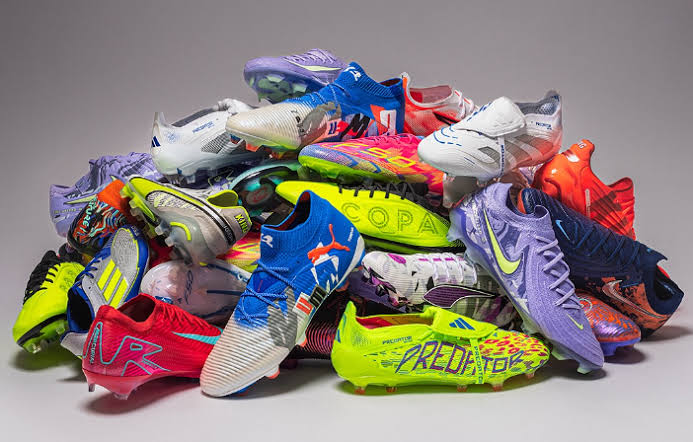
7 Things You Probably Don't Know About Football Boots
I want to tell you a very short story about a pair of shoelaces.
At the 1970 World Cup, just before Brazil played Peru in the quarter-final, Pelé asked the referee to wait a little so he could tie his boots. You would think it was nothing, abi? A man tying his laces. But the cameras went straight to his feet, and the whole world saw the Puma logo on his boots.
Now, the gist that has followed that moment for over 50 years is this. Adidas and Puma, two companies started by two brothers who could not stand each other, reportedly agreed not to sign Pelé, because a bidding war for him would cost both of them a fortune. According to the story, Puma broke that agreement, paid Pelé, and made sure the cameras caught those boots. If that story is true, those were the most expensive shoelaces in football history.
I know you are thinking boots are just boots. I am here to tell you they are not, and by the time you finish this, you will look at your favourite player's feet differently.
1. The two biggest boot brands in the world came from one family quarrel
Adi Dassler and his brother Rudolf used to make shoes together in their mother's laundry room in a small German town called Herzogenaurach. Then in 1948, they fell out so badly that they split the company into two. Adi went on to start Adidas, and if you look closely, the name is just his nickname plus the first three letters of his surname. Rudolf started what became Puma.
Both factories sat in the same town, on opposite sides of the river, and it got so bad that people reportedly looked at your shoes first before deciding whether to talk to you. They even called it the town of bent necks. I mean, we all have that one family quarrel that never ends. This one produced two companies worth billions.
2. West Germany's first World Cup was won partly by screw-in studs
In 1954, Hungary were the best team in the world, and it was not even close. They had gone more than 30 matches without losing, and they had already beaten West Germany 8-3 in the group stage of that World Cup in Switzerland. So when the two teams met again in the final in Bern, you know who everybody expected to win.
But it rained heavily that day. The Germans were wearing Adidas boots with screw-in studs, so they could simply swap in longer studs for the wet, heavy pitch. West Germany came back from 2-0 down to win 3-2, and Germans still call that final the Miracle of Bern. Adi Dassler was reportedly with the team that day, and from then on, his small company was a name the whole country knew. I am not saying studs won the World Cup. But I am not saying they didn't either.
3. For about 100 years, you could buy boots in any colour as long as it was black
For about a century, if you bought football boots, you bought black ones. There was no other option. They were heavy leather, built more like work shoes, and many of the early ones even had hard toe caps. Colour was simply not part of the conversation.
The first famous break came in the early 1970s, when Alan Ball, one of England's 1966 World Cup winners, agreed a deal with Hummel to wear their white boots. And the funny part is that the Hummel boots reportedly did not suit him, so Ball wore his Adidas boots, painted white, with the stripes covered. Hummel got their white boots on television, Ball got his comfort, and nobody watching knew the difference. From there, colour became a business decision, and today you will see boots in every colour you can think of.
4. The law says you must wear boots, but it does not care what they look like
Now, let me put on my lawyer's hat for a second. Law 4 of the Laws of the Game lists footwear as one of the five things every player must wear, together with a shirt, shorts, socks and shin guards. So you cannot decide to play barefoot in an official match, no matter how skilful you think your toes are.
But the Law says nothing about colour, design or even the type of stud you wear. The only real limit is that a player must not wear anything dangerous to himself or to anybody else. That is why officials check studs before a match, and why a player can be sent back to the dressing room to change his boots. In plain English, you can wear pink boots or gold boots with your name on them. You just cannot wear boots that can cut somebody.
5. Your club's kit deal stops at the ankle
This one is my favourite, because it is where my world as an agent comes in.
When your club signs a kit deal worth tens of millions a year, that deal covers the shirt, the shorts and the socks. The boots are usually left to the players. That is why you can watch an Adidas club and see Nike, Puma, New Balance and Mizuno boots in the same starting eleven.
The boot deal is the player's own contract, and at the top level it can be worth serious money. David Beckham's lifetime deal with Adidas, signed in 2003, was widely reported to be worth around $160 million. For a young player, his first boot deal is often the first commercial contract he ever signs, and it deserves as much attention as his club contract. That is where a good agent earns his money.
6. Nike built a boot around one Brazilian and changed the whole market
At the 1998 World Cup in France, Nike launched the first Mercurial boot for Ronaldo, the Brazilian one, R9. At that time he was the most famous footballer on the planet, so they built a boot around him. It was lighter than most boots on the market and came in silver, blue and yellow at a time when a lot of players were still in black.
Since then, the Mercurial has been on the feet of Cristiano Ronaldo, Mbappé and many more. It pushed the whole industry towards lighter, faster and flashier boots. And the smartest part of the business is that the boot was designed for one man's speed, but it was sold to millions of children who wanted to feel that fast too. I am sure some of you reading this begged your parents for a pair.
7. A blacked-out boot usually means somebody is negotiating
You must have seen it before. A player walks out in a big match and the logo on his boots has been painted over, taped over or blacked out completely.
It is not fashion. Most of the time, the player is between boot deals or in the middle of negotiating a new one, and he does not want to give any brand free advertising on television while it is not paying him. Some players also do it when they are testing a new model from another brand before they commit. So when I see a blacked-out boot, my first thought is not about style. My first thought is that somewhere, an agent is on the phone negotiating.
So you see, boots are not just boots. There is a family quarrel in there, a World Cup final, a law, and a lot of money moving between brands, players and agents. The next time your favourite player walks out, look at his feet before you look at his face.
My name is Ajoje. I am a FIFA Licensed Agent and International Sports Lawyer. I write on the Law and Business of Football, a lot. Repost and Follow if you want to read more posts like this.
Did you see anything about the 6-2 score line here?
NO!
Because only 3 points against Egypt mattered and 1-0 could easily have guaranteed the 3 points.
You be woman sha, I no expect you to understand 😀
https://t.co/t6gKijeIBE
@thefaveazubuike It is you who should understand now that we only needed a win vs Egypt even if it was 1-0.
Our goals whether 4 or 6 against Egypt didn't matter.
Our goals against those we are in a tiebreak with already did the job.
Is this hard to understand?
😱
@thefaveazubuike If it were to be by total goals scored Zambia would have been ranked No. 1 and Nigeria 2nd, Malawi would have been eliminated.
That's where our 6-2 would have really mattered.
You can carefully check up on the rules for tiebreaker in this WAFCON.
Google is your friend.
@thefaveazubuike Let me explain to you in layman terms so you can get it:
All 3 teams goal activities vs Egypt were not acknowledged... Only the 3 points mattered.
Now that Egypt is out of the way, please calculate the goals scored among the 3 teams involved and you'll get your proper ranking.
@Its_superdave While you should cover your mouth before affirming what is not... The rules were there before the tournament began... Small research you couldn't carry out, but you came online to start ranting out ignorance.
Your face should be buried in your hands man😂
@MartynsObot@Queen_Aeesha For better understanding
H2H was applied to all 6 pointers, and it comes first before goal difference.
Malawi beat Nigeria 3-2
Nigeria beat Zambia 1-0
Zambia beat Malawi 2-1
Malawi scored 4 goals in total
Nigeria scored 3 goals in total
Zambia scored 2 goals in total
🇳🇬 Super Falcons’ qualification scenarios.
Nigeria qualify with a win over Egypt, unless Zambia beat Malawi by one goal in a match where Malawi score at least three goals (e.g. 4–3, 5–4).
Otherwise, a win sends Nigeria through.
#WAFCON2026