When Dolly Parton approached Robert Plant for permission to record her version of “Stairway to Heaven,” she reportedly worried about how he would react. Instead, Plant’s response was wonderfully simple: “Of course you can, you’re Dolly Parton.”
And somehow, that feels like the perfect answer. Dolly didn’t try to copy Led Zeppelin — she took one of rock’s most iconic songs and made it unmistakably her own, adding a touch of country, gospel, and her unmistakable voice.
Sometimes, a legend recognizing another legend is all the permission you need.
A QUANT SPENDS THE FIRST HALF OF THIS VIDEO MAKING A MARKET ON A DICE ROLL, AND IT EXPLAINS THE WHOLE BUSINESS BETTER THAN ANY FINANCE BOOK
The setup is deliberately stupid. Roll a die, and whatever comes up is what the thing pays out. No news, no earnings, no chart to stare at. Everyone already knows the exact odds, which is the entire point — if you can't make money here, you can't make money anywhere.
He walks it in order:
▸ 00:52 making a dice market
▸ 03:10 finding mid
▸ 05:40 stability in quotes
▸ 08:15 statistically buying low and selling high
Fair value is 3.5 and everybody gets that immediately. But you don't quote 3.5. You quote 3.3 bid, 3.7 offer, and you sit there. Whoever wants out right now sells to you at 3.3. Whoever wants in pays you 3.7. You take both sides and keep 0.4, and you never once had to guess what the die does.
By the fourth chapter he's made the uncomfortable point. "Buying low and selling high" isn't a strategy at all — it's a description of what already happened, mechanically, because you set both prices yourself.
SpaceXAI engineer (ex-Cursor):
"I'm running 10-20 GrokBot agents right now, and they handle 90% of my routine.
I don't even manage them, I have a Chief of Staff agent that knows all the others and manages everything."
50 minutes from a SpaceXAI engineer, showing exactly how to build a team of agents that works for you 24/7.
Worth more than any $700 course on agentic engineering.
Watch it, then read the step-by-step guide on building your own Grok agent team for free, with ready-to-copy prompts.
A Chinese developer just explained the shift from Loop Engineering to Graph Engineering better than anyone.
most people are still building agents the way that's about to be obsolete.
> why single-agent loops break and go "goal blind"
> the 4 parts of a graph: nodes, edges, state, policy
> 3 topologies that run everything: diamond, supervisor, pipeline
> Anthropic's 5 official workflow patterns
the punchline: it's not how many agents you run. it's the determinism you build with verifiers, code fallbacks, and reality anchors.
I broke the same architecture down with Kimi K3. Full A-Z guide below.
A broke Italian gambler in 1560 wrote a short manual on how to win at dice. Nobody in finance read it for four hundred years.
The nine-trillion-dollar insurance industry runs on his equation.
His name was Girolamo Cardano. The book was called Liber de Ludo Aleae. He scribbled it in Milan to settle a card debt. Every dollar of premium ever collected on Earth is a footnote to that scribble.
Nobody connected the dots until 1996. A ninety-year-old man in New York wrote a book called Against the Gods and traced every modern risk model back to Cardano's manual. Wall Street called him the historian of risk.
His name was Peter Bernstein. In 2008 a small production company filmed him for thirteen minutes. He walked through the entire five-hundred-year arc. Cardano to Pascal to Fermat to Black-Scholes.
Then he stopped and said the industry had built glass towers on the back of an idea a broke gambler scribbled to shave the house edge.
He died the following summer. Age ninety.
There are only four ways to make money. Labor. Capital. Arbitrage. Insurance. Insurance is the oldest and the least visible. Every actuary on Earth still prices catastrophe risk with Cardano's framework.
The video is thirteen minutes long. Free on YouTube. Twenty-nine thousand people have watched it.
Jane street pays $600,000 for the skill of selling anything to anyone, and now this 21 minute Tony Robbins masterclass filmed 30 years ago in his castle gives it to you completely free.
This is the uncut 1992 session. Just raw persuasion from the master who coached presidents and billionaires.
You will learn how to find anyone's buying state and anchor your offer to that feeling. No scripts. No tricks. Just psychology that works on everyone.
This rare tape disappears regularly. Save it while you can ⭣
this is f*cking gold
Andrej Karpathy joined Anthropic five weeks ago.
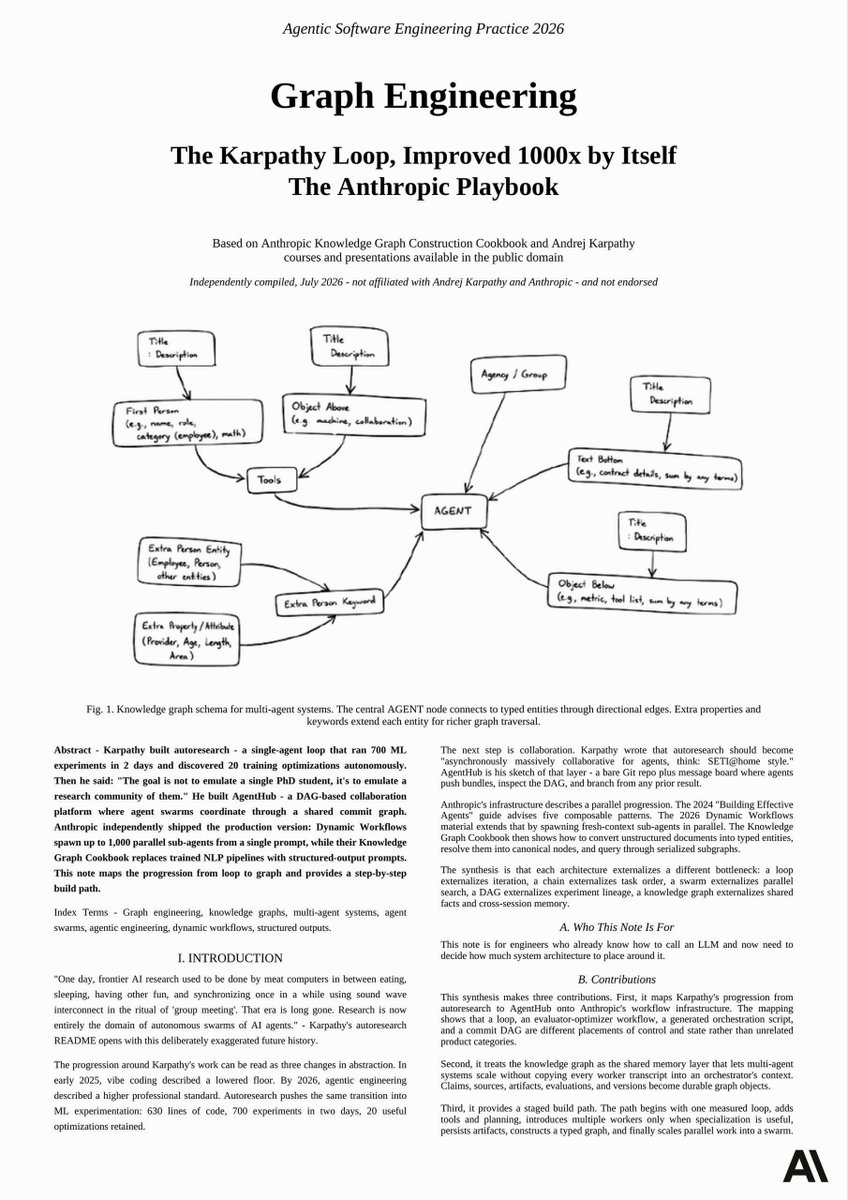
Two Anthropic seniors just made Karpathy's loop 1000x better with "Graph Engineering"
the agentic systems got 1000x better the moment you wired agents into a graph
I dropped it into my setup. The very first response was different.
Not slightly different. Completely different.
Claude stopped giving generic answers and started working exactly the way I think.
Bookmark it before it gets lost in your feed.
Read it now, then check the article below.
Google Brain founder, Andrew Ng:
"Prompting will die in 6 months.
Loops and Graphs are what's replacing it."
In 2 hours, he shows exactly what the best engineers already build instead, and how to start building it yourself.
The missing piece most people skip: how to connect those loops into a graph that compounds every time it runs.
Watch it, then read the full guide on loops and graphs below.
The best guide on the internet covering graph engineering.
Loop engineering is dead; we're now entering the era of designing graphs.
I cover: wtf is a graph? How do I deploy one now? and more.
This article teaches you everything you need to know (explain like I'm 5):
A hedge fund returned 50% a year for ten years straight. In 2005 the man who ran it sat on a desk at Columbia and taught the entire method to 30 students for free. No bank, no fund, no business school has ever promoted the recording.
His name is Joel Greenblatt. He ran Gotham Capital from 1985 to 1994. Almost nobody sustains 50% annually for a single year. He did it for ten. Then in 1995 he returned all outside capital, kept running his own money, and walked into a classroom.
The first lecture is about corners of the market where the usual buyers are structurally forced to sell regardless of price. Spinoffs, restructurings, situations where an index fund must dump a stock the day it leaves the index. He does not teach a screener or a formula. He teaches why these corners exist at all, and why they keep existing after everybody knows about them.
The uncomfortable part is what he says about diversification. He held very few positions. It runs directly against everything the business school teaches two floors down. Columbia charges $80K a year in tuition. The man upstairs gave away the method for free.
Every screener is free now. Every filing is searchable. The constraint was never information. It was knowing which information to ignore.
Filmed from the back row, audio uneven, students blocking the frame. He gave away 50% a year to a room of 30 people. Almost nobody traded on it.
One classroom. One camera. The full lecture is free. It is in the video.
A man who went to prison for talking people out of their money filmed himself doing it live, then sold the method as a course. 7 million people have watched him work.
The man is Jordan Belfort. The film about him made him famous. What almost nobody has done is watch the real one, on camera, running the actual technique on a real prospect for 22 minutes with no script and no edit.
And the way he does it is the reason to watch.
He barely talks about the product. The first minutes are almost entirely questions, and every answer gets used against the person later in his own words. He is not persuading. He is collecting.
Then the phrase the comments turned into a meme. He ends his key sentences with four words that make agreement feel like the neutral option and refusal feel like rudeness. Once you notice it, you cannot unhear it, and you will catch it in the next call you take.
One viewer broke the whole method into 9 steps in a comment. It got 12 thousand likes, which tells you people are studying this video like a manual.
Here is the uncomfortable part. Every technique in it is ordinary sales advice: listen, mirror, remove friction, set expectations. That is exactly what makes it worth studying. The tools were never the crime. The intent was.
Learn what is being done to you and it stops working on you. That is the only defense there is.
22 minutes. No script. It is in the video.
Loop engineering and graph engineering, explained like you are five. Everyone throws the words around, almost nobody defines them
A loop is one worker with a to-do list. It picks a task, does it, looks at what happened, picks the next one. Everything it knows lives in one conversation. When that conversation fills up, things start falling out of it.
A graph is an assembly line. Each station does one job. Between stations the work gets saved to disk. If station four fails, you rerun station four, not the whole line.
Three questions decide which one you need:
1. Will you do this a hundred more times? If not, use the loop. Building the line costs more than doing the work by hand
2. Can a script tell you the output is correct? If only your taste can judge it, the checkpoints are decoration
3. Do you know the steps yet? If not, the loop will find a path you would never have drawn
The loop is not dead, it got demoted. Every station on the line still has a worker running a loop inside it.
Bookmark this
This paper is f*cking brilliant
A computer science paper proves that graph engineering is the missing layer for production AI systems
The result: developers build stateful workflows using typed state, explicit nodes, conditional routing edges, and durable checkpointers
The crazy part is how graph engineering strips control flow completely away from prompt text
Graph nodes execute deterministic tools, edge functions evaluate execution state, and checkpointers preserve workflow memory across server restarts
Most teams try to enforce agent behavior inside long prompts
This framework constructs an inspectable control graph in pure python
Read the complete paper + article below
Bookmark it for future reference
This is f*cking gold.
I've just made the clearest explanation of graph engineering you'll find anywhere.
No jargon, no code, no 2-hour lecture, just the four shapes every agent graph is built from.
Read on, and you'll never build with AI the way you did before.
-------
Shape 0 - Basics
A graph is just a plan for your AI work, drawn out so you can see it - which jobs run and which one waits for which.
Graph engineering is the skill of drawing that plan well, so the work that doesn't depend on anything runs all at once, instead of one slow step at a time.
Get it right and one person can direct a whole fleet of agents. That is why the best engineers jumped on it the moment loops got old.
-------
Shape 1 - The Chain
This is the one everyone builds by default.
Do A, then B, then C, each step waiting politely for the last to finish. It works, and it is the slowest shape there is.
If one step stalls, everything behind it stops. Use it only when the steps genuinely need each other's output.
-------
Shape 2 - The Diamond
This is the workhorse of every serious graph.
You split the job, fan the workers out in parallel, verify what they found, then merge it all into one answer.
Use it the moment the work breaks into pieces that don't read each other. Same shape behind a research report, a market scan, or a code review.
-------
Shape 3 - The Router
Sometimes the next step depends on what you just found.
One node checks a result and picks the path. a small job gets a quick pass, a big one triggers a full audit.
Use it when the work needs to branch. The decision runs the same way every time, because it lives in the structure, not in a guess.
-------
Shape 4 - The Cycle
Some jobs you can't size up front.
A bug sweep where finding one problem reveals three more. So you add a controlled edge back: keep finding, checking, looping until two rounds turn up nothing new, then stop.
Use it for discovery of unknown size. The one rule is a hard limit, or it runs until your budget is gone.
-------
That's the base, now you know the four shapes and when each one fits.
If you want to go deeper, I wrote a full article just for that, it explains everything step by step and breaks down where graph engineering wins and where it breaks.
It also walks you through building your own graph from scratch, read it below.
Anthropic engineer just released a 2-hour workshop on "Graph Engineering" for agentic systems:
“80% of our engineers are using self-improving loops. Now everyone is building agentic graphs.”
• 00:00 - Introduction to RAG & Graphs
• 06:39 - Core of "Graph Engineering" (state, nodes)
• 14:29 - 3 feedback loops of Graph agents
• 23:06 - Agent evaluation with Graphs
• 36:29 - Agent cycles in graphs
• 1:15:22 - Agentic RAG & agent context
• 1:41:20 - Evaluation datasets based on Graphs
This 2-hour workshop will replace 10 paid courses on agentic engineering.
Watch it today, then learn how to become a Graph Engineer in the article below.
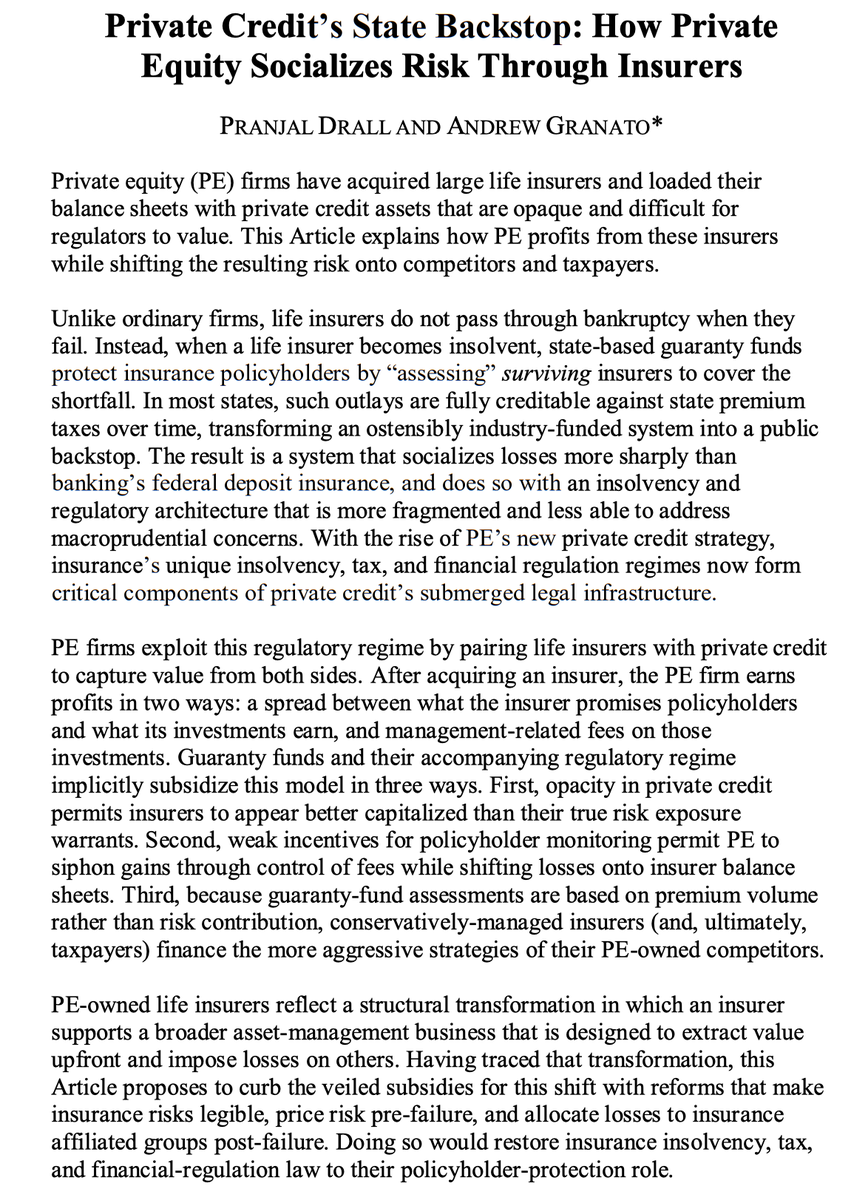
New w/ @PranjalDrall: Private Credit's State Backstop: How Private Equity Socializes Risk Through Insurers. It's about how insurance insolvency, tax, and financial-regulation law have subsidized PE's takeover of life insurance and become the submerged law of private credit.
This video will make you an expert loop engineer in 21 minutes.
Prompting is dead. You need to be running loops.
0:51 Understanding LLMs
3:41 wtf is a loop?
6:17 Two kinds of loops
8:54 /goal versus /loop
10:44 Website audit demo
13:27 Real loop workflow ideas
19:11 Scheduling loops
Two Anthropic seniors just made Karpathy's loop 1000x better with "Graph Engineering" - dropped 11-page PDF
the shift: the agentic systems got 1000x better the moment you wired agents into a graph
here's the playbook in 6 steps:
step 1 → build one loop: generate, critique, revise - one self-review cycle beats a smarter model with none
step 2 → add tools: search, code execution, database - thinking without tools is hallucinating
step 3 → go parallel: spin up agents in separate worktrees - same repo, different branches, no conflicts
step 4 → add a graph: agents write findings as typed nodes and edges - not transcripts - every claim keeps its source
step 5 → ground your evaluator: it checks claims against graph edges, not vibes - "Triple not found" beats "seems off"
step 6 → the graph survives every session - your agents stop rebuilding context from scratch
the result: Karpathy ran 1 agent in 1 direction - this system runs 1,000 with shared memory - same model, it's the architecture
read this 11-page PDF and paste it into your Claude - you won't regret it
bookmark - then read the article on building graphs from scratch ↓
Andrew Ng just dropped 8-page PDF on 4 agentic steps "from Loops to Graphs from scartch"
The twist: agent has amnesia without both: Loops let agents think - Graphs let agents remember
here's 4 workflows, step by step:
step 1 → reflection - agent writes, second prompt critiques, agent rewrites - one self-review loop beats a smarter model with none
step 2 → tool use - give it search, code execution, APIs - thinking without tools is hallucinating
step 3 → planning - break the task into JSON steps before running - Step fails? Agent replans around it
step 4 → multi-agent - stop running one agent - run a team - one codes, one reviews, one tests
how to wire this today:
step 5 → add one critique call after every generation - 10-30% quality lift, one day of work
step 6 → connect all 4 into a graph - agents share memory instead of transcripts - agent forgets, graph doesn't
the result: a weak model with 4 steps destroys a strong model without them - same cost, it's the architecture
this 8-page PDF is what comes after loop engineering
save this - then read the full build workflow in the article below ↓