Client Results so good people don’t believe me when I tell them the numbers.
We outperform in some ad categories on X by 99.92%. Yes it’s wild. Yes it’s true. We’re just the best at what we do.
Day 1,725 of consistency,
Grateful for the day.
Met with one of my best mentors today who is in town from out of state, great meeting.
Love getting checks in the mail for the Rental Property.
Made my first hole in one today, very cool.
Grateful
Day 1,506 of consistency,
Moved further along with the RE Rentals today. Got an insurance range cost today, cheaper than I was budgeting, good win. Need to talk to some bankers tmr.
Good productivity with Biz work today too.
Grateful.
Day 1,724 of consistency,
+ Lots of cleaning done today, house looks good
+ Got paid on a big deal, another on the way
+ Recorded 2 different first half of the VC Show podcast
+ First day trade in probably a couple years today, nice winner
Grateful
Electricity prices aren’t driven up by data centers but by a lack of supply.
When new generation comes online, energy costs will decrease supported by the Ratepayer Protection Pledge.
In the last 3 years, I've met a bunch of super cool, super successful people.
The one I've been most impressed with is @Samuel_Gibson_
A true gigabrain.
Today he just became, I believe, the youngest founder in American history to IPO and his company @hadron_energy $HDRN is also the first publicly traded company focused on light-water MMR technology.
In less than 2 years, he transformed an idea into a massive company and, along the way, received a signed letter of support from the President, signed agreements/MOUs and built a team of industry leaders with decades of regulatory background.
Beyond just Sam being impressive, the opportunity of what Hadron is building is very timely and unique.
Scroll this platform for 10 posts and you’ll probably see:
• 3 posts about politics
• 2 posts about Sydney Sweeney
• 5 posts about AI
AI is the dominant signal right now.
Every major tech company is racing to scale AI infrastructure, and they’re all running into the same problem: Power.
AI infrastructure and hyperscale data centers require massive amounts of continuous, always-on electricity.
That’s where advanced nuclear becomes a favorite.
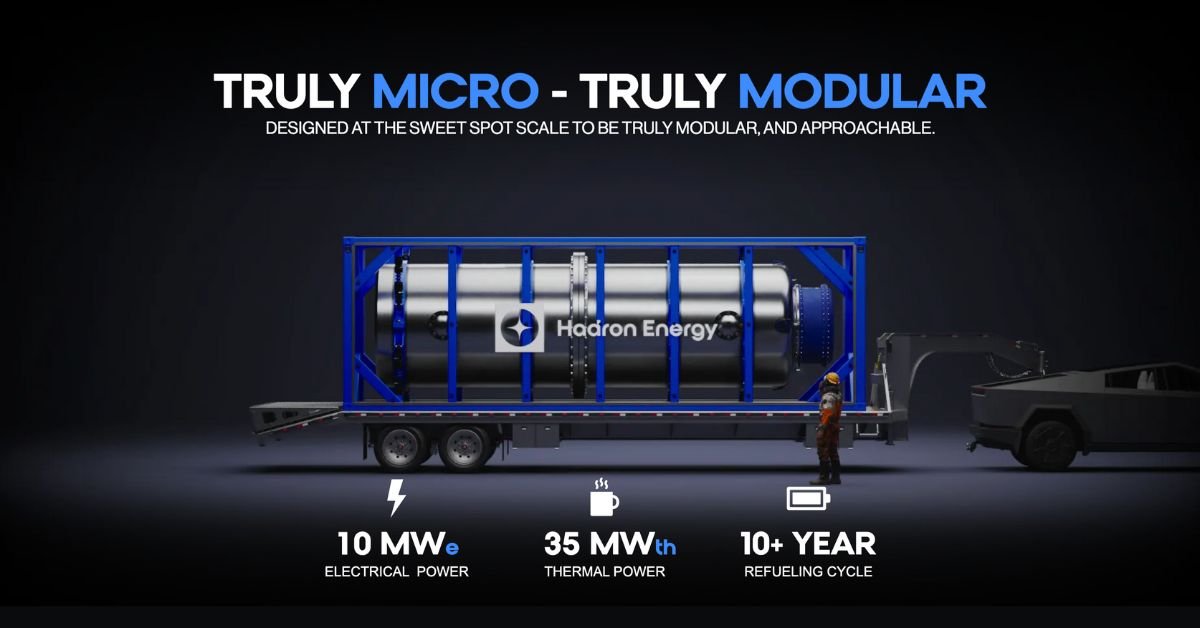
Hadron is developing Micro Modular Reactors (MMRs): factory-built nuclear reactors designed to deliver reliable carbon-free baseload power.
Unlike traditional large-scale plants, MMRs are designed for:
• On-site power generation
• Faster deployment
• AI data centers and industrial applications
• Remote and critical infrastructure
A single hyperscale AI data center can require power comparable to a small city, and the grid simply was not built for this level of always-on demand.
That’s a major reason companies like $AMZN, $GOOG, $META, and $MSFT are increasingly turning to nuclear in their long-term energy strategies.
The President has also signed multiple Executive Orders to boost the industry as well as push forward the Ratepayer Protection Pledge, which makes big tech buy, build, or bring the power they need to support their own demand.
That alone is a huge opportunity for companies like Hadron, which is building to match that exact demand.
The bottleneck has moved from compute to electricity, and companies capable of delivering scalable, reliable baseload power are becoming increasingly important.
I'm bullish on Sam.
I'm bullish on the nuclear energy opportunity.
I'm bullish on Hadron Energy.
And I think Hadron is positioned at the center of one of the most important tech and infrastructure shifts happening right now.
Yes, I bought the stock because I like it.
Really cool milestone to watch unfold today. Congrats to Sam and the entire Hadron Energy team!
Hadron Energy, Inc. has successfully completed its business combination with GigCapital7 and begins trading on Nasdaq today under the ticker symbol $HDRN
Through the transaction, Hadron secured approximately $31 million in total equity funding with zero debt, resulting in approximately $24.5 million of cash on the balance sheet.
The capital raised will support reactor design, NRC licensing, supply-chain development, and future deployments targeting AI data centers, industrial facilities, defense applications, and critical infrastructure.
This milestone positions Hadron as the first publicly traded company focused on light-water micro-modular reactor (MMR) technology. Hadron is developing the Halo MMR: a factory-built, transportable 10 MWe microreactor designed to deliver reliable carbon-free baseload power with a 10-year refueling cycle.
Going public builds on key achievements, including agreements with ConverDyn and Paragon Energy Solutions, as well as a deployment framework with Smartland Energy representing up to 1.8 GWe of potential demand.
We believe Hadron is positioned to help define the next generation of nuclear energy infrastructure. Follow along with @hadron_energy for the latest in microreactor innovation!
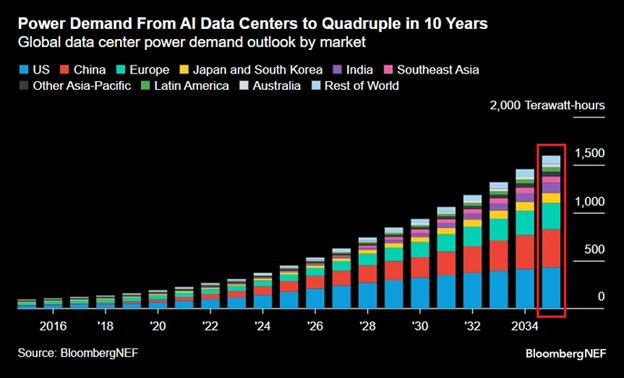
The world’s electricity demand is accelerating faster than the grid was built to handle.
AI infrastructure, hyperscale data centers, and advanced manufacturing are creating a systemic surge in global power demand.
The bottleneck is shifting from chips to gigawatts.
The constraint is no longer compute.
It is energy.
For the first time since the U.S. Census Bureau began tracking it, America is now spending more on data center construction than on office buildings.
This is not temporary. It is a structural shift in compute-intensive infrastructure, still in the early stages.
Only a small fraction of the workforce currently uses AI daily, meaning the demand curve is still early in its adoption cycle. As usage scales, so does energy demand.
Modern AI systems and hyperscale data centers require:
• Massive compute density
• 24/7 uptime
• Grid-scale reliability
This creates a hard requirement: continuous baseload power. A single hyperscale data center can require power comparable to a small city.
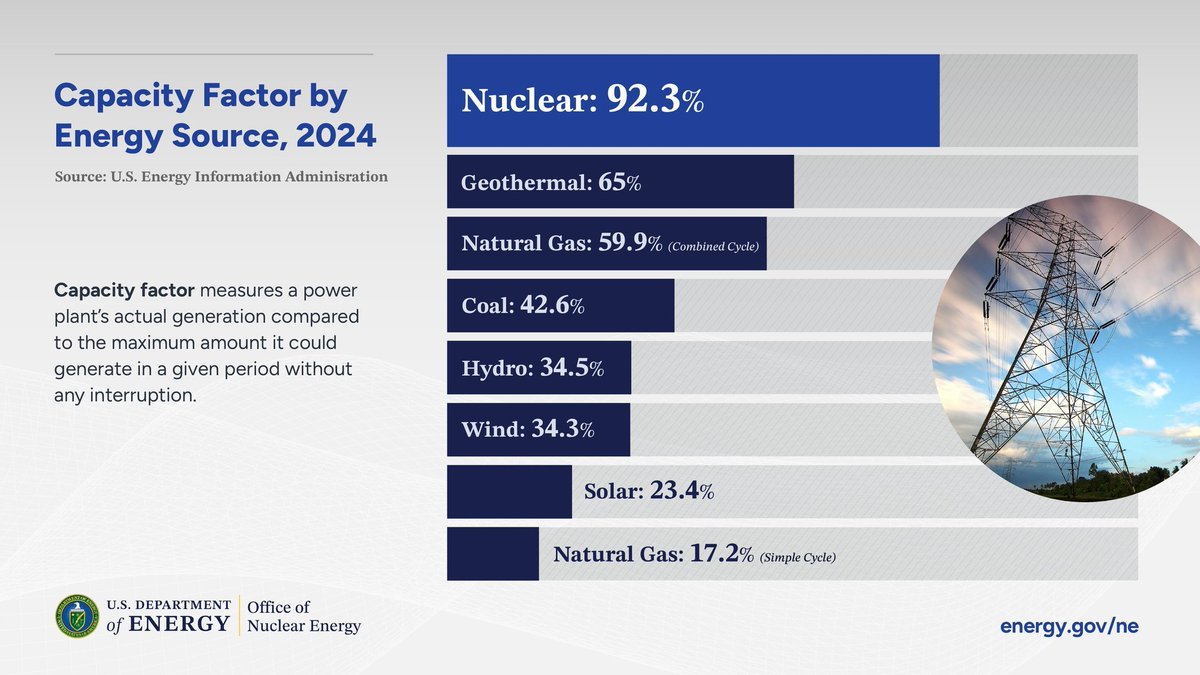
Nuclear energy provides continuous baseload power at industrial scale, with a high capacity factor aligned with always-on demand requirements.
Wind and solar require significant overbuild and storage to deliver reliable firm power at scale.
This difference shows up clearly in capacity factors:
• Nuclear ~92%
• Wind: ~34%
• Solar: ~23%
• Coal: ~55%
Nuclear's operational profile, characterized by near-continuous output with downtime driven mainly by scheduled maintenance, is uniquely aligned with AI-driven load profiles.
The scale of demand is already being reflected in the strategies of the largest technology companies.
Amazon, Google, Meta, and Microsoft are increasingly integrating nuclear energy into their long-term power strategies as they scale AI infrastructure globally.
To meet this demand, nuclear deployment is shifting toward advanced nuclear, including Small Modular Reactors (SMRs) and Micro Modular Reactors (MMRs).
These systems are:
• Factory-built
• Modular in size
• Faster to deploy
• Designed for flexible siting
Most importantly, they enable on-site power.
This means nuclear generation can be deployed directly alongside data centers and industrial sites, reducing dependence on long transmission buildouts and enabling behind-the-meter power supply.
At the same time, the economics of deployment are shifting.
The largest hyperscalers alone are projected to spend ~$660B in capex this year, with power availability increasingly becoming the binding constraint on deployment.
Policy frameworks like the Ratepayer Protection Pledge are reinforcing this shift by requiring hyperscalers to directly fund the generation of their own power.
This reduces pressure on public ratepayers while unlocking large-scale private capital for dedicated power buildouts.
On the supply side, nuclear energy is uniquely positioned to meet this challenge.
It is one of the lowest-carbon large-scale energy sources, preventing hundreds of millions of tons of CO₂ emissions annually in the United States alone.
It is also among the most land-efficient forms of energy generation, requiring roughly ~400x less land than comparable clean energy sources to produce the same output.
Globally, momentum is accelerating:
• 440+ reactors operating
• 60+ under construction
• Hundreds more planned or proposed
Bank of America projects global nuclear capacity to grow from ~442 GW today to ~683 GW by 2040.
Governments are also increasingly prioritizing:
• Energy security
• Domestic fuel supply chains
• Grid resilience
• Reliable baseload power for industrial growth
The conversation around energy has fundamentally changed. This is no longer about choosing between energy sources.
It is about whether the grid can physically support the next wave of compute-driven economic growth, and which technologies can meet that demand profile.
Nuclear is one of the only solutions capable of matching it at scale. That is the opportunity we are building toward at @hadron_energy.