THE EDUCATION OF A SENATOR is available now. Updates from former United States Senator Lamar Alexander. 7th generation Tennessean born and raised in Maryville.
Here's a rule I learned early on as governor. Don't be afraid to put all your eggs in one basket as long as it's the right basket.
In Chapter 22 of my new memoir, THE EDUCATION OF A SENATOR: FROM JFK TO TRUMP, I write about how at my first White House dinner, President Carter said, "Governors, go to Japan, persuade them to make in the United States what they sell here." So off I went, recruited Nissan to Tennessee, and before very long, Tennessee had about half of all the Japanese capital investment in the United States. That helped raise family incomes in our state and brought the auto industry to our state. It's the most important thing I could have done. And I figured that, well, I could go to Europe, I could go to different places, I could work on different things, but I'm only one governor. So if I focus most of my attention on Japan and the auto industry, maybe I'll get a better result.
After realizing how uneasy the Japanese were about doing business outside their own country, my strategy was to create a fourth advantage by doing everything I could to make Nissan feel at home in Tennessee. During my first twenty-four months as governor, I spent eight working weeks solely on Japan relations—three weeks in Japan and the rest visiting with an endless stream of Japanese visitors to Tennessee—from the National Diet, newspapers, chambers of commerce, and Nissan. Masahiko Zaitsu, from Nissan’s Los Angeles office, was a guest at the governor’s residence eleven times in 1979 and 1980. Our children began to think of him as some sort of Japanese uncle.
In THE EDUCATION OF A SENATOR: FROM JFK TO TRUMP, I paint portraits of the presidents I worked with, tell stories about what I saw behind the scenes, and recount the lessons I learned about American politics and our country’s future.
THE EDUCATION OF A SENATOR: FROM JFK TO TRUMP is available now from @PostHillPress.
You can use this link to order: https://t.co/2zBcn6BKGo
Jon Kyl’s life is a reminder of how important it is for our country to attract experienced, honest, and purposeful men and women to public life. In the US Senate, Jon always knew what he was talking about. As a result, other senators listened to him, and he rose to leadership positions in the Republican caucus.
He was a conservative who used his time in the Senate to apply his principles, while often working with those with whom he did not agree, to get a result. I valued his friendship and have great respect for his life and service to our country.
https://t.co/GdxbBMtEb9
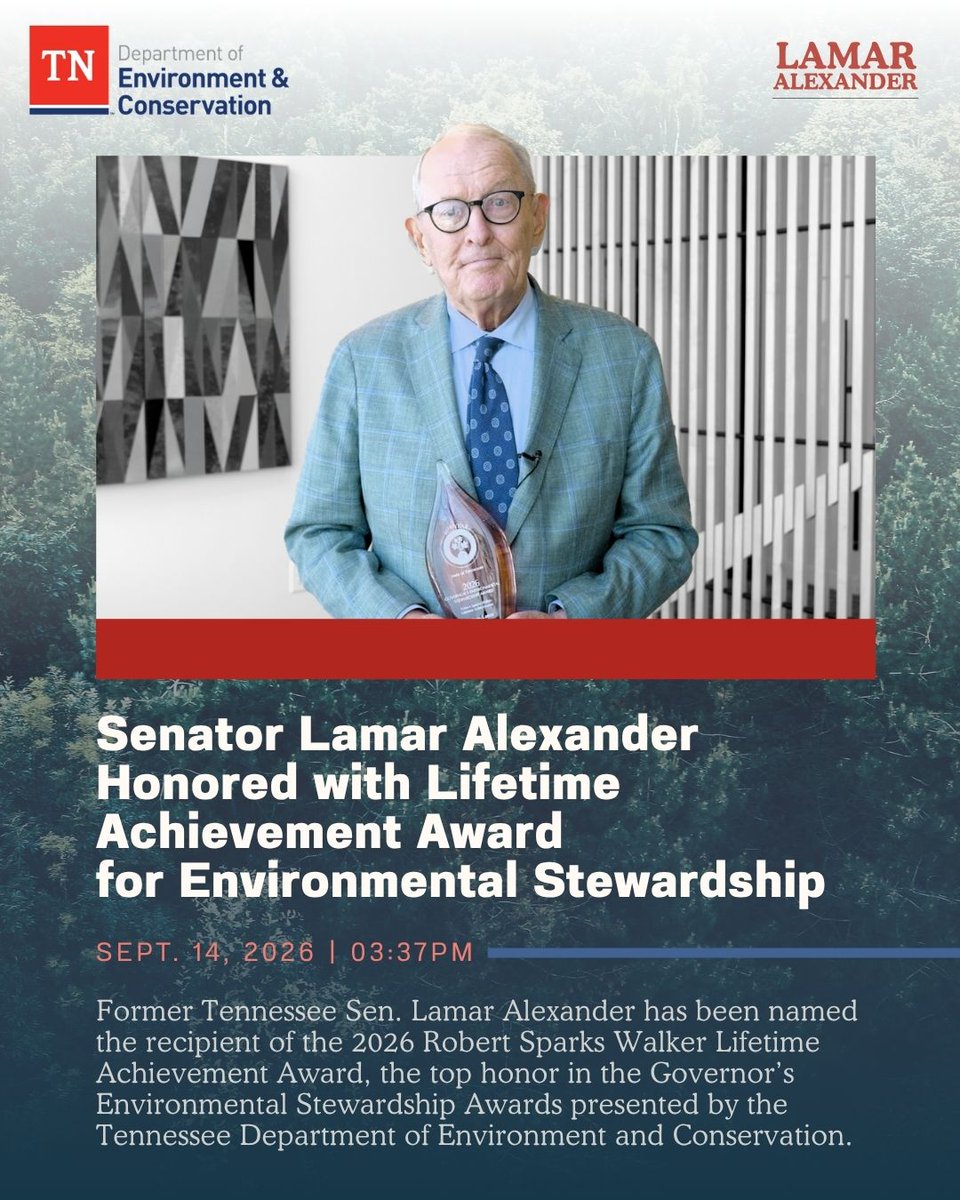
I was grateful to receive the Governor's Lifetime Stewardship Environmental Award, but in truth, I should have been honoring Gov. Bill Lee. Like Gov. Bill Haslam before him, Bill Lee has been a conservation governor. He expanded and improved maintenance of state parks, used agricultural easements to create more conservation land, encouraged economic development in non-brownfields instead of greenfields, built mountain biking trails on National Forest Service lands, and persuaded the legislature to appropriate $12 million for the Institute for Conservation Leadership and the Sciences at Maryville College to train a new generation of outdoor leaders.
Tennesseans have many things to be proud of, but at the top of the list is the Great Tennessee Outdoors. More Tennesseans have hunting and fishing licenses than vote in our party primaries. It is good to have leadership that preserves these outdoor experiences for ourselves and the next generations.
You can learn more here: https://t.co/61MiVPWO0F
In THE EDUCATION OF A SENATOR: FROM JFK TO TRUMP, I paint portraits of the presidents I worked with, tell stories about what I saw behind the scenes, and recount the lessons I learned about American politics and our country’s future.
THE EDUCATION OF A SENATOR: FROM JFK TO TRUMP is available now from @PostHillPress.
You can use this link to order: https://t.co/2zBcn6BcQQ
When you start to speak, “If you would start by saying, ‘Instead of making a speech, let me tell you a story,’ someone might actually listen to what you have to say," ROOTS author Alex Haley told me after hearing me speak when I was governor of Tennessee.
In his new memoir, IMPATIENCE IS A VIRTUE, Mitch Daniels (@purduemitch) shows that somewhere along his path through multiple public offices, he also learned the importance of storytelling. Mitch’s chapters reveal a capacity for remembering and telling stories that entertain, teach, and sometimes make the reader laugh out loud. In digging up these stories, the author had much fertile ground to plow, from his arrest as a student to attempting to balance the federal budget in the Reagan White House, to helping to create new medicines at a giant pharmaceutical company. He tells of nights spent with Hoosier families on his way to being Governor of Indiana to holding the line on tuition increases as president of Purdue University.
With modesty and conviction, Mitch Daniels recounts how he succeeded in every enterprise he undertook, providing inspiration and lessons for any American who understands that public service is the surest way to help the most people and to be a part of keeping our Republic from falling apart.
IMPATIENCE IS A VIRTUE is out now from Lyons Press/Globe Pequot Publishing Group.
You can order a copy of IMPATIENCE IS A VIRTUE here: https://t.co/9tEdLazd3Z
To give Delmar an example of the “function screen,” I told him the story of the Nashville doctor who had rarely ever voted, who came by my Nashville office on a February morning in 1994 when I was preparing to run for president.
As I write in the prologue to my new memoir, THE EDUCATION OF A SENATOR: FROM JFK TO TRUMP, the doctor said, “I’m going to run for the United States Senate.”
“Why would you do that?” I asked. “Why would you give up being one of the world’s leading heart transplant surgeons?”
He said, “Today, I can fly to Chattanooga, cut out a beating heart, put it on ice in an Igloo cooler, make sure I get back to Vanderbilt Hospital within four hours, and perform an eight-hour operation. A year later, I might meet one person on the street who will thank me for saving his or her life. If I’m a senator, maybe I can save a million lives.”
At age forty-two, Dr. Bill Frist (@bfrist) won that Senate race and, working with President George W. Bush, created PEPFAR (President’s Emergency Plan for AIDS Relief), investing $120 billion to combat HIV/AIDS. That saved twenty-six million lives. When he retired after two terms, he chaired the global board of The Nature Conservancy, but never again will he be able to help as many people as he did as a senator.
No one doubts that private citizens—from Edison to Einstein to Billy Graham—can make a huge difference. But Dr. Frist learned that public service is the surest way to unleash our country’s potential to help the most people.
The stories in my memoir are about that lesson, along with others that helped me, as both a governor and United States senator, to wake up every morning thinking that I might be able to do something good for our state or country, and to go to bed most nights thinking that I had.
In THE EDUCATION OF A SENATOR: FROM JFK TO TRUMP, I paint portraits of the presidents I worked with, tell stories about what I saw behind the scenes, and recount the lessons I learned about American politics and our country’s future.
THE EDUCATION OF A SENATOR: FROM JFK TO TRUMP is available now from @PostHillPress.
You can use this link to order: https://t.co/2zBcn6BcQQ
I wish that anyone who believes that the American Republic will not survive in the midst of all the current political goings-on could have been with me in Lebanon, Tennessee, on Tuesday when I met with more than 200 Wilson County high school students. The students asked me questions about my new memoir, THE EDUCATION OF A SENATOR: FROM JFK TO TRUMP, in which I do my best to persuade, hopefully inspire, others to believe that public service is the surest way to help the largest number of people and to be part of keeping our Republic from falling apart.
I told them that I woke up every day as senator and governor thinking I could do something to help my state or country and went to bed most nights thinking that I had. Tuesday's program impacted 14 teachers and administrators and 219 students (who were for the most part juniors and seniors) studying U.S. Civics and Government, JROTC, US History, and involved with Youth in Government (YIG) or Mock Trial. The students and their teachers attend/teach at:
Green Hill High School (@greenhillhigh)
Lebanon High School (@lebanon_high)
Mt. Juliet High (@mtjulietbears)
Watertown High School
Wilson Central High School
Moreover, the recording will be shared in U.S. Civics and Gov't classes across the district, impacting 1,500 students this school year, and potentially many more when we share it with other schools and districts across Tennessee.
Several students told me afterwards that they intend to spend at least part of their lives elected to the city council or legislature, or even as governor, or go to work for someone who has been elected.
In THE EDUCATION OF A SENATOR: FROM JFK TO TRUMP, I paint portraits of the presidents I worked with, tell stories about what I saw behind the scenes, and recount the lessons I learned about American politics and our country’s future.
THE EDUCATION OF A SENATOR: FROM JFK TO TRUMP is available now from @PostHillPress
You can use this link to order: https://t.co/2zBcn6BcQQ
On Tuesday morning, September 11, I was teaching at Harvard’s John F. Kennedy School in Cambridge. As the fall semester was getting underway, I watched in horror as the television showed the second terrorist plane crashing into the Twin Towers.
In Chapter 34 of my new memoir, THE EDUCATION OF A SENATOR: FROM JFK TO TRUMP, I write about how I tried to call our daughter Kathryn, who was living in Brooklyn. I thought about how five years earlier, during the presidential race, no candidate except Sen. Richard Lugar had even mentioned terrorism. It was Friday before the first Southwest plane flew to Nashville. I was one of three passengers. Before boarding, I removed my shoes, some clothes, was patted down, searched, and delayed—experiencing for the first time the permanent indignity that a few terrorists had inflicted on tens of millions of travelers.
I watched the national conversation shift from what pulls us apart to what pulls us together. Suddenly, Americans were again saying that diversity is important, but that our greatest strength is something different.
“No other nation has so successfully combined people of different races and nations into a single culture,” was how Margaret Thatcher explained it.
Throughout most of our country’s life, the national conversation had been a public classroom for teaching belief in the principles that allowed citizens of all backgrounds to say, “We are all Americans.” At the beginning of the twentieth century, as President Theodore Roosevelt was inveighing against “hyphenated Americanism,” institutions from Boys and Girls Scouts to Kiwanis Clubs “Americanized” a surge of immigrants.
During World War II, President Franklin Roosevelt made sure that those who charged the beaches of Normandy knew they were fighting for Four Freedoms. The chief Americanizing institution was the public school.
“The public school was created to help immigrant children learn the three Rs, and what it means to be an American, with a hope they would go home and teach their parents,” American Federation of Teachers President Albert Shanker said. McGuffey’s Readers sold 120 million copies to create a common culture of literature, patriotic speeches, and historical references, according to Diane Ravitch.
But for forty years, the conversation about what it means to be an American had been heading in a different direction. New waves of immigration, new cultural attitudes, and new scholarships had been challenging the notion that the greatest accomplishment of the United States of America, after establishing freedom and democracy, had been to find a way to unite its diversity into one country. Public schools had become reluctant to teach core values because teachers were afraid to answer the question, “Whose values?”
Americans were ignoring the country’s original motto—three Latin words engraved above the presiding officer’s chair in the Senate, 𝘌 𝘱𝘭𝘶𝘳𝘪𝘣𝘶𝘴 𝘶𝘯𝘶𝘮 — “Out of many, one.”
“We have too much pluribus and not enough unum,” filmmaker Ken Burns said.
“If it were many out of one, we would be the United Nations, not the United States of America,” Huntington wrote.
At least for a while, America’s response to 9/11 was to celebrate unity over diversity. After 9/11, television did the Americanizing, displaying patriotic exercises, prayers in prime time, President Bush’s visit to the Islamic Center, and NFL players reciting the Declaration of Independence.
At Thanksgiving, Bush spoke of “the American character.”
At the Kennedy School, Al Gore said, “We should honor their memories by fighting for the values that bind us together as a country.”
The Republican and Democratic presidential contestants of the previous year were saying the same thing, invoking a traditional, value-based national identity. Americans were listening.
This is an excerpt from THE EDUCATION OF A SENATOR.
Reagan’s experienced “team of rivals” helped to save his presidency. In 1987, when Reagan fell into trouble over the Iran-Contra scandal, he telephoned Howard Baker, who was in Miami on a family vacation. Joy Baker answered the president’s call. “Where’s Howard?” Reagan asked. “At the zoo,” Joy Baker answered. “Wait ‘til he hears about the zoo I have for him,” Reagan said.
Reagan made Baker chief of staff and asked him to get to the bottom of the scandal. Giving Baker that assignment was not without risk. Fourteen years earlier. Baker had helped to bring down another Republican president: Richard Nixon. “We are here to save the president, 𝘪𝘧 𝘩𝘦 𝘥𝘦𝘴𝘦𝘳𝘷𝘦𝘴 𝘵𝘰 𝘣𝘦 𝘴𝘢𝘷𝘦𝘥,” Baker told the new White House counsel, A.B. Culvahouse, Jr. His “team of rivals” cleaned up the scandal, and Reagan left office on a high note.
This is an excerpt from my new memoir, THE EDUCATION OF A SENATOR: FROM JFK TO TRUMP, where I paint portraits of the presidents I worked with, tell stories about what I saw behind the scenes, and recount the lessons I learned about American politics and our country’s future.
THE EDUCATION OF A SENATOR: FROM JFK TO TRUMP is available now from @PostHillPress.
You can use this link to order: https://t.co/2zBcn6BKGo
“If you want to feel like the butler, try being vice president,” Joe Biden told me in 2012. I began working in the Nixon White House in 1969 at a desk in Bryce Harlow’s West Wing office fifty feet from the Oval Office. After six months, Harlow carved space from his secretary’s office to create this cubbyhole office for me. When this photo was taken forty-three years later, the tiny office still was there and being used by then–Vice President Biden’s chief of staff. Proximity to the Oval Office makes even a cubbyhole a prized possession.”
This is an excerpt from my new memoir, THE EDUCATION OF A SENATOR: FROM JFK TO TRUMP, where I paint portraits of the presidents I worked with, tell stories about what I saw behind the scenes, and recount the lessons I learned about American politics and our country’s future.
THE EDUCATION OF A SENATOR: FROM JFK TO TRUMP is available now from @PostHillPress.
You can use this link to order: https://t.co/2zBcn6BKGo
“On Wednesday, January 17, 1979, Democrat leaders swore me, a Republican, into office three days early to stop Gov. Ray Blanton from pardoning prisoners who had paid cash for their release. As I talk to reporters after taking the oath, Honey holds the family Bible while Leslee, seven, Drew, nine, and Kathryn, five, stand in front and Lt. Gov. John Wilder, Speaker Ned McWherter, and Chief Justice Joe Henry watch.”
This is an excerpt from my new memoir, THE EDUCATION OF A SENATOR: FROM JFK TO TRUMP, where I paint portraits of the presidents I worked with, tell stories about what I saw behind the scenes, and recount the lessons I learned about American politics and our country’s future.
THE EDUCATION OF A SENATOR: FROM JFK TO TRUMP is available now from @PostHillPress.
You can use this link to order: https://t.co/2zBcn6BKGo
“Obviously you’ve never been a university president, or you wouldn’t ask a stupid question like that," is my answer when someone asks, “What was your hardest job? Senator, Governor, Education Secretary, or university president?” I told that to the current University of Tennessee President, Randy Boyd (@randyboyd), when he interviewed me about my new memoir, THE EDUCATION OF A SENATOR: FROM JFK TO TRUMP, at the Knoxville Rotary Club on Tuesday (@knoxrotaryclub).
I was the UT president on Friday, December 14, 1990, when President George H.W. Bush called to ask me to become US Education Secretary. I was settling into my third year as president. The university was prospering with more Merit scholars, higher faculty salaries, new research, and endowment dollars. As governor, I had been UT board chairman, and I thought I knew a lot about being president. But I learned pretty quickly that just because I had watched a lot of baseball, that didn’t make me an all-star shortstop.
As governor, I had seen how important a rising university is to a rising state, and I had funded it generously. But I soon learned that the "Moses let’s go this way” style of leadership I had used as governor did not fit the university.
One former university president said, “The faculty regards a decision by the president as a request to form a study committee.” Randy Boyd, on the other hand, was a successful businessman whose leadership skills seem to fit the university perfectly.
The University of Tennessee is moving ahead on all cylinders today, and Randy Boyd is the best president the university has had in a long time.
In THE EDUCATION OF A SENATOR: FROM JFK TO TRUMP, I paint portraits of the presidents I worked with, tell stories about what I saw behind the scenes, and recount the lessons I learned about American politics and our country’s future.
THE EDUCATION OF A SENATOR: FROM JFK TO TRUMP is available now from @PostHillPress.
You can use this link to order: https://t.co/2zBcn6BKGo
A senator who doesn’t say much attracts attention in the same way that Mahatma Gandhi attracted attention in India because no one could find him.
In Chapter 36 of my new memoir, THE EDUCATION OF A SENATOR: FROM JFK TO TRUMP, I write about how Benjamin Franklin used the technique of silence because he believed that others would suspect he knew more than he did, according to his biographer Walter Isaacson. The champion modern-day practitioners of silence have been Dick Cheney and Mitch McConnell. When Vice President Cheney attended a Republican Senate luncheon, he almost always would decline to speak, so that when he did—for example, on interrogating terrorists—senators listened.
Sometimes McConnell would simply ignore a question.
“I don’t get in trouble for what I don’t say,” he would explain.
There is not much competition among senators to say the least or be the last to speak. Most follow the advice that an old bull senator gave to freshman Sen. John W. Warner of Virginia: “Boy, there’s nothing to it. You just rear back, start talking, and eventually you’ll think of something to say.”
In THE EDUCATION OF A SENATOR: FROM JFK TO TRUMP, I paint portraits of the presidents I worked with, tell stories about what I saw behind the scenes, and recount the lessons I learned about American politics and our country’s future.
THE EDUCATION OF A SENATOR: FROM JFK TO TRUMP is available now from @PostHillPress.
You can use this link to order: https://t.co/2zBcn6BKGo
When I delivered the eulogy at Sen. Howard Baker’s funeral in 2014, Vice President Joe Biden was among the 140 mourners who had stuffed themselves into the wooden pews of the First Presbyterian Church in Huntsville, Tennessee, population 1,238. In chapter 48 of my new memoir, THE EDUCATION OF A SENATOR: FROM JFK TO TRUMP, I write about how I was then in the midst of a primary campaign against a Tea Party candidate. Out-of-state “political Pharisees” were arriving almost every day, attacking me for my reputation for bipartisanship and compromise.
After I spoke, Biden rushed up to me. “I hope you’ll give the eulogy at my funeral,” the vice president said. “Thank you, but can we wait until after the primary?” I replied, smiling.
Toward the end of my remarks, I had said, “I have added a rule to my LITTLE PLAID BOOK. ‘When invited to speak at a funeral, remember to mention the deceased at least as often as yourself.’ I have done my best to follow that rule today, but I hope you understand how difficult that is for me, as it would be for many of you. So, let me just get it out all at once. For the last half-century, Howard Baker has had more influence on my life than anyone outside my own family. He inspired me to help him build a two-party system. I babysat for Darek and Cissy. I met Honey at a softball game between the Baker staff and the John Tower staff. My favorite photograph of her is one Howard took at the Baker home when we were celebrating our marriage. Our daughter, Leslee, was flower girl at Darek and Karen’s wedding. I occupy the same Senate office Howard once had in the Dirksen Senate Office Building. My desk on the Senate floor once was his.”
In the case of Howard Baker, I did not possess Jon Meacham’s discipline to deliver a eulogy without a single personal pronoun.
In THE EDUCATION OF A SENATOR: FROM JFK TO TRUMP, I paint portraits of the presidents I worked with, tell stories about what I saw behind the scenes, and recount the lessons I learned about American politics and our country’s future.
THE EDUCATION OF A SENATOR: FROM JFK TO TRUMP is available now from @PostHillPress.
You can use this link to order: https://t.co/2zBcn6BcQQ
“Where is Tennessee?” the Nissan chairman asked at dinner in Tokyo in November 1979, as he studied this satellite photograph of the US with all its lights on at night. “Right in the middle of the lights,” I said, pointing to the center of a brightly lit nation. This became the most important map in Tennessee’s future, helping to persuade Nissan and other auto companies to locate plants in a centrally located state with a right-to-work law, thus reducing shipping costs of millions of cars and trucks and avoiding problems with organized labor.
In THE EDUCATION OF A SENATOR: FROM JFK TO TRUMP, I paint portraits of the presidents I worked with, tell stories about what I saw behind the scenes, and recount the lessons I learned about American politics and our country’s future.
THE EDUCATION OF A SENATOR: FROM JFK TO TRUMP is available now from @PostHillPress.
You can use this link to order: https://t.co/2zBcn6BKGo
Neither Honey nor I was prepared for another Senate tradition that is best called “innocent until nominated,” a televised spectacle of senators talking that is on full display during confirmation of Supreme Court nominees. As I write in Chapter 29 of my new memoir, THE EDUCATION OF A SENATOR: FROM JFK TO TRUMP, this “innocent until nominated” tradition can apply to nominees for education secretary too.
On Wednesday, February 6, 1991, Senator Ted Kennedy presided over my confirmation hearing; Ohio Democrat Senator Howard Metzenbaum lived up to his reputation for cantankerousness. “Governor, I have seen some newspaper stories concerning your financial situation. I don’t think I’m fully prepared to inquire on that subject at the moment,” he said, presenting the media with an opportunity to speculate about what nefarious activities I might have undertaken. Metzenbaum put a hold on my nomination that threatened to send me back to Tennessee, instead of into President Bush’s cabinet.
I asked New Hampshire Sen. Warren Rudman for advice. “You have no cards to play,” he said. “In 1976 President Ford nominated me for the Interstate Commerce Commission. The Democrat Senator from New Hampshire, John Durkin, put a hold on my nomination just like Metzenbaum is doing to you. I was twisting in the wind. People from New Hampshire were asking, 'What’s wrong with Warren? Did he beat his wife? Steal money?'
“Did Durkin lift his hold?” I asked. “No,” Rudman said,” I asked the President to withdraw my nomination. And I ran against the SOB and beat him in the next election. That is how I got in the Senate.”
I took Rudman’s advice and kept quiet. Then, abruptly, after a two-month delay, the Committee approved my nomination, and the Senate approved it by unanimous voice consent. I never heard what broke the logjam.
In THE EDUCATION OF A SENATOR: FROM JFK TO TRUMP, I paint portraits of the presidents I worked with, tell stories about what I saw behind the scenes, and recount the lessons I learned about American politics and our country’s future.
THE EDUCATION OF A SENATOR: FROM JFK TO TRUMP is available now from @PostHillPress.
You can use this link to order: https://t.co/2zBcn6BcQQ